
1. General Questions on ML Pipelines
Answers 30 interview-style questions covering ML pipeline stages, versioning, monitoring, testing, CI/CD, MLOps, security, and ethics.
What this file does
Answers 30 interview-style questions covering ML pipeline stages, versioning, monitoring, testing, CI/CD, MLOps, security, and ethics.
When to use it
- Preparing for ML engineering or MLOps interviews
- Reviewing core concepts before designing a pipeline
- Onboarding new team members to ML pipeline fundamentals
1. General Questions on ML Pipelines
Q1: What is an ML pipeline, and why is it important?
An ML pipeline is a structured workflow that automates various steps in machine learning, from data preprocessing to model deployment. It is crucial for: ✅** Reproducibility — Standardized steps ensure consistent results. ✅ Scalability — Enables efficient handling of large datasets. ✅ Automation — Reduces manual efforts in training and deployment. ✅ **Monitoring & Maintenance — Helps detect performance degradation and model drift.
Q2: What are the key stages of an ML pipeline?
A typical ML pipeline consists of the following stages: 1️⃣** Data Ingestion — Collecting, cleaning, and transforming raw data. 2️⃣ Feature Engineering — Selecting and creating meaningful features. 3️⃣ Model Training — Experimenting with different models and hyperparameters. 4️⃣ Model Evaluation — Comparing models using metrics like accuracy, F1-score, RMSE. 5️⃣ Model Versioning & Registry — Storing trained models and their metadata. 6️⃣ Deployment — Serving the model in a production environment. 7️⃣ **Monitoring & Logging — Tracking model performance and identifying drift.
Q3: How does an ML pipeline improve model deployment?
An ML pipeline enhances deployment by: ✔** Automating model selection to reduce manual effort. ✔ Using model versioning to ensure smooth rollbacks if needed. ✔ Integrating with CI/CD tools for continuous training and deployment. ✔ **Monitoring real-time performance to track prediction accuracy and identify drift.
2. Model Versioning and Registry
Q4: What is model versioning, and why is it necessary?
Model versioning keeps track of different iterations of a machine learning model, ensuring: ✅** Experiment tracking — Allows comparisons between different models. ✅ Reproducibility — Enables retraining with identical conditions. ✅ Rollback & Debugging — Facilitates restoration of older models if the new one fails. ✅ **Compliance & Auditability — Maintains historical records for regulatory needs.
Q5: How would you implement a model registry in an ML pipeline?
A model registry can be implemented by: 1️⃣** ** Storing models with metadata , including training datasets and parameters. 2️⃣** Using a centralized repository for versioned storage. 3️⃣ Automating model registration within CI/CD pipelines. 4️⃣ **Defining an approval workflow to prevent unintended deployments.
Common tools for model versioning: MLflow Model Registry, DVC, Kubeflow, AWS SageMaker Model Registry.
3. Logging & Monitoring
Q6: Why is logging important in an ML pipeline?
Logging records events throughout the pipeline, ensuring: ✔** Debugging capability — Helps trace errors in data preprocessing and training. ✔ Performance tracking — Ensures models perform as expected over time. ✔ **Compliance readiness — Provides historical logs for audit purposes.
Q7: What components should be logged in an ML pipeline?
Important components to log include: ✅** Data Preprocessing — Any transformations or handling of missing values. ✅ Model Training — Hyperparameters, loss values, training duration. ✅ Model Inference — Predictions and response times. ✅ **Error Handling — Exception messages and failures.
Q8: How do you monitor a deployed ML model?
Monitoring a production model involves: 1️⃣** Tracking performance metrics like accuracy, precision-recall, and RMSE. 2️⃣ Detecting data drift by comparing real-time data distributions with training data. 3️⃣ Observing model drift to identify when prediction accuracy declines. 4️⃣ **Setting alerts for anomalies using monitoring tools to notify teams of performance degradation.
Popular monitoring tools: Prometheus, Grafana, Datadog, and Evidently AI.
4. Testing in ML Pipelines
Q9: What types of testing are necessary in an ML pipeline?
🔹** Unit Testing — Verifies that individual functions work correctly. 🔹 Integration Testing — Ensures seamless interaction between pipeline components. 🔹 Regression Testing — Confirms that updates do not degrade performance. 🔹 **Performance Testing — Evaluates inference speed and scalability.
Q10: How do you test an end-to-end ML pipeline?
End-to-end testing includes: 1️⃣** Loading test data to simulate real-world inputs. 2️⃣ Executing the full pipeline from ingestion to deployment. 3️⃣ Validating outputs to ensure model predictions are accurate. 4️⃣ **Checking inference performance to meet service-level agreements (SLAs).
5. CI/CD for ML Pipelines
Q11: How does CI/CD work in ML pipelines?
CI/CD automates the ML workflow by: ✅** Automating model training and validation to maintain quality. ✅ Running performance checks before deployment. ✅ Deploying new models automatically if they pass quality checks. ✅ **Rolling back to previous models when performance drops.
Popular tools: GitHub Actions, Jenkins, MLflow, Kubeflow.
Q12: What is a canary deployment, and how does it help in ML pipelines?
A** canary deployment releases a new model to a small subset of users before full deployment. This approach: ✔ Minimizes risk by testing the new model with limited users. ✔ Enables real-world monitoring before full rollout. ✔ **Allows rollback options if performance declines.
6. Advanced ML Pipeline Concepts
Q13: How do you ensure reproducibility in an ML pipeline?
Reproducibility ensures consistent results when retraining a model. Best practices include: ✅** Versioning code and data using Git, DVC, or MLflow. ✅ Fixing random seeds in all ML frameworks to maintain consistency. ✅ Using containerization (e.g., Docker) to ensure identical environments. ✅ **Logging model artifacts and metadata for reference.
Q14: What are the biggest challenges in deploying ML models to production?
Some key challenges include: 1️⃣** Scalability — Handling large-scale, real-time predictions. 2️⃣ Latency — Meeting strict response time requirements. 3️⃣ Model Drift — Ensuring accuracy over time despite data changes. 4️⃣ Resource Optimization — Managing compute costs effectively. 5️⃣ **Security & Compliance — Protecting sensitive data and meeting regulations.
Q15: How do you handle data drift in an ML pipeline?
To detect and address data drift: 📌** Monitor feature statistics to identify shifts in data distribution. 📌 Automate retraining when significant drift is detected. 📌 **Store feature histories for comparisons and trend analysis.
Common drift detection techniques: Kolmogorov-Smirnov test, Wasserstein distance, statistical hypothesis testing.
7. CI/CD & MLOps in ML Pipelines
Q16: What is the difference between DevOps and MLOps?
DevOps focuses on** ** software deployment , whereas MLOps extends DevOps principles to** ** machine learning models , covering: ✅** Data versioning in addition to code versioning. ✅ Model monitoring beyond application performance tracking. ✅ **Automated model retraining to counteract data drift.
Q17: What are best practices for scaling ML models in production?
📌** Batch Inference — Processing data in groups rather than in real time. 📌 Microservices Architecture — Deploying models as independent services. 📌 Serverless ML — Using cloud functions for flexible deployments. 📌 **Model Caching — Storing frequent predictions for quick retrieval.
8. Advanced ML Pipeline Architecture & Optimization
Q18: What strategies can be used to optimize an ML pipeline for scalability?
To ensure an ML pipeline can scale effectively: ✅** Distributed Data Processing — Use Apache Spark, Dask, or Ray for large datasets. ✅ Feature Store Integration — Implement a centralized feature store to prevent redundant computations. ✅ Parallel Processing — Train models in parallel using GPUs, TPUs, or cloud-based infrastructure. ✅ Asynchronous Workflows — Use message queues (Kafka, RabbitMQ) to decouple pipeline stages. ✅ **Auto-scaling Infrastructure — Deploy models in Kubernetes, leveraging auto-scaling mechanisms.
Q19: How do you ensure low latency in real-time ML predictions?
Reducing inference latency requires: ✔** Model Quantization — Reducing model size by using lower-precision data types. ✔ Optimized Model Serving — Deploying models using TensorRT, ONNX, or TorchServe. ✔ Efficient Feature Serving — Precomputing and caching frequently used features. ✔ Edge Computing — Deploying models closer to the end user, reducing network overhead. ✔ **Efficient Request Handling — Using load balancers to distribute inference requests across multiple instances.
Q20: How do you handle long-running ML training jobs efficiently?
For large-scale training jobs: 📌** Checkpointing — Save intermediate training states to resume from failures. 📌 Spot Instance Utilization — Use cloud-based spot instances (AWS, GCP) to reduce costs. 📌 Gradient Accumulation — Optimize memory usage by accumulating gradients over multiple mini-batches. 📌 **Data Pipeline Optimization — Use TFRecord, Parquet, or other columnar formats to speed up data loading.
9. ML Pipeline Monitoring & Observability
Q21: What are the key challenges in monitoring ML models in production?
The biggest challenges in ML model monitoring include: 1️⃣** Data Drift — Changes in input data distributions affecting model predictions. 2️⃣ Model Drift — Degradation in prediction accuracy over time. 3️⃣ Concept Drift — Relationship between input features and output labels changes. 4️⃣ Latency Issues — Slow inference due to model complexity or inefficient deployment. 5️⃣ **Explainability & Bias Detection — Ensuring fairness and transparency in model predictions.
Q22: What strategies can be used to detect model drift?
Model drift can be detected using: ✔** Performance Monitoring — Track key metrics (accuracy, precision, recall, RMSE). ✔ Statistical Tests — Apply Kolmogorov-Smirnov test or Jensen-Shannon divergence to compare distributions. ✔ Data Profiling — Compare feature distributions between training and live data. ✔ **Automated Alerts — Set thresholds for drift detection and trigger retraining pipelines.
Q23: How can you improve the observability of an ML pipeline?
Observability ensures better insights into ML models and their performance. Best practices include: ✅** Centralized Logging — Collect logs from all pipeline stages for debugging. ✅ Telemetry & Tracing — Use OpenTelemetry to track model behavior across services. ✅ Custom Dashboards — Build visualizations for real-time monitoring (Grafana, Kibana). ✅ **Explainability Models — Integrate tools like SHAP and LIME for model interpretability.
10. MLOps & Governance
Q24: What are the best practices for integrating MLOps into an ML pipeline?
MLOps improves ML workflow efficiency through: ✅** Continuous Integration (CI) — Automate testing of feature engineering and model training scripts. ✅ Continuous Delivery (CD) — Deploy models using version control and automation. ✅ Automated Retraining — Trigger new model training when drift is detected. ✅ **Model Governance — Enforce compliance through model versioning, explainability, and auditing.
Q25: How do you ensure governance and compliance in ML pipelines?
✔** Data Lineage Tracking — Document data sources, transformations, and usage. ✔ Model Documentation — Maintain audit logs of hyperparameters, training runs, and results. ✔ Fairness & Bias Testing — Evaluate models for potential bias before deployment. ✔ **Security & Access Control — Implement role-based access control (RBAC) for sensitive data.
11. ML Pipeline Deployment & Automation
Q26: What are the differences between batch inference and real-time inference?
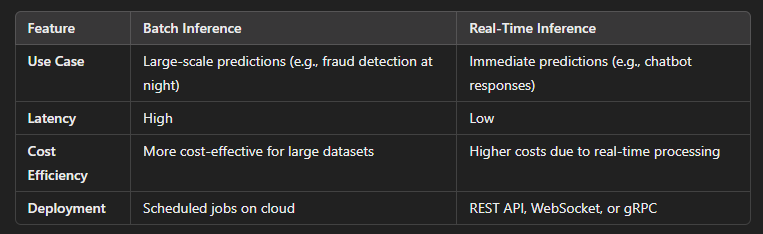
Q27: How do you automate the retraining of ML models?
Automating model retraining involves: ✔** Drift Detection — Monitoring input features for significant changes. ✔ Scheduled Retraining — Periodically retraining the model based on fresh data. ✔ Retraining Triggers — Initiating model retraining when performance drops below a threshold. ✔ **Retraining Pipelines — Using CI/CD for model updates, testing, and deployment.
Q28: How do you handle A/B testing for ML models in production?
A/B testing allows comparison between multiple models before full deployment. Best practices include: 📌** Traffic Splitting — Serving different model versions to different user groups. 📌 Metric Tracking — Comparing accuracy, latency, and user engagement across variants. 📌 Gradual Rollout — Deploying models incrementally to monitor real-world performance. 📌 **Rollback Strategies — Reverting to the previous model if the new version underperforms.
12. Security & Ethical Considerations in ML Pipelines
Q29: How do you ensure security in an ML pipeline?
✔** Data Encryption — Protect data at rest and in transit. ✔ Access Control — Restrict access to sensitive models and datasets. ✔ Adversarial Testing — Test models against adversarial inputs to detect vulnerabilities. ✔ **Model Watermarking — Embed unique identifiers to detect unauthorized use.
Q30: How do you mitigate bias in ML models?
📌** Diverse Training Data — Ensure datasets are representative of the population. 📌 Bias Audits — Regularly evaluate models using fairness metrics (e.g., disparate impact analysis). 📌 Explainability Methods — Use SHAP or LIME to understand model decisions. 📌 **Human-in-the-loop Review — Incorporate domain experts to validate model predictions.
What's inside
12 sections, 30 Q&A pairs, no code or diagrams
Change this for your project
- Replace
https://miro.medium.com/v2/resize:fit:1400/1*A6-m1E_OOLgOmkenbjxCeg.pngwith your own diagram or remove the image reference - Replace
Prometheus, Grafana, Datadog, and Evidently AIwith your actual monitoring stack - Replace
GitHub Actions, Jenkins, MLflow, Kubeflowwith your CI/CD tools
Where it goes
Keep it in your repository where the agent or team that needs it will read it.
Worth borrowing
- Organizing knowledge as Q&A pairs for quick reference
- Grouping related topics (e.g., monitoring, testing) into numbered sections
Related Documents
OpenCode Agents
Provides a collection of specialised Markdown agent files for OpenCode, each with a distinct role and thinking algorithm.
🌟 GitHub MCP Server - Feature Showcase
Showcases eight GitHub MCP server tools with example inputs, outputs, and real-world use cases for AI agents.
Chloe 部署文档
Guides you through deploying an enhanced SillyTavern fork with direct, Docker, and reverse-proxy setups, plus security hardening and troubleshooting.
Software License Compliance Report
Documents that all dependencies in an early cancer prediction project are FOSS and OSI-approved, confirming commercial use is permitted.