
erikbern.ann-benchmarks
Benchmarks approximate nearest neighbor algorithms on high-dimensional datasets using Docker containers and precomputed ground truth.
What this file does
Benchmarks approximate nearest neighbor algorithms on high-dimensional datasets using Docker containers and precomputed ground truth.
When to use it
- Comparing ANN algorithm performance on your own datasets
- Adding a new ANN algorithm to the benchmark suite
- Reproducing published ANN benchmark results
- Evaluating trade-offs between recall and query time
Assumes this stack
Benchmarking nearest neighbors

Doing fast searching of nearest neighbors in high dimensional spaces is an increasingly important problem, but so far there has not been a lot of empirical attempts at comparing approaches in an objective way.
This project contains some tools to benchmark various implementations of approximate nearest neighbor (ANN) search for different metrics. We have pregenerated datasets (in HDF5) formats and we also have Docker containers for each algorithm. There's a test suite that makes sure every algorithm works.
Evaluated
- Annoy
- FLANN
- scikit-learn: LSHForest, KDTree, BallTree
- PANNS
- NearPy
- KGraph
- NMSLIB (Non-Metric Space Library): SWGraph, HNSW, BallTree, MPLSH
- hnswlib (a part of nmslib project)
- RPForest
- FAISS
- DolphinnPy
- Datasketch
- PyNNDescent
- MRPT
- NGT: ONNG, PANNG
- SPTAG
- PUFFINN
- N2
Data sets
We have a number of precomputed data sets for this. All data sets are pre-split into train/test and come with ground truth data in the form of the top 100 neighbors. We store them in a HDF5 format:
| Dataset | Dimensions | Train size | Test size | Neighbors | Distance | Download |
|---|---|---|---|---|---|---|
| DEEP1B | 96 | 9,990,000 | 10,000 | 100 | Angular | HDF5 (3.6GB) |
| Fashion-MNIST | 784 | 60,000 | 10,000 | 100 | Euclidean | HDF5 (217MB) |
| GIST | 960 | 1,000,000 | 1,000 | 100 | Euclidean | HDF5 (3.6GB) |
| GloVe | 25 | 1,183,514 | 10,000 | 100 | Angular | HDF5 (121MB) |
| GloVe | 50 | 1,183,514 | 10,000 | 100 | Angular | HDF5 (235MB) |
| GloVe | 100 | 1,183,514 | 10,000 | 100 | Angular | HDF5 (463MB) |
| GloVe | 200 | 1,183,514 | 10,000 | 100 | Angular | HDF5 (918MB) |
| Kosarak | 27983 | 74,962 | 500 | 100 | Jaccard | HDF5 (2.0GB) |
| MNIST | 784 | 60,000 | 10,000 | 100 | Euclidean | HDF5 (217MB) |
| NYTimes | 256 | 290,000 | 10,000 | 100 | Angular | HDF5 (301MB) |
| SIFT | 128 | 1,000,000 | 10,000 | 100 | Euclidean | HDF5 (501MB) |
Results
These are all as of 2019-06-10, running all benchmarks on a c5.4xlarge machine on AWS:
glove-100-angular

sift-128-euclidean

fashion-mnist-784-euclidean

gist-960-euclidean
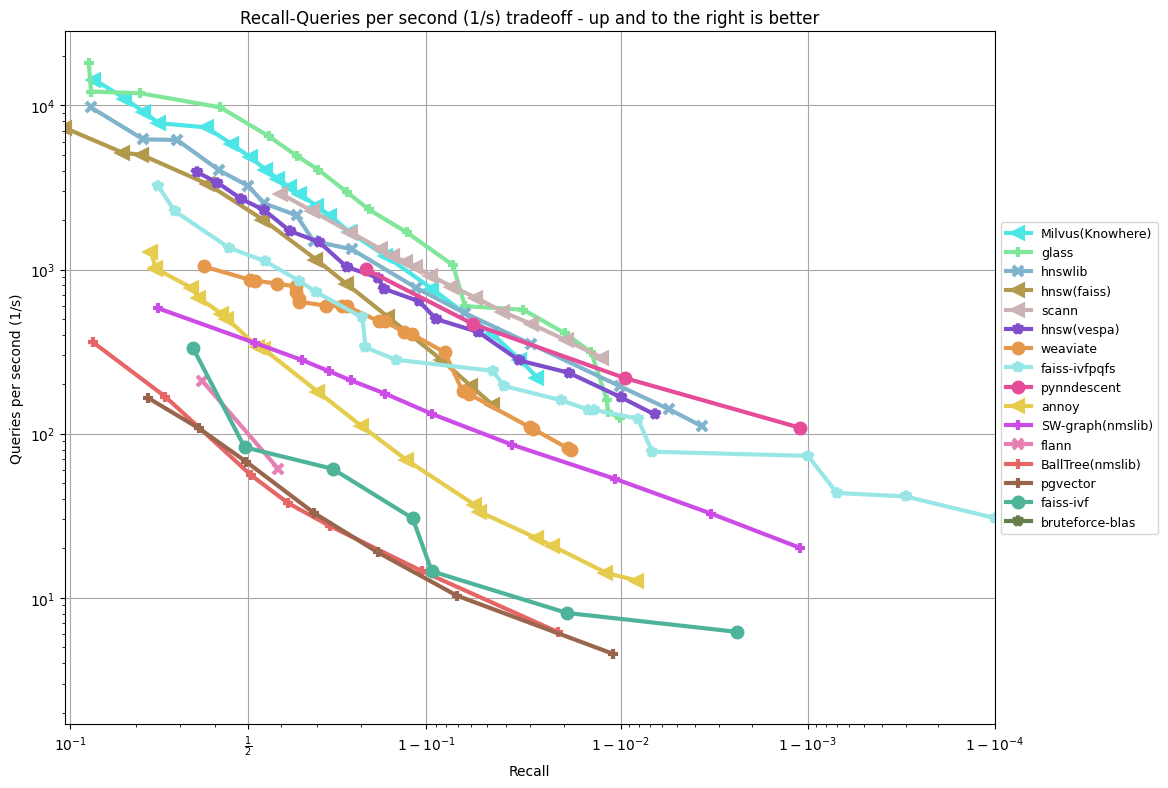
nytimes-256-angular

glove-25-angular

Install
The only prerequisite is Python (tested with 3.6) and Docker.
- Clone the repo.
- Run
pip install -r requirements.txt. - Run
python install.pyto build all the libraries inside Docker containers (this can take a while, like 10-30 minutes).
Running
- Run
python run.py(this can take an extremely long time, potentially days) - Run
python plot.pyorpython create_website.pyto plot results.
You can customize the algorithms and datasets if you want to:
- Check that
algos.yamlcontains the parameter settings that you want to test - To run experiments on SIFT, invoke
python run.py --dataset glove-100-angular. Seepython run.py --helpfor more information on possible settings. Note that experiments can take a long time. - To process the results, either use
python plot.py --dataset glove-100-angularorpython create_website.py. An example call:python create_website.py --plottype recall/time --latex --scatter --outputdir website/.
Including your algorithm
- Add your algorithm into
ann_benchmarks/algorithmsby providing a small Python wrapper. - Add a Dockerfile in
install/for it - Add it to
algos.yaml - Add it to
.travis.yml
Principles
- Everyone is welcome to submit pull requests with tweaks and changes to how each library is being used.
- In particular: if you are the author of any of these libraries, and you think the benchmark can be improved, consider making the improvement and submitting a pull request.
- This is meant to be an ongoing project and represent the current state.
- Make everything easy to replicate, including installing and preparing the datasets.
- Try many different values of parameters for each library and ignore the points that are not on the precision-performance frontier.
- High-dimensional datasets with approximately 100-1000 dimensions. This is challenging but also realistic. Not more than 1000 dimensions because those problems should probably be solved by doing dimensionality reduction separately.
- Single queries are used by default. ANN-Benchmarks enforces that only one CPU is saturated during experimentation, i.e., no multi-threading. A batch mode is available that provides all queries to the implementations at once. Add the flag
--batchtorun.pyandplot.pyto enable batch mode. - Avoid extremely costly index building (more than several hours).
- Focus on datasets that fit in RAM. Out of core ANN could be the topic of a later comparison.
- We mainly support CPU-based ANN algorithms. GPU support exists for FAISS, but it has to be compiled with GPU support locally and experiments must be run using the flags
--local --batch. - Do proper train/test set of index data and query points.
- Note that set similarity was supported in the past. This might hopefully be added back soon.
Authors
Built by Erik Bernhardsson with significant contributions from Martin Aumüller and Alexander Faithfull.
Related Publication
The following publication details design principles behind the benchmarking framework:
- M. Aumüller, E. Bernhardsson, A. Faithfull: ANN-Benchmarks: A Benchmarking Tool for Approximate Nearest Neighbor Algorithms. Information Systems 2019. DOI: 10.1016/j.is.2019.02.006
What's inside
README with 7 sections: evaluated algorithms list, dataset table, result plots, install/run instructions, contribution guide, principles, and citation.
Change this for your project
- Replace
erikbern/ann-benchmarkswith your own repository in the Travis badge URL - Replace
ann-benchmarks.comdataset URLs with your own hosted datasets - Replace
c5.4xlargemachine type in results section with your benchmark hardware
Where it goes
Keep alongside your test suite. Used to define and score model evaluations.
Worth borrowing
- Use Docker containers to isolate algorithm dependencies and ensure reproducibility
- Precompute ground truth nearest neighbors for standardized evaluation across algorithms
- Plot precision-performance frontier by sweeping algorithm parameters
Related Documents
IATA BCBP Standard Compliance
Documents which IATA BCBP fields and barcode formats a Swift library implements, including Version 8 gender code support.
Evaluating AI Agent Systems: Metrics, Benchmarks, and Quality Assurance (2024-2026)
Surveys 2024-2026 metrics, benchmarks, and monitoring tools for evaluating AI agent systems, with recommendations for a self-improving coding agent.
Voice AI Leaderboards, Benchmarks, and Evaluation Gaps (Jan 2025 -- Feb 2026)
Surveys 20+ voice AI benchmarks from Jan 2025, Feb 2026, identifies evaluation gaps, and provides leaderboard data for STT, TTS, and end-to-end voice agents.
LLM Evaluation — Deep Dive
Covers why LLM evaluation is hard, benchmark taxonomy, LLM-as-judge methodology, contamination, robustness, and designing an eval suite for a product.