 CoPilot
Back to Blog openclaw
 discuss
 devchallenge
 googlecloud
 gemma
 nvidia
 oracle
Deploy OpenClaw on AWS: Choose the right options for your AI workload
Channy Yun April 14, 2026
2 views
Since introducing OpenClaw on Amazon Lightsail on March 4, 2026, customers ranging from individual...
Since introducing OpenClaw on Amazon Lightsail on March 4, 2026, customers ranging from individual developers to enterprises have requested deployment options tailored to their specific workload requirements. This post presents four AWS offerings for running OpenClaw, each optimized for different use cases, organizational requirements, and scale.
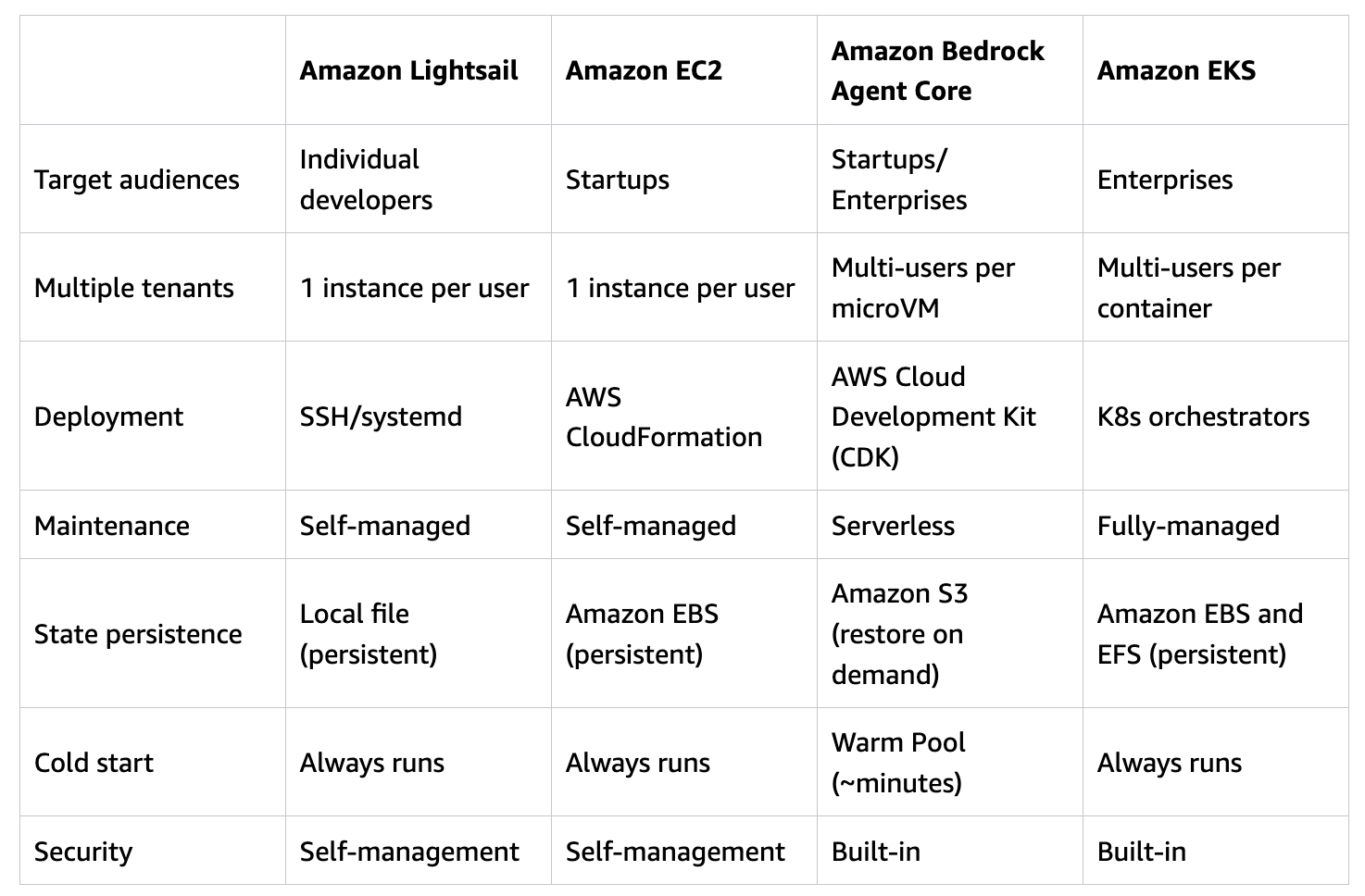
Use this comparison to choose the deployment option that best fits your workload requirements. Amazon Lightsail provides simplicity for individual developers, while Amazon Elastic Compute Cloud (Amazon EC2) offers greater control and deeper AWS service integration. Amazon Bedrock AgentCore delivers a serverless approach for variable agentic AI workloads, and Amazon Elastic Kubernetes Service (Amazon EKS) provides enterprises with multi-tenant isolation and advanced orchestration capabilities.
The following sections explain how to get started with each deployment option.
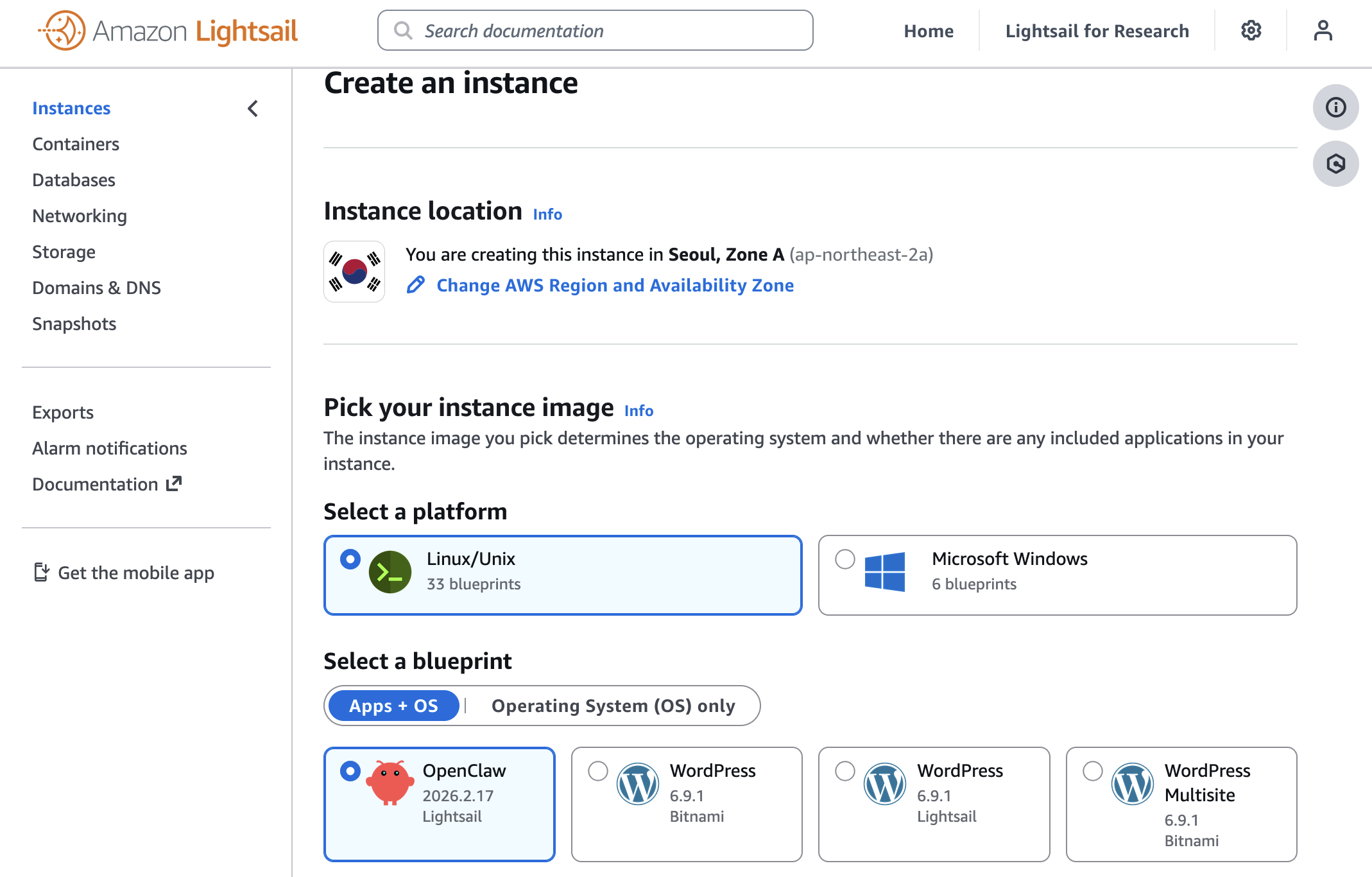
OpenClaw on Amazon Lightsail You can deploy OpenClaw using a prebuilt blueprint in Amazon Lightsail. With just a few clicks, you launch a fully configured instance with OpenClaw already integrated with Amazon Bedrock. The setup includes built-in security through device pairing, ensuring only authorized devices can access your AI assistant.
To get started, visit my previous blog post and getting started guide in the AWS documentation.
I want to introduce the Agent in Action, a hands-on lab guide built by Jorge Rodriguez, an AWS community leader. You can build a functional AI agent from scratch in about 45 minutes with OpenClaw on Amazon Lightsail. You’ll get web search capabilities and human-sounding voice responses powered by Amazon Bedrock.
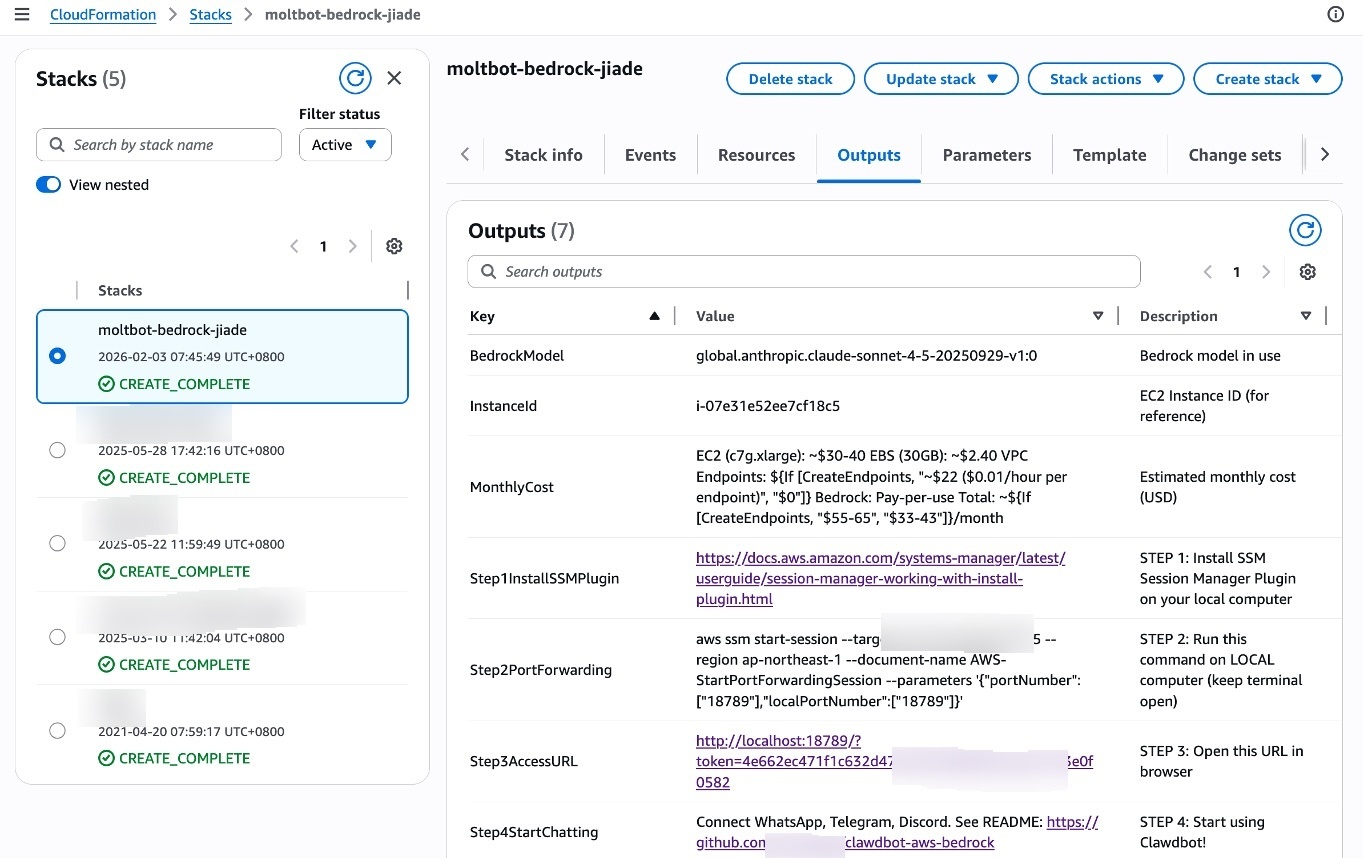
OpenClaw on Amazon EC2 For those who need deeper AWS integration and control, Amazon EC2 provides the flexibility you need. Using AWS Graviton processors, you can save 20-40% on compute costs compared to x86 instances. AWS Systems Manager Session Manager provides secure shell access without exposing SSH ports to the internet. Amazon Virtual Private Cloud (Amazon VPC) endpoints ensure your traffic never leaves the AWS network, and AWS CloudTrail automatically logs every API call for compliance and auditing.
Follow this hands-on lab guide to deploy EC2 instances. If you want to deploy with AWS CloudFormation templates, visit the AWS Sample project.
OpenClaw on Amazon Bedrock AgentCore While Lightsail and EC2 work well for getting started, they aren’t ideal for multi-user scenarios. Each user requires a dedicated instance, which limits scalability and lacks built-in user isolation. Additionally, you pay for compute resources whether they’re being used or not. For serverless deployments, Amazon Bedrock AgentCore offers a better solution.
Amazon Bedrock AgentCore is a purpose-built serverless runtime specifically designed for AI agents. You can focus on your agent logic, skills, and prompts, while AWS manages scaling, security, and availability. You can deploy OpenClaw on Bedrock AgentCore with this AWS Sample project.
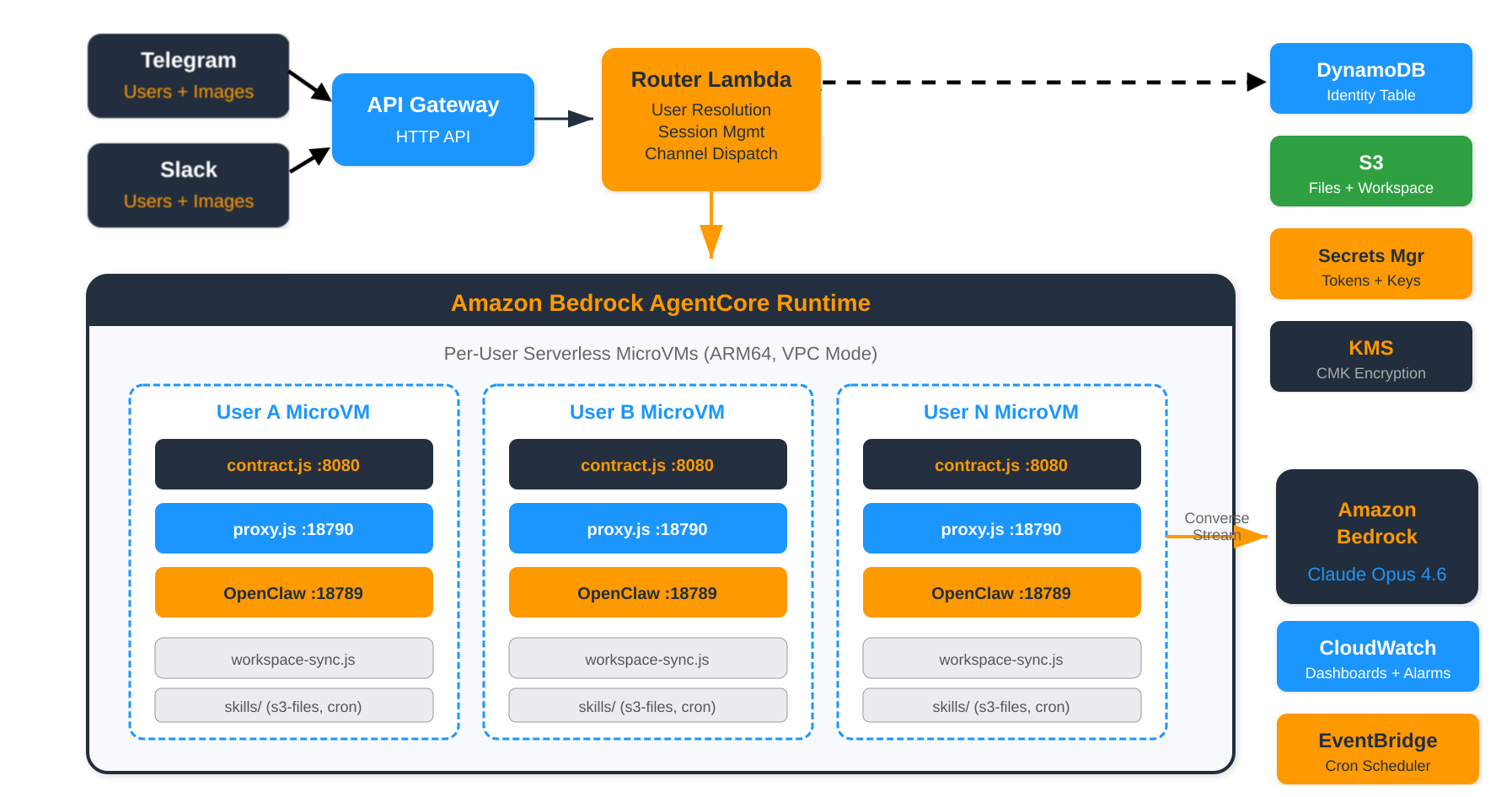
The architecture supports asynchronous invocation—AWS Lambda immediately acknowledges the webhook, stores the message in Amazon DynamoDB, then invokes AgentCore in the background as an asynchronous event. The agent processes at its own pace and responds through the channel. This decoupling ensures no timeouts, provides built-in retry logic, and creates an audit trail of all interactions. It’s a production-grade pattern that handles the reality of serverless cold starts gracefully.
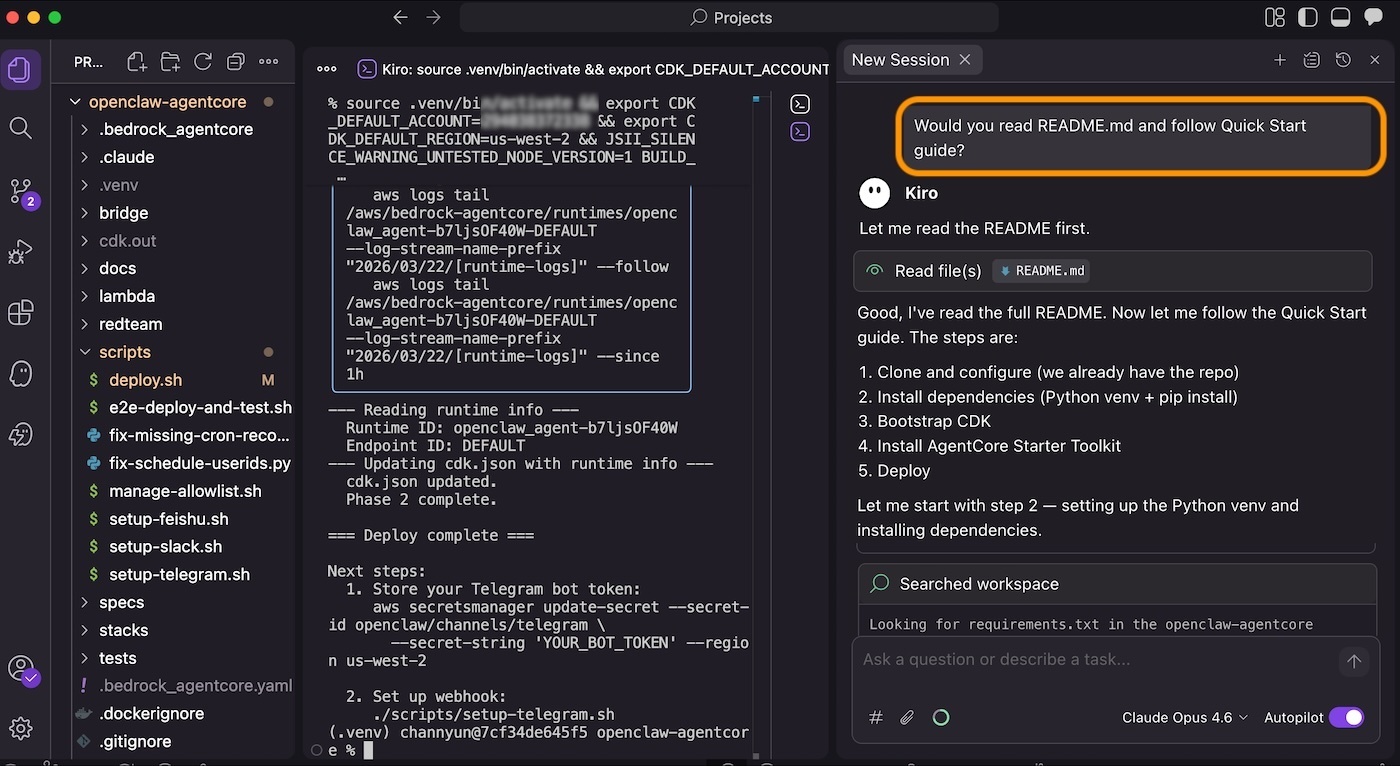
This sample project provides a deployment with Infrastructure-as-Code using AWS Cloud Development Kit (CDK). Clone the GitHub repository, run the deployment script, and within minutes you have a production-ready OpenClaw microVM running on Bedrock AgentCore.
I recommend that you use Kiro, an agentic AI development tool, to simplify the installation process and onboard quickly. Kiro will help you through the entire process of configuring a development environment, identifying dependencies, and deploying to AWS.
OpenClaw on Amazon EKS Multi-tenancy represents the defining challenge for enterprise OpenClaw deployments. Amazon EKS with virtual machine (VM)-level isolation delivers the operational simplicity of shared infrastructure combined with the security advantages of dedicated VMs. Each tenant’s workload runs in a lightweight VM, providing hardware-level isolation while maintaining Kubernetes’s orchestration benefits. This approach has been validated in production by financial services and healthcare organizations with strict compliance requirements.
For multi-tenancy deployments of OpenClaw with Amazon EKS, there are two complementary approaches:
- Kata container builds a standard implementation of lightweight VMs that perform like containers, but provide the workload isolation and security advantages of VMs. It’s application-agnostic, treating OpenClaw like any other workload. To getting started, visit the Multi-tenancy OpenClaw on EKS and OpenClaw on EKS with Kata Containers and LiteLLM.
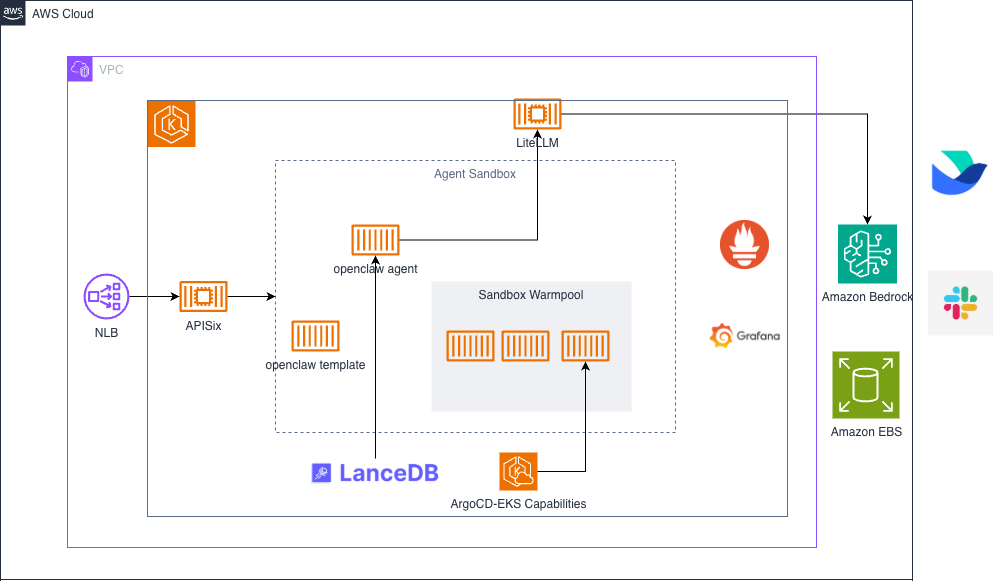
- OpenClaw Kubernetes Operator directly deploys and manages OpenClaw AI agent instances in Kubernetes clusters with production-grade security, observability, and lifecycle management. To get started, visit the Amazon EKS deployment guide.
You can think of the Kata Container as providing the foundation and the OpenClaw Kubernetes Operator as the specialized orchestration layer. You can choose these open source-based sample architectures for organizations serving hundreds or thousands of OpenClaw users from a single Kubernetes cluster.
Wrap up Choose the deployment option that matches your requirements and scale. For individual developers and early experiments, Amazon Lightsail provides the fastest path—pre-configured, simple, and ready in minutes. Startups with AWS experience should consider Amazon EC2 for better integration and control. Amazon Bedrock AgentCore is transformative for teams without operation resources—it’s serverless, auto-scaling, and cheaper for other multi-user scenarios. Finally, enterprises with complex security requirements and multiple teams should use Amazon EKS for its VM-level isolation, sophisticated orchestration, and production-proven scalability.
You can start simple and evolve—begin with Lightsail for prototyping, then migrate to Bedrock AgentCore or EKS as your needs grow.
— Channy
Comments
More Blog
View alldiscussDev Opportunity Radar #21: $500K Y Combinator Funding, Bolt Builders Week, and AI Safety Research Residency
TL;DR Welcome back to Dev Opportunity Radar! This is a weekly series where I share opportunities,...
H
Hemapriya Kanagala 3
devchallengeCongrats to the Hacktoberfest Open-Source AI Challenge: Touch Grass Winners!
We are so excited to announce the winners of the Hacktoberfest Open-Source AI Challenge: Touch...
J
Jem 2
googlecloudBuilding Production-Ready Open-Weights AI Agents with Gemma, Google ADK, and Cloud Run GPUs
How I designed, connected, scaled, governed, evaluated, and QLoRA fine-tuned an enterprise SecOps & FinOps agent on Google Cloud.
R
Robina Mirbahar 1
gemmaDo Drafters Work on Small Models? Gemma 4 E2B and E4B on Two Small GPUs
Yes. Speculative decoding with Google's 59 MB QAT multi-token prediction (MTP) drafters speeds up Gemma 4 E4B 1.72x and E2B 1.40x on an 8 GB RTX 3050, and 1.49x and 1.18x on a 4 GB laptop GTX 1650 Ti, served by llama.cpp one request at a time, with unchanged GSM8K and BFCL scores.
X
xbill 1
nvidiaDon't Assume Your Cloud T4 Runs at Spec: Gemma 4 Decode Falls 7% as the Card Warms
The same Tesla T4 on the same Google Cloud VM decoded Gemma 4 E2B at 115 tokens/s at 45 °C and 107 at 77 °C. The card sits at its 70 W limit, a hotter chip draws more power at the same clock, so the clock drops. No thermal throttle fires, and no spec sheet mentions it.
X
xbill 1
oracleBuilding ora-tui with Google Antigravity & Gemini 4 Argon: An MS-DOS Retro TUI & OpenTelemetry Exporter for Oracle RAC, DB & SAN Multipath
How I pair-programmed with Google Antigravity powered by Gemini 4 Argon to build a zero-dependency Go TUI and OpenTelemetry/Prometheus observability stack for Oracle Databases and Linux SAN storage.
M
Mario Ezquerro 1
Ready-made automations for this
Workflows from the Neura Market marketplace related to this CoPilot resource
- Automate QuickBooks Customers & Sales Receipts Generation from a Google Sheetn8n · $4.99 · Related topic
- Automate Mautic Contact Creation from New Shopify Customersn8n · $3.99 · Related topic
- Sync Email Updates from Mailchimp to WooCommerce Customersmake · $3.99 · Related topic
- Automatically Create Bullet Clients from New WooCommerce Customersmake · $2.99 · Related topic