
Back to Blog javascript
 kubernetes
 ai
ai typescript
 showdev
 ai
ai agents
Spread vs Rest Operators in JavaScript: Expand or Collect Like a Pro
Ritam Saha April 24, 2026
0 views
Introduction Imagine you're juggling arrays and objects in JavaScript, and suddenly you...
## Introduction
Imagine you're juggling arrays and objects in JavaScript, and suddenly you need to copy, merge, or slice them without breaking a sweat.
Entry of the **spread operator (`...`)** and **rest operator (`...`)**—two syntactic superheroes that look identical buthave different jobs. They're game-changers for clean, readable code in modern JS and provide perfect Developer's experience, especially in React apps, Node.js backend applications.
But what's the difference between these two?
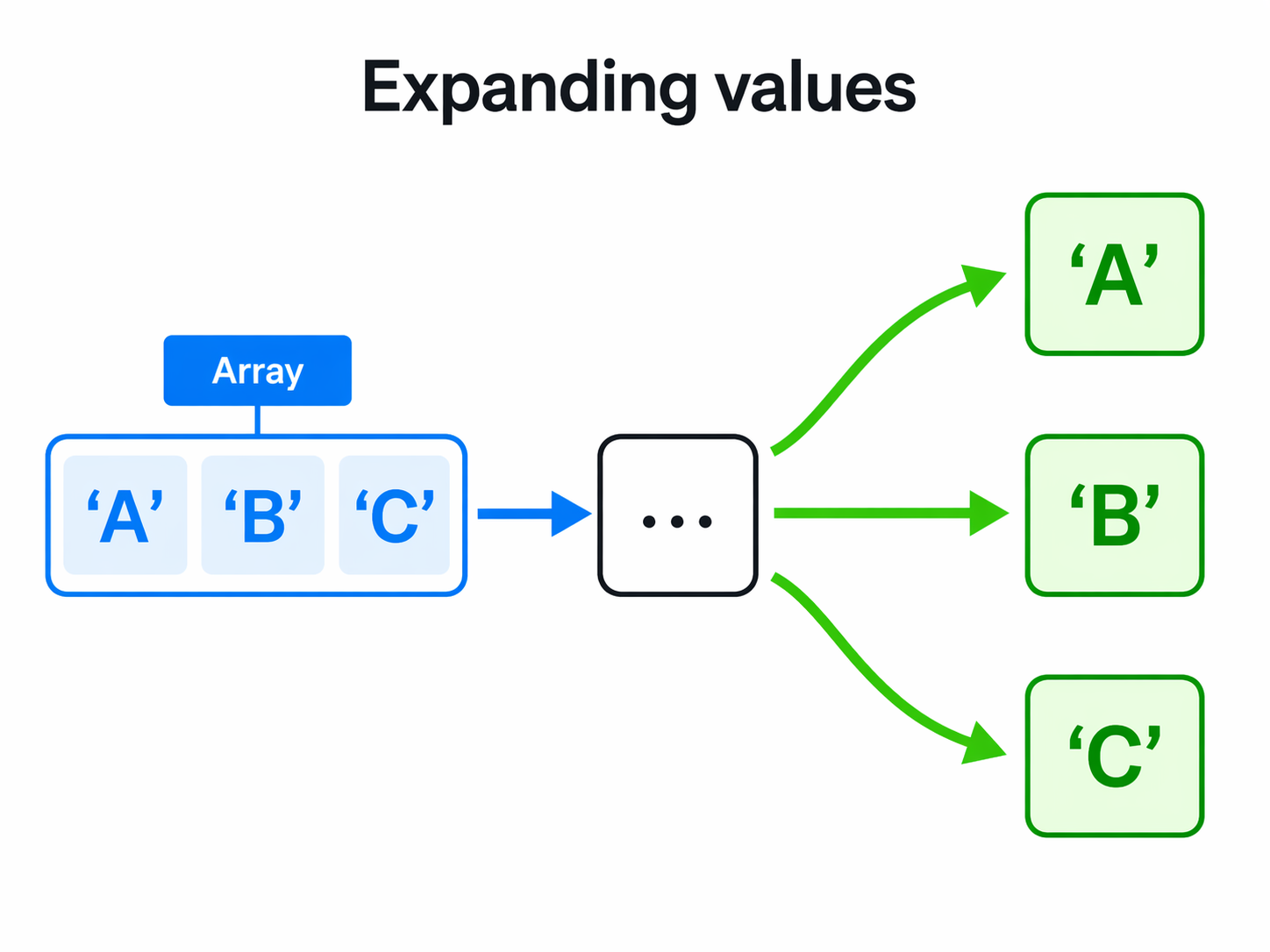
**Spread _expands_ values into individual elements;
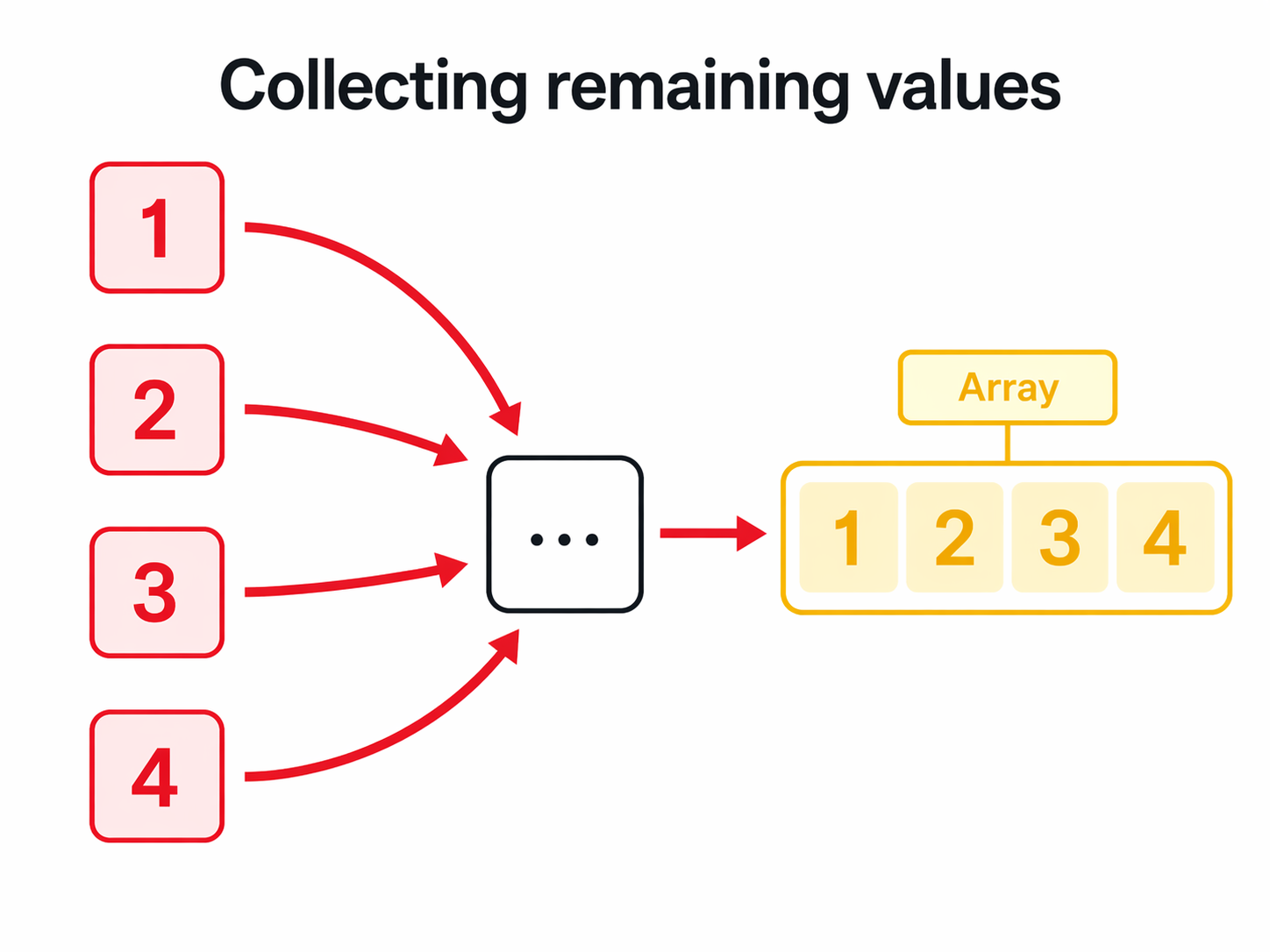
Rest _collects_ them into a single array or object**
Let's dive in with examples and see how they shine (or clash) in real scenarios.
---
## What the Spread Operator Does: Expanding Values
The spread operator (`...`) is like dropping a glass from a height and it spreads down completely with so many broken parts; this takes an iterable—like an array or object—and **spreads** (expands) its elements into individual items. It's like _unpacking_ a box: everything spills out for easy use.
```javascript
const fruits = ['apple', 'banana'];
const moreFruits = ['orange', ...fruits, 'grape'];
// Result: ['orange', 'apple', 'banana', 'grape']
```
Here, `...fruits` expands the array, letting you merge without messy loops.
```javascript
const user = { name: 'Ritam', city: 'Kolkata' };
const updatedUser = { ...user, age: 20, hobby: 'coding' };
// Result: { name: 'Ritam', city: 'Kolkata', age: 20, hobby: 'coding' }
```
Spread creates **shallow copies** and merges—perfect for immutable updates in state management.
---
## What the Rest Operator Does: Collecting Values
The rest operator (`...`) does the opposite: it **gathers** (collects) elements into a single array. It only works in function parameters depending on the passed arguments and for destrcturing, acting like a "vacuum" for leftovers.
```javascript
function sum(...numbers) {
return numbers.reduce((acc, num) => acc + num, 0);
}
sum(1, 2, 3, 4); // Result: 10 (numbers = [1, 2, 3, 4])
```
Rest collects all arguments into `numbers`.
```javascript
const [first, ...rest] = ['apple', 'banana', 'orange']; //Array destructuring
console.log(first); // 'apple'
console.log(rest); // ['banana', 'orange']
```
It grabs the first item, then collects the rest.
---
## Key Differences: Spread Expands, Rest Collects
| Aspect | Spread (`...`) | Rest (`...`) |
|-----------------|---------------------------------|----------------------------------|
| **Direction** | Expands (unpacks) | Collects (packs) |
| **Context** | Anywhere (arrays, objects, calls) | Function params or destructuring |
| **Use Case** | Copying, merging, passing args | Variable args, destructuring leftovers |
| **Example** | `[...arr]` clones array | `function(...args)` |
Spread is for *spreading* values outward; rest is for *gathering* them inward. Confuse them? Your code breaks—spread won't work in params!
---
## Practical Use Cases: Real-World Wins
### **Cloning Arrays/Objects (Spread):** Avoid mutations in React state.
```javascript
const state = { users: [] };
const newState = { ...state, users: [...state.users, newUser] };
```
### **Function Arguments (Spread):** Pass arrays dynamically.
```javascript
const coords = [10, 20];
console.log(Math.max(...coords)); // 20
```
### **API Data Merging (Spread):** Combine defaults with user input.
```javascript
const defaults = { method: 'GET' };
const config = { ...defaults, url: '/api/users' };
fetch(config.url, config);
```
### **Variable Args in Node.js Utils (Rest):** Build flexible helpers.
```javascript
function log(...messages) {
console.log(new Date(), ...messages);
}
log('User login:', userId, timestamp);
```
### **Destructuring Props (Rest):** In React components.
```javascript
function Button({ children, ...props }) {
return <button {...props}>{children}</button>;
}
```
These patterns pop up everywhere—from your full-stack deploys on Vercel to interview coding rounds.
---
## Wrapping Up: Master Both for Cleaner JS
Spread and rest operators turn clunky array/object ops into elegant one-liners, saving you headaches in full-stack dev. Remember: spread *expands* for copying/merging; rest *collects* for flexible params. Practice with small examples, and they'll become second nature for your portfolio projects. Next time you're refactoring Node.js routes or React components, reach for `...`—your future self will thank you. What's your favorite use case? Drop it in the comments!
Comments
More Blog
View allkubernetesMinimalist EKS: The Easy Way
Amazon EKS manages the Kubernetes control plane, but you remain responsible for provisioning the...
J
Joaquin MenchacaaiNever forget to enter the Stern Grove lottery again!
Browser automation with Playwright, Python, GitHub Actions, and Entire to auto-enter San Francisco Stern Grove concert lotteries each week!
L
Lizzie SiegletypescriptA Free Screenshot Editor That Never Uploads Your Image
A free screenshot and image editor that runs entirely in your browser. Keeping every edit reversible and handling big phone photos, in plain TypeScript and Canvas2D.
M
Martin StarkshowdevI built a CLI to break my highlights out of Apple Books
A macOS CLI + MCP server that exports Apple Books highlights to Markdown and gives AI assistants direct access to your reading notes.
A
Andrey KorchakaiA Developer's Guide to Agent Hooks in Antigravity CLI
Motivation To be quite honest, "Hooks"—the shell commands we trigger at specific points...
T
TanaikeagentsTactical vs. Strategic Agentic AI Development — A Playbook for Developers
The Strategic Engineer: Why Writing Code Is No Longer Your Most Valuable Skill ...
A
Adewumi Saheed Adewale