
Back to Blog multiagentsystems
 kubernetes
 ai
ai typescript
 showdev
 ai
ai agents
Multi-Agent A2A with the Agent Development Kit(ADK), Azure Functions, and Gemini CLI
xbill May 3, 2026
0 views
Leveraging the Google Agent Development Kit (ADK) and the underlying Gemini LLM to build Multi-Agent...
---
title: Multi-Agent A2A with the Agent Development Kit(ADK), Azure Functions, and Gemini CLI
published: true
series: Azure
date: 2026-05-03 02:02:47 UTC
tags: multiagentsystems,geminicli,googleadk,a2aprotocol
canonical_url: https://xbill999.medium.com/multi-agent-a2a-with-the-agent-development-kit-adk-azure-functions-and-gemini-cli-da1d5e0612a7
---
Leveraging the Google Agent Development Kit (ADK) and the underlying Gemini LLM to build Multi-Agent Applications with A2A protocol support using the Python programming language.
#### Aren’t There a Billion Python ADK Demos?
Yes there are.
Python has traditionally been the main coding language for ML and AI tools. The goal of this article is to provide a multi-agent test bed for building, debugging, and deploying multi-agent applications.
#### What you talkin ‘bout Willis?
So what is different about this lab compared to all the others out there?
This is one of the first deep dives into a Multi-Agent application leveraging the advanced tooling of Gemini CLI. The starting point for the demo was an existing Codelab- which was updated and re-engineered with Gemini CLI.
The original Codelab- is here:
[Building a Multi-Agent System | Google Codelabs](https://codelabs.developers.google.com/codelabs/production-ready-ai-roadshow/1-building-a-multi-agent-system/building-a-multi-agent-system#0)
#### What Is Python?
Python is an interpreted language that allows for rapid development and testing and has deep libraries for working with ML and AI:
[Welcome to Python.org](https://www.python.org/)
#### Python Version Management
One of the downsides of the wide deployment of Python has been managing the language versions across platforms and maintaining a supported version.
The **pyenv** tool enables deploying consistent versions of Python:
[GitHub - pyenv/pyenv: Simple Python version management](https://github.com/pyenv/pyenv)
As of writing — the mainstream python version is 3.13. To validate your current Python:
```console
python --version
Python 3.13.13
```
#### Azure Functions
Azure Functions is a serverless, event-driven compute service that allows developers to run code on-demand without managing infrastructure. It supports multiple languages (C#, Python, JavaScript, Java, PowerShell) and scales automatically, charging only when code executes. Key use cases include building APIs, processing data, and running scheduled tasks. [[1](https://learn.microsoft.com/en-us/azure/azure-functions/functions-overview), [2](https://www.youtube.com/shorts/j7XrxnoRgjg), [3](https://www.youtube.com/shorts/9kUy9HrLM1g), [4](https://www.youtube.com/watch?v=zIfxkub7CLY&t=351), [5](https://learn.microsoft.com/en-us/azure/azure-functions/)]
Key Aspects of Azure Functions
- Serverless Architecture: You focus on code, while Azure handles infrastructure, patching, and scaling.
- Event-Driven Triggers: Functions are triggered by events such as HTTP requests, timers, or data changes in Azure Storage/Cosmos DB.
- Bindings: Connect to other services (e.g., queues, databases) with minimal code.
- Durable Functions: Enable stateful, long-running workflows with features like chaining, fan-out, and checkpoints.
More details are available here:
[https://azure.microsoft.com/en-us/products/functions](https://azure.microsoft.com/en-us/products/functions)
#### Why would I want Gemini CLI with Azure? Isn’t that a Google Thing?
Yes- Gemini CLI leverages the Google Cloud console and Gemini models but it is also open source and platform agnostic. Many applications are already cross-cloud so this enables familiar tools to be run natively on Microsoft Azure.
#### Azure Functions Configuration
To configure your Azure Service with the base system tools- this article provides a reference:
[MCP Development with Gemini CLI, Python, and Azure Functions](https://dev.to/gde/mcp-development-with-gemini-cli-python-and-azure-functions-1g7n)
#### Gemini CLI
If not pre-installed you can download the Gemini CLI to interact with the source files and provide real-time assistance:
```console
npm install -g @google/gemini-cli
```
#### Testing the Gemini CLI Environment
Once you have all the tools and the correct Node.js version in place- you can test the startup of Gemini CLI. You will need to authenticate with a Key or your Google Account:
```plaintext
▝▜▄ Gemini CLI v0.33.1
▝▜▄
▗▟▀ Logged in with Google /auth
▝▀ Gemini Code Assist Standard /upgrade no sandbox (see /docs) /model Auto (Gemini 3) | 239.8 MB
```
#### Node Version Management
Gemini CLI needs a consistent, up to date version of Node. The **nvm** command can be used to get a standard Node environment:
[GitHub - nvm-sh/nvm: Node Version Manager - POSIX-compliant bash script to manage multiple active node.js versions](https://github.com/nvm-sh/nvm)
#### Agent Development Kit
The [Google Agent Development Kit](https://www.google.com/search?q=Google+Agent+Development+Kit&rlz=1CAIWTJ_enUS1114&oq=what+is+the+adk+google&gs_lcrp=EgZjaHJvbWUyBggAEEUYOTIICAEQABgWGB4yCAgCEAAYFhgeMggIAxAAGBYYHjIICAQQABgWGB4yCAgFEAAYFhgeMggIBhAAGBYYHjIKCAcQABgKGBYYHjINCAgQABiGAxiABBiKBTIKCAkQABiABBiiBNIBCDMxODlqMGo3qAIAsAIA&sourceid=chrome&ie=UTF-8&mstk=AUtExfB5Oo7ZHHcDEHu7aqZiPBA2l1c-QGh5dB7xkkDPIiYcn8O1Imt2IHNR7bzA6JnyDCSDCUGpGWTeBW14namlN_QqzJLLI5-px1BE9jfSxwli6njPDPERjm5pRqNP3uC6HhUKiRcTJ1T8x5LHQrCkVxylw7QWg0N8B4dQDIcWpnVX9Gc&csui=3&ved=2ahUKEwjYu-G8p-uSAxXrv4kEHUbpLo0QgK4QegQIARAB) (ADK) is an open-source, Python-based framework designed to streamline the creation, deployment, and orchestration of sophisticated, multi-agent AI systems. It treats agent development like software engineering, offering modularity, state management, and built-in tools (like Google Search) to build autonomous agents.
The ADK can be installed from here:
[Agent Development Kit (ADK)](https://google.github.io/adk-docs/)
#### Agent Skills
Gemini CLI can be customized to work with ADK agents. Both an Agent Development MCP server, and specific Agent skills are available.
More details are here:
[Agent Development Kit (ADK)](https://adk.dev/tutorials/coding-with-ai/)
To get the Agent Skills in Gemini CLI:
```plaintext
> /skills list
Available Agent Skills:
- adk-cheatsheet
MUST READ before writing or modifying ADK agent code. ADK API quick reference for Python — agent types, tool definitions, orchestration
patterns, callbacks, and state management. Includes an index of all ADK documentation pages. Do NOT use for creating new projects (use
adk-scaffold).
- adk-deploy-guide
MUST READ before deploying any ADK agent. ADK deployment guide — Agent Engine, Cloud Run, GKE, CI/CD pipelines, secrets, observability, and
production workflows. Use when deploying agents to Google Cloud or troubleshooting deployments. Do NOT use for API code patterns (use
adk-cheatsheet), evaluation (use adk-eval-guide), or project scaffolding (use adk-scaffold).
- adk-dev-guide
ALWAYS ACTIVE — read at the start of any ADK agent development session. ADK development lifecycle and mandatory coding guidelines —
spec-driven workflow, code preservation rules, model selection, and troubleshooting.
- adk-eval-guide
MUST READ before running any ADK evaluation. ADK evaluation methodology — eval metrics, evalset schema, LLM-as-judge, tool trajectory
scoring, and common failure causes. Use when evaluating agent quality, running adk eval, or debugging eval results. Do NOT use for API code
patterns (use adk-cheatsheet), deployment (use adk-deploy-guide), or project scaffolding (use adk-scaffold).
- adk-observability-guide
MUST READ before setting up observability for ADK agents or when analyzing production traffic, debugging agent behavior, or improving agent
performance. ADK observability guide — Cloud Trace, prompt-response logging, BigQuery Agent Analytics, third-party integrations, and
troubleshooting. Use when configuring monitoring, tracing, or logging for agents, or when understanding how a deployed agent handles real
traffic.
- adk-scaffold
MUST READ before creating or enhancing any ADK agent project. Use when the user wants to build a new agent (e.g. "build me a search agent")
or enhance an existing project (e.g. "add CI/CD to my project", "add RAG").
```
and the ADK documentation:
```plaintext
> /mcp list
Configured MCP servers:
🟢 adk-docs-mcp (from adk-docs-ext) - Ready (2 tools)
Tools:
- mcp_adk-docs-mcp_fetch_docs
- mcp_adk-docs-mcp_list_doc_sources
```
#### Where do I start?
The strategy for starting multi agent development is a incremental step by step approach.
First, the basic development environment is setup with the required system variables, and a working Gemini CLI configuration.
Then, ADK Multi-Agent is built, debugged, and tested locally. Finally — the entire solution is deployed to Azure Functions .
#### Setup the Basic Environment
At this point you should have a working Python environment and a working Gemini CLI installation. All of the relevant code examples and documentation is available in GitHub.
The next step is to clone the GitHub repository to your local environment:
```console
cd ~
git clone https://github.com/xbill9/gemini-cli-azure
cd mulit-functions
```
Then run **init2.sh** from the cloned directory.
The script will attempt to determine your shell environment and set the correct variables:
```console
source init2.sh
```
If your session times out or you need to re-authenticate- you can run the **set\_env.sh** script to reset your environment variables:
```console
source set_env.sh
```
Variables like PROJECT\_ID need to be setup for use in the various build scripts- so the **set\_env** script can be used to reset the environment if you time-out.
Finally install the packages and dependencies:
```console
cd multi-functions
make install
```
#### Verify The ADK Installation
To verify the setup, run the ADK CLI locally with the researcher agent:
```console
xbill@penguin:~/gemini-cli-azure/multi-functions/agents$ adk run researcher
/home/xbill/.pyenv/versions/3.13.13/lib/python3.13/site-packages/authlib/_joserfc_helpers.py:8: AuthlibDeprecationWarning: authlib.jose module is deprecated, please use joserfc instead.
It will be compatible before version 2.0.0.
from authlib.jose import ECKey
/home/xbill/.pyenv/versions/3.13.13/lib/python3.13/site-packages/google/adk/features/_feature_decorator.py:72: UserWarning: [EXPERIMENTAL] feature FeatureName.PLUGGABLE_AUTH is enabled.
check_feature_enabled()
Log setup complete: /tmp/agents_log/agent.20260502_210037.log
To access latest log: tail -F /tmp/agents_log/agent.latest.log
{"asctime": "2026-05-02 21:00:37,163", "name": "root", "levelname": "INFO", "message": "Logging initialized for researcher", "filename": "logging_config.py", "lineno": 54, "service": "researcher", "log_level": "INFO"}
{"asctime": "2026-05-02 21:00:37,165", "name": "researcher.agent", "levelname": "INFO", "message": "Initialized researcher agent with model: gemini-2.5-flash", "filename": "agent.py", "lineno": 85}
{"asctime": "2026-05-02 21:00:37,167", "name": "google_adk.google.adk.cli.utils.envs", "levelname": "INFO", "message": "Loaded .env file for researcher at /home/xbill/gemini-cli-azure/multi-functions/.env", "filename": "envs.py", "lineno": 83}
{"asctime": "2026-05-02 21:00:37,168", "name": "google_adk.google.adk.cli.utils.local_storage", "levelname": "INFO", "message": "Using per-agent session storage rooted at /home/xbill/gemini-cli-azure/multi-functions/agents", "filename": "local_storage.py", "lineno": 84}
{"asctime": "2026-05-02 21:00:37,169", "name": "google_adk.google.adk.cli.utils.local_storage", "levelname": "INFO", "message": "Using file artifact service at /home/xbill/gemini-cli-azure/multi-functions/agents/researcher/.adk/artifacts", "filename": "local_storage.py", "lineno": 110}
{"asctime": "2026-05-02 21:00:37,170", "name": "google_adk.google.adk.cli.utils.service_factory", "levelname": "INFO", "message": "Using in-memory memory service", "filename": "service_factory.py", "lineno": 266}
{"asctime": "2026-05-02 21:00:37,193", "name": "google_adk.google.adk.cli.utils.local_storage", "levelname": "INFO", "message": "Creating local session service at /home/xbill/gemini-cli-azure/multi-functions/agents/researcher/.adk/session.db", "filename": "local_storage.py", "lineno": 60}
Running agent researcher, type exit to exit.
[user]:
```
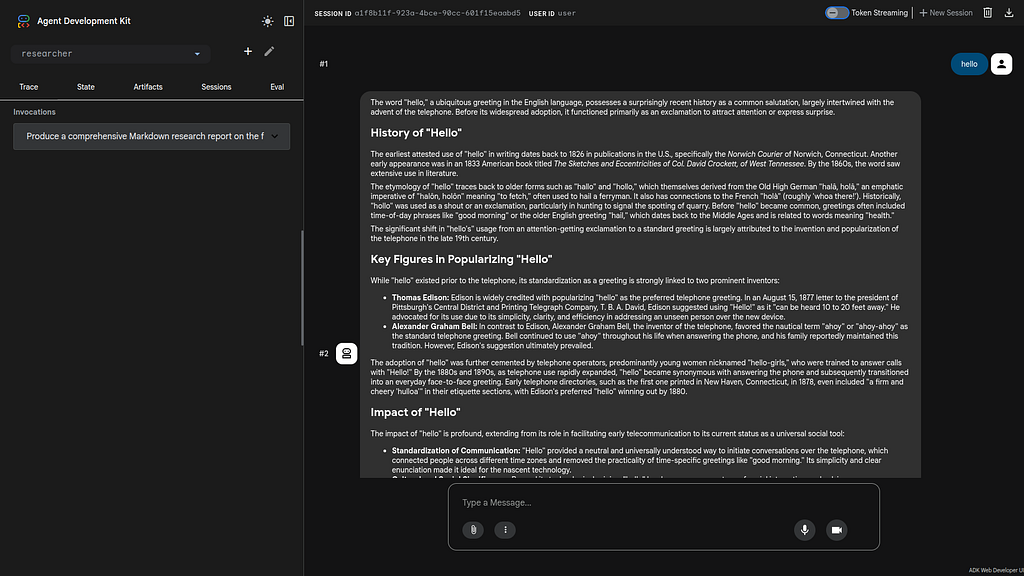
#### Test The ADK Web Interface
This tests the ADK agent interactions with a browser:
```console
/home/xbill/.pyenv/versions/3.13.13/lib/python3.13/site-packages/google/adk/auth/credential_service/in_memory_credential_service.py:33: UserWarning: [EXPERIMENTAL] BaseCredentialService: This feature is experimental and may change or be removed in future versions without notice. It may introduce breaking changes at any time.
super(). __init__ ()
INFO: Started server process [8827]
INFO: Waiting for application startup.
+-----------------------------------------------------------------------------+
| ADK Web Server started |
| |
| For local testing, access at http://0.0.0.0:8000. |
+-----------------------------------------------------------------------------+
```
Then use the web interface — either on the local interface **127.0.0.1** or the catch-all web interface **0.0.0.0** -depending on your environment:
Special note for Google Cloud Shell Deployments- add a CORS **allow\_origins** configuration exemption to allow the ADK agent to run:
```console
adk web --host 0.0.0.0 --allow_origins 'regex:.*'
```
#### Multi Agent Design
The multi-agent deployment consists of 5 agents:
- Researcher
- Judge
- Orchestrator
- Content Builder
- Course Builder
An overview of the multi-agent system can be found here:
[Multi-Agent A2A with the Agent Development Kit(ADK), Cloud Run, Agent Skills, and Gemini CLI](https://dev.to/gde/multi-agent-a2a-with-the-agent-development-kitadk-cloud-run-agent-skills-and-gemini-cli-4n1h)
#### Running/Testing/Debugging Locally
The main Makefile has been extended with extensive targets for managing the agents on the local development environment.
The key targets include:
```console
xbill@penguin:~/gemini-cli-azure/multi-functions$ make help
✦ The available make commands are:
┌────────────────────┬────────────────────────────────────────────────────┐
│ Command │ Description │
├────────────────────┼────────────────────────────────────────────────────┤
│ install │ Install all dependencies for root, agents, and app │
│ start, run │ Start all services locally │
│ stop │ Stop all local services │
│ status │ Show status of local services and Azure Functions │
│ local │ Show local service URLs │
│ test │ Run all tests (pytest) │
│ e2e-test │ Run E2E test against local environment │
│ e2e-test-functions │ Run E2E test against Azure Functions endpoint │
│ deploy │ Deploy all-in-one container to Azure Functions │
│ destroy │ Delete Azure Functions resources │
│ endpoint │ Show Azure Functions endpoint │
│ lint │ Run linting checks (ruff) │
│ clean │ Remove caches and logs │
└────────────────────┴────────────────────────────────────────────────────┘
```
First check for local running agents:
```console
xbill@penguin:~/gemini-cli-azure/multi-functions$ make status
Checking status of locally running agents and servers...
--- Network Status ---
No services listening on expected ports (8000-8004, 5173).
--- Process Status ---
No matching processes found.
```
Then all the agents can be started together:
```console
xbill@penguin:~/gemini-cli-azure/multi-functions$ make start
Stopping any existing agent and server processes...
Starting all agents in background...
Waiting for sub-agents to start...
All agents started. Logs: researcher.log, judge.log, content_builder.log, orchestrator.log
Starting App Backend in background...
Starting Frontend dev server in background...
All services started. Logs: researcher.log, judge.log, content_builder.log, orchestrator.log, backend.log, frontend.log
Frontend: http://localhost:5173
Backend: http://localhost:8000
xbill@penguin:~/gemini-cli-azure/multi-functions$
make status
Checking status of locally running agents and servers...
--- Network Status ---
tcp 0 0 0.0.0.0:5173 0.0.0.0:* LISTEN 10245/node
tcp 0 0 0.0.0.0:8001 0.0.0.0:* LISTEN 9690/python3
tcp 0 0 0.0.0.0:8000 0.0.0.0:* LISTEN 10031/python3
tcp 0 0 0.0.0.0:8003 0.0.0.0:* LISTEN 9696/python3
tcp 0 0 0.0.0.0:8002 0.0.0.0:* LISTEN 9695/python3
tcp 0 0 0.0.0.0:8004 0.0.0.0:* LISTEN 10019/python3
--- Process Status ---
xbill 9687 0.0 0.0 2584 1628 pts/1 S 21:03 0:00 /bin/sh -c /bin/bash -c "source .env 2>/dev/null || true; \ /home/xbill/.pyenv/shims/python3 -m shared.adk_app --host 0.0.0.0 --port 8001 --a2a agents/researcher"
```
The entire project can be linted and tested as unit:
```console
xbill@penguin:~/gemini-cli-azure/multi-functions$ make lint
ruff check .
All checks passed!
> make test
✦ The test suite ran successfully. All 30 tests passed with 5 experimental feature warnings.
```
And end to end tested:
```console
make e2e-test
│ E2E Test Completed successfully! │
╰───────────────────────────────────────────────────────────────────────────────────────────────────────────────────╯
✦ The end-to-end test ran successfully. The orchestrator coordinated with the researcher, judge, and content builder
agents to generate a full Markdown course about the history of the internet, and streamed the result back over the API
endpoint.
```
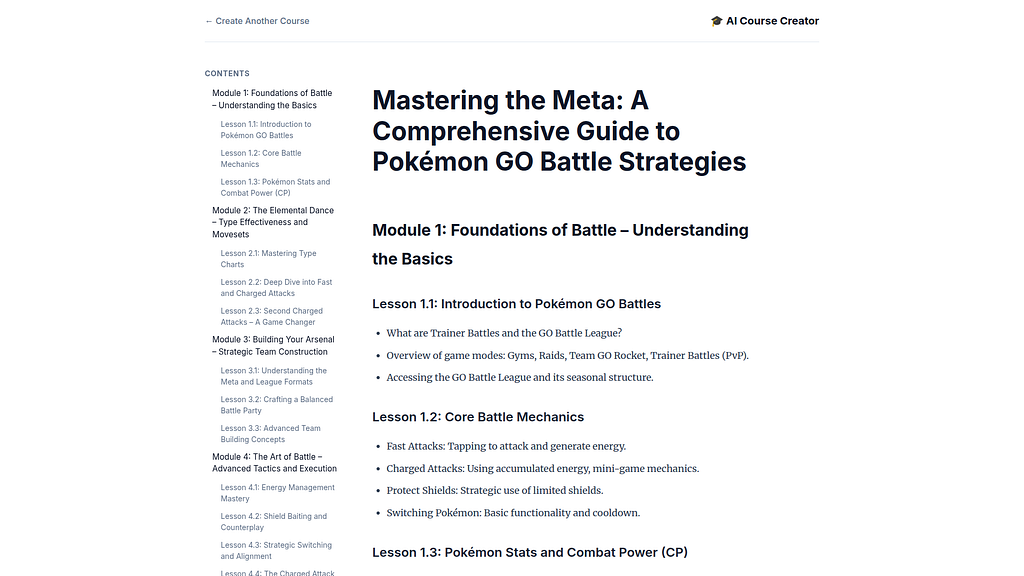
Then connect to the local front end:
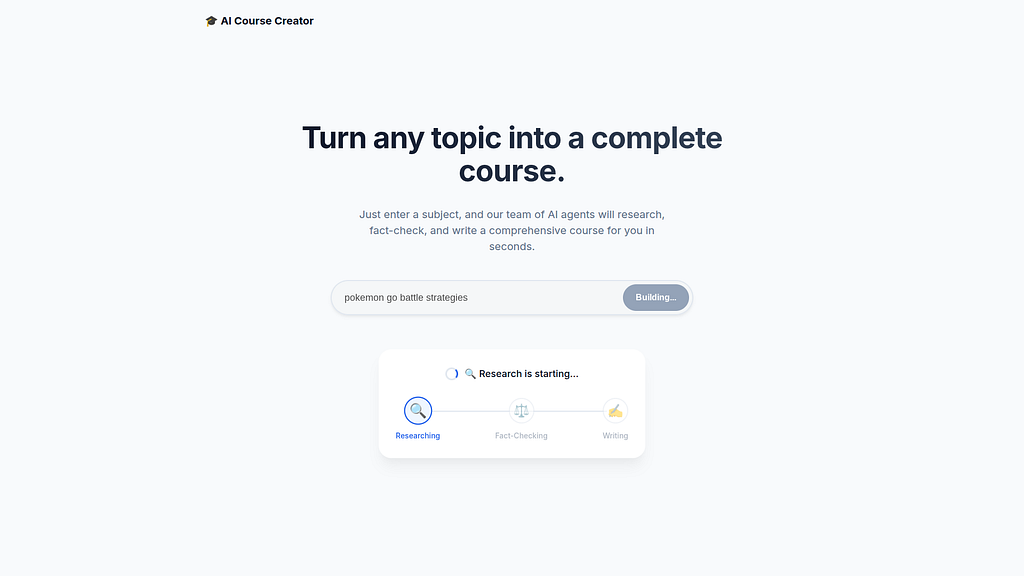
And the entire agent system will run in the local environment:
#### Local Logging / Debugging
Gemini CLI has full access to the local agent logs for debugging and troubleshooting:
```plaintext
✦ I've analyzed the logs from your e2e run. All agents (researcher, judge, content_builder, orchestrator) and both frontend and backend services
started successfully. The course creation pipeline ran as expected: the orchestrator initiated the "history of the internet" course, the researcher
gathered information, the judge approved it, and the content builder generated the course content.
```
#### Deploying to Azure Functions
The project level Makefile has targets for managing the Agent deployment to serverless endpoints:
```console
xbill@penguin:~/gemini-cli-azure/multi-aci$ az login
A web browser has been opened at https://login.microsoftonline.com/organizations/oauth2/v2.0/authorize. Please continue the login in the web browser. If no web browser is available or if the web browser fails to open, use device code flow with `az login --use-device-code`.
```
A utility script check the deployment to Azure ACI:
```plaintext
✦ I ran make status (as make status-functions isn't a defined target in the Makefile, but make status achieves the same
goal).
Here is the status of your Azure Functions deployment:
Azure Functions Status:
* Name: adk-penguin-func
* Location: West US 2
* State: Running
* ResourceGroup: adk-rg-functions
* DefaultHostName: adk-penguin-func.azurewebsites.net
* AppServicePlan: adk-plan-penguin
The function app is currently up and running. If you want to get the direct URL to the endpoint, you can use make
endpoint.
```
You can then deploy the services:
```console
make deploy
Full Log Output: │
│ ./single-container/deploy.sh │
│ === Azure Functions All-in-One Deployment === │
│ Resource Group: adk-rg-functions │
│ ACR Name: adkacrpenguinx4ocqm │
│ Storage Name: adkstoragepenguinx4ocqm │
│ Function Name: adk-penguin-func │
│ ============================= │
```
Once the containers are deployed- you can then get the endpoint:
```console
> make status
Remote Environment (Azure):
- Function App adk-penguin-func is Running in the adk-rg-functions resource group.
- The default hostname is adk-penguin-func.azurewebsites.net.
```
And check the endpoint:
```console
> make endpoint
✦ The deployed Azure Function App endpoint is:
https://adk-penguin-func.azurewebsites.net
```
#### Test End to End in A
The entire agent system is tested on the remote Azure endpoint:
```plaintext
The end-to-end test against the Azure Function App completed successfully!
The system correctly executed the following steps:
1. Orchestrator Selection: The updated AGENT_NAME=orchestrator setting ensured the full pipeline was invoked.
2. Research Phase: The Researcher agent gathered comprehensive information on the history of the internet, including
early concepts like packet switching and ARPANET.
3. Judge Phase: The Judge agent evaluated the research findings for quality and completeness.
4. Content Builder Phase: The Content Builder agent transformed the validated research into a well-structured,
multi-module Markdown course.
The final course, titled "The History and Impact of the Internet", is now available and verified on the cloud
environment.
```
#### Running the Web Interface
Start a connection to the Cloud Run deployed app:
```plaintext
https://adk-penguin-func.azurewebsites.net
```
Then connect to the app :
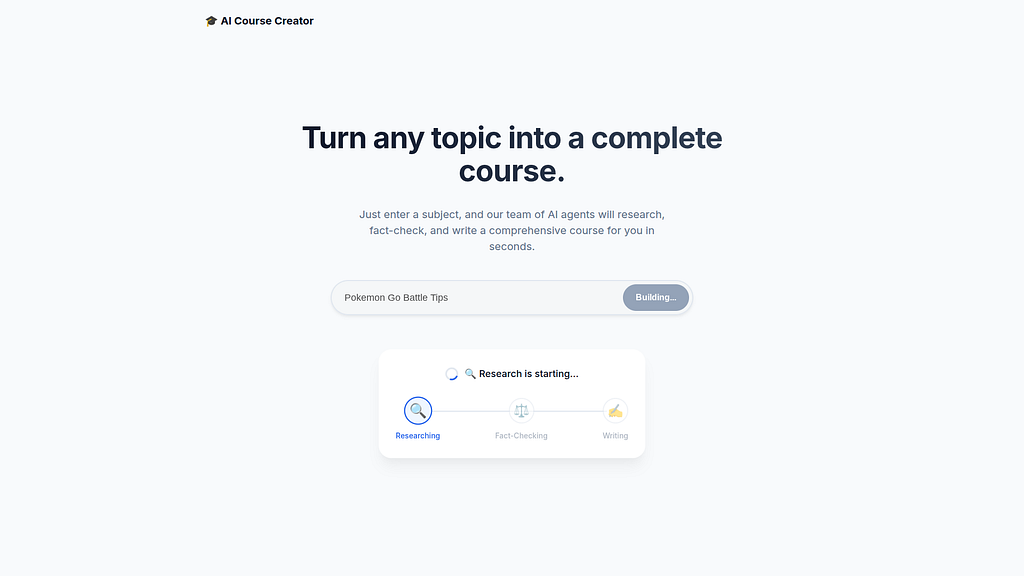
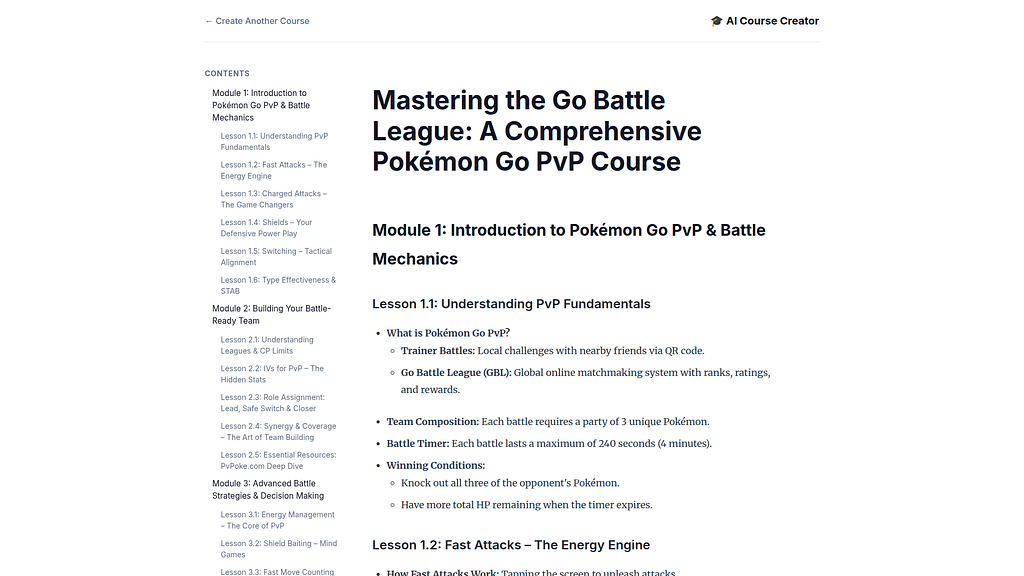
Then use online course generator:
#### Final Gemini CLI Code Review
As a final step — Gemini CLI was used for a full code review of the project:
```plaintext
Overall Code Review Summary
After reviewing the app and agents directories, I can say this is an exceptionally well-engineered multi-agent system.
High-Level Architecture:
The architecture is sophisticated and effective. The use of a main orchestrator to manage a pipeline of specialized agents (researcher, judge,
content_builder) is a strong and scalable pattern. The inclusion of a research-and-refine loop with the judge agent is a standout feature that
significantly enhances the quality of the final output.
Key Strengths:
1. Expert ADK Usage: The project demonstrates a deep understanding of the Google ADK, using advanced features like SequentialAgent, LoopAgent,
RemoteA2aAgent, structured Pydantic outputs, and agent callbacks to their full potential.
2. Excellent Prompt Engineering: The instruction prompts for all agents are clear, specific, and well-crafted. This is the foundation of the
system's success.
3. Robust State Management: The custom StateCapturer agent is a brilliant, reusable utility that cleanly handles the flow of information between
agents.
4. Production-Ready Features: The system includes production-grade features like environment-aware authentication for service-to-service calls,
robust error handling, and detailed logging.
```
#### Summary
The Agent Development Kit (ADK) was used to build a multi-agent system with A2A support using the Gemini Flash LLM Model. This application was tested locally with Gemini CLI and then deployed to Azure Functions. Several key take-aways and lessons learned were summarized from debugging and testing the multi-agent system- including deep log reviews. Finally, Gemini CLI was used for a complete project code review.
Comments
More Blog
View allkubernetesMinimalist EKS: The Easy Way
Amazon EKS manages the Kubernetes control plane, but you remain responsible for provisioning the...
J
Joaquin MenchacaaiNever forget to enter the Stern Grove lottery again!
Browser automation with Playwright, Python, GitHub Actions, and Entire to auto-enter San Francisco Stern Grove concert lotteries each week!
L
Lizzie SiegletypescriptA Free Screenshot Editor That Never Uploads Your Image
A free screenshot and image editor that runs entirely in your browser. Keeping every edit reversible and handling big phone photos, in plain TypeScript and Canvas2D.
M
Martin StarkshowdevI built a CLI to break my highlights out of Apple Books
A macOS CLI + MCP server that exports Apple Books highlights to Markdown and gives AI assistants direct access to your reading notes.
A
Andrey KorchakaiA Developer's Guide to Agent Hooks in Antigravity CLI
Motivation To be quite honest, "Hooks"—the shell commands we trigger at specific points...
T
TanaikeagentsTactical vs. Strategic Agentic AI Development — A Playbook for Developers
The Strategic Engineer: Why Writing Code Is No Longer Your Most Valuable Skill ...
A
Adewumi Saheed Adewale