
Back to Blog agenticarchitect
 kubernetes
 ai
ai typescript
 showdev
 ai
ai agents
gke-scout, your AI On-Call SRE for Google Kubernetes Engine
Nguyen Hai Truong June 25, 2026
0 views
I built gke-scout, a CLI tool that acts as an AI on-call SRE for GKE. Point it at a broken workload,...
I built `gke-scout`, a CLI tool that acts as an AI on-call SRE for GKE. Point it at a broken workload, and it investigates read-only through a safety guardrail, then writes an evidence-cited root-cause report. It uses Gemini (via the Antigravity CLI) and the GKE MCP server under the hood, but never mutates your cluster.
> Google Cloud credits are provided for this project. Thank Google :)
**TL;DR**
The full source is at [https://github.com/truongnh1992/gke-sre-ai-agent](https://github.com/truongnh1992/gke-sre-ai-agent). MIT licensed.
```bash
git clone https://github.com/truongnh1992/gke-sre-ai-agent.git
cd gke-sre-ai-agent
uv tool install .
gke-scout init
gke-scout diagnose <your-deployment>
```
[App Features Demo](https://raw.githubusercontent.com/truongnh1992/truongnh1992.github.io/refs/heads/main/assets/img/gke-scout-demo.gif)
In this post, I'll walk through the architecture, the safety model, and the interesting engineering challenges I ran into.
## The Problem
When you're paged at 3 AM for a failing GKE workload, the first 10 minutes are usually the same: `kubectl get pods`, `kubectl describe pod`, `kubectl logs`, `kubectl get events` — a mechanical checklist before you even start thinking about root causes. An AI agent can do this faster, but the hard part isn't the investigation — it's **trusting** an agent near production.
What if the agent accidentally runs `kubectl delete pod`? What if it leaks a Secret value to a model provider? What if it hangs and you're stuck watching a spinner for 20 minutes?
`gke-scout` is my answer: a local CLI that wraps an AI reasoning engine in a read-only safety guardrail, redacts secrets before they reach the model, logs every tool call for auditability, and produces a structured Markdown report.
## Architecture
Here's the end-to-end flow when you run `gke-scout diagnose`
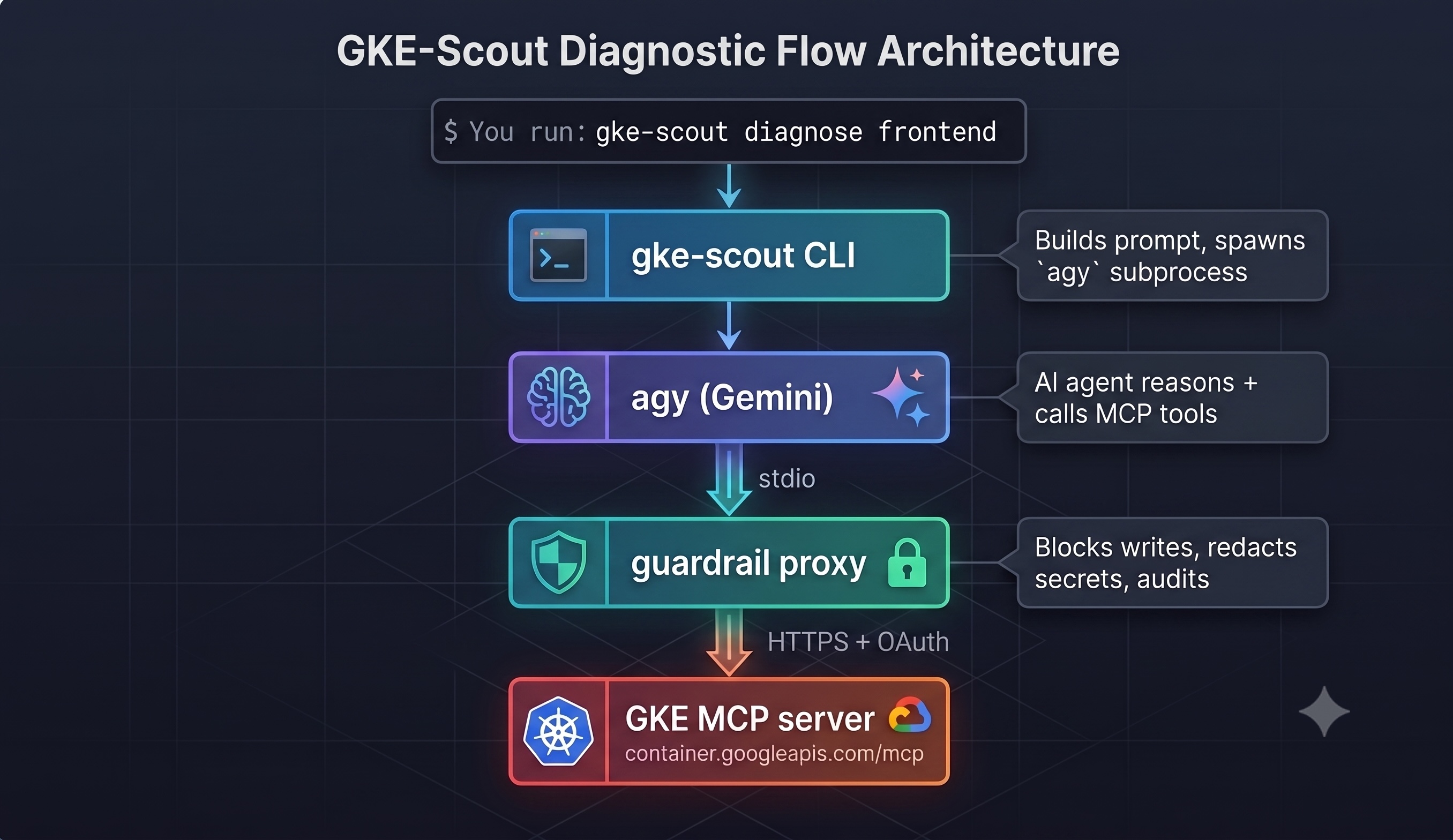
Three Google AI products power this:
1. **Gemini** — the LLM that reasons about the cluster state, decides which tools to call, and generates the diagnosis.
2. **Antigravity CLI (`agy`)** — Google's agent runtime that manages the multi-turn tool-calling conversation with Gemini.
3. **GKE MCP server** — a Google Cloud API endpoint that exposes Kubernetes operations (`get pods`, `describe resource`, `read logs`, `list events`) as [Model Context Protocol](https://modelcontextprotocol.io/) tools.
The guardrail proxy sits between the AI agent and the GKE MCP server. It's a local stdio MCP server that the Antigravity CLI launches as a subprocess. From the agent's perspective, it looks identical to the upstream server — same tools, same schemas. But every call passes through three safety layers before reaching the cluster.
## The Safety Model
The guardrail implements defense-in-depth with three layers: policy enforcement, secret redaction, and audit logging.
### Layer 1: Read-Only Policy (Default-Deny)
Every tool call name is tokenized and checked against two sets:
```python
MUTATING_TOKENS = frozenset({
"apply", "create", "update", "patch", "delete", "remove",
"scale", "restart", "exec", "drain", "cordon", "edit", ...
})
READ_TOKENS = frozenset({
"list", "get", "read", "describe", "logs", "events", "watch", ...
})
```
The evaluation logic is deliberately strict:
1. If **any** mutating token is present → **blocked** (even `get_exec_session` is caught by `exec`)
2. Else if a read token is present → **allowed**
3. Else → **blocked** (default-deny for unknown tools)
This handles all naming conventions: `delete_pod`, `deletePod`, `delete-pod` all get tokenized the same way. The default-deny means that if Google adds a new MCP tool tomorrow, it's blocked until explicitly recognized as read-only.
### Layer 2: Secret Redaction
Before any API response reaches the AI agent, sensitive data is scrubbed:
- **Kubernetes Secrets**: All `data` values in Secret objects are replaced with `***REDACTED***`
- **Sensitive keys**: Any key matching `password`, `token`, `api_key`, `credential`, `bearer`, etc. has its value redacted — recursively through nested dicts and lists
- **Text patterns**: Bearer tokens and key-value pairs with sensitive names are regex-scrubbed from string content
This runs on both the tool response (what the agent sees) and the audit log arguments (what hits disk). The redaction is pure — it deep-copies the input and never mutates the original.
### Layer 3: Append-Only Audit Log
Every tool call — allowed or blocked — is written to `~/.gke-scout/audit.jsonl`:
```json
{
"ts": "2026-06-23T16:14:49.649628+00:00",
"tool": "get_k8s_resource",
"args": {"namespace": "default", "parent": "projects/.../clusters/...", "resourceType": "pod"},
"allowed": true,
"reason": "read-only call permitted"
}
```
Arguments are redacted before logging, so secrets never appear in the audit trail. This gives you a complete record of everything the agent did (and tried to do) during an investigation.
## The Prompt Engineering
The agent follows a structured investigation playbook defined in [SKILL.md](https://github.com/truongnh1992/gke-sre-ai-agent/blob/main/src/gke_scout/skills/k8s-troubleshooter/SKILL.md), which is inlined directly into the prompt for the Antigravity engine:
```plaintext
Investigate workload 'frontend' in namespace 'default'.
Cluster context (skip discovery, use these directly):
project: my-project
location: us-central1
cluster: my-cluster
parent: projects/my-project/locations/us-central1/clusters/my-cluster
IMPORTANT: Use ONLY the MCP tools from the gke-scout-guardrail server...
Follow these instructions exactly:
<full SKILL.md content>
```
Two key optimizations:
**1. Cluster context injection:** The CLI parses `kubectl config current-context` to extract the project, location, and cluster name, then injects them directly into the prompt. Without this, the agent would waste 2-3 MCP calls running `list_clusters` and `get_cluster` just to discover what it's connected to.
**2. Tool call minimization:** The skill explicitly forbids calling discovery tools (`get_k8s_version`, `list_k8s_api_resources`, `get_k8s_cluster_info`) and instructs the agent to emit a `STRUCTURED_RESULT` immediately once it has a diagnosis -- no unnecessary follow-up investigations.
## What I Learned
**The guardrail is more important than the agent.** Most of the engineering effort went into the safety layer, not the AI prompt. Getting the policy right (default-deny, tokenized matching), the redaction right (deep recursive, regex for text), and the error handling right (fail-closed, no leaked errors) — that's what makes this safe to run against production clusters.
**MCP is a good abstraction.** The Model Context Protocol let me insert a transparent proxy between the agent and the API without the agent knowing. Same tool list, same schemas, just filtered. The agent doesn't need to be "aware" of the guardrail.
**LLM agents are slow for simple problems.** A `CreateContainerConfigError` that takes 2 seconds with `kubectl describe pod` takes 3-5 minutes with an AI agent doing multiple MCP calls. The value is in complex, multi-service failures where a human would spend 15-30 minutes doing the same checklist.
Comments
More Blog
View allkubernetesMinimalist EKS: The Easy Way
Amazon EKS manages the Kubernetes control plane, but you remain responsible for provisioning the...
J
Joaquin MenchacaaiNever forget to enter the Stern Grove lottery again!
Browser automation with Playwright, Python, GitHub Actions, and Entire to auto-enter San Francisco Stern Grove concert lotteries each week!
L
Lizzie SiegletypescriptA Free Screenshot Editor That Never Uploads Your Image
A free screenshot and image editor that runs entirely in your browser. Keeping every edit reversible and handling big phone photos, in plain TypeScript and Canvas2D.
M
Martin StarkshowdevI built a CLI to break my highlights out of Apple Books
A macOS CLI + MCP server that exports Apple Books highlights to Markdown and gives AI assistants direct access to your reading notes.
A
Andrey KorchakaiA Developer's Guide to Agent Hooks in Antigravity CLI
Motivation To be quite honest, "Hooks"—the shell commands we trigger at specific points...
T
TanaikeagentsTactical vs. Strategic Agentic AI Development — A Playbook for Developers
The Strategic Engineer: Why Writing Code Is No Longer Your Most Valuable Skill ...
A
Adewumi Saheed Adewale