
Back to Blog career
 gemma
gemma community
 ai
ai ai
ai githubactions
 ai
ai
7 Years of Experience, 0% Conversion: A Reality Check on the 2026 Job Market
Atef February 5, 2026
0 views
Why the 2026 market is ghosting senior devs, and why I'm pivoting to automation.
title: "7 Years of Experience, 0% Conversion: A Reality Check on the 2026 Job Market" published: true description: "Why the 2026 market is ghosting senior devs, and why I'm pivoting to automation." tags: career, webdev, automation, jobsearch cover_image: "https://dev-to-uploads.s3.amazonaws.com/uploads/articles/v92xl5qo1j7t8xpdhko0.png"
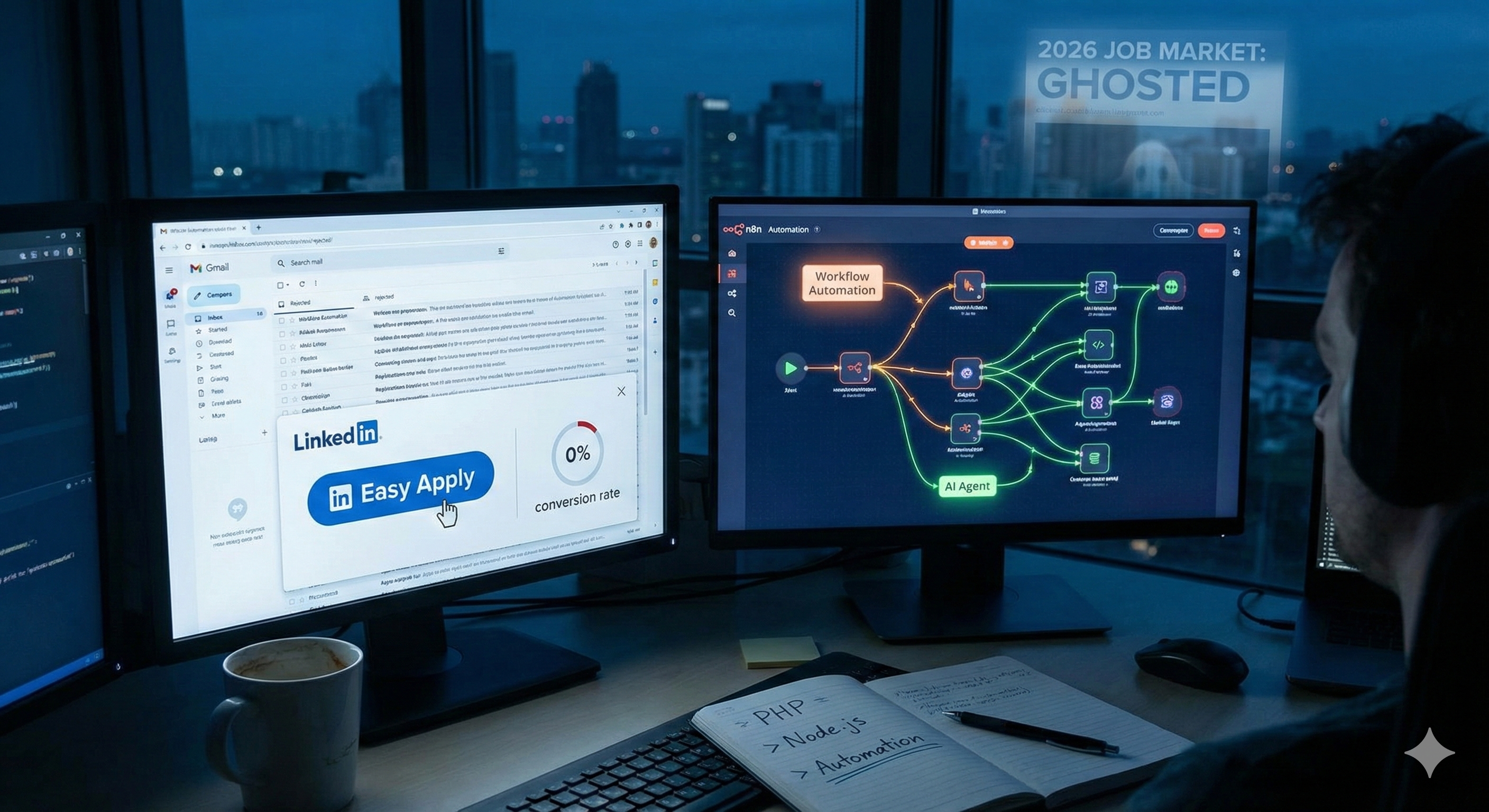
I have 7 years of experience in software development. I’ve successfully migrated stacks (PHP to Node.js), built scalable backends, and delivered full-stack applications.
In 2024, that resume guaranteed at least a screening call.
In 2026, my interview conversion rate dropped to 0%.
Like many of you, I stared at the "Easy Apply" button on LinkedIn, wondering if there was a hidden flag on my profile. Was it my location? My stack? Or has the market fundamentally broken?
I turned to the ExperiencedDevs community on Reddit for a "code review" of my career strategy. The responses were harsh, insightful, and a much-needed wake-up call. Here is what I learned about surviving the "Ghost Market" of 2026.
1. The "Generalist" is Deprecated
The most consistent feedback I received was that "Full Stack" has become a meaningless label. The market has shifted from "growth" to "efficiency," meaning companies are getting aggressively picky.
One commenter noted that companies now demand exact tech stack matches. Even with solid experience, if you don't have the specific framework or cloud provider they use, you are getting filtered out by the ATS before a human even sees your resume.
The takeaway: The market no longer pays for "I'm smart, I can figure it out." It pays for "I can hit the ground running immediately." If you aren't an exact match, you are invisible.
2. The Competition: It’s Not Just You, It’s the "FAANG Flood"
Perhaps the most sobering reality check came from a hiring manager who pulled back the curtain on what their inbox looks like right now. It’s not just about volume; it’s about the caliber of the desperate.
They shared that for a single Senior role, they are receiving applications from:
- Meta candidates laid off last year.
- Pinterest candidates laid off this round.
- Snap and Uber alumni with impressive track records.
- Highly skilled H1B visa holders willing to accept anything just to secure their status.
This is the "Ghost Market" reality: We aren't just competing with other mid-level devs. We are competing with ex-FAANG engineers who are flooding the mid-market.
3. LinkedIn is a "Pay-to-See-Others-Apply" Game
Given the competition described above, the consensus is that LinkedIn Premium has become a vanity metric.
The "Easy Apply" button is a trap. It gives a dopamine hit of productivity ("I applied to 50 jobs today!"), but the return on investment is near zero against that level of competition. The real hiring is happening through:
- Niche job boards (where the FAANG flood is less prevalent).
- Direct outreach to recruiters (who are desperate to filter through the noise).
- The "Hidden Market" of referrals.
4. The Pivot: From "Coder" to "Automator"
This feedback forced me to re-evaluate my value proposition. If the world doesn't need another generic Node.js developer, what does it need?
It needs efficiency.
The feedback I got suggested targeting startups that value problem solving over buzzword compliance. This aligns perfectly with where I’ve found myself naturally drifting: Automation.
I am no longer just "looking for a Node.js job." I am pivoting my output to demonstrate Workflow Automation and Micro-SaaS development.
My "Patch" for the Career Search
Instead of sending Resume v105.pdf into the void, I am focusing on "Proof of Work" using tools like n8n.
I’m currently building a travel-tech Micro-SaaS that aggregates data from Booking.com and Reddit to help travelers make better decisions.
- The Old Me would have built a CRUD app and hoped someone looked at the repo.
- The New Me is building an automated pipeline that delivers value instantly, using AI agents to parse sentiment and n8n to handle the orchestration.
This isn't just a side project; it's my argument that I can save a company time and money on day one.
Conclusion: Adapt or Die
The 2026 market isn't "bad"—it’s just different. The days of passive applying are over.
If you are a mid-to-senior dev struggling right now:
- Stop spamming applications. You cannot beat the volume game against the current talent pool.
- Pick a niche (mine is Automation/Integration).
- Build something that solves a business problem, not a code problem.
To the founders and engineering leads reading this: If you're looking for someone who cares more about automating your business logic than arguing about syntax, let's talk.
Comments
More Blog
View allgemmaFive Gemma-4 models, one accelerator: what porting E2B 31B to AWS Inferentia2 taught me
I ported the whole Gemma-4 family — E2B, E4B, 12B, 31B, and the 26B-A4B MoE — to run on...
X
xbillcommunityHey DEV, I'm Tobore. Let's actually connect.
Hey DEV, I'm Tobore. Let's actually connect. I've been on here for a while now, mostly writing and...
L
Laurina AyarahaiI burned through thousands of AI tokens. Then a friend did it for free
(yep, kinda clickbait, just for the funsies 😊) At the beginning of the year, I relaunched my...
P
Paulo HenriqueaiClaude might be saturating your machine
My laptop was sitting idle with the fan at full tilt. Nothing was running that I knew of. The culprit...
S
Sidhant PandagithubactionsAutomated GitHub Code Reviews Using Google Gemini
I Built a Thing! TL;DR — Google Gemini-based Pull Request reviews and Issue Triaging for...
D
Darren "Dazbo" LesteraiWhat is an "agentic harness," actually?
I've been hearing the word "harness" thrown around a lot lately. I assumed it just meant "the IDE" or...
T
Tilde A. ThuriumReady-made automations for this
Workflows from the Neura Market marketplace related to this DeepSeek resource
- Automate PDF to Blog Conversion with AI Agentsn8n · $14.99 · Related topic
- Automate Blog-to-Audio Conversion and Distribution with Eleven Labs & GPT-4n8n · $9.99 · Related topic
- Automate YouTube Video to SEO Blog Post Conversion with AIn8n · $9.99 · Related topic
- Sync Zendesk Knowledge Base Articles to Airtable with Markdown Conversionn8n · $14.99 · Related topic