
Back to Blog startup
 gemma
gemma community
 ai
ai ai
ai githubactions
 ai
ai
A Founder’s Blueprint to Creating a Technical Sales Team
Abraham Gomez February 27, 2026
0 views
I have found that technical founders tend to treat Go-To-Market (GTM) as an afterthought (or a black...
I have found that technical founders tend to treat Go-To-Market (GTM) as an afterthought (or a black box) instead of a creative venture. Just as you, as a technologist, know exactly when to use a SQL vs. NoSQL database or when to leverage Gemini vs. classical BERT models, you need to know exactly when to deploy DevRel, Sales Engineers, Forward Deployed Engineers, and Solutions Architects.
The Technical Founder’s Sales Dilemma
Over the past 5 years as a Startup Customer Engineer at Google Cloud, I’ve helped over 400 founders build and sell AI. Some have built unicorns, others have executed crazy pivots, and each journey has offered incredible lessons. With that kind of exposure, clear Go-To-Market patterns emerge.
For technical founders, the most common pitfall I see is flying blind into the art (and science) of designing a technical GTM team. While YC has taught founders how to obsess over product feedback, there is a massive blind spot when it comes to structuring the team that builds commercial traction in parallel. Let’s admit it: the idea that “if you build it, they will come” rarely works out in practice.
This guide aims to provide a simplified, highly actionable approach to designing your technical sales motion. First, we’ll demystify the roles of DevRel, Sales Engineer, Forward Deployed Engineer, Solutions Architect, and Technical Account Manager. Then, borrowing from the SQL relational model (think 1-to-many, 1-to-few, or 1-to-1), I’ll give you a mental model for understanding which roles make sense—and when to hire them without burning unnecessary runway.
I’m adopting the mindset that at a startup, everyone generally falls into one of two camps: the builders & the sellers (as investor Jack Altman succinctly put it).
{% embed https://x.com/jaltma/status/1481834098347819013 %}
Consider this your baseline blueprint—mold it to your startup’s unique GTM goals.
VCs are Hungry for Capital Preservation
You hear it often: “We are on the cusp of seeing the world’s first single-employee unicorn.” This is driven by the sheer velocity at which developers can now go from MVP to production leveraging SOTA models and agent frameworks (read more on The Growth Mind blog).
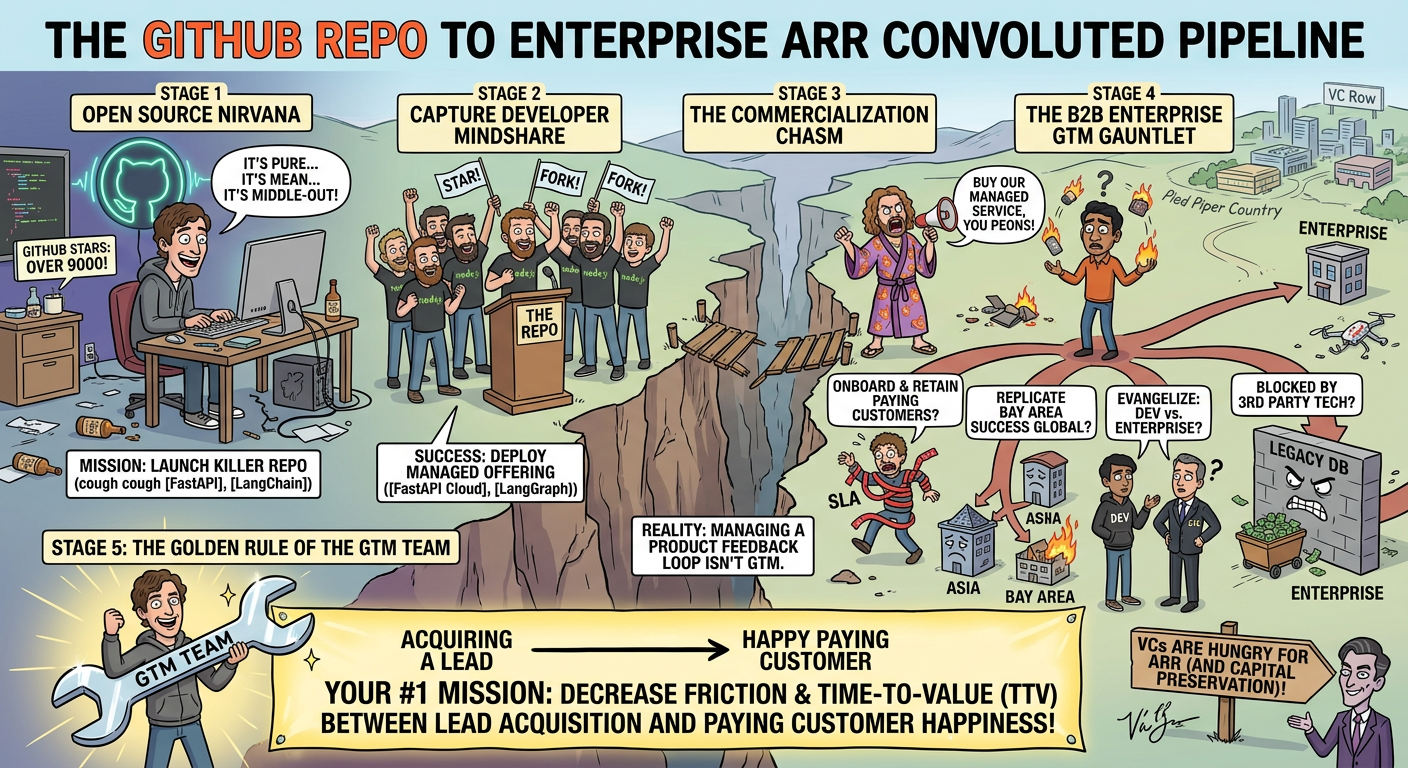
Let’s look at the classic Open-Source-to-B2B founder pipeline. A founder launches a killer repo on GitHub (cough cough FastAPI, LangChain). Having captured developer mindshare, they deploy a managed, enterprise offering for their open-source tech (FastAPI Cloud, LangGraph).
Now, on top of managing a product feedback loop, that founder has to figure out:
- How (and who) should focus on onboarding and retaining our paying customers?
- How do we replicate our success in the Bay Area across the rest of the US, Europe, and Asia?
- Who evangelizes our product to developers vs. enterprise buyers?
- What do we do if a high-paying enterprise is blocked from deploying because of 3rd-party tech we don’t own?
- How do we build educational content for specific, lucrative industry verticals?
Here is your golden rule: Your technical GTM team’s #1 mission is to decrease the friction and time-to-value (TTV) between acquiring a lead and turning them into a happy, paying customer.
Demystifying Key Technical GTM Roles: Who, What, and When?
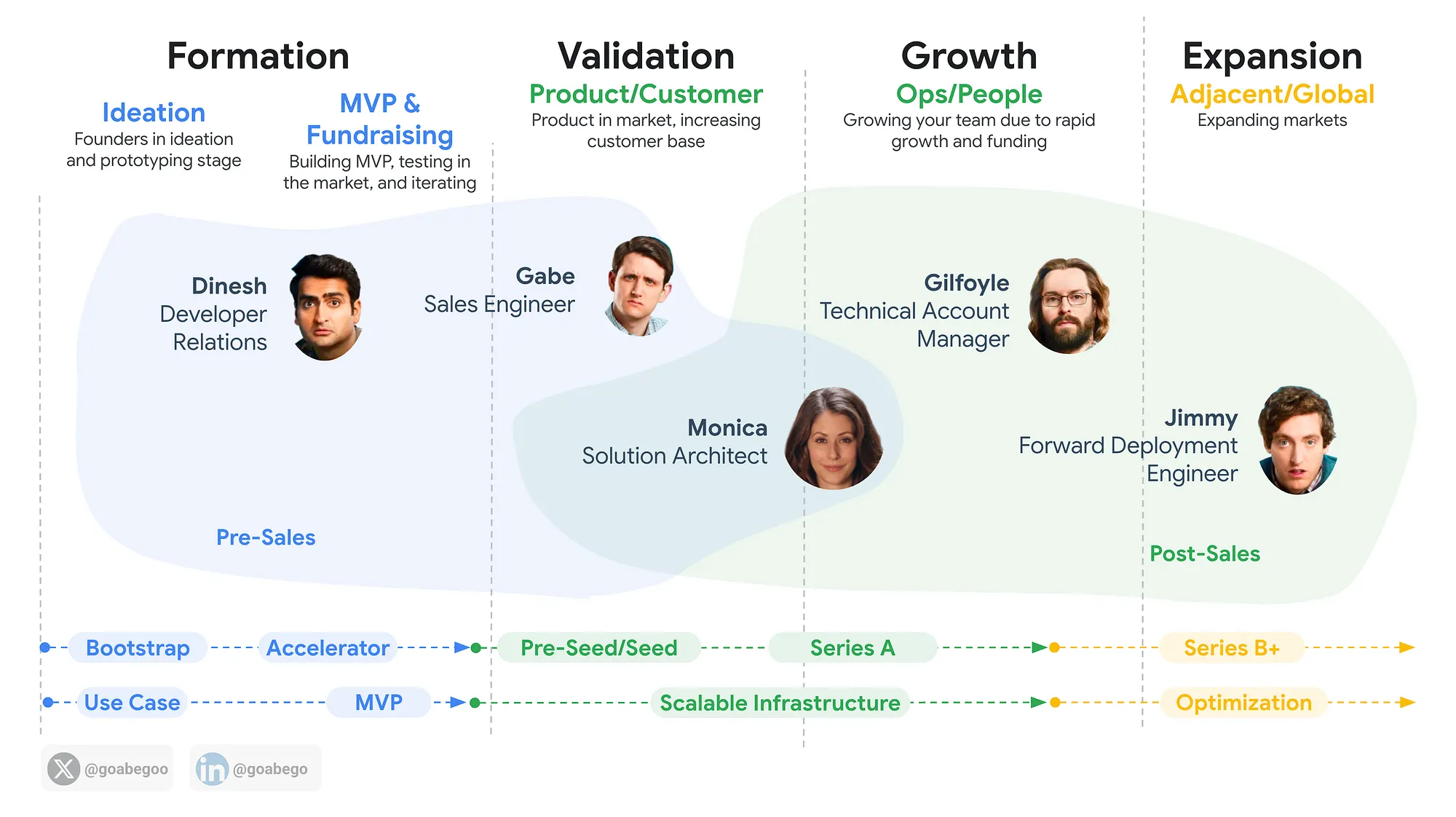
I am giving you hard definitions below. But in full transparency: the earlier you are in your lifecycle (Pre-Seed/Seed), the more these roles bleed into one another. In the early days, your first technical GTM hire will likely wear all these hats to win over a customer.
As you scale, specialization is what drives ARR.
1) Developer Relations (DevRel)
DevRel professionals are your company’s bridge to the developer community. They foster engagement and advocate for your product within the broader technical ecosystem. They are less about direct quota-carrying sales, and more about creating top-of-funnel demand by making developers want to use your product.
- What they really do: Create world-class documentation, write code samples, speak at conferences, live in developer forums/Discord, and funnel community feedback directly to your product team.
- When You Need Them: Essential for developer-first products, platforms, or APIs (B2D models). Hire them when you are ready to build a self-sustaining ecosystem and drive organic adoption. They are often a strong early-stage hire (Seed to Series A).
- When You Don’t Need Them (and why): If your product doesn’t have a direct developer audience, or if your sales motion is purely top-down enterprise (selling to CIOs, not SWEs), dedicated DevRel is a waste of capital. Forcing them to do direct sales will destroy their community credibility.
- Aliases: Developer Advocate, Developer Evangelist, Community Engineer.
2) Sales Engineer (SE)
Sales Engineers are the technical backbone of your closing team. They bridge the gap between complex technology and business needs during the pre-sales process. They prove to the buyer that your product actually works for their specific environment.
- What they really do: Deliver tailored product demos, scope and manage Proof-of-Concepts (PoCs), answer brutal technical security questionnaires, and overcome technical objections to get the deal signed.
- When You Need Them: Crucial when your product requires deep technical validation, integration discussions, or custom scoping before a buyer will sign. Usually hired as you transition away from founder-led sales (Series A+ for B2B).
- When You Don’t Need Them (and why): For self-serve Product-Led Growth (PLG) SaaS products, an SE is expensive overkill. Furthermore, they shouldn’t be your post-sales implementation team. Founder Sanity Check: The cost of a single SE needs to be easily justified by the pipeline they help close.
- Aliases: Solutions Consultant, Pre-Sales Engineer, Solutions Engineer.
3) Forward Deployed Engineer (FDE)
Pioneered heavily by companies like Palantir, Forward Deployed Engineers are elite technical operators who go deep with customers post-sale. They embed themselves into the customer's environment to force successful integrations and sticky adoption.
- What they really do: Lead complex custom integrations, write bespoke scripts, provide deep technical advisory, and solve post-sales blockers that require SWE-level code understanding.
- When You Need Them: When your product requires significant customization, integration into messy legacy enterprise environments, or ongoing technical hand-holding. Common in Series B+ (or highly technical Series A) where churn prevention is tied to complex implementation.
- When You Don’t Need Them (and why): If your product integrates in 5 minutes via a standard API, FDEs are an unnecessary drag on margins. Do not treat them as a glorified IT helpdesk—their ROI comes from unlocking massive enterprise deployments.
- Aliases: Implementation Engineer, Professional Services Engineer, Deployment Strategist.
4) Solutions Architect (SA)
Solutions Architects design the overarching technical blueprint. They look at how your product fits into the buyer's broader tech stack. They are focused on macro-architecture rather than just pitching features, and often have deep industry/vertical specialization.
- What they really do: Architect comprehensive technical solutions, assess enterprise feasibility, define scope for multi-million dollar rollouts, and translate complex designs to both engineers and C-suite executives.
- When You Need Them: When deals require integrating your product into a massive, multi-cloud enterprise architecture, or when you are selling multi-product bundles. Typically seen at Series B+ when moving upmarket into the Fortune 500.
- When You Don’t Need Them (and why): If your product is standalone software, a full-time SA is premature. SAs also shouldn't be bogged down writing day-to-day production code.
- Aliases: Enterprise Architect, Cloud Architect, Technical Architect.
5) Technical Account Manager (TAM)
Technical Account Managers provide dedicated, proactive technical support to your most strategic paying customers. They ensure long-term health, adoption, and expansion.
- What they really do: Serve as the trusted technical advisor for VIP accounts. They proactively identify scaling issues, manage massive technical escalations, and guide the customer on new feature adoption.
- When You Need Them: For your highest-value enterprise accounts where losing them would physically hurt your ARR. Usually employed at Series B+ for Enterprise B2B models to drive Net Revenue Retention (NRR).
- When You Don’t Need Them (and why): For SMBs or accounts with simple needs. TAMs are expensive; they should not be handling routine support tickets that a standard Customer Success team could manage.
- Aliases: Strategic Account Engineer, Client Technical Advisor.
Putting It All Together: Your Technical GTM Playbook
Deciding who to hire and when is a strategic chess match. This table provides a concise overview of key roles and highlights their operational differences to help you hire accurately based on your current constraints.
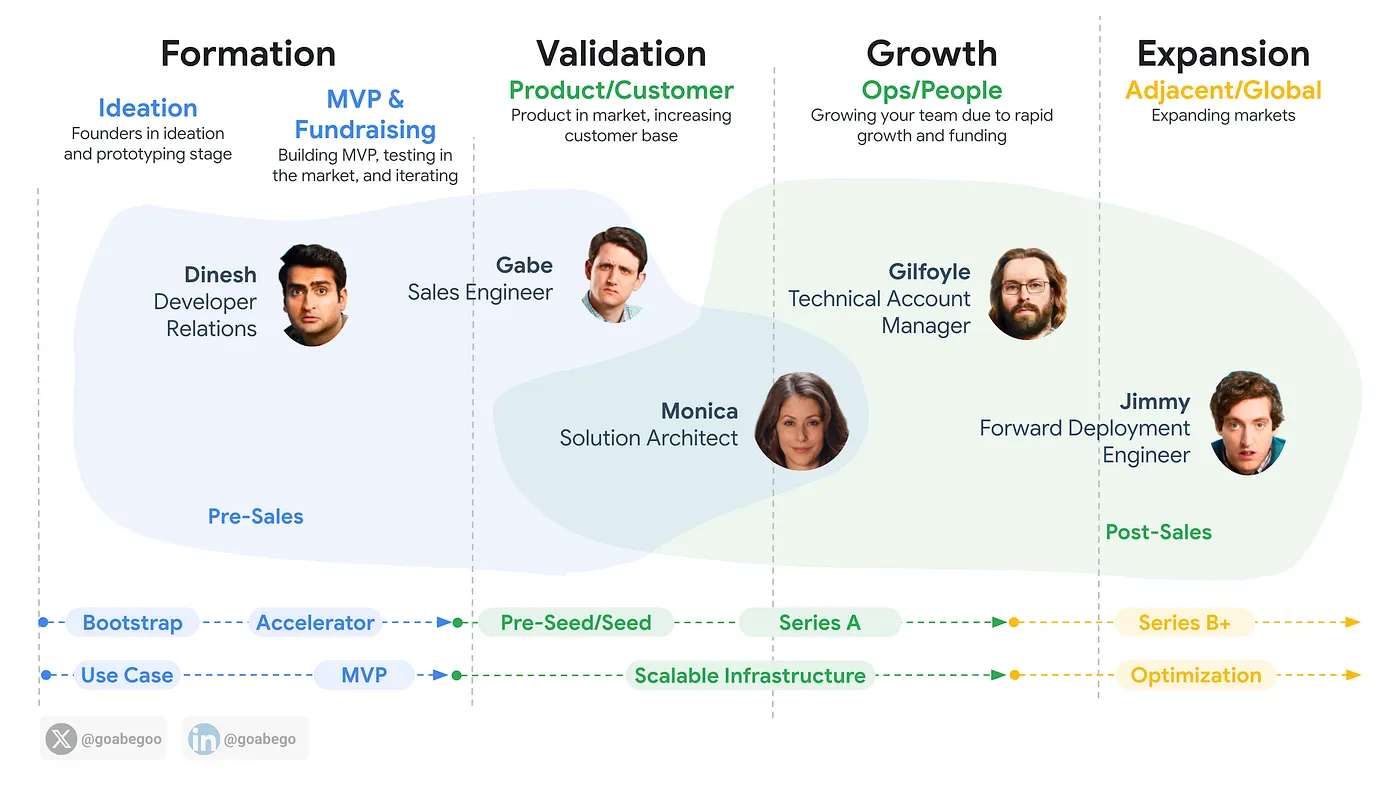
As a founder, map your hires across two spectrums: pre-sales vs. post-sales challenges, and one-to-one vs. one-to-many engagement models.
Initially, most startups focus on a pre-sales, one-to-many approach (DevRel) and a one-to-few approach (Sales Engineers). As product-market fit solidifies and margins allow for GTM expansion, you introduce FDEs, SAs, and TAMs to capture and retain enterprise whales.
(Note: The diagram above isn’t absolute. While SAs and TAMs typically arrive later in the startup life cycle, we are seeing an increasing trend of early-stage, deeply technical AI startups hiring FDEs much earlier to ensure their first few pilots don't fail).
Technical GTM Role Comparison: A Founder’s Quick Guide
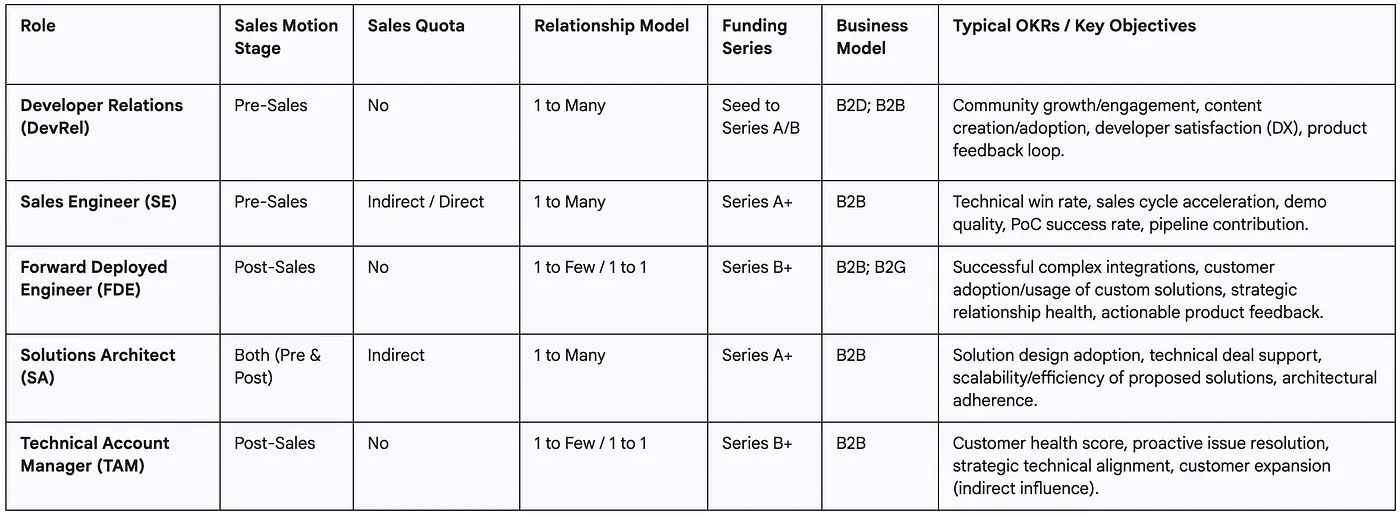
How to use the table above: Think of this table as your strategic compass, not a rigid checklist. As you budget for headcount, ask yourself:
- What is our product’s technical complexity? Simpler products scale with Sales Engineers pre-sale. Highly complex, heavy-lift products require FDEs and TAMs post-sale to prevent churn.
- What is our core sales motion? Is it developer-led (DevRel is key)? Is it top-down enterprise (SEs and SAs are vital)? Or is it heavily dependent on custom post-sale integration (FDEs)?
Strategic Team Building: The true power of a technical GTM team is how the roles complement one another. An SE wins the technical evaluation. An FDE ensures the complex deployment actually goes live. A TAM ensures the account expands next year. Building your team strategically means identifying the exact bottleneck in your revenue funnel and plugging it with the right persona.
Your New GTM Blueprint
Finding product-market fit is only half the battle. To truly scale and achieve the ARR metrics that drive Series A and B rounds, you need a technical Go-to-Market team engineered to collapse the sales feedback loop. It’s not just about "selling"—it’s about enabling, integrating, and evangelizing your tech in ways traditional Account Executives simply cannot do alone.
By understanding the distinct lanes of DevRel, Sales Engineers, FDEs, Solutions Architects, and TAMs, you now have a mental model to avoid costly mis-hires. This is about aligning your pre-sales and post-sales bottlenecks with the right one-to-many or one-to-one talent.
As you plan your next quarter, ask yourself: Where are deals stalling because we lack technical translation? Is your team actually built to handle the heavy lift of enterprise adoption, or are you hoping your core engineering team will just "figure it out" on the weekends?
What GTM strategies have worked for you so far, and what blind spots are you trying to solve right now?
Honorable Mentions
Note: I excluded Customer Success Managers (CSMs), Outbound PMs, Field CTOs, and standard Account Executives (AEs) for the sake of brevity.
Inspiration and further reading:
- https://caseysoftware.com/blog/developer-relations-a-painful-reckoning
- https://www.tessakriesel.com/devrel-is-sales/
- https://www.reddit.com/r/salesengineers/comments/13y5rxi/move_from_se_to_developer_relations/
- https://medium.com/codex/developer-relations-sales-devrel-sitting-in-a-tree-k-i-s-s-i-n-g-b8158d87bed4
- https://devrelbook.substack.com/p/the-developer-journey-map
- https://news.ycombinator.com/item?id=23906841
- https://www.barry.ooo/posts/fde-culture
About the Author: Abe is a Startup Customer Engineer at Google Cloud where he has helped over 400 founders build, scale, and sell AI products.
Questions/feedback/concerns? Let's connect: x.com/whoinvitedabe | linkedin.com/in/goabego
Comments
More Blog
View allgemmaFive Gemma-4 models, one accelerator: what porting E2B 31B to AWS Inferentia2 taught me
I ported the whole Gemma-4 family — E2B, E4B, 12B, 31B, and the 26B-A4B MoE — to run on...
X
xbillcommunityHey DEV, I'm Tobore. Let's actually connect.
Hey DEV, I'm Tobore. Let's actually connect. I've been on here for a while now, mostly writing and...
L
Laurina AyarahaiI burned through thousands of AI tokens. Then a friend did it for free
(yep, kinda clickbait, just for the funsies 😊) At the beginning of the year, I relaunched my...
P
Paulo HenriqueaiClaude might be saturating your machine
My laptop was sitting idle with the fan at full tilt. Nothing was running that I knew of. The culprit...
S
Sidhant PandagithubactionsAutomated GitHub Code Reviews Using Google Gemini
I Built a Thing! TL;DR — Google Gemini-based Pull Request reviews and Issue Triaging for...
D
Darren "Dazbo" LesteraiWhat is an "agentic harness," actually?
I've been hearing the word "harness" thrown around a lot lately. I assumed it just meant "the IDE" or...
T
Tilde A. ThuriumReady-made automations for this
Workflows from the Neura Market marketplace related to this DeepSeek resource
- Creating a Secure Webhook - Must Haven8n · $9.99 · Related topic
- Automate Multi-Timeframe Technical Analysis for Binance Spot Marketn8n · $24.99 · Related topic
- Automated Stock Analysis Reports with Technical & News Sentiment using GPT-4n8n · $24.99 · Related topic
- Tesla 1-Day Indicators Tool (Macro-Level Technical AI)n8n · $9.99 · Related topic