
Back to Blog antigravity
 ai
ai hermesagentchallenge
 midsommar
 ai
ai devchallenge
 webrtc
Building an agentic PR reviewer with Antigravity SDK
Remigiusz Samborski June 18, 2026
0 views
As announced in this blog post on June 18, 2026, Gemini CLI and Gemini Code Assist IDE extensions...
As announced in this [blog post](https://developers.googleblog.com/an-important-update-transitioning-gemini-cli-to-antigravity-cli/?utm_campaign=CDR_0x87fa8d40_default_b517845989&utm_medium=external&utm_source=blog) on June 18, 2026, Gemini CLI and Gemini Code Assist IDE extensions will stop serving requests for Google AI Pro and Ultra, as well as those using it free of charge using Gemini Code Assist for individuals. Google is unifying its AI terminal tools by transitioning the community-focused Gemini CLI into Antigravity CLI, a new agent-first platform built for complex, multi-agent workflows.
With this transition timeline in place, development teams relying on Gemini CLI for repository management and automated tasks must establish a migration path. In this post, I will show you how to transition seamlessly by building an automated "first-pass" pull request reviewer using the Google [Antigravity SDK](https://antigravity.google/product/antigravity-sdk?utm_campaign=CDR_0x87fa8d40_default_b517845989&utm_medium=external&utm_source=blog) and the [run-agy-sdk](https://github.com/rsamborski/run-agy-sdk) composite [GitHub Action](https://github.com/features/actions).
## The orchestration tax
The approach I am proposing also solves another pressing issue for modern engineering teams: cognitive overload. As [Addy Osmani](https://x.com/addyosmani) recently pointed out, there is an [orchestration tax](https://x.com/addyosmani/status/2059844244907696186) to using AI for coding. The time developers save generating code is often pushed onto reviewers as large, complex PRs, causing context switching and cognitive fatigue.
> By offloading the tedious "first pass" search to an Antigravity agent, human reviewers can mitigate this tax and focus on high-level architecture and safeguarding quality.
## Why we need automated agentic code reviews
AI-generated code can be deceptively good. It is often clean, well-documented, and syntactically correct. This makes it harder for human reviewers to spot subtle logical bugs or security vulnerabilities that might not be immediately obvious.
In a large codebase, manually verifying every change is simply not feasible. This is why we need autonomous agents that can step into the codebase and analyze it from a fresh perspective.
But if a developer used an LLM to generate the code, how can we trust another AI to find the bugs? The answer lies in the agent architecture and context separation.
Developers might write code using any tool — whether it's CLI, an IDE extension, or various models like Gemini 3.5 Flash or Gemini 3.1 Pro. The reviewer, however, is a managed Antigravity Agent running via a separate SDK integration. This agent has a specialized, low-freedom persona and strict system instructions that force it to act as an adversarial code auditor rather than a developer. Furthermore, it operates in an isolated environment. Because it has a different system prompt, safety guardrails, and context boundaries, the agent reviews the changes with a completely fresh perspective, catching logical bugs and vulnerabilities that the original generator might miss.
To demonstrate it in practice I created an agentic review pipeline, which:
1. Leverages a managed [Antigravity Agent](https://ai.google.dev/gemini-api/docs/antigravity-agent?utm_campaign=CDR_0x87fa8d40_default_b517845989&utm_medium=external&utm_source=blog) configured via the SDK to review the code. The agent uses advanced reasoning to explore files and verify logic under strict guidelines.
2. Runs reviews inside isolated workspaces or sandboxes with custom policies to prevent shell or arbitrary code execution risks.
3. Enables the agent to use the GitHub MCP server to interact directly with the environment to write pull request comments and reviews.
4. Avoids using the `synchronize` trigger in pull request workflows to prevent redundant review runs and endless loops. Instead, runs reviews on `opened` and `reopened` events, and triggers subsequent passes manually by posting a `@agy /review` comment on the PR.
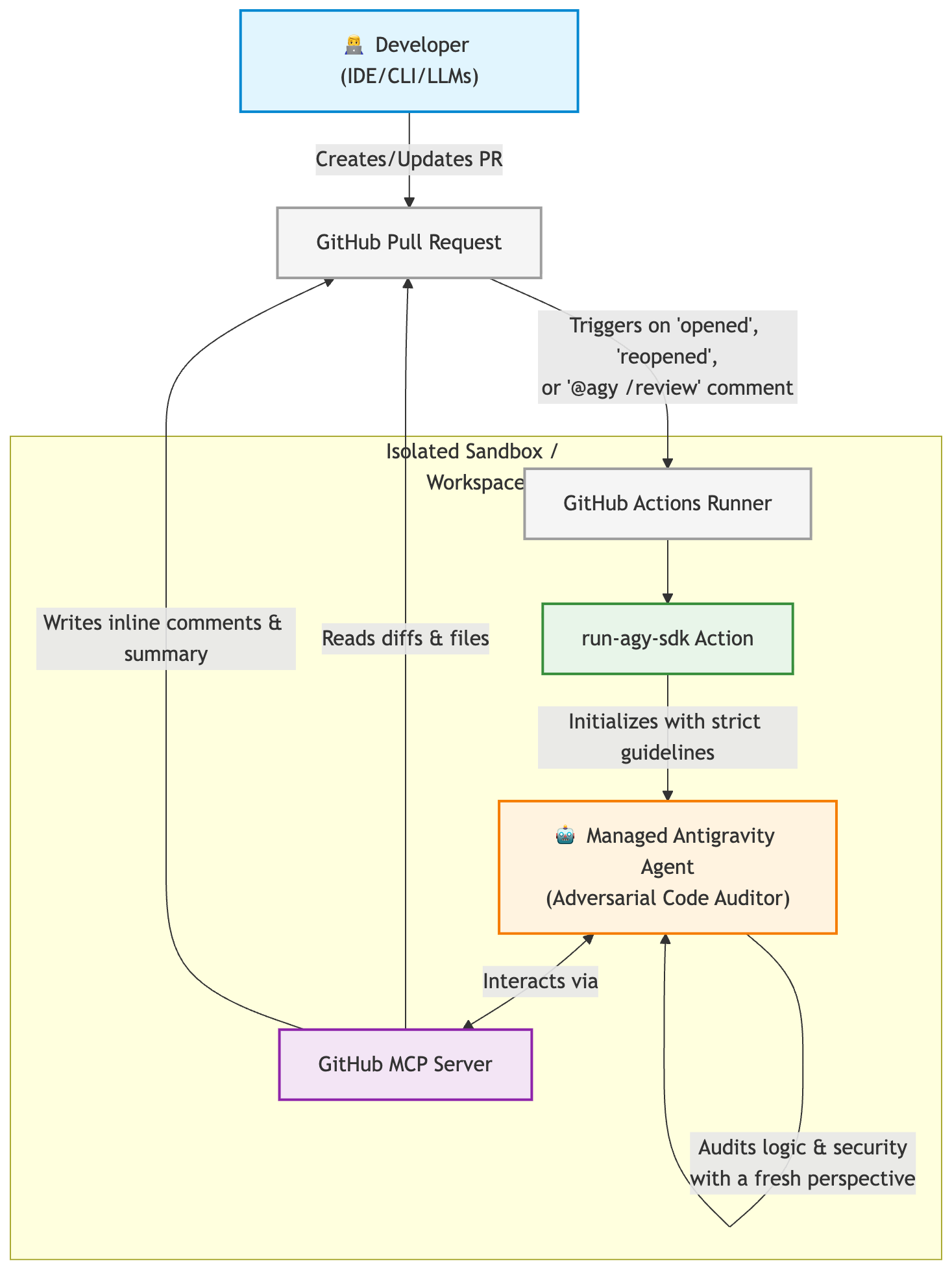
You can find the code at [run-agy-sdk](https://github.com/rsamborski/run-agy-sdk).
## What is run-agy-sdk?
The [run-agy-sdk](https://github.com/rsamborski/run-agy-sdk) is a composite GitHub Action that runs the Google Antigravity SDK (`google-antigravity`) directly on the GitHub Actions host runner.
## Why run on the host instead of a container?
By running directly on the host, the Antigravity SDK has access to the host's Docker daemon. This allows the SDK to spawn Docker-based MCP servers (like the GitHub MCP server) to read files, run tests, and post reviews.
Sub-containers should ideally run with restricted network access and read-only filesystems where possible to prevent an LLM from being tricked into executing arbitrary destructive commands. The limited set of permissions is handled in the GitHub Action configuration ([see here](https://github.com/rsamborski/run-agy-sdk/blob/da0ff77fc9dfc82e5ad89a430bc51476aeb8f867/.github/workflows/antigravity-autonomous-review.yml#L33)). Whereas the Antigravity agent has a limited number of tools it can use from GitHub MCP ([see here](https://github.com/rsamborski/run-agy-sdk/blob/da0ff77fc9dfc82e5ad89a430bc51476aeb8f867/run_agent.py#L160-L161)).
Moreover the workflow is explicitly protected from running automatically on forks, preventing unauthorized code execution. The automated review job will only run if the pull request originates from the same repository ([see here](https://github.com/rsamborski/run-agy-sdk/blob/da0ff77fc9dfc82e5ad89a430bc51476aeb8f867/.github/workflows/antigravity-autonomous-review.yml#L45)). On-demand reviews triggered by commenting `@agy /review` are restricted so that they can only be initiated by maintainers ([see here](https://github.com/rsamborski/run-agy-sdk/blob/da0ff77fc9dfc82e5ad89a430bc51476aeb8f867/.github/workflows/antigravity-autonomous-review.yml#L59-L61)).
## Demonstration walkthrough
The demo below shows the action triggered by a new PR:
{% embed https://youtu.be/30-LS9YnY_g %}
## Implementation: How to install the action in your repo
Let's walk through the setup process step-by-step.
### Step 1: Add your API key to GitHub secrets
The action requires a Google Gemini or Antigravity API key to authenticate language model interactions.
1. [Generate your API key](https://aistudio.google.com/api-keys).
2. Navigate to your target GitHub repository and go to **Settings** \> **Secrets and variables** \> **Actions**.
3. Create a new Repository Secret named `ANTIGRAVITY_API_KEY` and paste your API key as the value.
### Step 2: Configure the GitHub Actions workflow
Add a new file in your repository at `.github/workflows/antigravity-review.yml` and add the following configuration:
```yaml
name: '🔎 Antigravity PR Review'
on:
pull_request:
types: [opened, reopened]
workflow_dispatch:
concurrency:
group: '${{ github.workflow }}-${{ github.event.pull_request.number || github.ref_name }}'
cancel-in-progress: true
jobs:
antigravity-review:
runs-on: 'ubuntu-latest'
timeout-minutes: 20
permissions:
contents: 'read'
pull-requests: 'write'
issues: 'write'
steps:
- name: 'Checkout Repository'
uses: 'actions/checkout@v6'
with:
persist-credentials: false
- name: 'Run Antigravity PR Review'
uses: 'rsamborski/run-agy-sdk@main'
id: 'agy_pr_review'
with:
api-key: '${{ secrets.ANTIGRAVITY_API_KEY }}'
github-token: '${{ secrets.GITHUB_TOKEN }}'
mode: 'review'
prompt: '/antigravity-review'
trust-workspace: 'true'
sandbox-profile: 'true'
```
**Pro Tip:** Pin the action version to a specific commit SHA (e.g., `rsamborski/run-agy-sdk@<commit-sha>`) rather than using `@main`. This prevents unexpected breaks from upstream updates.
While you can reference `run-agy-sdk` directly in your workflows, its real power lies in using it as a blueprint. I encourage you to [fork the repository](https://github.com/rsamborski/run-agy-sdk) and use it as a template to build your own custom, agentic GitHub Actions. By modifying the safety policies, custom tools, or prompts in `run_agent.py`, you can tailor the agent's review behavior to your team's specific codebase, style guidelines, and compliance rules.
For a full workflow template supporting both automated PR reviews and comment-triggered reviews, refer to the [workflows](https://github.com/rsamborski/run-agy-sdk/blob/main/.github/workflows) folder in the repository.
## Conclusions
Automating code reviews is a necessity as AI-generated code volumes increase. By using `run-agy-sdk`, you can run the Antigravity SDK to review PRs automatically and shift more of the burden of code quality assurance away from human reviewers.
- Access the full source code in the [GitHub Repository](https://github.com/rsamborski/run-agy-sdk).
- Read the documentation to customize the prompts and mode.
- Feel free to fork the repository and build your own automation.
## Acknowledgments
This project was inspired by the [run-gemini-cli](https://github.com/google-github-actions/run-gemini-cli) action, while shifting to the recently released Antigravity SDK. It is a personal sample implementation of how to run the Antigravity SDK in a GitHub Action, and is not an officially supported Google product.
## Let’s connect\!
I’d love to hear how you’re using Antigravity for your agentic workflows. Are you building automated code review loops or keeping a tighter leash on your agents?
- Connect with me on [LinkedIn](https://www.linkedin.com/in/remigiusz-samborski/)
- Follow me on [X](https://x.com/RemikSamborski)
- Catch me on [Bluesky](https://bsky.app/profile/rsamborski.bsky.social)
Comments
More Blog
View allaiSkills over System Prompts: Building an Anki Tutor with the Antigravity SDK
AI has made me a little lazier. Not dramatically lazy. Not "the robots will do everything" lazy....
E
Ertuğrul DemirhermesagentchallengeCongrats to the Hermes Agent Challenge Winners!
We are thrilled to announce the winners of the Hermes Agent Challenge! Over the past few weeks, the...
J
Jess LeemidsommarFirebase Midsommer Madnesss with Antigravity CLI
This is a submission for the June Solstice Game Jam This installment brings a Firebase build to...
X
xbillaiI'm not a developer, but I built a calendar app to fix my most annoying work task
I’m not a developer! I’ve never coded anything in my life. As far as I’m concerned, a Cloudtop is...
A
Aria HellerdevchallengeCongrats to the Gemma 4 Challenge Winners!
We are so excited to announce the winners of the Gemma 4 Challenge! This is officially our most...
J
Jess LeewebrtcHow to Read a webrtc-internals Dump, Section by Section
When a WebRTC call goes bad, the browser already recorded what happened. Chrome keeps a live record...
T
Tsahi Levent-Levi