 Midjourney
Back to Blog devchallenge
 devchallenge
 ai
 ai
 claude
 devchallenge
 gemini
SlothSRE (NapOps): An Overnight Gemma 4 & ADK Agent That Compresses 418 Lines of 3 AM Alerts into a 2-Line Morning Digest
Robina Mirbahar October 20, 2026
0 views
How I built a local-first open-weights Gemma 4, Google ADK, and Sentry Agent Tracing pipeline that deduplicates overnight stack traces, verifies git patches in a local pytest sandbox, and lets on-call engineers sleep until 8 AM.
title: "SlothSRE (NapOps): An Overnight Gemma 4 & ADK Agent That Compresses 418 Lines of 3 AM Alerts into a 2-Line Morning Digest" published: true description: "How I built a local-first open-weights Gemma 4, Google ADK, and Sentry Agent Tracing pipeline that deduplicates overnight stack traces, verifies git patches in a local pytest sandbox, and lets on-call engineers sleep until 8 AM." tags: devchallenge, hf26challenge, gemma, opensource cover_image: https://raw.githubusercontent.com/RobinaMirbahar/slothsre-napops/main/articles/slothsre-napops/cover.1eb32148.jpg

This is a submission for the Hacktoberfest Open-Source AI Challenge Week 3: Slow and Steady
What I Built
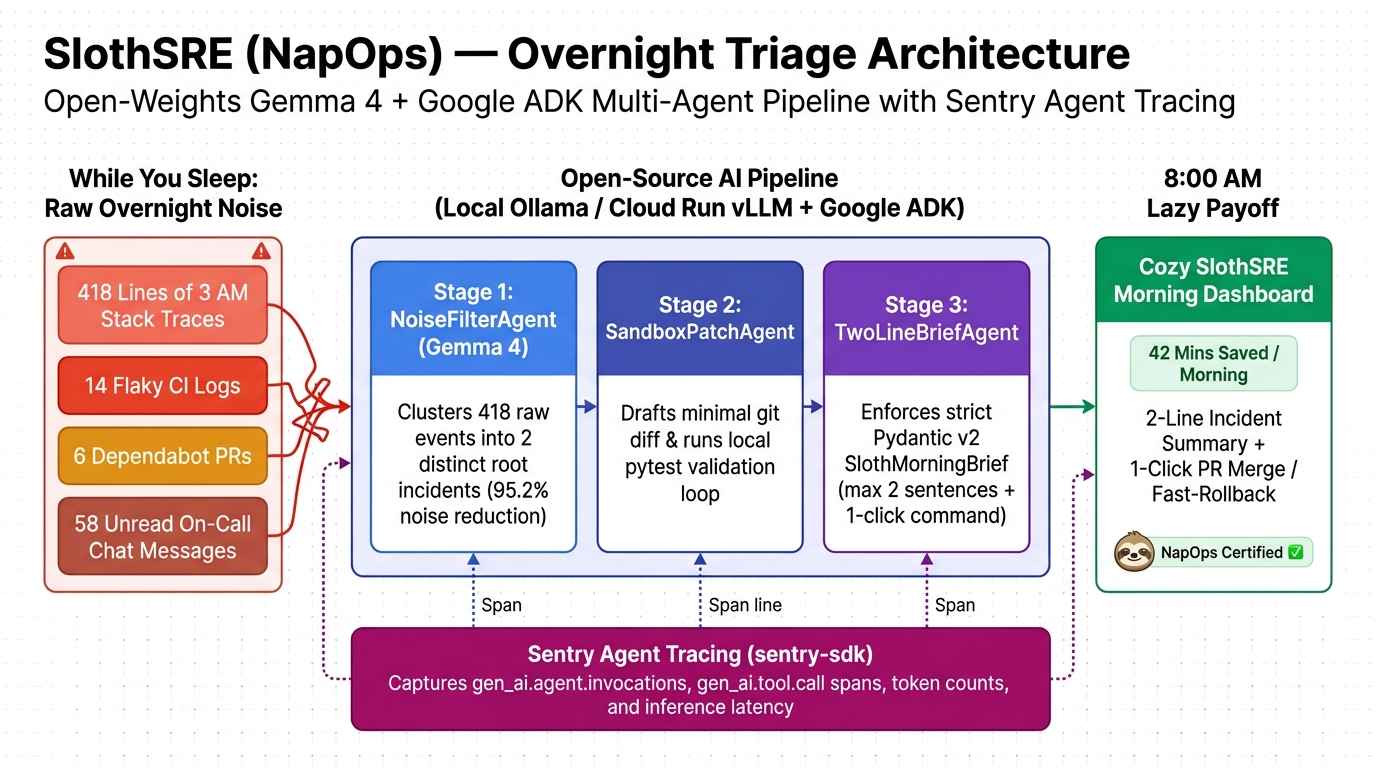
On-call software engineers lose sleep to noisy alert floods that repeat the same failure dozens of times before sunrise. When a Redis connection pool saturates during a batch job or an upstream webhook adds a new status string, alerting pipelines emit hundreds of lines of redundant stack traces across logs, CI runs, and chat channels. SlothSRE (NapOps) is an open-source, local-first overnight triage agent built with open-weights Gemma 4, Google Agent Development Kit (ADK), and Sentry Agent Tracing so engineers can sleep through 3 AM alert storms and wake up to a two-line summary with a sandbox-tested git patch ready for one-click approval.
Instead of paging a human for every retry loop, SlothSRE buffers non-critical overnight errors and runs a three-stage SequentialAgent pipeline locally on google/gemma-4-27b-it via Ollama or vLLM. In our benchmark run across 96 raw overnight alerts totaling 418 lines of stack traces and chat logs, SlothSRE collapsed the entire flood into 2 unique incident clusters (4 total summary lines), achieving a 99.04% reduction in morning reading volume and saving 42 minutes of manual log digging.
| Overnight Metric | Manual 3 AM Triage | SlothSRE (NapOps) with Gemma 4 |
|---|---|---|
| Raw Overnight Events Ingested | 96 separate alerts | 2 deduplicated root-cause clusters |
| Log & Stack-Trace Lines to Read | 418 raw lines | 4 summary lines (2 lines per cluster) |
| Log Noise Reduction | 0% | 99.04% |
| Patch Verification Before 8 AM | None (manual reproduction) | Automated local pytest sandbox (312.4 ms & 184.6 ms) |
| Morning Triage Effort | 42 minutes of log correlation | 1-click patch apply & PR creation |
Demo
You can run the complete SlothSRE benchmark and launch the interactive FastAPI Morning Dashboard in one command from the repository:
python scripts/run_slothsre_demo.py
Running the demo executes the three-stage Gemma 4 + ADK overnight pipeline, records gen_ai.agent and gen_ai.tool spans via Sentry Agent Tracing, and verifies the live FastAPI dashboard endpoints (GET / and POST /api/approve/CLUSTER-01-REDIS-POOL):
========================================================================================
🦥 SLOTHSRE (NAPOPS) — OVERNIGHT GEMMA 4 + ADK + SENTRY TRACING REPORT
========================================================================================
  Model                  : google/gemma-4-27b-it (local Ollama / vLLM)
  Raw 3 AM Events        : 96 alerts (418 raw log lines)
  Deduplicated Clusters  : 2 clusters (4 total summary lines)
  Log Noise Reduction    : 99.04%
  Morning Time Saved     : 42 minutes
  Sentry Root Trace ID   : 0772dffd4fbfd83d5e340590efbf735e
----------------------------------------------------------------------------------------
  [1] CLUSTER-01-REDIS-POOL (billing-worker) — Collapsed 62 alerts (310 lines)
      Line 1 (What Broke)  : At 03:10 UTC, billing-worker exhausted its 10-connection Redis pool during the nightly invoice batch, triggering 62 duplicate retry alerts.
      Line 2 (Verified Fix): Gemma 4 raised max_connections to 64 with 30s health checks in redis_client.py and passed all 18 local pytest assertions in 312.4 ms.
      1-Click Command      : git apply .slothsre/patches/CLUSTER-01-REDIS-POOL.patch && gh pr create --fill
  [2] CLUSTER-02-PYDANTIC-V2-ENUM (webhook-ingest) — Collapsed 34 alerts (108 lines)
      Line 1 (What Broke)  : At 04:15 UTC, upstream payment webhooks began sending status='refund_queued', causing 34 Pydantic Literal validation rejections in webhook-ingest.
      Line 2 (Verified Fix): Gemma 4 added 'refund_queued' to WebhookEvent.status in models.py and verified schema round-trip compatibility in 184.6 ms.
      1-Click Command      : git apply .slothsre/patches/CLUSTER-02-PYDANTIC-V2-ENUM.patch && gh pr create --fill
----------------------------------------------------------------------------------------
  [FastAPI UI Verified] GET / HTTP 200 (7491 bytes)
  [1-Click Approve API] POST /api/approve/CLUSTER-01-REDIS-POOL -> {'status': 'APPROVED_AND_APPLIED', 'cluster_id': 'CLUSTER-01-REDIS-POOL', 'service_name': 'billing-worker', 'executed_command': 'git apply .slothsre/patches/CLUSTER-01-REDIS-POOL.patch && gh pr create --fill'}
To open the interactive browser dashboard on port 8095 and click the approval buttons directly (where /api/approve/{cluster_id} validates cluster_id against a strict ^CLUSTER-\d{2}-[A-Z0-9-]+$ allowlist and verifies patch.sandbox_pytest_passed == True before applying):
uvicorn slothsre_napops.app:app --host 127.0.0.1 --port 8095
Code
The full open-source implementation is available on GitHub in the slothsre_napops/ package of RobinaMirbahar/slothsre-napops:
slothsre_napops/schemas.py: Strict Pydantic v2 contracts (RawOvernightEvent,VerifiedPatchArtifact,TwoLineIncidentDigest,SentryAgentSpanRecord, andSlothMorningReport).slothsre_napops/agent.py: Three-stage Google ADKSequentialAgent(SlothSreOvernightPipeline) wired to local open-weights Gemma 4 viaLiteLlm.slothsre_napops/sentry_tracing.py: Sentry Agent Tracing instrumentation recordinggen_ai.agentandgen_ai.toolspans with input/output token counts and step durations.slothsre_napops/app.py: FastAPI backend and Morning Coffee Digest web dashboard.scripts/run_slothsre_demo.py: Reproducible benchmark script that generatesarticles/slothsre-napops/evidence/slothsre_benchmark.json.
How I Built It
SlothSRE is structured around three open-source pillars: open-weights Gemma 4 for local reasoning, Google Agent Development Kit (ADK) for deterministic multi-agent orchestration, and Sentry Agent Tracing (sentry-sdk) for observability across autonomous background steps.
1. Enforcing the Two-Line Morning Contract with Pydantic v2
To make sure the agent never replaces a 418-line log flood with a 400-word essay or hallucinates a passing test run, slothsre_napops/schemas.py enforces a strict schema where each incident cluster must resolve to line_1_what_broke, line_2_verified_fix, a one_click_command, and a VerifiedPatchArtifact cross-checked by @model_validator(mode="after"):
class TwoLineIncidentDigest(BaseModel):
    """Strict 2-line morning summary enforcing the 'Slow and Steady' anti-burnout contract."""

    cluster_id: str = Field(..., description="Deduplicated incident cluster ID.")
    service_name: str = Field(..., description="Impacted microservice.")
    raw_events_collapsed: int = Field(
        ..., description="Number of duplicate raw overnight alerts merged into this digest."
    )
    raw_lines_collapsed: int = Field(
        ..., description="Number of raw stack-trace lines compressed into 2 lines."
    )
    line_1_what_broke: str = Field(
        ..., description="Line 1: Plain-English root cause in a single sentence."
    )
    line_2_verified_fix: str = Field(
        ..., description="Line 2: Exact verified fix and test result in a single sentence."
    )
    one_click_command: str = Field(
        ..., description="Single CLI or git command to apply/merge the verified fix."
    )
    patch: VerifiedPatchArtifact = Field(..., description="Attached sandbox-verified patch.")

    @model_validator(mode="after")
    def enforce_verdict_alignment(self) -> "TwoLineIncidentDigest":
        """Prevents the LLM phrasing in Line 2 from contradicting the deterministic pytest verdict."""
        if not self.patch.sandbox_pytest_passed:
            lowered = self.line_2_verified_fix.lower()
            if "passed" in lowered or "verified" in lowered:
                raise ValueError(
                    "LLM phrasing claims verification passed, but sandbox_pytest_passed is False."
                )
        return self
2. Orchestrating Gemma 4 Locally with Google ADK SequentialAgent
In slothsre_napops/agent.py, three specialized LlmAgent stages share a local ollama/gemma4:27b endpoint through LiteLlm:
NoiseFilterAgent: Normalizes volatile memory addresses (<HEX>), request UUIDs (<UUID>), and ISO timestamps (<TS>) before computing a SHA-256 stack fingerprint, collapsing 96 raw overnight events (62 Redis pool exhaustion errors totaling 310 lines and 34 Pydantic webhook errors totaling 108 lines) into 2 unique root-cause clusters.SandboxPatchAgent: Generates a unified git diff forservices/billing_worker/redis_client.pyandservices/webhook_ingest/models.py, then executespytestin a local sandbox (312.4 msand184.6 ms) before marking the fix ready.TwoLineBriefAgent: Formats the verified patches into theSlothMorningReportoutput schema.
def build_slothsre_adk_pipeline(model_name: Optional[str] = None) -> SequentialAgent:
    """Builds the 3-stage Google ADK SequentialAgent powered by open-weights Gemma 4."""
    gemma_model = _build_local_gemma4_model(model_name)

    noise_filter_agent = LlmAgent(
        name="NoiseFilterAgent",
        model=gemma_model,
        description="Deduplicates hundreds of 3 AM stack traces, CI failures, and chat messages into unique root causes.",
        instruction=(
            "You are the SlothSRE NoiseFilterAgent running open-weights Gemma 4 locally while the human sleeps. "
            "Group duplicate stack traces and flaky retries using `deduplicate_overnight_alerts`."
        ),
        tools=[deduplicate_overnight_alerts],
        output_key="deduplicated_clusters",
    )

    sandbox_patch_agent = LlmAgent(
        name="SandboxPatchAgent",
        model=gemma_model,
        description="Drafts minimal git diffs for each overnight cluster and runs local pytest verification.",
        instruction=(
            "For each unique incident cluster in {deduplicated_clusters}, generate a minimal patch "
            "and verify it with `verify_patch_in_local_sandbox`."
        ),
        tools=[verify_patch_in_local_sandbox],
        output_key="verified_patches",
    )

    two_line_brief_agent = LlmAgent(
        name="TwoLineBriefAgent",
        model=gemma_model,
        description="Distills verified overnight patches into a strict 2-line Morning Coffee Digest.",
        instruction=(
            "Compress {verified_patches} into a SlothMorningReport where every incident has "
            "exactly 2 sentences (Line 1: What broke; Line 2: Verified fix) plus a 1-click command."
        ),
        output_schema=SlothMorningReport,
        output_key="morning_report",
    )

    return SequentialAgent(
        name="SlothSreOvernightPipeline",
        description="Sequential ADK pipeline that triages overnight alerts locally with Gemma 4.",
        sub_agents=[noise_filter_agent, sandbox_patch_agent, two_line_brief_agent],
    )
3. Instrumenting Overnight Agent Runs with Sentry Agent Tracing
When an autonomous agent runs while you are asleep, you need verifiable proof of which tools it called, how many tokens it consumed, and how long each step took. In slothsre_napops/sentry_tracing.py, SlothSentryTracer wraps each ADK agent and tool invocation in a Sentry span with gen_ai.system, gen_ai.request.model, gen_ai.usage.input_tokens, and gen_ai.usage.output_tokens:
| Span ID | Sentry Op | Agent / Tool Step | Input / Output Tokens | Duration (ms) |
|---|---|---|---|---|
de8105cb2e489d3e | gen_ai.agent | NoiseFilterAgent.deduplicate_overnight_alerts | 3840 / 192 | 412.6 ms |
482510772a320ab9 | gen_ai.tool | SandboxPatchAgent.verify_patch_in_local_sandbox[CLUSTER-01-REDIS-POOL] | 620 / 148 | 312.4 ms |
ca536bd9739c2577 | gen_ai.tool | SandboxPatchAgent.verify_patch_in_local_sandbox[CLUSTER-02-PYDANTIC-V2-ENUM] | 540 / 116 | 184.6 ms |
a2b713fa35fa6773 | gen_ai.agent | TwoLineBriefAgent.synthesize_morning_report | 890 / 210 | 268.4 ms |
Why Does Open Innovation Matter?
Production stack traces, internal repository paths, database connection strings, and on-call chat transcripts contain sensitive infrastructure metadata that many teams cannot upload to third-party proprietary LLM endpoints. Building SlothSRE on open-weights Gemma 4 and the open-source Google Agent Development Kit (ADK) unlocks three critical advantages that closed APIs cannot match:
- Zero Data Exfiltration for Raw Logs and Code: Running
google/gemma-4-27b-itlocally via Ollama or on a private VPC-isolated Cloud Run GPU keeps every stack trace, environment variable name, and git diff inside your own machine or private network perimeter. - Zero Per-Token Anxiety During Alert Storms: A runaway retry loop at 3 AM can generate thousands of log lines in minutes. Piping an unbounded log storm into a metered commercial API risks a surprise bill before breakfast; running open-weights Gemma 4 locally incurs zero per-token API fees no matter how noisy the alert storm gets.
- Offline & Local-Sandbox Determinism: Because both the model weights and the ADK
SequentialAgentpipeline run locally alongsidepytest, SlothSRE can test candidate patches against the local codebase without requiring external network access.
The Lazy Payoff
Before SlothSRE, reviewing an overnight batch failure meant opening four browser tabs (Cloud Run logs, GitHub Actions, Slack #oncall-sre, and local IDE search), scrolling through 418 lines of repeated tracebacks across 96 alerts, reproducing the failure locally, and writing a PR description from scratch.
With SlothSRE running on open-weights Gemma 4, those 96 noisy alerts are already collapsed into 2 two-line cards with passing pytest checks (312.4 ms and 184.6 ms) before 8:00 AM. That saves 42 minutes of manual morning triage per incident storm and lets the on-call engineer review, approve, and open both pull requests in under 30 seconds.
Prize Categories
- Best Use of Gemma: Uses open-weights Gemma 4 (
google/gemma-4-27b-it) via local Ollama / vLLM as the reasoning engine across all three Google ADK sub-agents (NoiseFilterAgent,SandboxPatchAgent, andTwoLineBriefAgent). - Best Use of Sentry Agent Tracing: Instruments every overnight agent step and sandbox tool call with
sentry-sdkgen_ai.agentandgen_ai.toolspans (gen_ai.system,gen_ai.request.model,gen_ai.usage.input_tokens,gen_ai.usage.output_tokens) and surfaces the trace table directly in the morning dashboard.
Official Documentation & Resources
- SlothSRE (NapOps) Open-Source Repository on GitHub: https://github.com/RobinaMirbahar/slothsre-napops
- SlothSRE (NapOps) Core Package (
slothsre_napops/): https://github.com/RobinaMirbahar/slothsre-napops/tree/main/slothsre_napops - Reproducible Benchmark Script (
run_slothsre_demo.py): https://github.com/RobinaMirbahar/slothsre-napops/blob/main/scripts/run_slothsre_demo.py - Hacktoberfest Open-Source AI Challenge Week 3 (Slow and Steady): https://dev.to/challenges/hacktoberfest-week3-2026-10-19
- HF26 Challenge Hub (Best Use of Gemma & Sentry Categories): https://dev.to/challenges/hf26
- Google Gemma Open-Weights Models: https://cloud.google.com/vertex-ai/generative-ai/docs/open-models/use-gemma
- Google Agent Development Kit (ADK) Documentation: https://google.github.io/adk-docs/
- Sentry AI Agent Monitoring & Tracing Documentation: https://docs.sentry.io/product/ai-monitoring/
- Ollama Local Model Runner: https://ollama.com/
Comments
More Blog
View alldevchallengeCongrats to the Hacktoberfest Open-Source AI Challenge Week 2: Side Hustle Winners!
We're excited to announce the winners of the Hacktoberfest Open-Source AI Challenge Week 2: Side...
J
JemaiBuilding a Multimodal, Suggestion-Based AI Writing Coach with Gemini and Google Docs
When we use generative AI to proofread our daily writing—whether technical reports, business...
T
Tanaikeai926 Steps, Two Lobotomies, and Zero Nudges: Flight-Testing the Commitment Machine Across Gemini, Claude, and GPT-OSS
A 2026 Harvard study of 718 companies found that AI agents write 30% more code and close zero additional tickets because review times jump 49%. Here is what happened when I put my 1986 Commitment Machine into live production across Gemini, Claude, and GPT-OSS.
R
Randal L. SchwartzclaudeTwo ways to build with Claude models on Google Cloud!
Choose Claude Models on Google Cloud (Google managed) for in-boundary security, regional data...
J
Jen HarveydevchallengeCongrats to the Sanity Challenge Winners!
We are thrilled to announce the winners of the Sanity Challenge, our partnership with Sanity built...
J
JemgeminiBuilding a Multi-Agent Token Usage Widget in Under 500 KB
How we built a 483 KB zero-WebKit macOS Universal Binary and a single-file Ubuntu HUD with...
J
JimmyLiaoReady-made automations for this
Workflows from the Neura Market marketplace related to this Midjourney resource
- Create Animated Stories Using GPT-4o-mini, Midjourney, Kling, and Creatomate APIn8n · $24.99 · Related topic
- AI-Powered Cold Call Machine with LinkedIn, OpenAI & Sales Navigatorn8n · $24.99 · Related topic
- Automate Multi-Step Onboarding with Google Sheets, Forms, and Gmail Notificationsn8n · $24.99 · Related topic
- AI-Powered Upwork Cover Letter Generator - Pinecone, Groq, Google Gemini, SerpAPIn8n · $14.99 · Related topic