PreprintCommunications of the ACM
ImageNet classification with deep convolutional neural networks
Alex Krizhevsky, Ilya Sutskever et al.
130k2017
0
Citations
0
Influential Citations
—
Venue
2024
Year
A comprehensive system for developing Large Multimodal Models, comprising curated datasets, training recipes, model architectures, and pre-trained models that demonstrate strong in-context learning capabilities and competitive performance on various tasks.
Large multimodal models (LMMs) that can understand images, text, and their interleaved combinations are becoming central to AI applications. However, most state-of-the-art LMMs are closed-source or lack detailed documentation of their training data and recipes. BLIP-3 (xGen-MM) addresses this gap by releasing a complete open-source framework: curated datasets, model architectures, training procedures, and pre-trained weights. This transparency enables reproducibility and further innovation, especially for in-context learning across multiple images—a capability critical for real-world tasks like document analysis, visual reasoning, and interactive assistants.
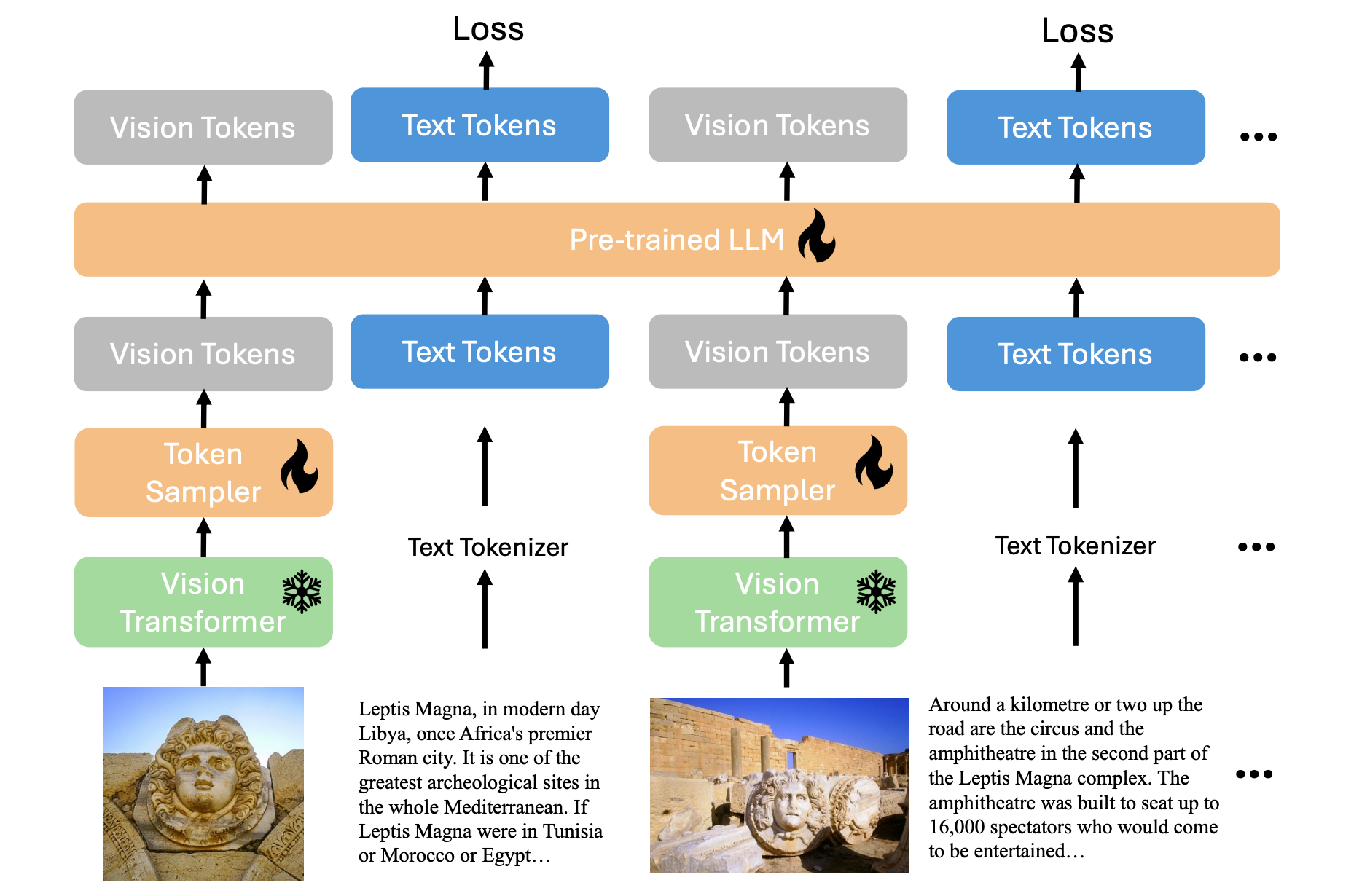
The xGen-MM framework builds on the Salesforce xGen initiative. Its architecture combines a Vision Transformer (ViT) with a perceiver resampler that compresses image embeddings into a fixed number of tokens, feeding them into a pre-trained LLM (phi3-mini). A key innovation is the dynamic high-resolution encoding strategy used during fine-tuning and post-training: instead of resizing images to a fixed low resolution, the model splits an image into patches, encodes each patch separately, and concatenates them with a downsampled global view. This preserves fine-grained details, crucial for OCR and document understanding.
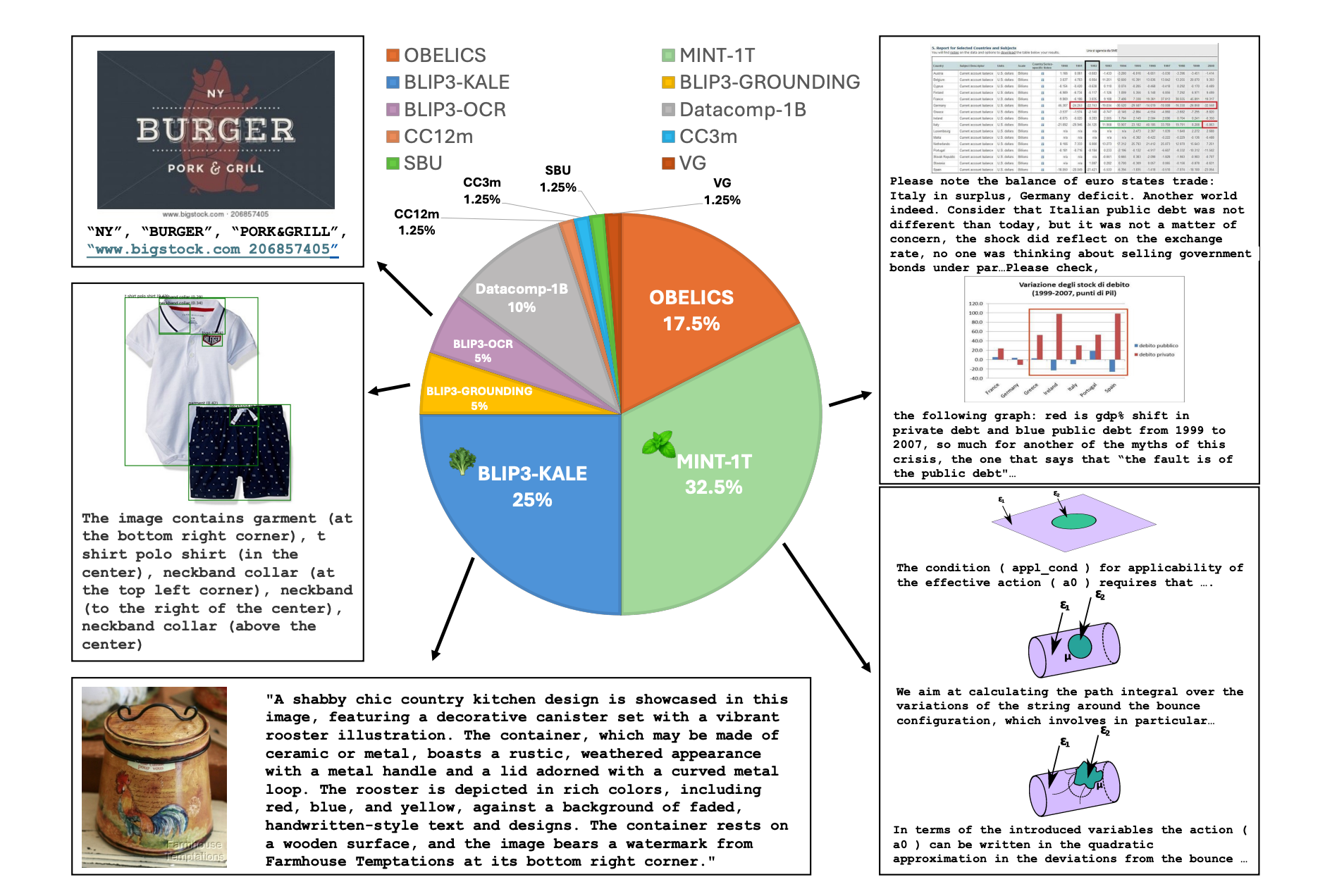
The training pipeline consists of four stages:
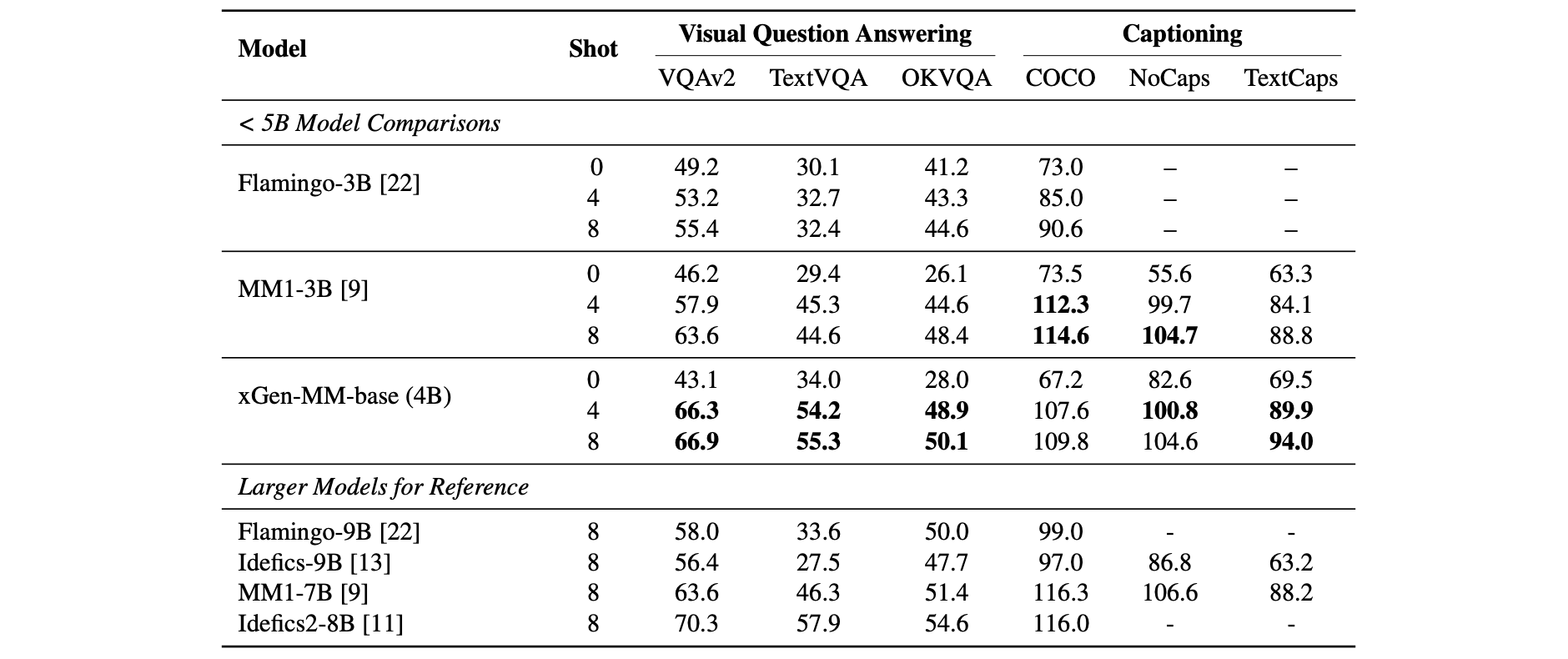
The pre-trained base model shows strong few-shot learning, outperforming comparably sized models like MM1-3B and Idefics-9B on OCR tasks (TextCaps, TextVQA) and VQA-v2. Performance improves with more shots, demonstrating effective in-context learning.
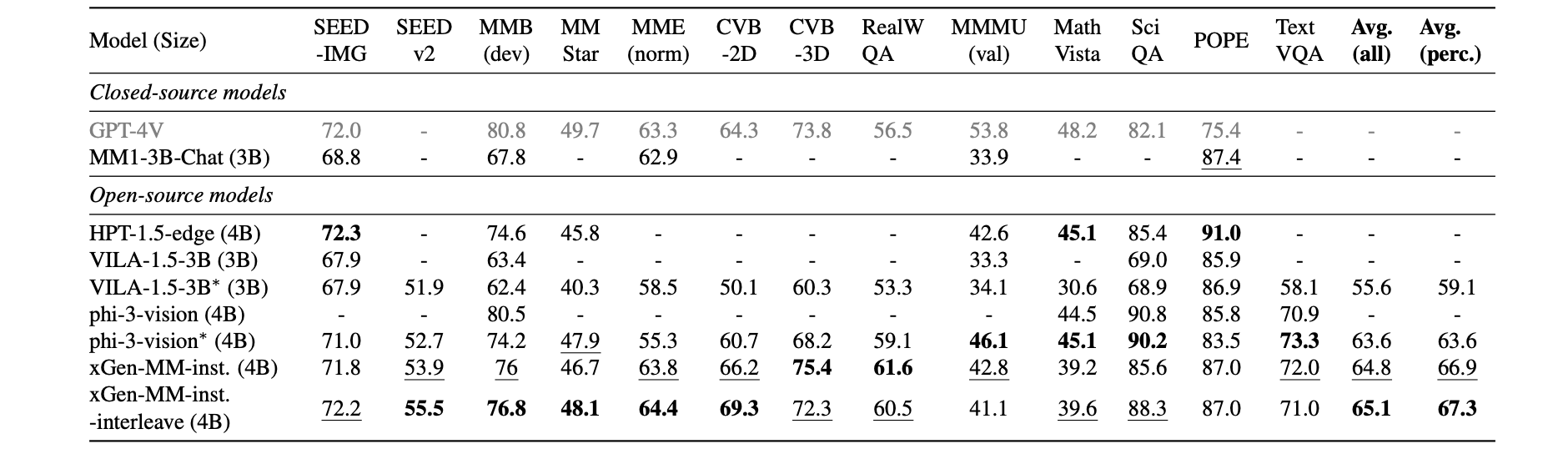
The SFT model (xGen-MM-instruct) surpasses prior baselines on general VQA and visual perception benchmarks. The interleave version achieves the highest overall scores across all single-image benchmarks.

On multi-image benchmarks, the single-image SFT model performs poorly, while the interleave fine-tuned model shows dramatic improvement, confirming the necessity of multi-image training for such tasks.

DPO reduces hallucination rates (HallusionBench, POPE) and safety fine-tuning lowers the attack success rate on VLGuard, both with slight gains in helpfulness.
BLIP-3 provides a complete, open-source recipe for building competitive multimodal models. Its modular design—separating pre-training, instruction tuning, multi-image tuning, and post-training—allows practitioners to adapt each stage to their needs. The release of curated datasets (BLIP3-KALE, BLIP3-OCR-200M, BLIP3-GROUNDING-50M) addresses data scarcity in OCR and grounding tasks. The two-stage post-training offers a practical template for improving truthfulness and safety without sacrificing performance. This work democratizes access to state-of-the-art LMM technology and sets a new standard for reproducibility in the field.
Alex Krizhevsky, Ilya Sutskever et al.
Ashish Vaswani, Noam Shazeer et al.
Douglas M. Bates, Martin Mächler et al.
Diederik P. Kingma, Jimmy Ba