PreprintCommunications of the ACM
ImageNet classification with deep convolutional neural networks
Alex Krizhevsky, Ilya Sutskever et al.
130k2017
0
Citations
0
Influential Citations
—
Venue
2023
Year
Proposes an approach to make the training of LLMs for program synthesis more efficient by unifying key components of model architectures, learning methods, infill sampling, and data distributions
CodeGen2 tackles a core challenge in training large language models (LLMs) for program synthesis: how to efficiently combine the strengths of different architectures, learning objectives, and data sources. As AI practitioners increasingly deploy models that must both generate and understand code, the paper’s systematic evaluation of design choices offers actionable insights. It challenges assumptions like the "free lunch" of infill sampling and the necessity of separate encoder-decoder architectures, providing a clearer path toward unified models.
The paper evaluates four hypotheses through controlled experiments:
Model Architecture: It compares causal decoders (uni-directional attention) with PrefixLM (bi-directional attention on a prefix, uni-directional on the rest). The goal is to unify encoder and decoder capabilities.
Learning Algorithm: A mixture of causal language modeling (CLM) and span corruption is used. Span corruption masks random spans of tokens, and the model must reconstruct them, combining next-token prediction with denoising.
Sampling Procedure: The authors test whether training with infill objectives (e.g., PSM: prefix, suffix, middle) degrades left-to-right generation. They hypothesize a "free lunch" where infill adds no cost.
Data Distributions: Models are trained on a 50/50 mix of natural language (The Pile) and code (The Stack) to see if multi-domain training harms single-domain performance.
Key technical details:

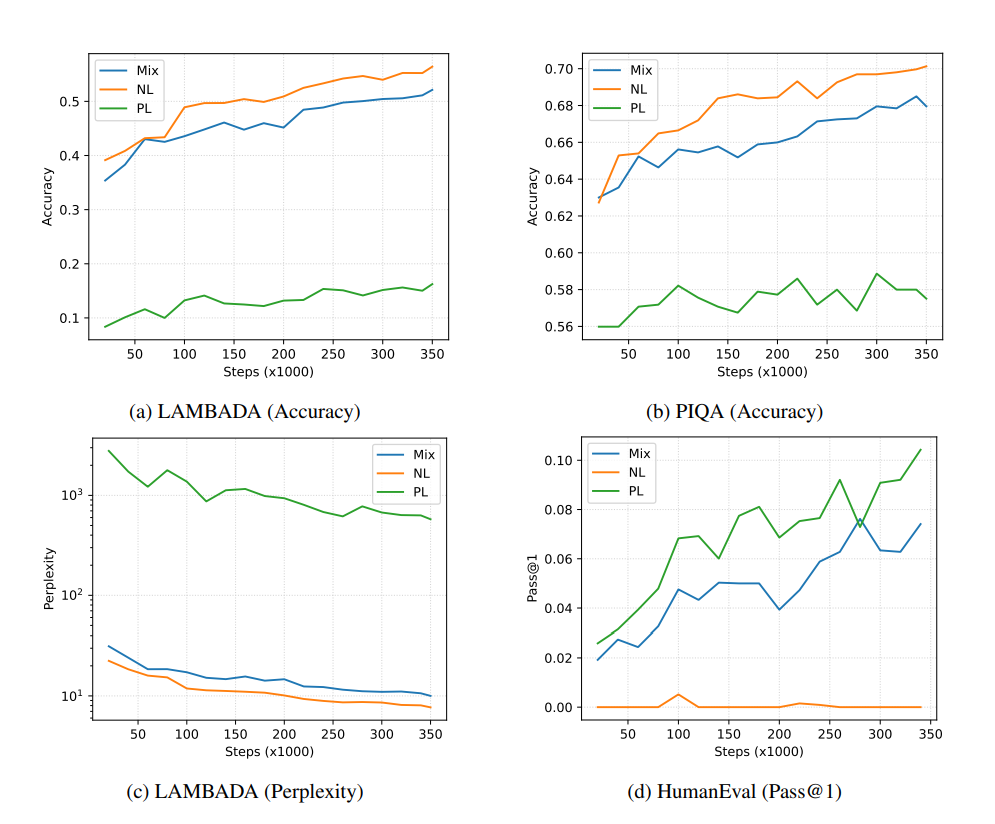
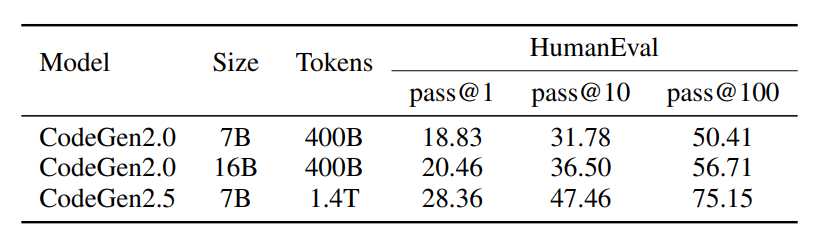
CodeGen2 provides practical lessons for training LLMs on code and natural language. The key takeaway is that simple, carefully chosen objectives (CLM + span corruption) can be effective, while architectural innovations like PrefixLM may not justify their complexity. The paper also highlights trade-offs: infill sampling degrades left-to-right generation, and multi-domain training requires careful resource allocation. For practitioners, this means focusing on objective design and data mixing strategies rather than chasing architectural novelties. The multi-epoch training results suggest that repeated exposure to data, combined with span corruption as augmentation, can yield substantial gains, though the exact mechanism needs further study.
Alex Krizhevsky, Ilya Sutskever et al.
Ashish Vaswani, Noam Shazeer et al.
Douglas M. Bates, Martin Mächler et al.
Diederik P. Kingma, Jimmy Ba