PreprintCommunications of the ACM
ImageNet classification with deep convolutional neural networks
Alex Krizhevsky, Ilya Sutskever et al.
130k2017
0
Citations
0
Influential Citations
—
Venue
2025
Year
A 111 billion parameter open-weights research release model optimized for business-critical agentic and multilingual tasks. It features a 256K context length, is trained on 23 languages, and is specifically designed for RAG and tool use,offering verifiable citations for both.
The release of Command A marks a significant step in making large language models more practical for real-world business applications. With 111 billion parameters and a 256K context window, it is designed to handle complex, multi-step tasks that require reasoning, retrieval, and tool use. Its support for 23 languages and focus on verifiable citations address key enterprise needs for accuracy and multilingual communication. The open-weights nature of the model also allows practitioners to inspect, fine-tune, and deploy it in custom environments, fostering innovation in agentic AI.
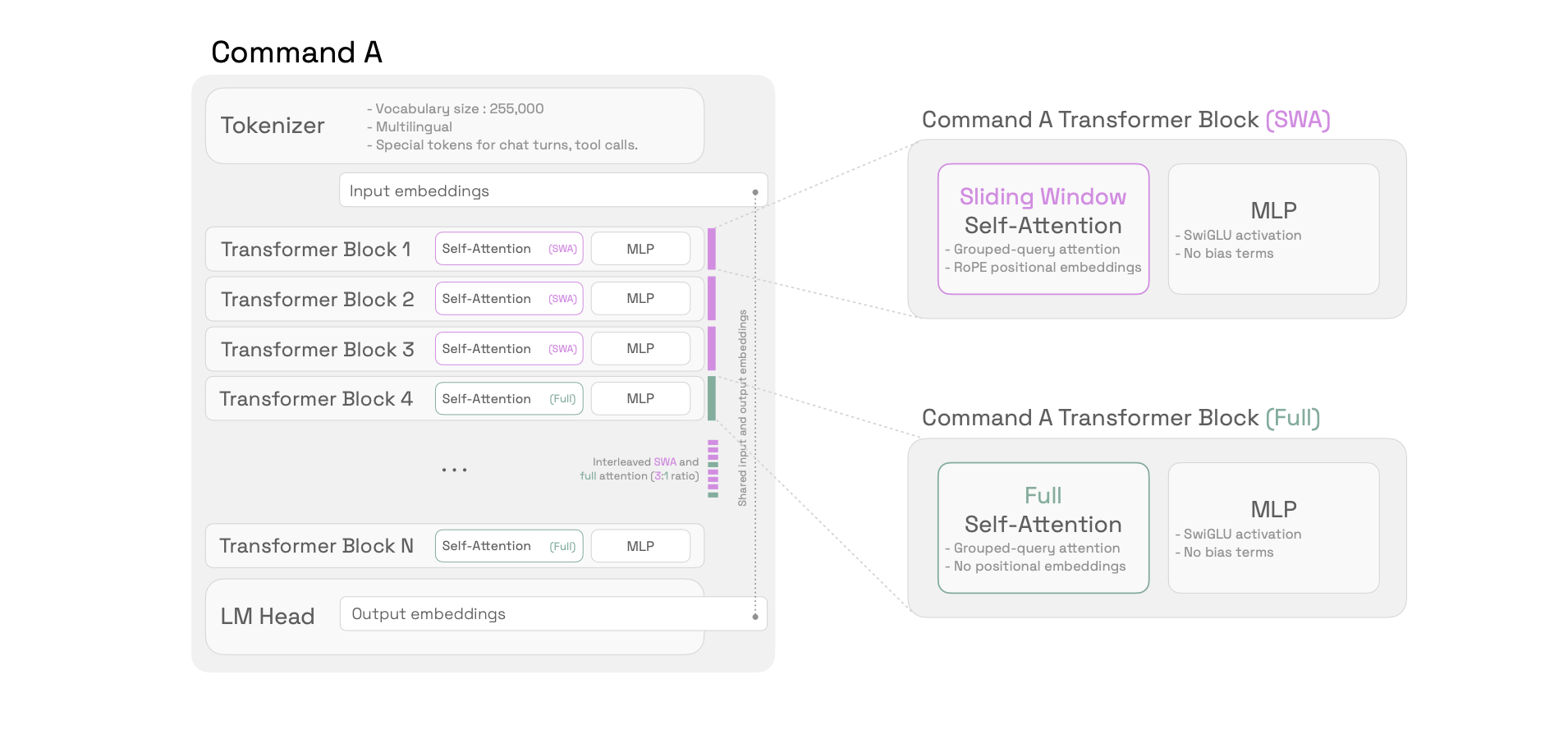
Command A is built on a decoder-only Transformer architecture with several key design choices. It uses SwiGLU activation for better performance, interleaved attention layers (three sliding window layers for every full attention layer) with RoPE for sliding window and NoPE for full attention, and grouped-query attention (GQA) to improve serving throughput. The parallel transformer block and removal of bias terms enhance training stability and throughput. Input and output embeddings are shared to reduce memory footprint given the large vocabulary.
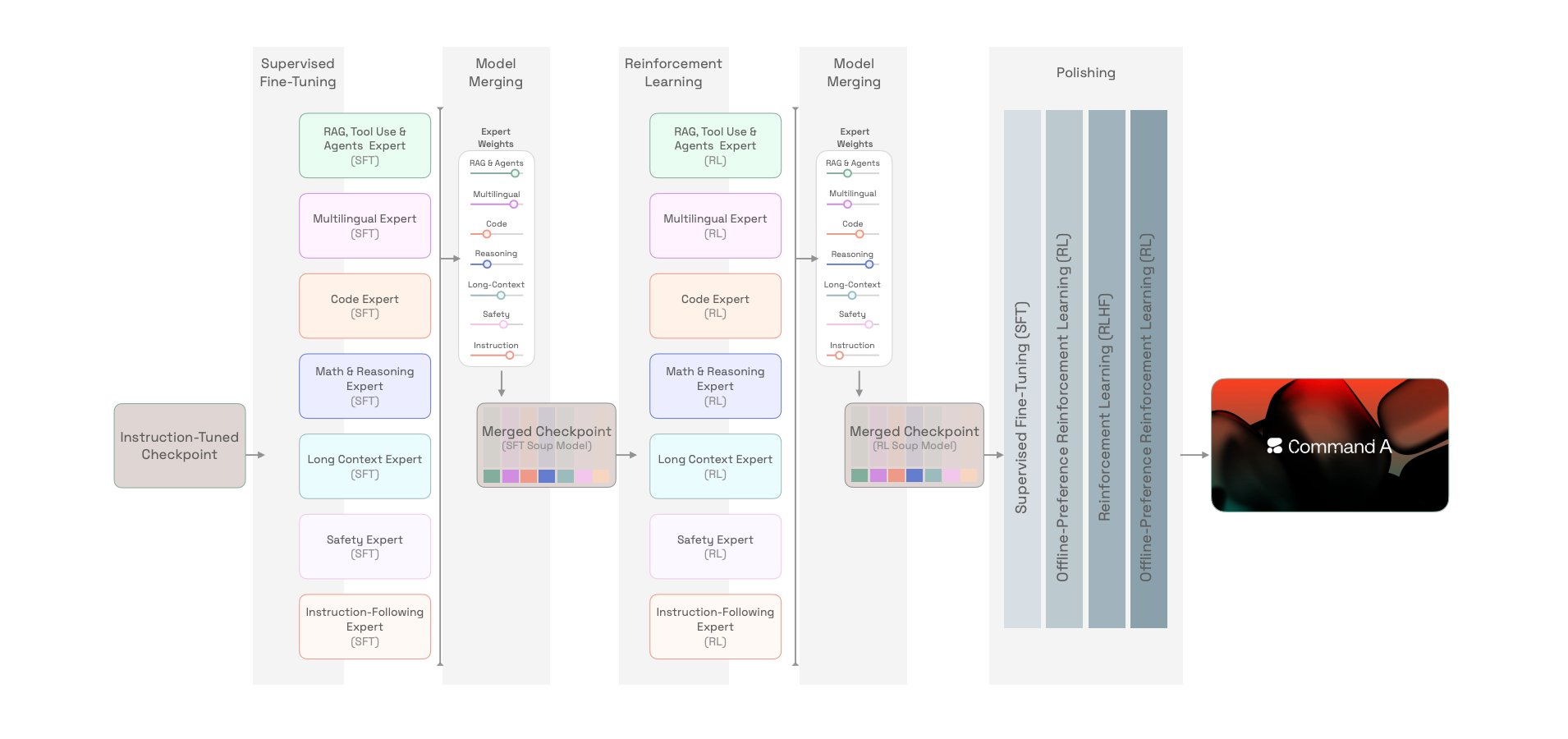
Pretraining uses a carefully curated multilingual dataset from web text, synthetic data, human annotations, and vendor sources. The data mixture is optimized by upsampling educational content and downsampling low-quality samples using ML-based filters. Post-training is where the innovation lies: it alternates between centralized stages (fine-tuning a single model) and decentralized stages (training multiple expert models separately). Six experts are trained for Code, Safety, RAG, Math, Multilingual, and General Long-Context. These are merged via parameter soups at both SFT and RL stages. The final polishing phase uses best-of-N supervised training followed by a ping-pong approach alternating offline preference and online RL optimization until performance plateaus.
A novel RL method called SRPO (Self-Improving Robust Preference Optimization) is introduced. SRPO uses a min-max objective where the model learns a generative policy that is hard for a self-refinement policy to improve upon, reducing reliance on the preference dataset distribution. The objective includes KL regularization to keep policies close to a reference. For reward optimization, Contrastive Policy Gradient (CoPG) is used, which compares rewards of multiple completions for the same prompt, making it robust and applicable in both offline and online settings.


Command A excels in instruction-following, RAG, tool use, multilingual tasks, and code generation. For instruction-following, synthetic prompts with two completions are rated by humans, and preference pairs are used to train both the model and reward model iteratively. SRPO outperforms other preference tuning methods like SLiC, IPO, and DPO across evaluation tasks. For RAG and tool use, the model follows the ReAct framework, interleaving reasoning and action with tool calls and verifiable citations. It is trained on human-annotated and synthetic data in multiple languages, covering code execution, document uploads, and general API environments. Multilingual capabilities are enhanced through best-of-N selection from expert models and iterative training. Code capabilities focus on 8 priority languages and 5 SQL dialects, with execution feedback and unit test validation used during RL to optimize correctness and style.
Command A represents a practical advancement in making LLMs more useful for enterprise settings. Its combination of long context, multilingual support, and agentic capabilities with verifiable citations addresses key barriers to adoption. The open-weights release allows the community to build upon this work, potentially accelerating progress in RAG and tool use. However, the paper lacks detailed benchmark comparisons against other large models, and the computational cost of training such a large model is not discussed. Future work could explore scaling the expert model approach further or applying SRPO to other domains. Overall, Command A is a valuable contribution to the field of applied AI, particularly for businesses seeking reliable, multilingual, and agentic AI systems.
Alex Krizhevsky, Ilya Sutskever et al.
Ashish Vaswani, Noam Shazeer et al.
Douglas M. Bates, Martin Mächler et al.
Diederik P. Kingma, Jimmy Ba