PreprintCommunications of the ACM
ImageNet classification with deep convolutional neural networks
Alex Krizhevsky, Ilya Sutskever et al.
130k2017
0
Citations
0
Influential Citations
—
Venue
2023
Year
A stable, performant, and computationally lightweight algorithm that fine-tunes llms to align with human preferences without the need for reinforcement learning, by directly optimizing for the policy best satisfying the preferences with a simple classification objective.
Aligning large language models with human preferences is critical for safety and usefulness, but the dominant approach—Reinforcement Learning from Human Feedback (RLHF)—is notoriously complex. It requires training a separate reward model, then using reinforcement learning (often PPO) to optimize the policy, which introduces instability, hyperparameter sensitivity, and high computational costs. Direct Preference Optimization (DPO) cuts through this complexity by showing that the language model itself can serve as a reward model, enabling direct policy optimization with a simple classification loss. This makes alignment faster, more stable, and more accessible to practitioners without deep RL expertise.
The standard RLHF pipeline has three stages: supervised fine-tuning (SFT) on high-quality data, training a reward model on human preference comparisons, and then using RL (e.g., PPO) to optimize the policy against that reward model while staying close to the SFT reference policy. The reward model is typically learned via the Bradley-Terry model, which defines the probability of preferring one completion over another.
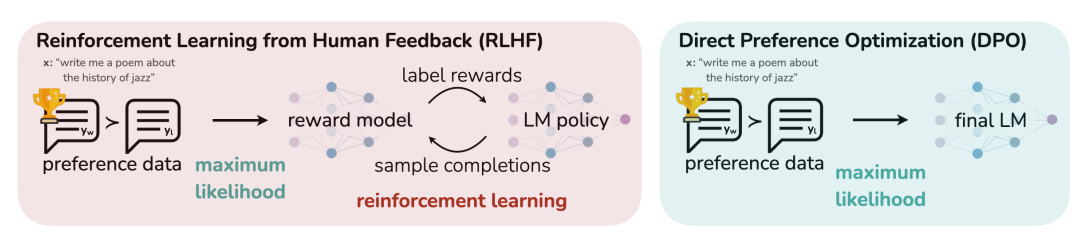
DPO's key insight is to reparameterize the reward function in terms of the policy itself. Starting from the standard RL objective that maximizes reward while constraining KL divergence from a reference policy, the authors derive a closed-form expression for the optimal policy. By taking the logarithm and rearranging, they express the reward as a function of the policy ratio:

This reparameterization allows them to plug the reward directly into the Bradley-Terry preference model, yielding an objective that depends only on the policy and reference policy—no separate reward model needed. The resulting loss function is a simple binary cross-entropy loss that increases the log-probability of preferred completions and decreases that of dispreferred ones, weighted by how much the implicit reward model favors the dispreferred completion.
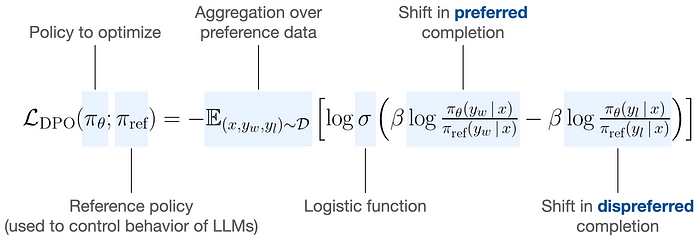
The gradient update naturally pushes the policy to prefer human-preferred outputs while staying close to the reference policy, avoiding the instability of RL-based optimization.
The paper demonstrates DPO's effectiveness on tasks including sentiment generation, summarization, and dialogue. On sentiment control, DPO matches or exceeds PPO-based RLHF in steering model outputs toward positive sentiment while maintaining fluency. For summarization on the Reddit TL;DR dataset, DPO achieves comparable or better summary quality as measured by human evaluation and automatic metrics, with significantly less computational overhead. The method is also more stable—it does not require careful tuning of RL hyperparameters like learning rates or clipping thresholds, and it converges reliably across different seeds.
DPO represents a paradigm shift in preference-based alignment. By eliminating the need for a separate reward model and RL training loop, it reduces the barrier to entry for fine-tuning LLMs with human feedback. Practitioners can now align models using only a dataset of preferences and a standard supervised learning framework. This simplicity also makes DPO more amenable to theoretical analysis and easier to debug. However, the method inherits the limitations of the Bradley-Terry model, which assumes transitive preferences and may not capture more nuanced human judgments. Future work may extend DPO to more flexible preference models or incorporate online data collection. Overall, DPO is a practical and elegant solution that has already influenced subsequent alignment research and deployment.
Alex Krizhevsky, Ilya Sutskever et al.
Ashish Vaswani, Noam Shazeer et al.
Douglas M. Bates, Martin Mächler et al.
Diederik P. Kingma, Jimmy Ba