PreprintCommunications of the ACM
ImageNet classification with deep convolutional neural networks
Alex Krizhevsky, Ilya Sutskever et al.
130k2017
0
Citations
0
Influential Citations
—
Venue
2024
Year
Combines Supervised Fine-Tuning (SFT) with Reinforcement Learning from Human Feedback (RLHF) to enhance pedagogical instruction in conversational AI, co-trained with Gemini's SFT, Reward Model (RM), and RL stages.
Large language models (LLMs) like Gemini, GPT-4, and Claude have shown remarkable general abilities, but their effectiveness in specialized domains like education remains uneven. The LearnLM paper tackles a critical gap: how to make a general-purpose conversational AI behave like a skilled tutor without losing its broad knowledge and reasoning. This matters because education is one of the most promising applications of AI, yet most models lack the nuanced pedagogical behaviors—like guiding without giving answers, fostering curiosity, and adapting to learner needs—that human tutors excel at. By demonstrating a practical co-training method that integrates pedagogical instruction into Gemini's existing post-training pipeline, the paper offers a blueprint for domain-specific fine-tuning that preserves core capabilities.
The core innovation is co-training: instead of running pedagogical post-training separately after Gemini's standard pipeline, LearnLM mixes pedagogical data directly into Gemini's Supervised Fine-Tuning (SFT), Reward Model (RM), and Reinforcement Learning (RL) stages. This avoids catastrophic forgetting of other skills like reasoning, multimodal understanding, and safety.
First, the SFT data is updated so that each conversation begins with a different System Instruction that explicitly describes the desired pedagogical behavior (e.g., "act as a Socratic tutor who asks guiding questions"). Vague instructions are avoided because the model learns to ignore them when they don't help predict target responses.
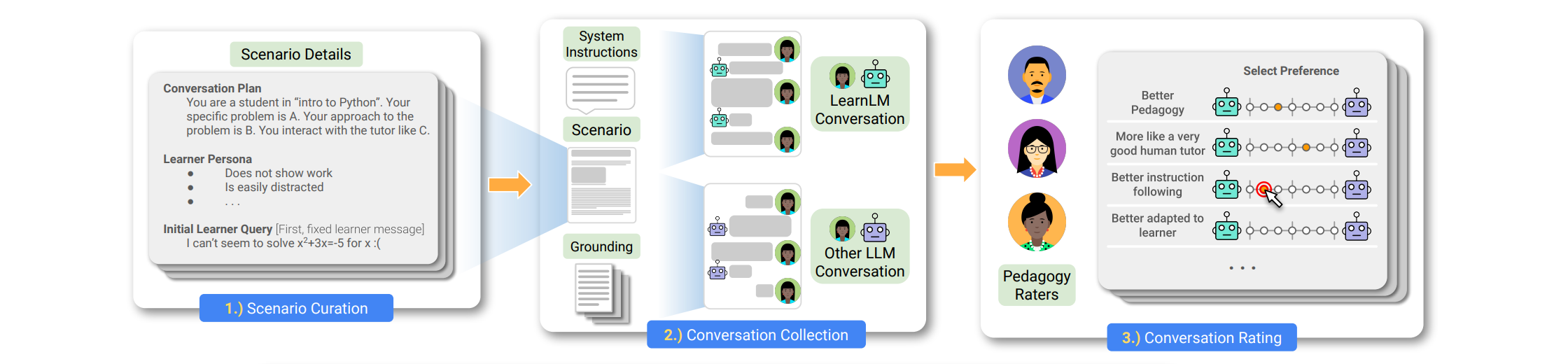
For RLHF, human raters label model samples based on how well they follow the pedagogical system instructions in long conversations. These turn-level labels train a reward model that scores policy model samples during RL. The paper finds that while SFT improves instruction following somewhat, RL is significantly more effective because preference judgments capture subtle distinctions in how instructions are interpreted over extended dialogues.
LearnLM was evaluated against GPT-4o, Claude 3.5 Sonnet, and Gemini 1.5 Pro in tutoring scenarios using 2360 conversations (58,459 messages). Expert evaluations involved two stages: role-playing as learners and providing feedback, then comparing pairs of conversations across pedagogical categories.
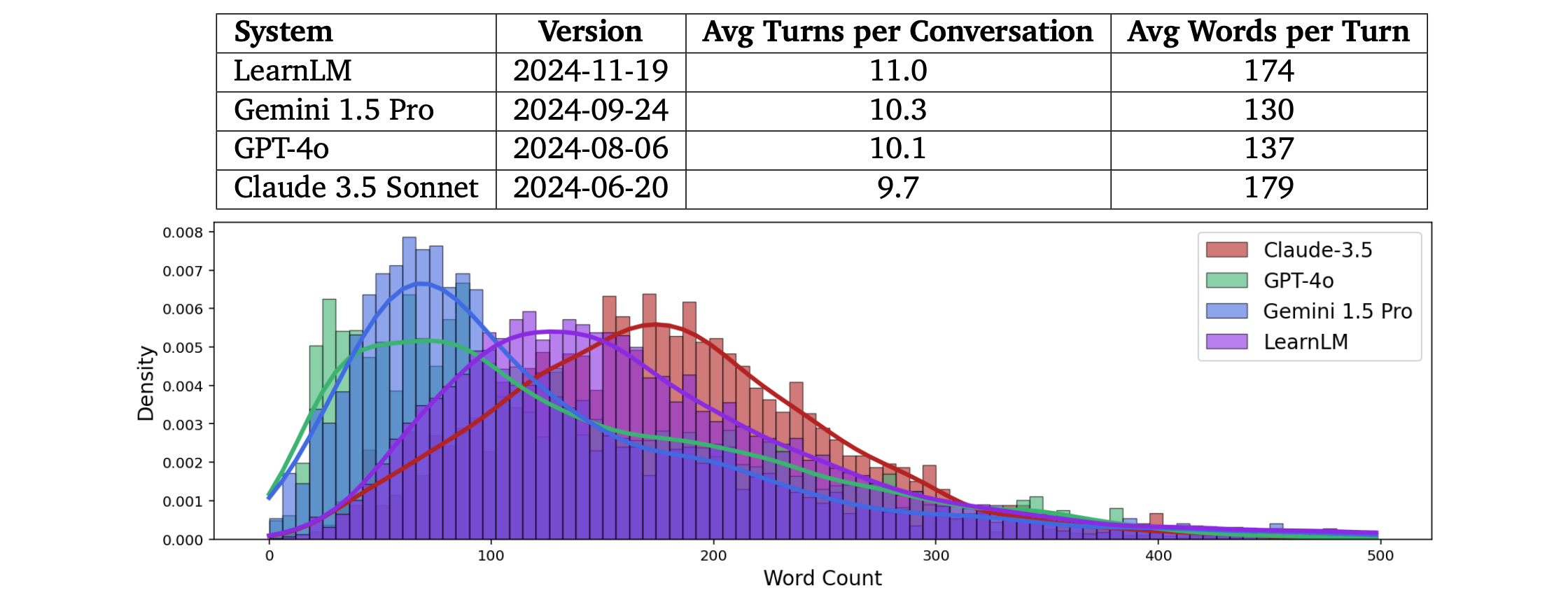
Key findings include:
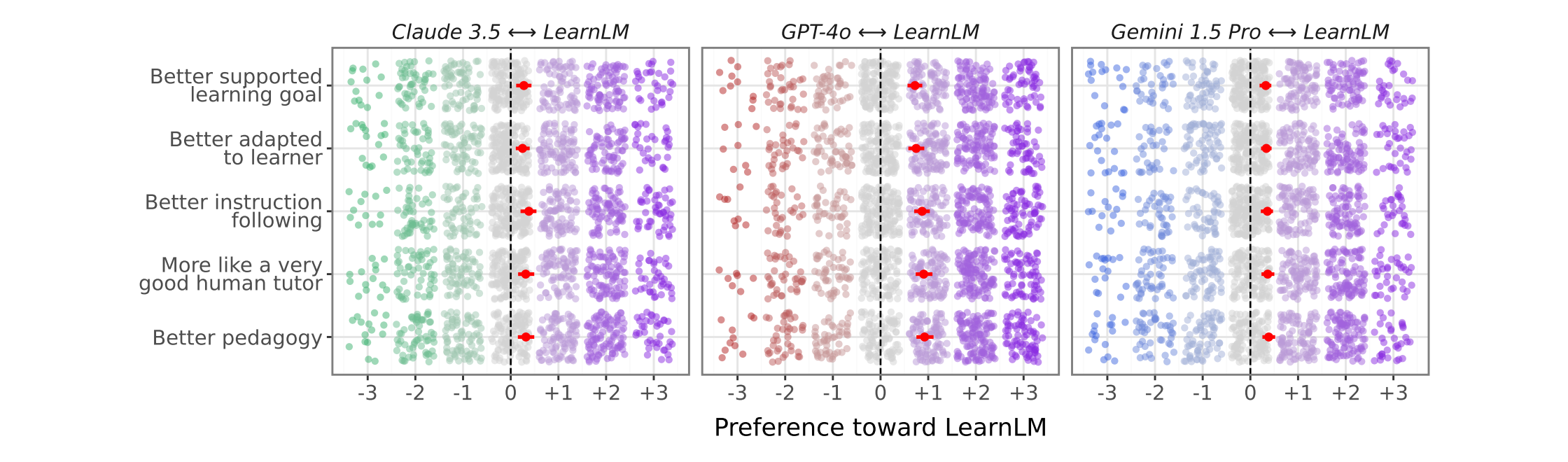
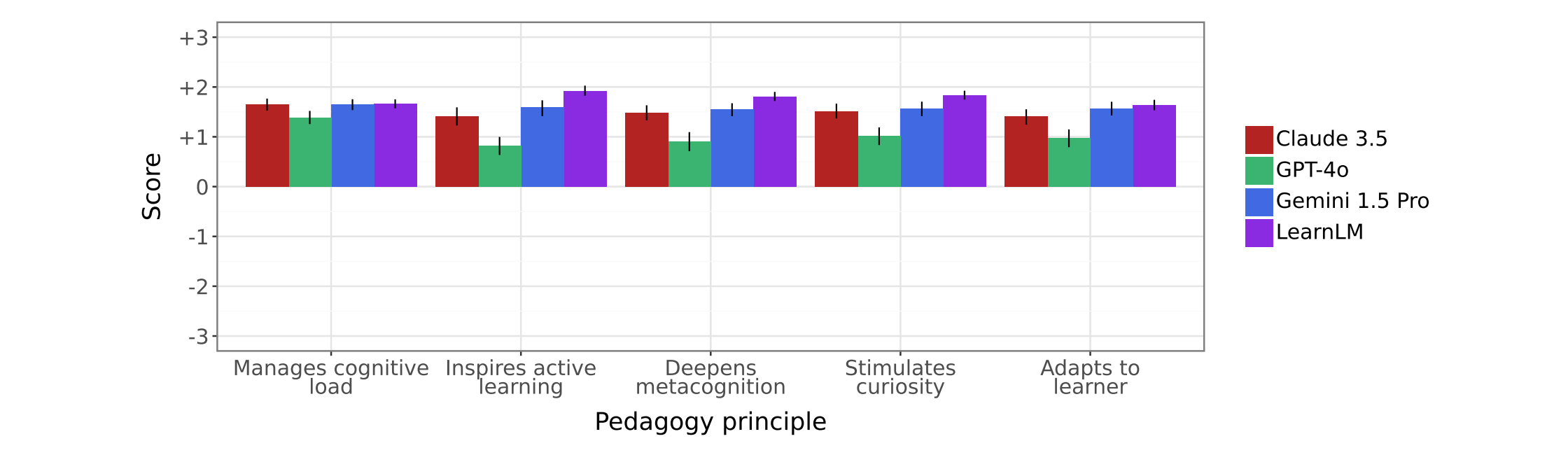
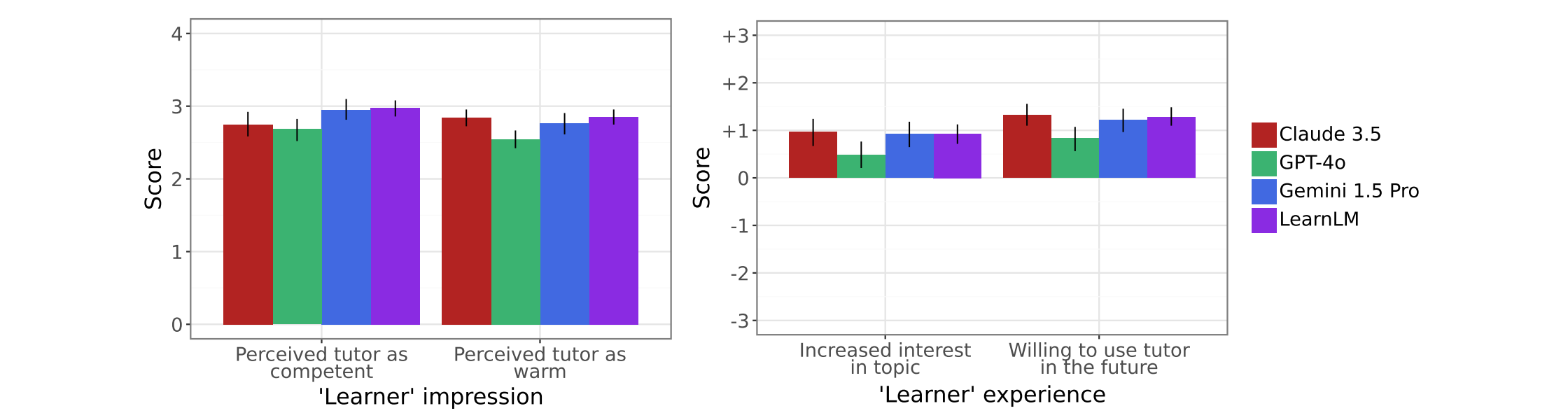
The LearnLM paper is significant for several reasons. First, it provides a practical method for injecting domain-specific instruction following into a general-purpose LLM without sacrificing breadth—a common challenge in fine-tuning. Second, it empirically demonstrates that RLHF is crucial for nuanced pedagogical behaviors, as SFT alone fails to capture the subtlety of long-context instruction following. Third, the evaluation framework—using expert role-playing and comparative ratings—sets a high standard for assessing educational AI systems. The co-training approach also ensures that LearnLM can stay in sync with Gemini's evolving training recipe, making it a sustainable path for continuous improvement. This work opens the door for similar domain-specific enhancements in other areas like healthcare, legal advice, or customer support, where specialized instruction following is key.
Alex Krizhevsky, Ilya Sutskever et al.
Ashish Vaswani, Noam Shazeer et al.
Douglas M. Bates, Martin Mächler et al.
Diederik P. Kingma, Jimmy Ba