Preprint
Machine Learning

LLaMA

February 1, 2023

0

Citations

0

Influential Citations

Venue

2023

Year

Abstract

A collection of foundation LLMs by Meta ranging from 7B to 65B parameters, trained using publicly available datasets exclusively.

Analysis

Why This Paper Matters

The LLaMA paper from Meta marks a pivotal shift in the landscape of large language models (LLMs). At a time when the trend was toward ever-larger models trained on proprietary or undisclosed datasets, LLaMA showed that a family of models ranging from 7 billion to 65 billion parameters, trained exclusively on publicly available data, could match or even surpass the performance of much larger models like GPT-3 (175B) and PaLM (540B). This democratizes access to state-of-the-art LLM research, as the training data is open and the models themselves are released for non-commercial use. The key insight is that training on more data, rather than simply scaling parameters, is a more efficient path to high performance.

How It Works

LLaMA's success hinges on a meticulously curated training dataset and a streamlined transformer architecture. The training data, totaling about 1.4 trillion tokens, is sourced from seven public domains:
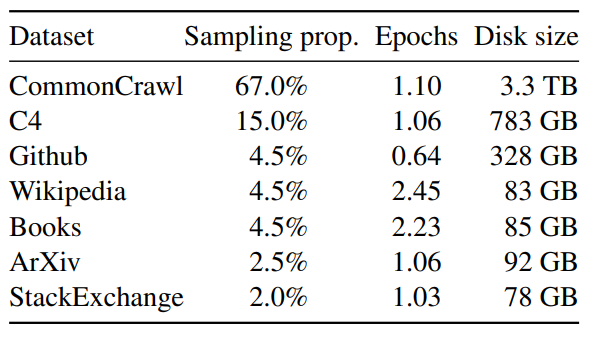
  • English CommonCrawl (67%): Five dumps from 2017-2020 are processed with the CCNet pipeline, which includes line-level deduplication, language identification via a fastText classifier, and quality filtering using an n-gram language model. A linear model further filters pages based on Wikipedia reference likelihood.
  • C4 (15%): The Colossal Clean Crawled Corpus adds diversity, with heuristic-based quality filtering (e.g., punctuation, word/sentence counts).
  • GitHub (4.5%): Public repositories under permissive licenses (Apache, BSD, MIT) are filtered by line length and alphanumeric proportion, with boilerplate removed via regex, then deduplicated at the file level.
  • Wikipedia (4.5%): Dumps from June-August 2022 covering 20 Latin/Cyrillic script languages are cleaned of hyperlinks, comments, and formatting.
  • Gutenberg and Books3 (4.5%): Public domain books and the Books3 subset of ThePile are deduplicated at the book level (removing >90% overlap).
  • ArXiv (2.5%): LaTeX files are processed to remove pre-first-section content, bibliography, comments, and inline-expand user macros.
  • Stack Exchange (2%): The 28 largest sites' Q&A data is kept, HTML stripped, answers sorted by score.

Pre-training data. Data mixtures used for pretraining.

Tokenization uses byte-pair encoding (BPE), splitting all numbers into individual digits and falling back to bytes for unknown UTF-8 characters. Most tokens are used once, except Wikipedia and books (about two epochs).

The architecture is a transformer with three key improvements:
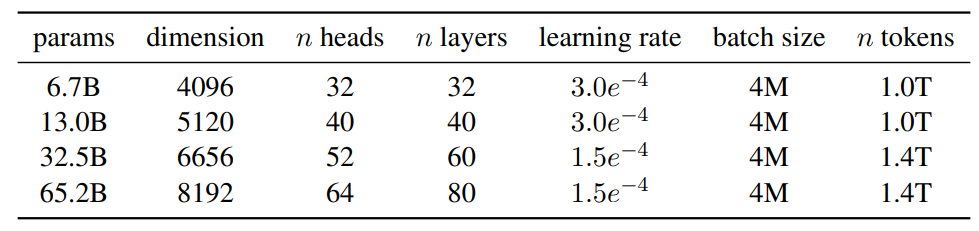
  • Pre-normalization (from GPT-3): RMSNorm is applied to the input of each sub-layer, improving training stability.
  • SwiGLU activation (from PaLM): Replaces ReLU, with a dimension of 2/3 * 4d (instead of 4d in PaLM).
  • Rotary Positional Embeddings (RoPE, from GPTNeo): Used at every layer instead of absolute positional embeddings.

Model sizes, architectures, and optimization hyper-parameters.

Results

LLaMA is evaluated on 20 benchmarks across zero-shot and few-shot settings. Key findings:
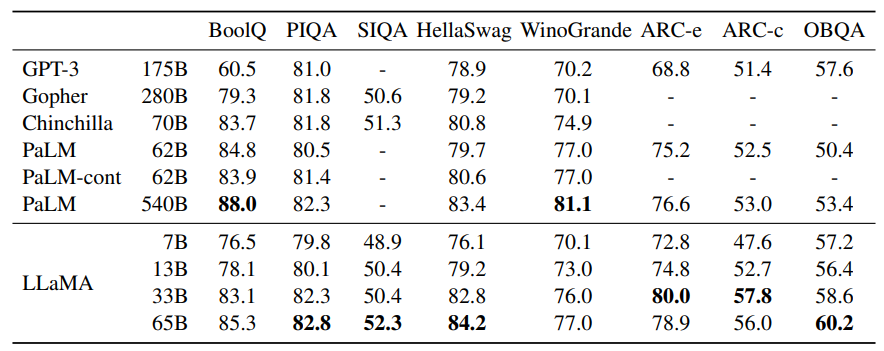
  • Common Sense Reasoning: LLaMA-65B outperforms Chinchilla-70B on all benchmarks except BoolQ, and surpasses PaLM-540B everywhere except BoolQ and WinoGrande. LLaMA-13B beats GPT-3 on most benchmarks despite being much smaller.

Zero-shot performance on Common Sense Reasoning tasks.

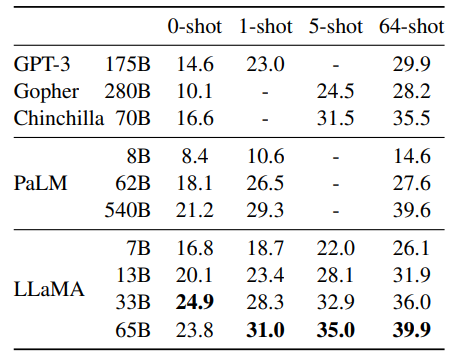
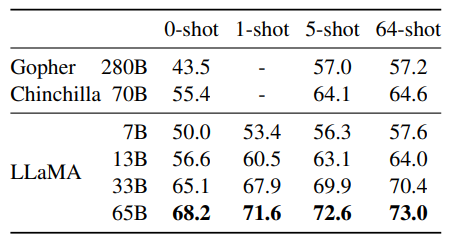
  • Closed-book QA: LLaMA-65B achieves state-of-the-art zero-shot and few-shot exact match on NaturalQuestions and TriviaQA. LLaMA-13B is competitive with GPT-3 and Chinchilla despite being 5-10x smaller.

NaturalQuestions. Exact match performance

TriviaQA. Zero-shot and few-shot exact match performance on the filtered dev set.

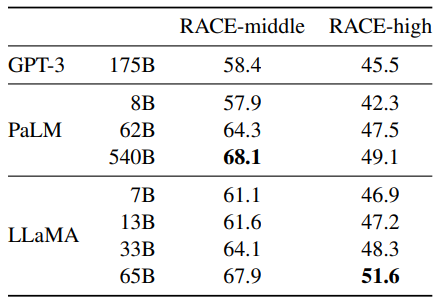
  • Reading Comprehension: LLaMA-65B is competitive with PaLM-540B; LLaMA-13B outperforms GPT-3 by a few percentage points.

Reading Comprehension. Zero-shot accuracy.

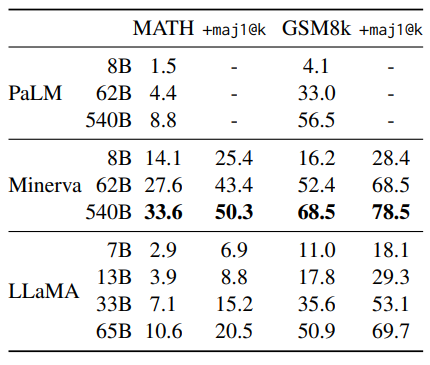
  • Mathematical Reasoning: LLaMA-65B outperforms Minerva-62B on GSM8k without any fine-tuning on mathematical data, using majority voting (maj1@k).

Model performance on quantitative reasoning datasets.

  • Code Generation: LLaMA-13B beats LaMDA-137B on HumanEval and MBPP; LLaMA-65B outperforms PaLM-62B even with longer training.

Model performance for code generation.

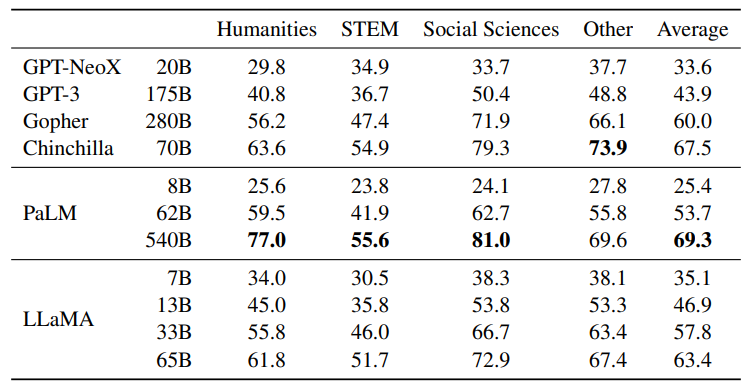
  • MMLU: LLaMA-65B lags behind Chinchilla-70B and PaLM-540B, likely due to less book data (177GB vs up to 2TB).

Massive Multitask Language Understanding (MMLU). Five-shot accuracy.

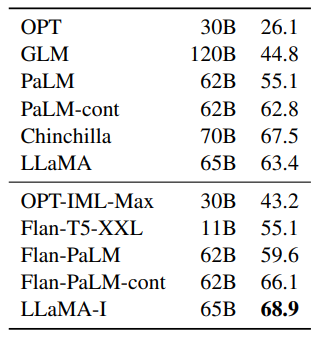
  • Instruction Finetuning: Even without fine-tuning, LLaMA-65B follows basic instructions. After instruction tuning (LLaMA-I), it achieves 68.9% on MMLU, outperforming other moderate-sized instruction-tuned models but still below GPT code-davinci-002 (77.4%).

Instruction finetuning — MMLU (5-shot). Comparison of models of moderate size with and without instruction finetuning on MMLU

Significance

LLaMA's primary contribution is demonstrating that open, efficient models can rival proprietary giants. By focusing on data quality and diversity rather than sheer scale, the paper provides a practical recipe for building high-performance LLMs with limited resources. The architectural choices (pre-norm, SwiGLU, RoPE) have become standard in subsequent models. The release of LLaMA (though initially restricted) spurred a wave of open-source LLM development, including fine-tuned variants like Alpaca and Vicuna. The main limitation is the performance gap on knowledge-intensive tasks like MMLU, likely due to less exposure to book corpora. Nonetheless, LLaMA set a new benchmark for efficiency and transparency in foundation models.