PreprintCommunications of the ACM
ImageNet classification with deep convolutional neural networks
Alex Krizhevsky, Ilya Sutskever et al.
130k2017
0
Citations
0
Influential Citations
—
Venue
2024
Year
An improved version of a LLaVA 1.5 with enhanced reasoning, OCR, and world knowledge capabilities, featuring increased image resolution
LLaVA 1.6 represents a significant leap in open-source multimodal AI, addressing critical limitations in visual reasoning, OCR, and world knowledge. By introducing dynamic high-resolution processing and a carefully curated data mixture, the model achieves performance that rivals commercial systems like Gemini Pro while maintaining the minimalist, efficient design philosophy of its predecessor. This work is particularly important for practitioners who need high-quality visual understanding without relying on proprietary APIs or massive computational resources.
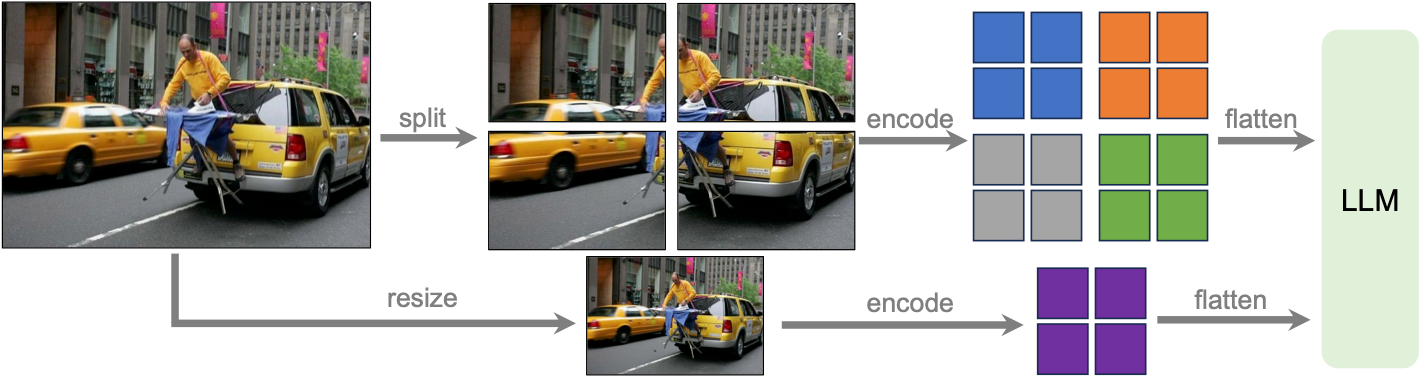
The core technical advancement in LLaVA 1.6 is the Dynamic High Resolution feature, which allows the model to process images at up to four times the pixel count of LLaVA 1.5. Instead of a fixed resolution, the model supports three aspect ratios: 672x672, 336x1344, and 1344x336. This is achieved through the 'AnyRes' technique, which divides the image into a grid of patches and processes them efficiently, balancing performance and computational cost. This significantly reduces hallucinations and misinterpretations common with low-resolution inputs.
Another key improvement is the enhanced data mixture for visual instruction tuning. The authors curated a 15K dataset from real-world user requests from the LLaVA demo, carefully filtered for privacy and safety. They also replaced TextCaps with DocVQA and SynDog-EN to boost zero-shot OCR performance, and added ChartQA, DVQA, and AI2D for better chart and diagram understanding. This data mixture ensures the model can handle diverse visual tasks, from reading text in natural scenes to interpreting complex graphs.
Finally, LLaVA 1.6 scales the LLM backbone to include models like Vicuna-1.5 (7B and 13B), Mistral-7B, and Nous-Hermes-2-Yi-34B. This expansion not only increases language capacity but also adds bilingual support (English and Chinese) and flexibility for commercial use. Despite these enhancements, the model retains the minimalist design of LLaVA 1.5, reusing the pretrained connector and using less than 1 million visual instruction tuning samples.
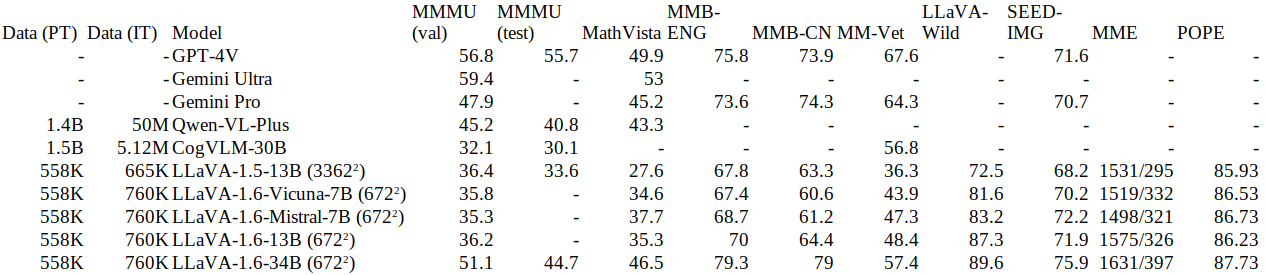
LLaVA 1.6 achieves state-of-the-art performance among open-source large multimodal models, surpassing CogVLM and Yi-VL on multiple benchmarks. It also catches up to Gemini Pro and outperforms Qwen-VL-Plus on selected tasks. Notably, the model exhibits strong zero-shot Chinese multimodal capabilities, achieving state-of-the-art on MMBench-CN despite being trained only on English multimodal data. This demonstrates the effectiveness of the improved visual processing and data mixture in generalizing across languages.
LLaVA 1.6 sets a new standard for open-source multimodal AI by proving that careful engineering—dynamic resolution, targeted data curation, and scalable LLM integration—can yield results competitive with closed-source systems. Its minimalist design ensures that these advances are accessible to researchers and practitioners with limited resources. The model's strong OCR and chart understanding capabilities open up practical applications in document analysis, education, and accessibility. Future work could explore extending these techniques to even higher resolutions, more languages, and more complex reasoning tasks, further bridging the gap between open-source and proprietary models.
Alex Krizhevsky, Ilya Sutskever et al.
Ashish Vaswani, Noam Shazeer et al.
Douglas M. Bates, Martin Mächler et al.
Diederik P. Kingma, Jimmy Ba