PreprintCommunications of the ACM
ImageNet classification with deep convolutional neural networks
Alex Krizhevsky, Ilya Sutskever et al.
130k2017
0
Citations
0
Influential Citations
—
Venue
2024
Year
Prunes an existing Nemotron model and re-trains it with a fraction of the original training data, achieving compression factors of 2-4×, compute cost savings of up to 40×, and improved performance on various language modeling tasks.
Training large language models from scratch is incredibly expensive. The Minitron paper tackles this head-on by asking: can we prune an existing large model and retrain it with a fraction of the original data to get a smaller, equally capable model? The answer is a resounding yes, with compression factors of 2-4x and compute savings up to 40x. This is a game-changer for organizations that need multiple model sizes but can't afford to train each one from scratch.
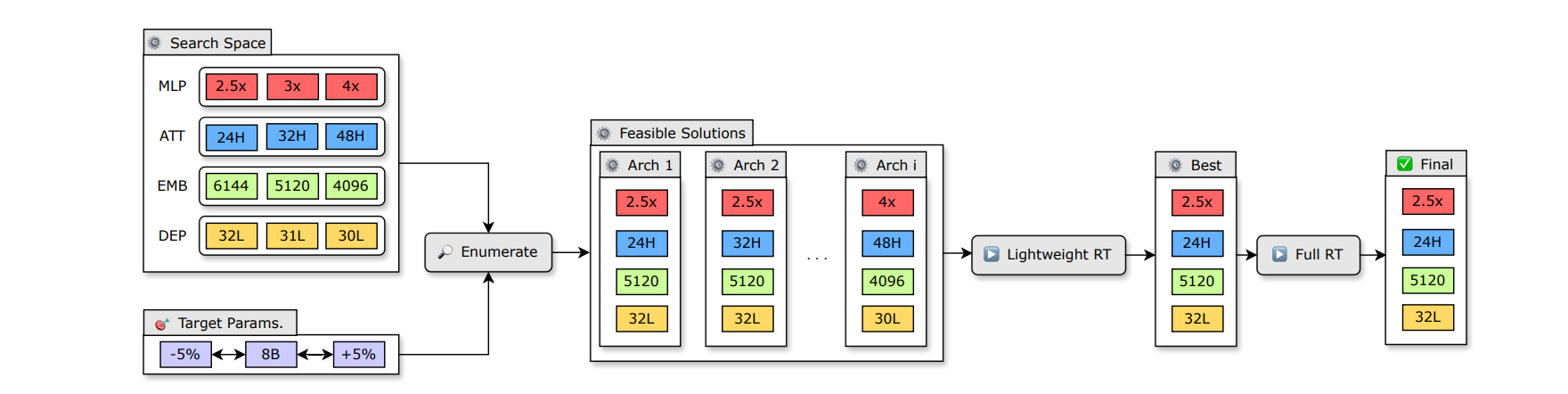
The core idea is to take a large teacher model (Nemotron-4 15B) and prune it down to target sizes (8B and 4B) using a structured pruning approach that removes entire layers, attention heads, neurons, and embedding channels. The pruning decisions are guided by importance scores computed from a tiny calibration dataset (just 1024 samples) using only forward passes.
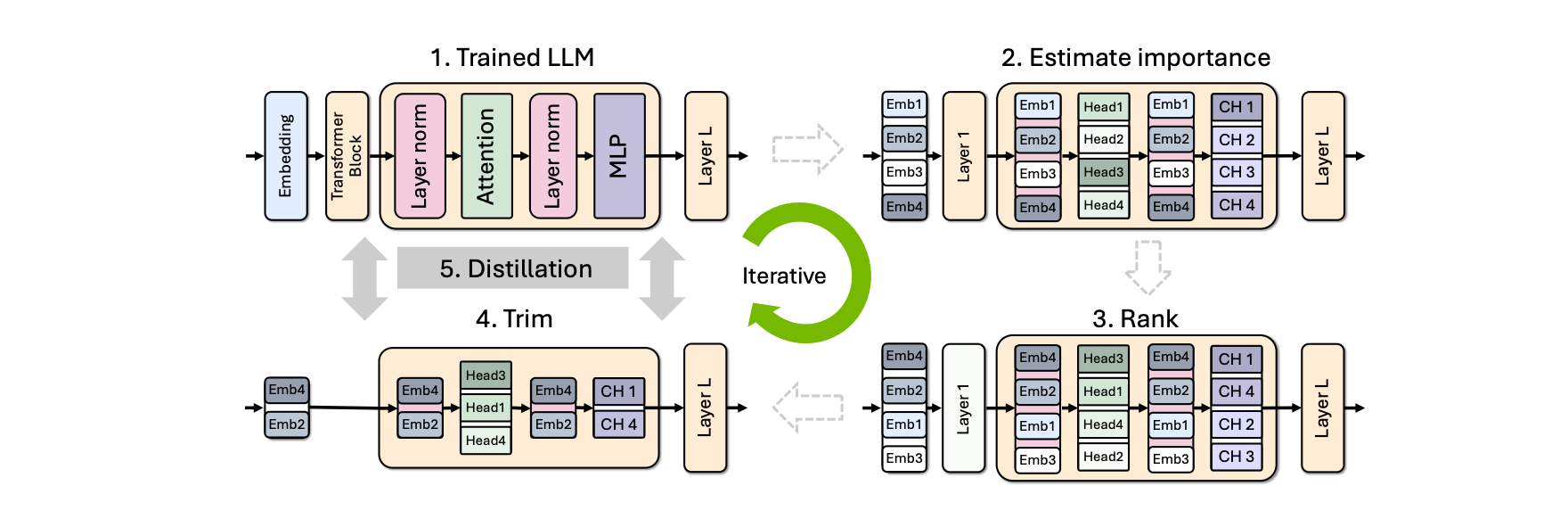
Importance Estimation: The method computes importance for width axes (heads, neurons, embedding channels) by aggregating activation magnitudes across batch and sequence dimensions. For depth, it uses two metrics: perplexity change when a layer is removed, and block importance (cosine distance between layer input and output).


Iterative Pruning: The authors found that single-shot importance estimation works just as well as iterative pruning, simplifying the process. They prune elements with lowest importance directly from the weight matrices.
Retraining with Distillation: After pruning, the model is retrained using a combination of standard cross-entropy loss and knowledge distillation from the original teacher. The distillation loss includes both logit-based (KL divergence of output probabilities) and intermediate state-based components (matching hidden states via a learned linear transformation).
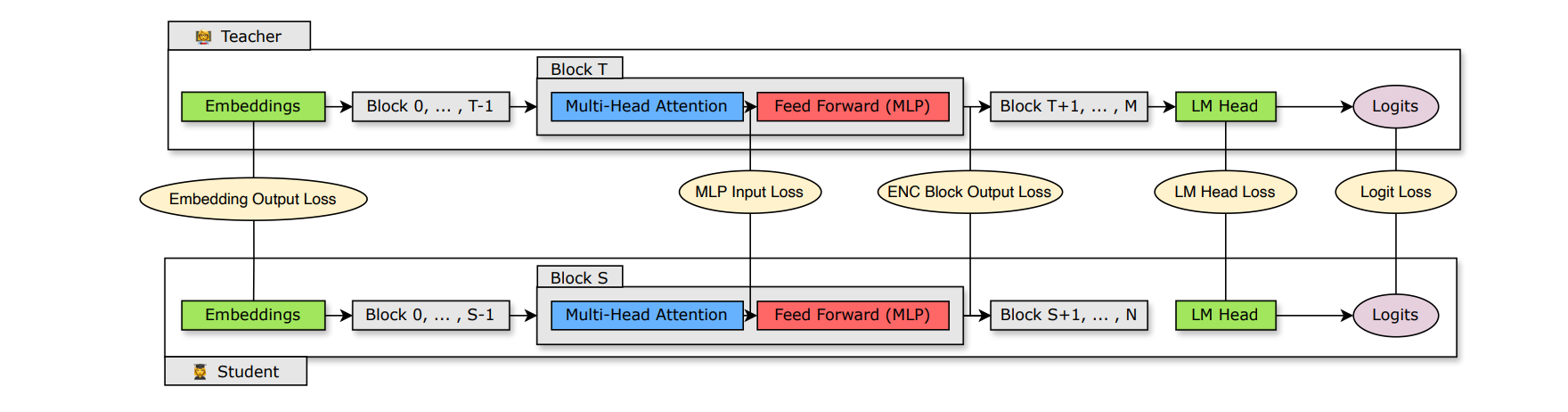



The total loss is L = L_CLM + L_logits + α * L_is, where α weights the intermediate state loss.
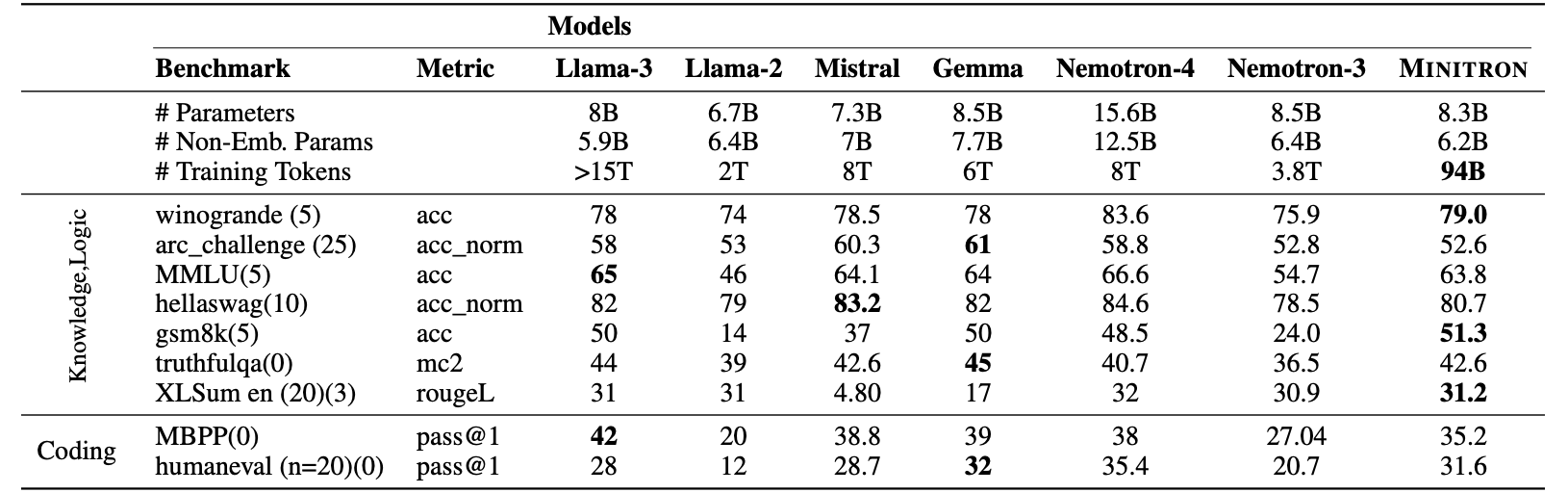
Minitron 8B outperforms Nemotron-3 8B and LLaMa-2 7B, and performs similarly to Mistral 7B, Gemma 7B, and LLaMa-3 8B, while using significantly fewer training tokens.
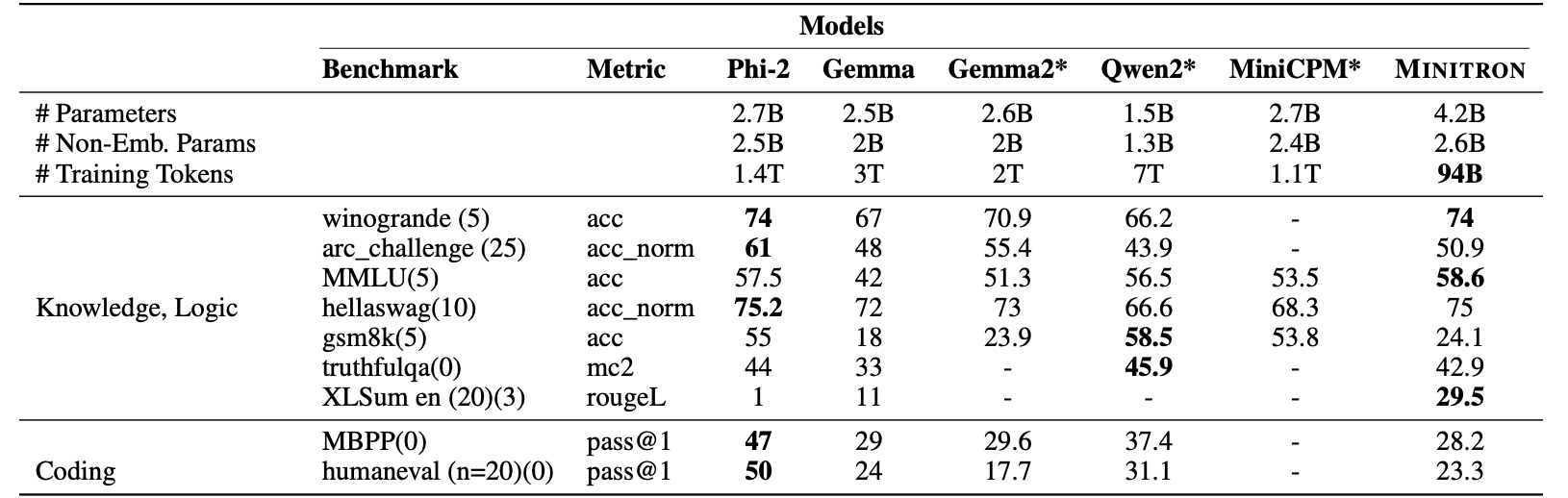
Minitron 4B retains model capabilities better than smaller specialized models and outperforms Gemma2.
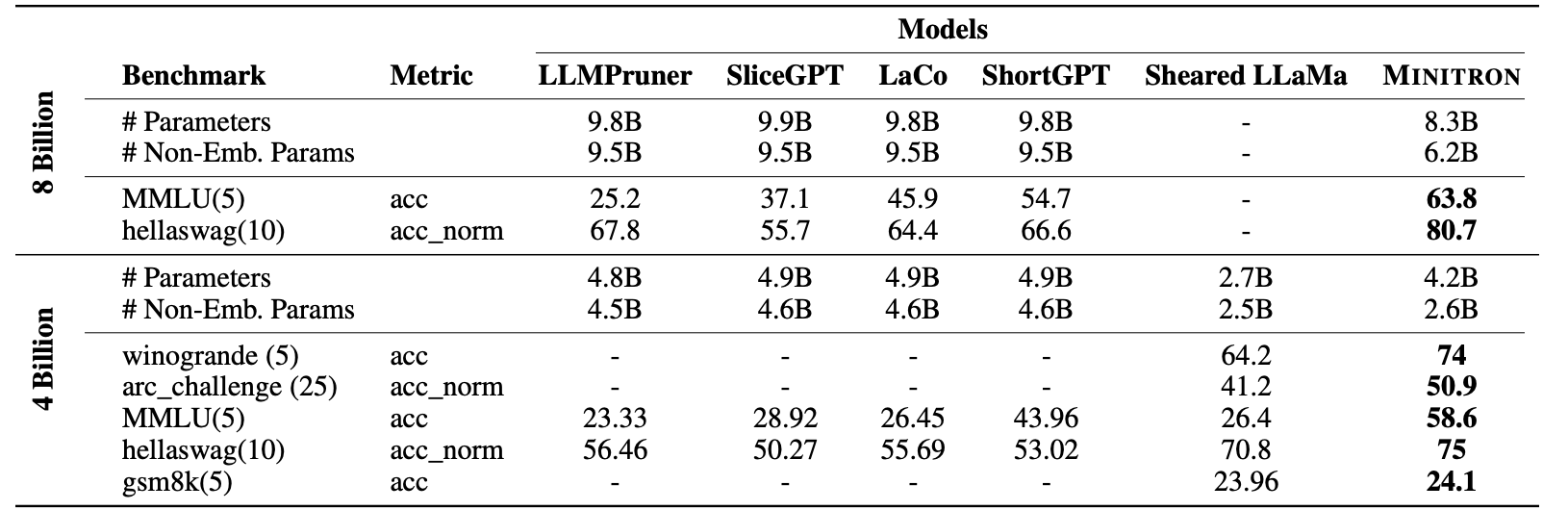
Minitron 8B significantly outperforms multiple depth-pruned models of larger size (~10B parameters).
The paper provides a clear, actionable recipe for model compression that is both compute-efficient and performance-preserving. The key insight is that pruning followed by knowledge distillation can yield models that are not just smaller but sometimes better than training from scratch. The best practices distilled from the experiments (e.g., prefer width pruning over depth, use logit-only distillation when depth is unchanged) are immediately useful for practitioners. This work democratizes access to multiple model sizes from a single training run, which is especially valuable for resource-constrained teams.
Alex Krizhevsky, Ilya Sutskever et al.
Ashish Vaswani, Noam Shazeer et al.
Douglas M. Bates, Martin Mächler et al.
Diederik P. Kingma, Jimmy Ba