PreprintCommunications of the ACM
ImageNet classification with deep convolutional neural networks
Alex Krizhevsky, Ilya Sutskever et al.
130k2017
0
Citations
0
Influential Citations
—
Venue
2024
Year
Small language models fine-tuned on a synthetic dataset of C4 text passages and LLM-generated structured extraction templates and outputs, achieving comparable or superior performance to much larger LLMs like GPT-4 on complex extraction tasks while being significantly smaller and offering zero-shot, hybrid few-shot (using output examples), and fine-tuning capabilities.
The race to build ever-larger language models often overshadows a crucial insight: for many practical tasks, smaller specialized models can outperform their giant counterparts. NuExtract provides compelling evidence that a 3.8B parameter model can match GPT-4o on structured extraction — a task central to countless enterprise workflows. This matters because it democratizes access to high-quality information extraction, allowing organizations to run inference on commodity hardware without sacrificing accuracy.
The core innovation is a synthetic data pipeline that eliminates the need for expensive human annotation. The authors start with 300k text passages from the C4 dataset and use Llama 3 70B to generate extraction templates — empty JSON structures that define what information to look for. A second pass fills these templates with actual values extracted from the text. Crucially, for half the examples, they remove parts of the text while keeping the original template, creating empty fields that teach the model to return empty strings when information is missing. This negative sampling technique directly combats hallucination.
The template format is deliberately simple: empty strings indicate fields to extract, arrays contain element templates, and only string values are allowed. The authors argue that examples are more informative than field descriptions, so no descriptions are included. After filtering out examples where the template isn't followed or values aren't found in the text, they obtain 50k high-quality training pairs.
For NuExtract 1.5, the dataset expands to include multilingual documents (French, German, Spanish, Italian, Portuguese) and longer texts. A novel "continuation" training strategy enables processing arbitrarily long documents: the model learns to merge previously extracted information with new information from subsequent chunks, effectively creating a recurrent extraction process.
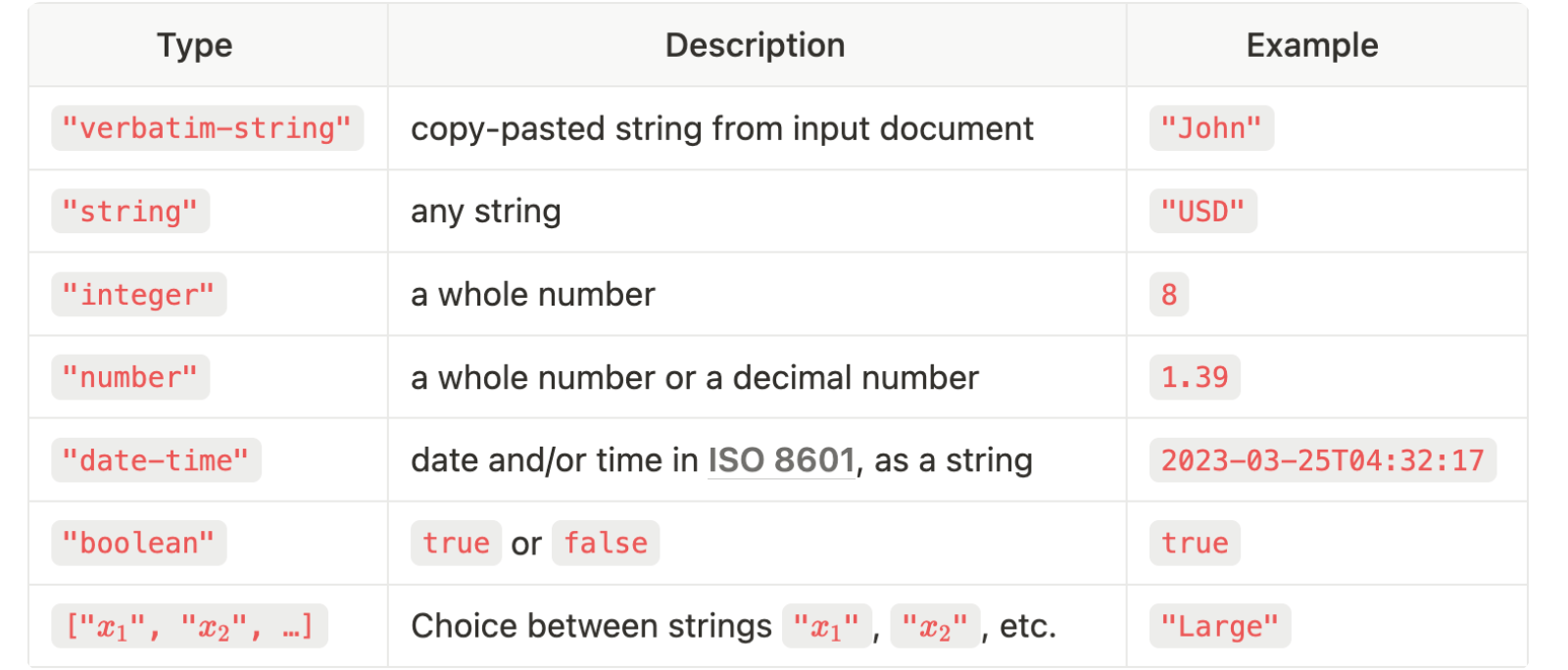
NuExtract 2.0 shifts to vision-language model backbones (Qwen VL variants), enabling direct image-to-JSON extraction without OCR. It also introduces typed fields: "verbatim-string" for literal extraction, "string" for free generation, plus "choice", "date", "number", and "null". This allows the model to reformat outputs, deduce answers, classify, and even generate text.
The zero-shot results are striking: NuExtract-tiny (0.5B) outperforms GPT-3.5 while being at least 100x smaller. NuExtract (3.8B) beats Llama3-70B, and NuExtract-large (7B) reaches GPT-4o levels. Fine-tuning amplifies these gains — on a chemistry extraction task, even the tiny model surpasses GPT-4o after fine-tuning.
NuExtract 1.5 shows similar dominance: it slightly outperforms GPT-4o in zero-shot English extraction and significantly outperforms it on long documents (8k-20k tokens). The continuation strategy proves effective, with performance degrading gracefully as extraction window size decreases.
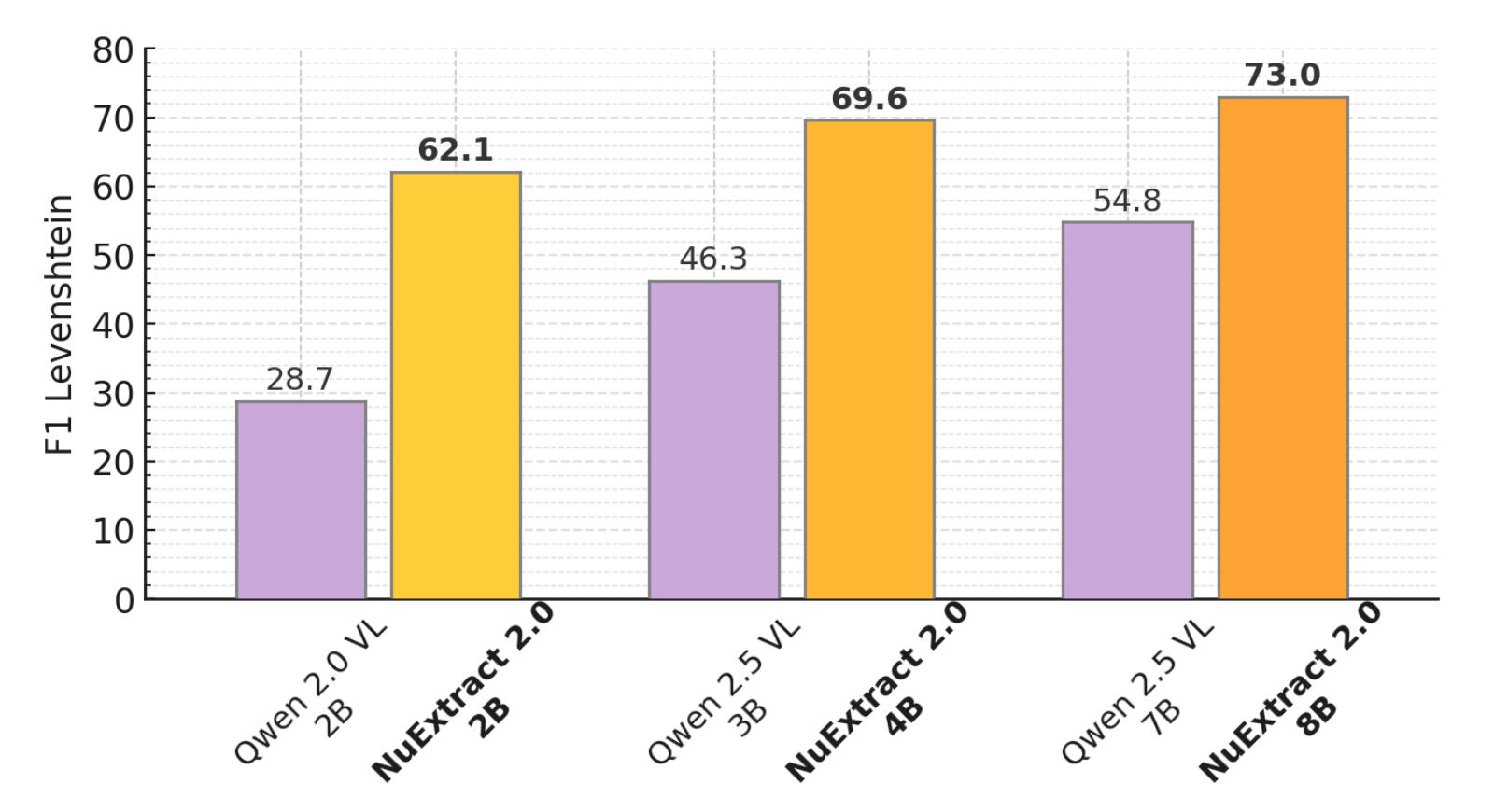
NuExtract 2.0 8B achieves 73 F-Score, matching non-reasoning frontier models. The PRO version exceeds GPT-4.1 by +9 F-Score and even surpasses reasoning models like Claude 4 Opus and Gemini 2.5 PRO.
NuExtract challenges the prevailing assumption that bigger is always better for LLM-based extraction. By carefully designing a synthetic data pipeline and training specialized small models, the authors achieve frontier-level performance at a fraction of the computational cost. The progression from pure text extraction (v1) to multilingual long-document processing (v1.5) to vision and reasoning (v2) to unified extraction with reinforcement learning (v3) demonstrates a clear roadmap for building practical, deployable extraction systems.
The main limitation is that multilingual performance still lags behind GPT-4o, likely due to model size constraints. Additionally, the continuation procedure for long documents, while effective, is not perfect and shows some degradation with smaller windows. Nevertheless, NuExtract represents a significant step toward making high-quality structured extraction accessible to everyone, not just those with massive GPU clusters.
Alex Krizhevsky, Ilya Sutskever et al.
Ashish Vaswani, Noam Shazeer et al.
Douglas M. Bates, Martin Mächler et al.
Diederik P. Kingma, Jimmy Ba