PreprintCommunications of the ACM
ImageNet classification with deep convolutional neural networks
Alex Krizhevsky, Ilya Sutskever et al.
130k2017
0
Citations
0
Influential Citations
—
Venue
2024
Year
A public AI4Maths dataset, comprising 860,000 competition math problems and solutions, ranging from high-school to advanced competition levels, annotated with chain-of-thought traces. It aims to improve mathematical reasoning in LLMs and is instrumental in developing a model that won the 1st AIMO Progress Prize, demonstrating its effectiveness in advancing state-of-the-art mathematical reasoning models.
Mathematical reasoning remains a critical frontier for large language models (LLMs), yet progress has been hampered by the lack of large-scale, high-quality training data. The NuminaMath paper directly addresses this gap by releasing the largest public dataset for AI4Maths—860,000 competition math problems and solutions, ranging from high-school to advanced olympiad levels. Each problem is meticulously annotated with chain-of-thought (CoT) traces, providing a structured reasoning path. This dataset was instrumental in developing the model that won the 1st AIMO Progress Prize, demonstrating its practical impact. By making this resource openly available, the authors empower the research community to push the boundaries of LLM mathematical reasoning without relying on proprietary data.
The NuminaMath dataset is a comprehensive collection of 860k pairs of competition math problems and solutions. Problems range from high-school-level to advanced-competition-level, all meticulously annotated with accompanying chain-of-thought traces. This dataset is designed to enhance the mathematical reasoning capabilities of LLMs and stands as the largest math dataset ever released in the field.
The project is available at GitHub.

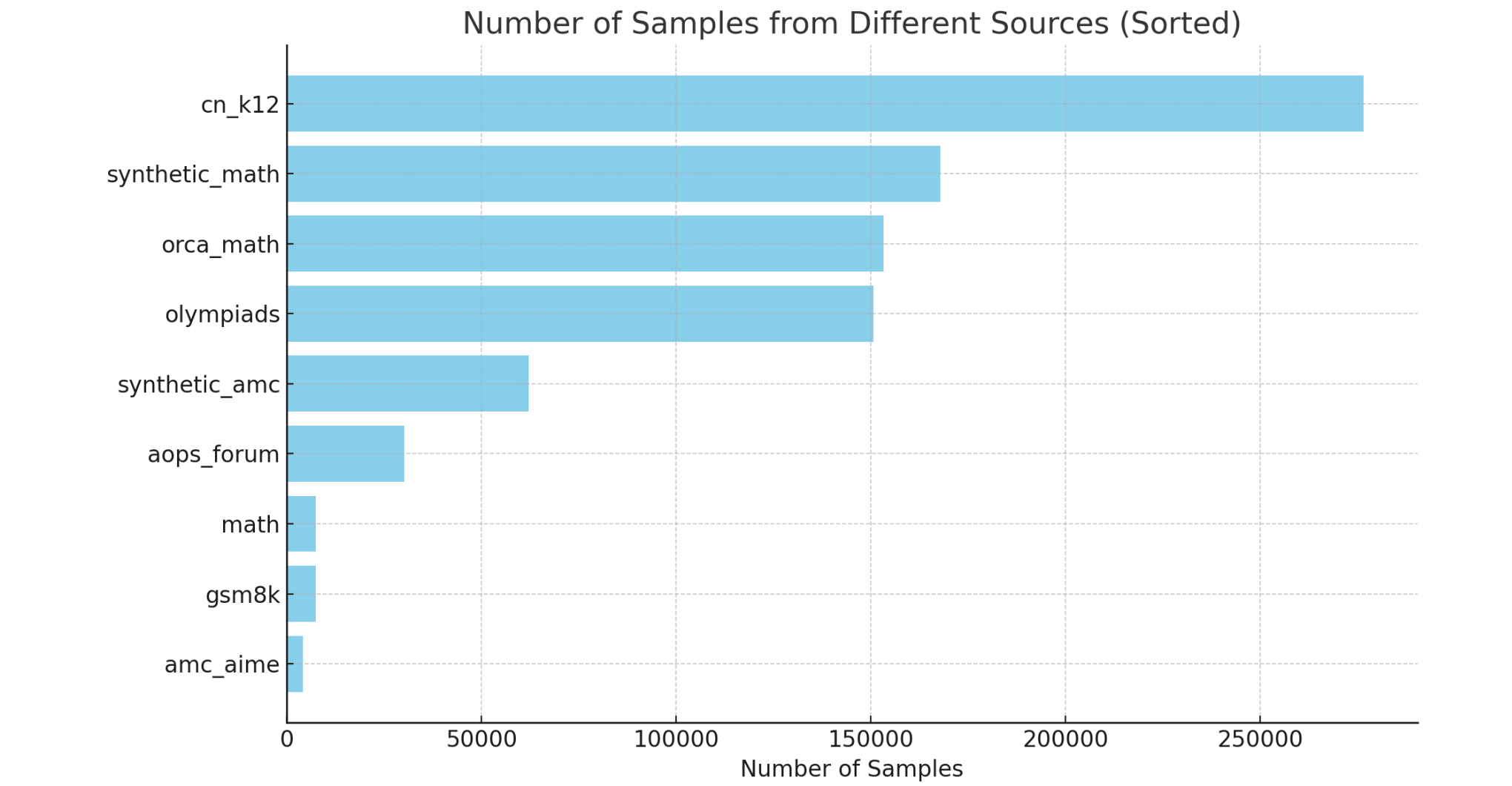
The data sources include Chinese high school math exercises, US and international mathematics olympiad problems, and problems collected from online forums.
The following two-step decontamination strategy is used:
After creating the NuminaMath-CoT dataset, extending to TIR (tool integrated reasoning) is straightforward. The same approach as ToRA, particularly their prompt, is followed to sample TIR data from GPT-4o. The process to create this TIR dataset is as follows:
Models are fine-tuned using a two-stage process inspired by the MuMath-Code paper.
Models are trained at two scales:

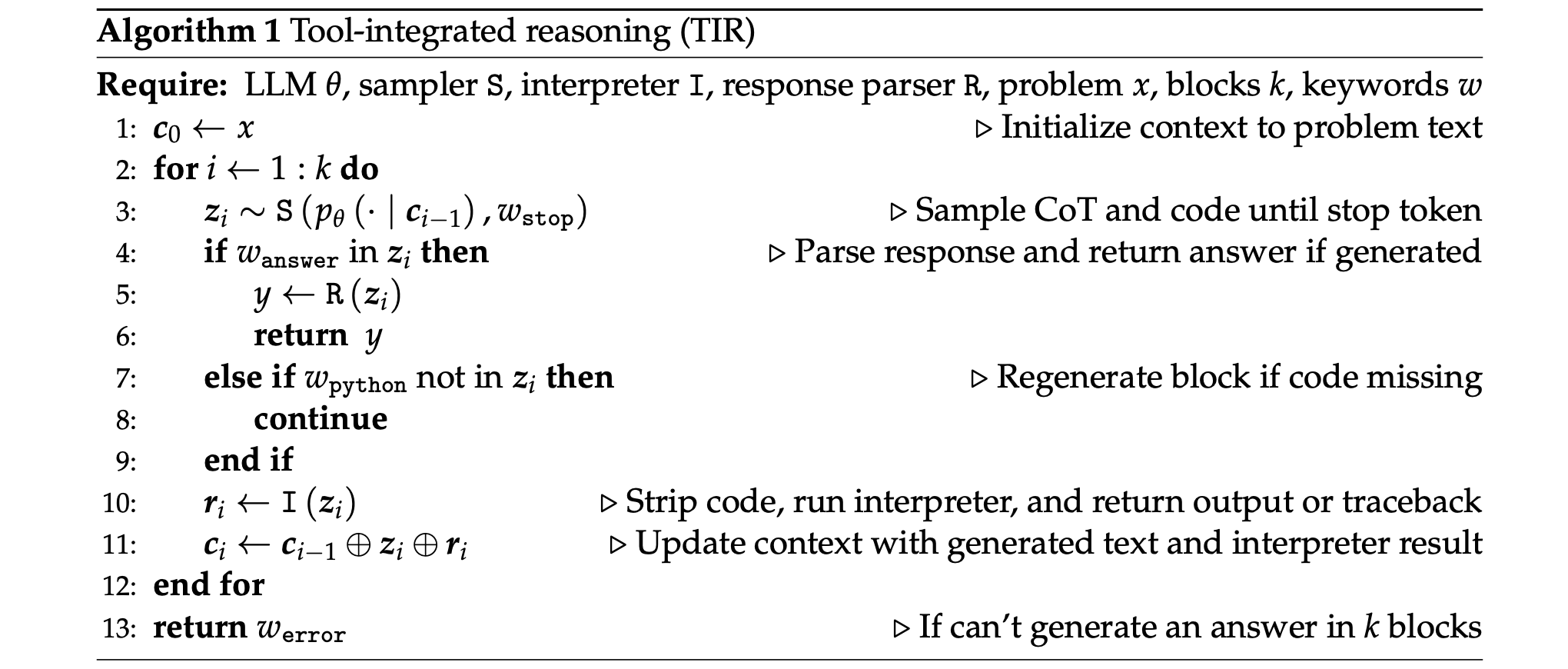
Each run of TIR begins with a problem, x. The goal of TIR is to sample a candidate solution, y. TIR begins by initializing a context, c, with an initial prompt c0 containing only x. This context is then extended through up to k rounds of interaction.
On each iteration, i, TIR uses a sampler, S, and an LLM, θ, to sample text containing CoT and Python source code, zi, until reaching the stop keyword wstop = ```output. After sampling zi, TIR first checks if a candidate solution has been generated, which would be wrapped in the keyword wanswer = \boxed{}.
If an answer is present, TIR applies a response parser, R, to the output, which acts to sanitize the text and return only the final numerical response with any units and other formatting removed. If no valid response is present, TIR assesses whether any code has been generated by matching a regular expression with the python region keyword wpython = python(.*).
If no such region is available, zi is discarded, and TIR proceeds to the next iteration, resampling a fresh block of text. If such a region is available, the Python source code is passed to the Python interpreter, I, which parses and executes the source code. The result, ri from running I(zi) may include the output of print statements, or a truncated Traceback if an exception was raised.
The running context is then extended, proceeding to the next round of interaction, via setting ci to ci−1 ⊕ zi ⊕ ri, where ⊕ denotes concatenation. Thus, by the end of interaction, c = c0z1r1z2r2 . . . z≤k, where either a candidate answer, y, is successfully extracted from z≤k else an error keyword werror.
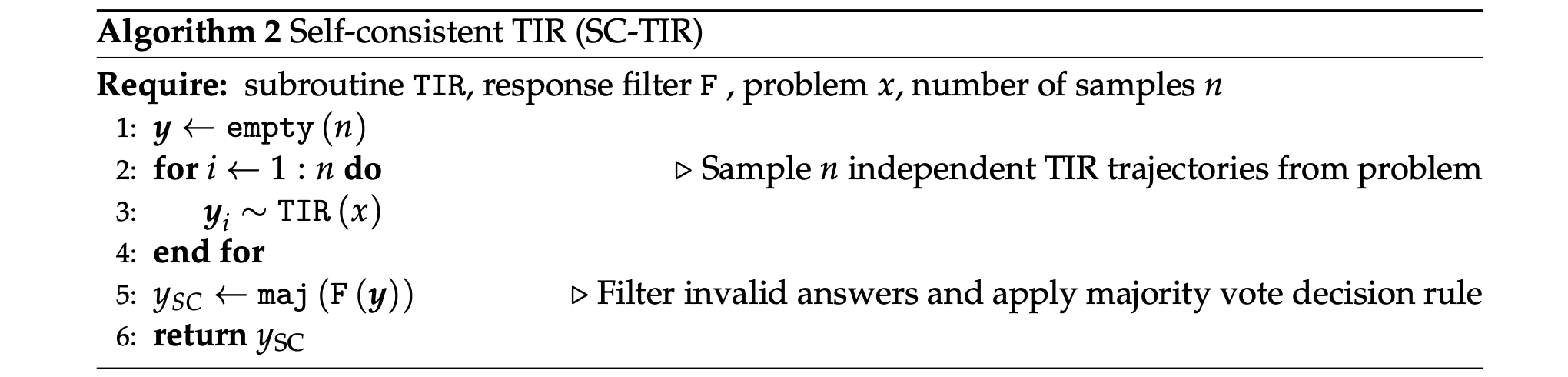
In the case of SC-TIR, n samples are generated from TIR, then a filter, F is applied, which removes ill-formed responses and finally self-consistency majority voting is applied.
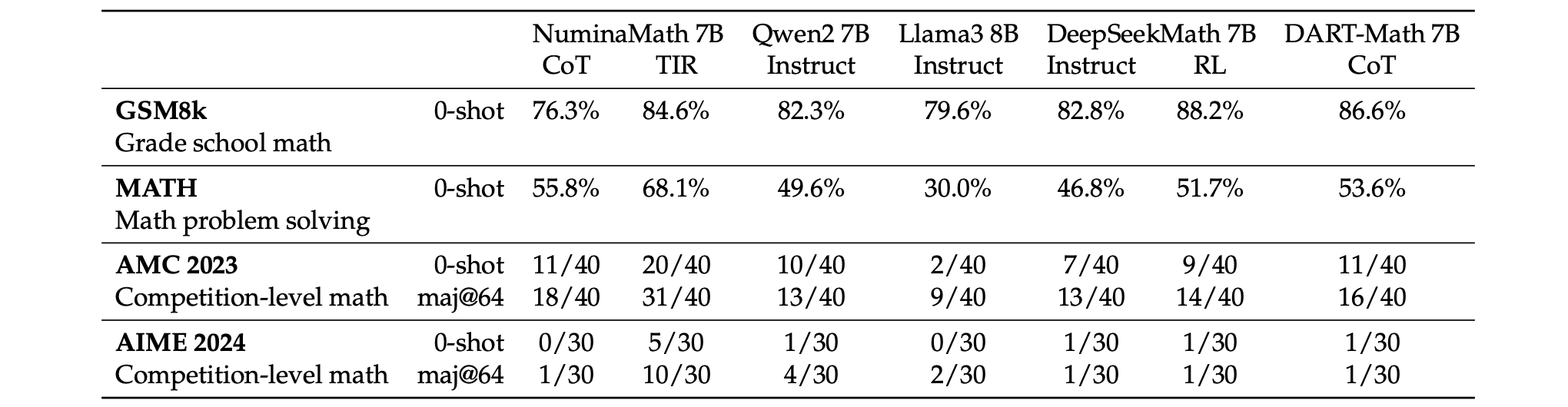
Various 7B, 8B, and 70B parameter language models are compared on benchmarks, including GSM8k (grade school math), MATH (math problem solving), AMC 2023 (competition-level math), and AIME 2024 (competition-level math).
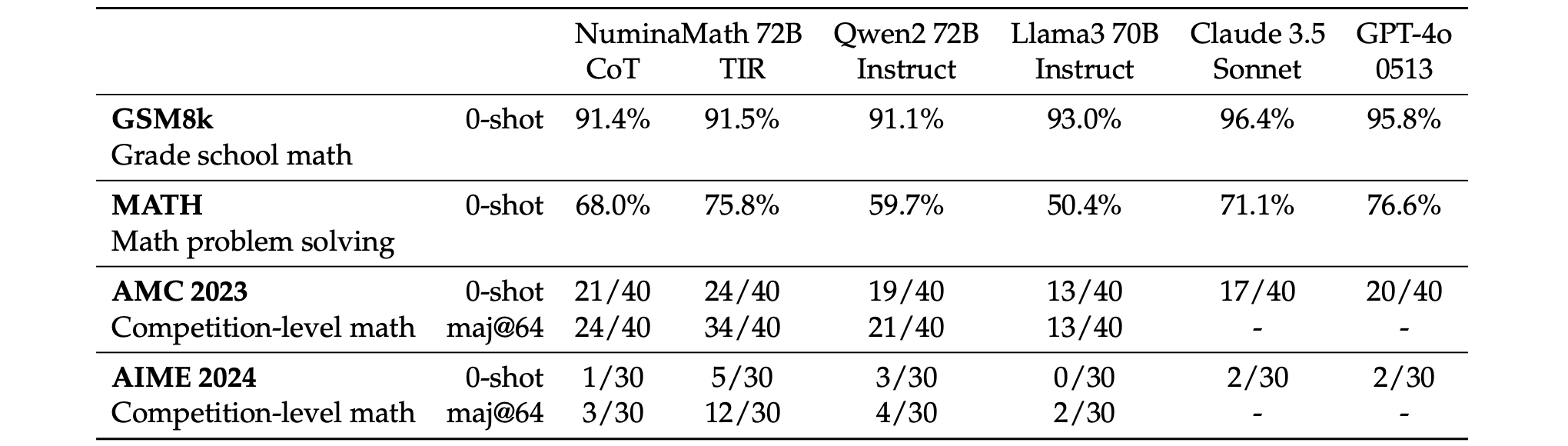
The NuminaMath paper represents a landmark contribution to AI4Maths by providing the largest public dataset of its kind. Its two-stage fine-tuning approach—combining natural language CoT with tool-integrated reasoning—offers a practical blueprint for enhancing LLM mathematical reasoning. The competitive performance against much larger proprietary models underscores the value of high-quality training data. The release of NuminaMath-1.5 further refines the dataset with richer metadata, ensuring verifiable outputs. This work not only advances state-of-the-art but also democratizes access, enabling smaller research teams to build capable math reasoning systems. Future work could explore extending the dataset to other domains or improving the synthetic data generation pipeline to reduce reliance on GPT-4.
Alex Krizhevsky, Ilya Sutskever et al.
Ashish Vaswani, Noam Shazeer et al.
Douglas M. Bates, Martin Mächler et al.
Diederik P. Kingma, Jimmy Ba