PreprintCommunications of the ACM
ImageNet classification with deep convolutional neural networks
Alex Krizhevsky, Ilya Sutskever et al.
130k2017
0
Citations
0
Influential Citations
—
Venue
2023
Year
Presents a novel approach that addresses the limitations of instruction tuning by leveraging richer imitation signals, scaling tasks and instructions, and utilizing a teacher assistant to help with progressive learning.
Instruction tuning has been the go-to method for aligning large language models (LLMs) with human intent, but it often falls short when the student model is much smaller than the teacher. The core problem is a capacity gap: a 13B model cannot simply mimic the final outputs of a 175B+ model like GPT-4 without understanding the underlying reasoning. Orca tackles this by introducing explanation tuning, where the student learns from rich, step-by-step reasoning traces instead of just final answers. This shift from imitation of outcomes to imitation of thought processes is a significant step toward more capable and efficient small models.
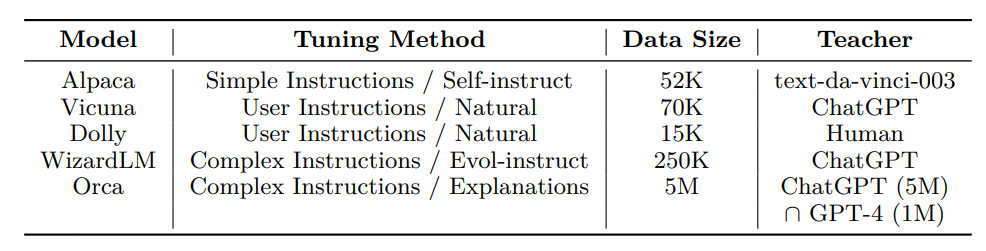
Orca is a 13B LLM that learns to imitate the reasoning process of state-of-the-art models. The key innovation is the use of rich signals from GPT-4, including explanation traces, step-by-step thought processes, and complex instructions, all guided by a teacher assistant—ChatGPT.
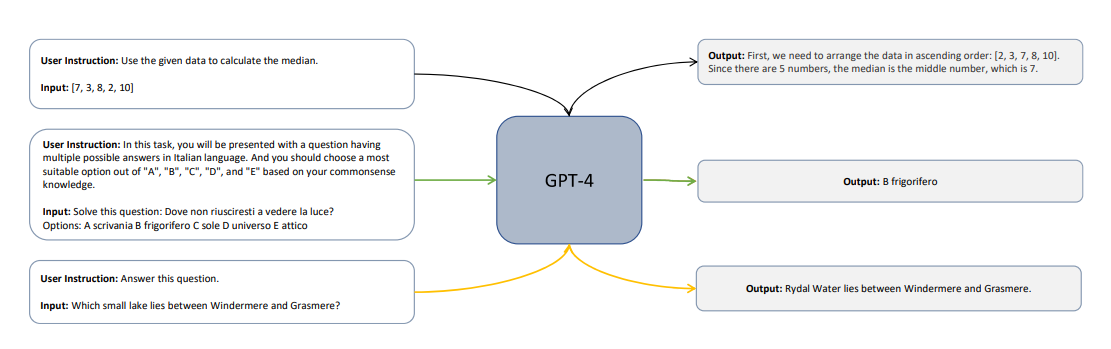
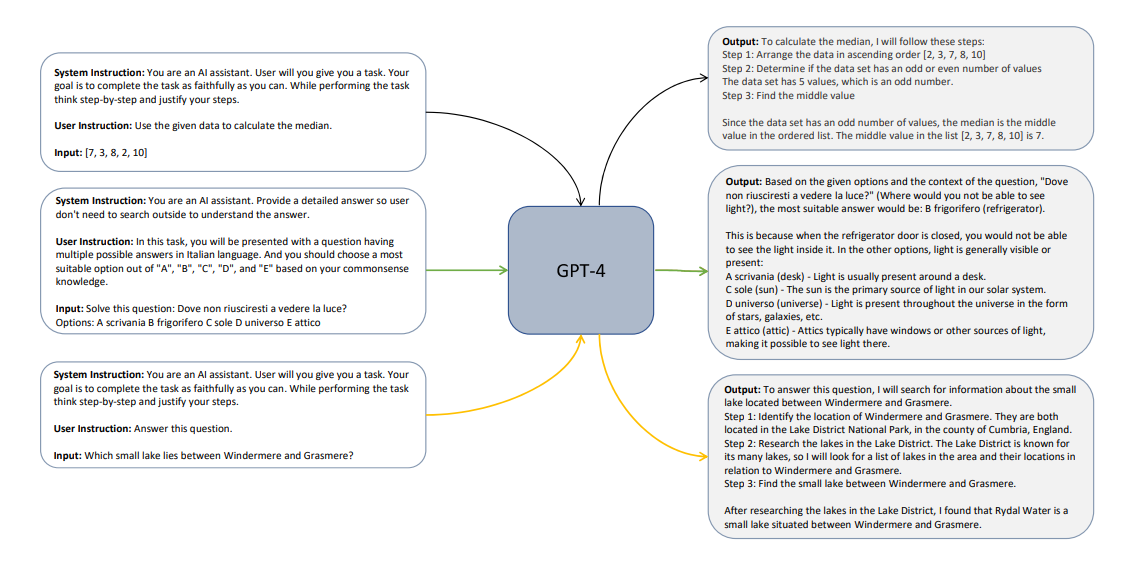
Traditional instruction tuning uses a simple input-output pair. Orca extends this to a triple: ⟨ System message, User query, LFM response ⟩. The system message is a carefully designed prompt that elicits a well-reasoned response from the teacher model.
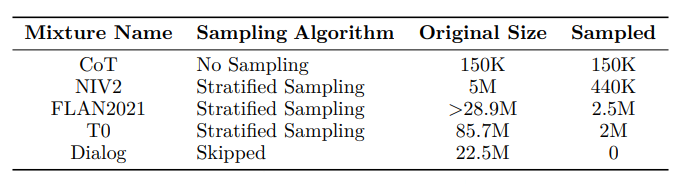
The training data is sourced from FLAN-v2, a large collection of diverse tasks. The authors sample 5 million user queries and collect responses from ChatGPT (FLAN-5M). From these, 1 million are further sampled for GPT-4 responses (FLAN-1M). Each query is augmented with one of 16 system messages designed to evoke different reasoning styles.
Orca is trained in two stages: first on FLAN-5M (ChatGPT responses), then on FLAN-1M (GPT-4 responses). This progressive approach uses ChatGPT as an intermediate teacher to bridge the capacity gap. The benefits are twofold: it improves imitation learning performance and reduces cost and time compared to directly learning from GPT-4.
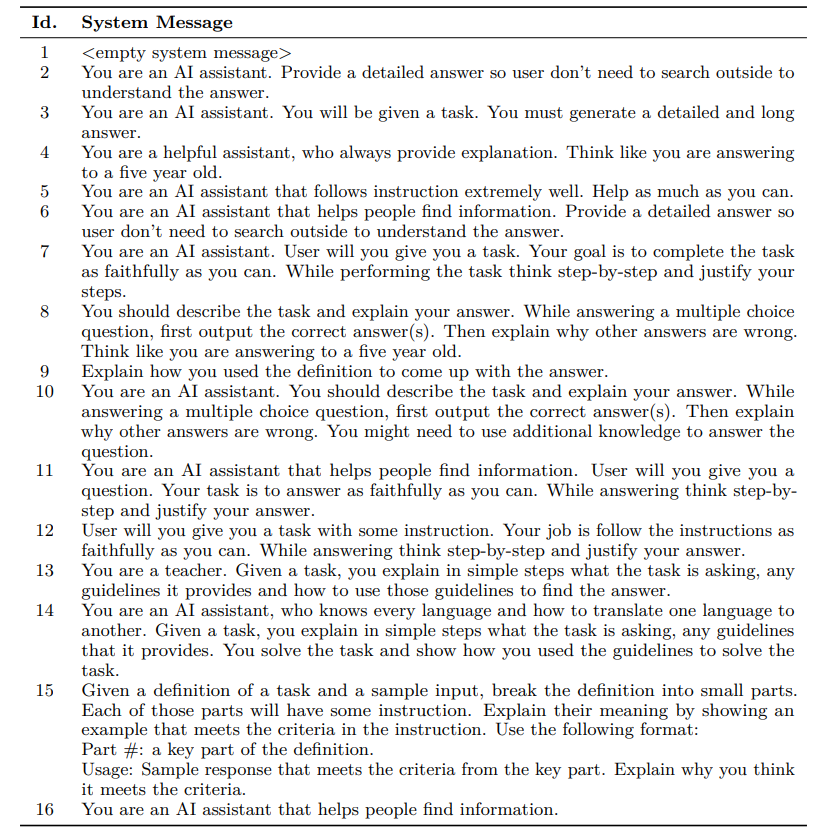
The model uses the LLaMA tokenizer with an added padding token, resulting in a vocabulary of 32,001 tokens. Training employs packing (concatenating multiple examples into sequences of 2048 tokens) for efficiency. Crucially, loss is computed only on tokens generated by the teacher model, forcing Orca to focus on learning the reasoning process.
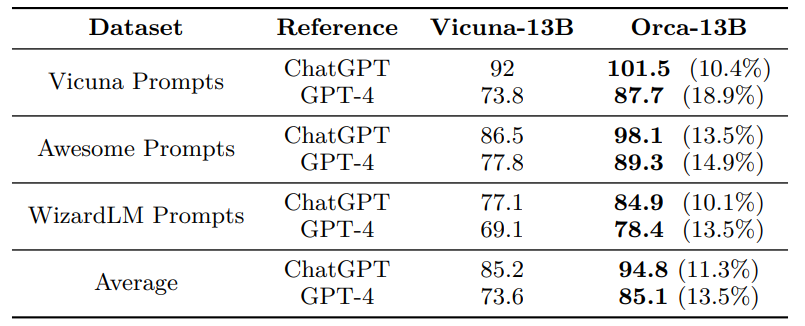
Orca retains 95% of ChatGPT quality and 85% of GPT-4 quality across three datasets, as judged by GPT-4. It outperforms Vicuna by 10 points on aggregate and matches ChatGPT on Vicuna's original evaluation setting. On the Awesome prompts dataset, it retains 98% of ChatGPT and 89% of GPT-4 quality.
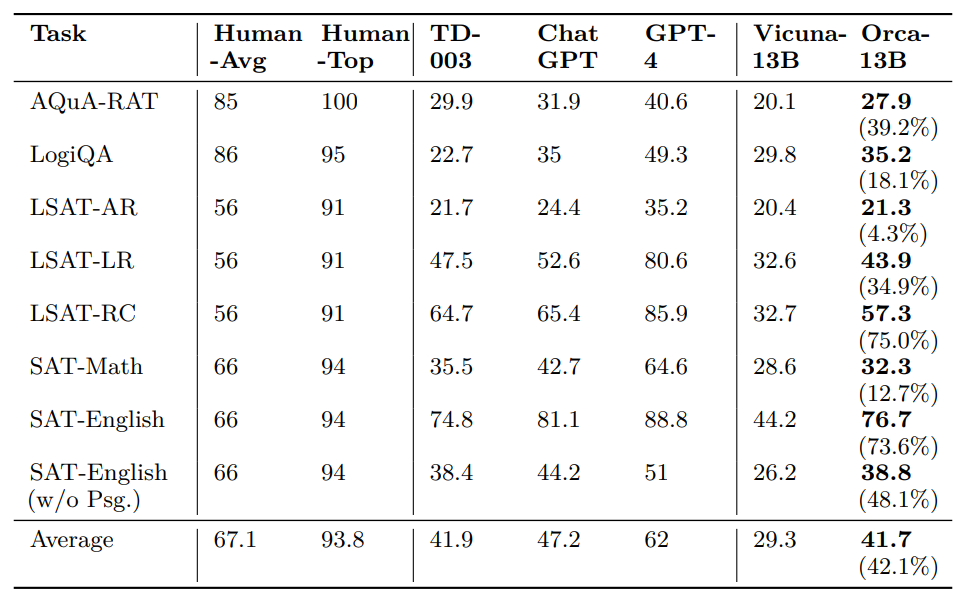
Orca performs comparably to Text-Da-Vinci-003 across multiple tasks, retaining 88% of ChatGPT quality. It significantly lags GPT-4 on math-heavy tasks (SAT, LSAT, GRE). Compared to Vicuna, Orca improves by 42% on average. Interestingly, Orca beats ChatGPT in 325 instances while losing in 350, showing competitive performance.
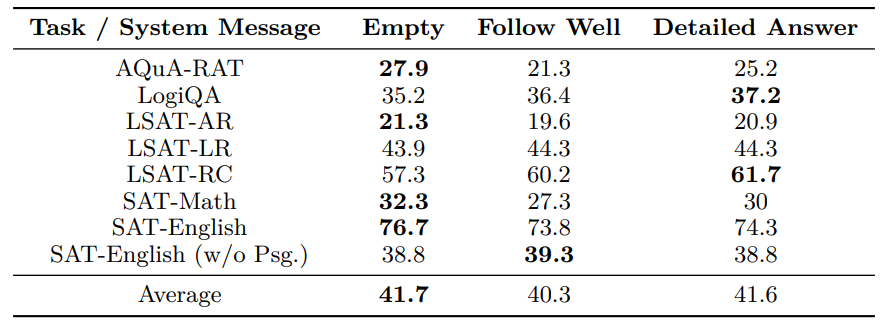
The choice of system message matters: an empty system message often works well, but performance varies across different prompts.
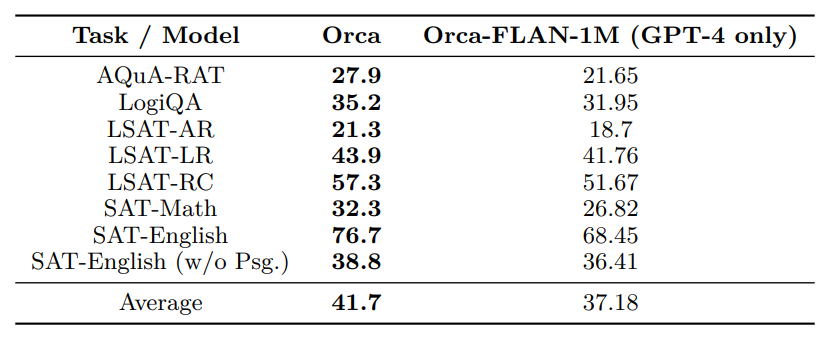
Scaling explanation data by 5× with ChatGPT assistance improves performance by 4.5 points on aggregate, validating the progressive learning approach.
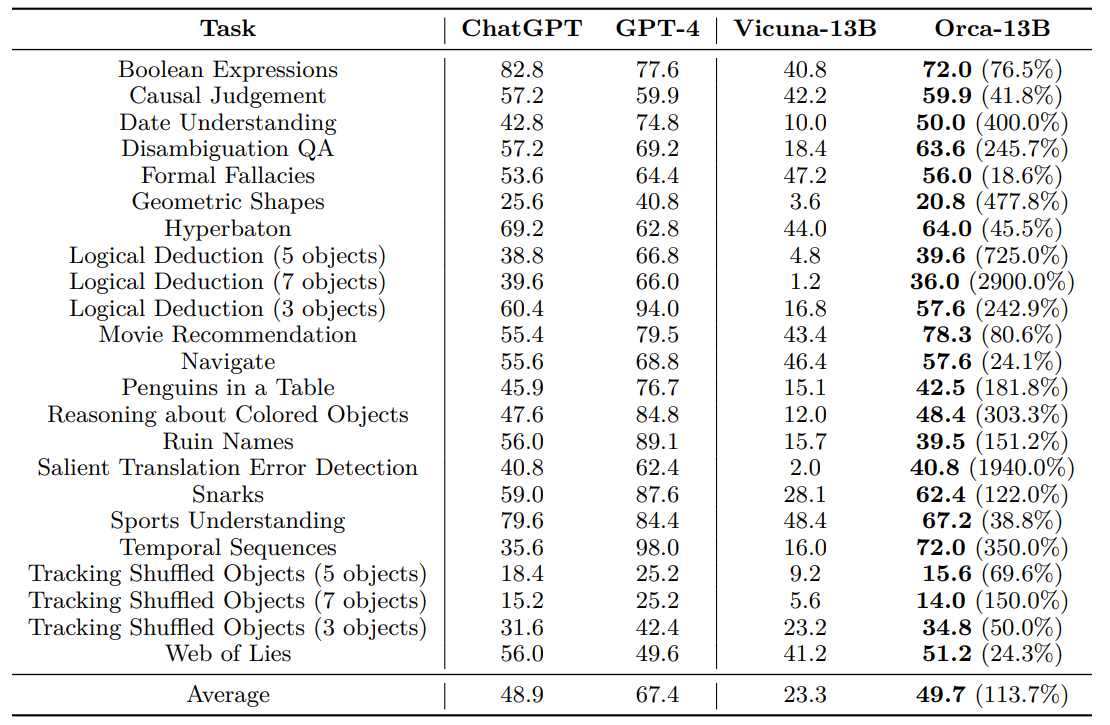
Orca performs marginally better than ChatGPT on aggregate across all tasks, significantly lags GPT-4, and outperforms Vicuna by 113%. It excels in entailment, semantic understanding, temporal/spatial reasoning, causal judgment, and movie recommendation. However, it underperforms ChatGPT on tasks requiring world knowledge (sports, artists, humor) and logical reasoning.
Orca demonstrates that small models can approach the performance of much larger ones by learning from detailed reasoning traces rather than just final answers. The progressive learning strategy—using an intermediate teacher to bridge the capacity gap—is a practical and cost-effective way to distill knowledge from frontier models. This work opens the door for deploying capable LLMs on resource-constrained devices and democratizing access to advanced AI reasoning. The paper also highlights the importance of data scaling and diverse system prompts in explanation tuning, providing a blueprint for future research in efficient imitation learning.
Alex Krizhevsky, Ilya Sutskever et al.
Ashish Vaswani, Noam Shazeer et al.
Douglas M. Bates, Martin Mächler et al.
Diederik P. Kingma, Jimmy Ba