PreprintCommunications of the ACM
ImageNet classification with deep convolutional neural networks
Alex Krizhevsky, Ilya Sutskever et al.
130k2017
0
Citations
0
Influential Citations
—
Venue
2024
Year
A family of 8B and 70B parameter models trained on 15T tokens with a focus on data quality, demonstrating state-of-the-art performance on various benchmarks, improved reasoning capabilities.
Llama 3 represents a significant leap in open-source foundation models, demonstrating that careful data curation and scaling can produce models competitive with proprietary leaders like GPT-4. By releasing models at 8B, 70B, and 405B parameters, Meta provides a spectrum of capabilities for different deployment scenarios, from edge devices to cloud servers. The emphasis on data quality over sheer quantity, along with novel scaling laws, offers practical insights for the AI community on how to train more efficient and capable models.

Llama 3 retains the decoder-only transformer architecture but introduces key improvements. The tokenizer uses a vocabulary of 128K tokens, encoding language more efficiently and boosting performance. Grouped query attention (GQA) is applied across all model sizes to enhance inference speed. Training sequences are 8,192 tokens long, with a mask preventing self-attention across document boundaries.
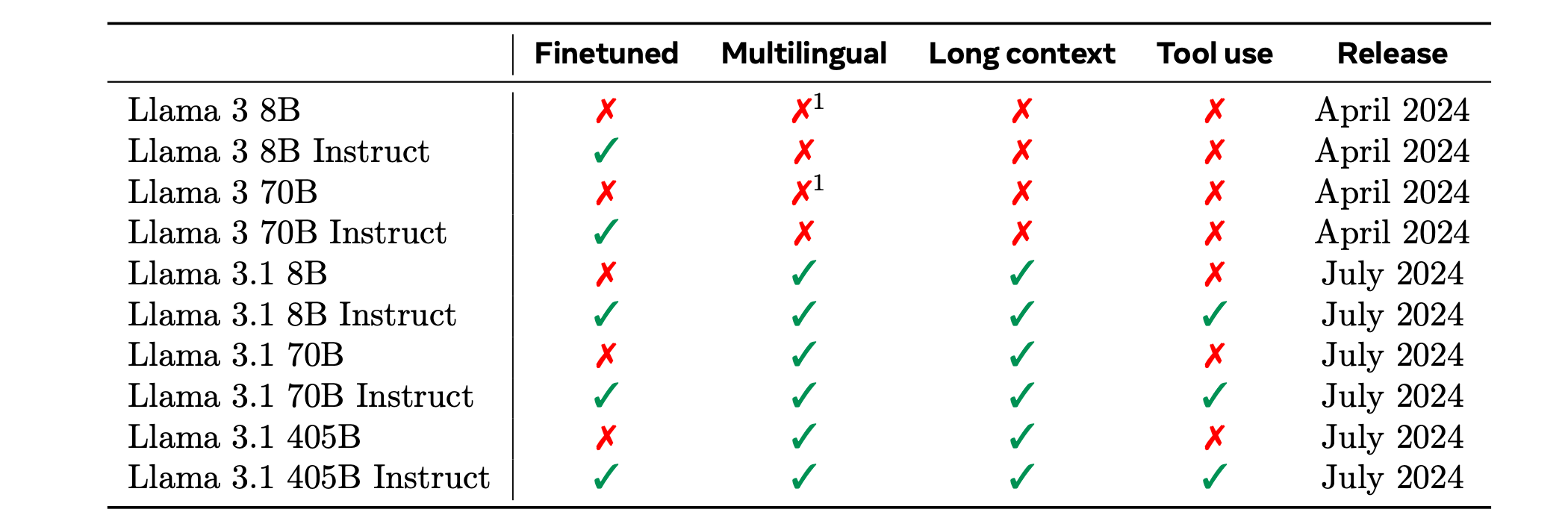
The pre-training dataset comprises over 15 trillion tokens from public sources—seven times larger than Llama 2—with four times more code. Over 5% of the data is high-quality non-English text covering 30+ languages. To ensure quality, Meta developed a pipeline of heuristic filters, NSFW filters, semantic deduplication, and text classifiers trained using Llama 2. These classifiers predict data quality, filtering out low-value content.
Scaling laws were derived to evaluate downstream benchmarks, allowing the team to select an optimal data mix and allocate compute efficiently. Notably, they found that model performance continues to improve log-linearly even after training on two orders of magnitude more data than the Chinchilla-optimal point (200B tokens for an 8B model). Larger models can match smaller ones with less compute, but smaller models are preferred for inference efficiency.
Post-training combines supervised fine-tuning (SFT), rejection sampling, proximal policy optimization (PPO), and direct preference optimization (DPO). The quality of prompts and preference rankings heavily influences aligned model performance. Preference training helps models learn to select correct reasoning traces even when they can generate them, improving reasoning and coding tasks.
The pretrained models set new state-of-the-art results at their scales. The 8B and 70B Llama 3 models show major leaps over Llama 2 in reasoning, code generation, and instruction following.
Human preference rankings highlight the strong performance of the 70B instruction-following model compared to competitors of similar size in real-world scenarios.
Llama 3's release marks a milestone in democratizing access to high-performance AI. By providing models that rival GPT-4 in capability while being openly available, Meta enables researchers, startups, and developers to build advanced applications without relying on proprietary APIs. The insights on data quality, scaling laws, and preference-based fine-tuning offer a blueprint for future model development. However, the environmental and ethical implications of training such large models remain important considerations for the field.
Alex Krizhevsky, Ilya Sutskever et al.
Ashish Vaswani, Noam Shazeer et al.
Douglas M. Bates, Martin Mächler et al.
Diederik P. Kingma, Jimmy Ba