PreprintCommunications of the ACM
ImageNet classification with deep convolutional neural networks
Alex Krizhevsky, Ilya Sutskever et al.
130k2017
0
Citations
0
Influential Citations
—
Venue
2023
Year
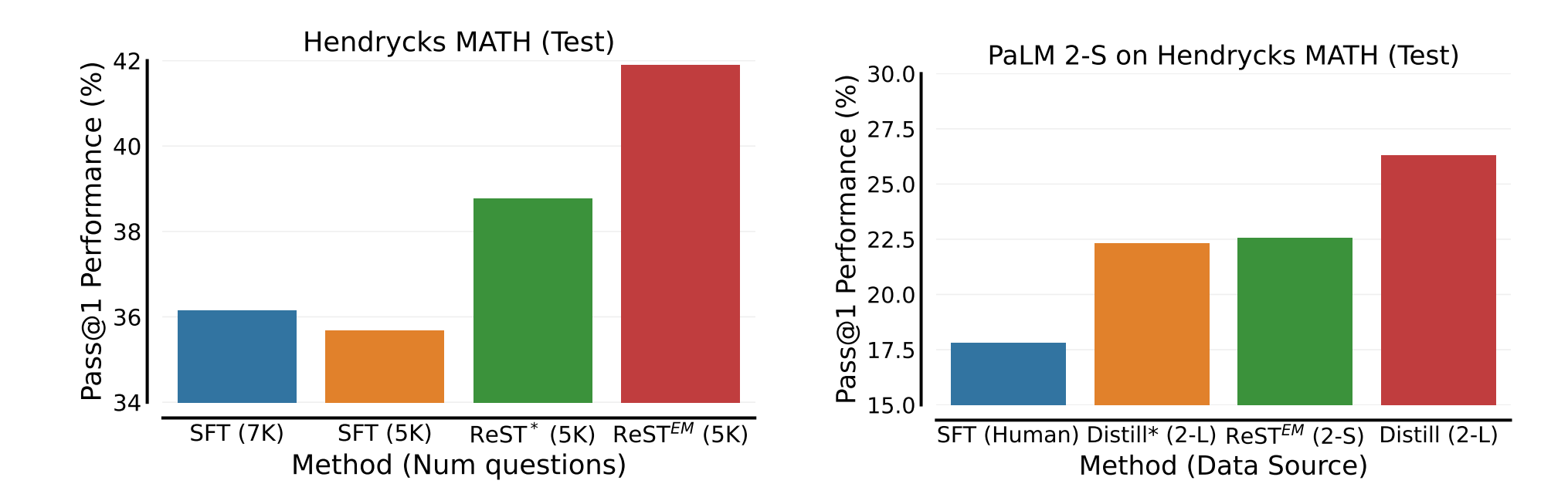
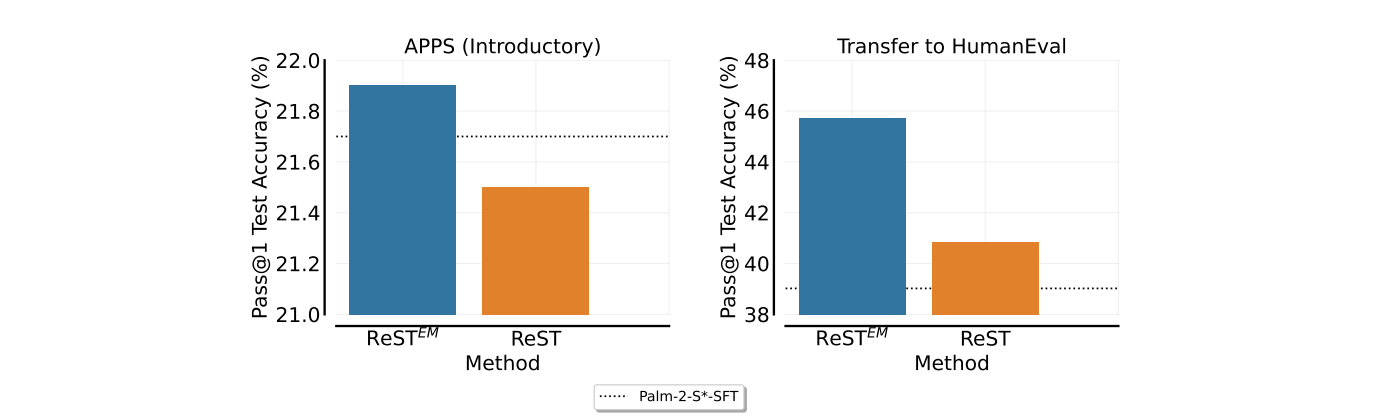
A self-training method based on expectation-maximization for reinforcement learning with language models. It iteratively generates samples from the model, filters them using binary feedback (E-step), and fine-tunes the base pretrained model on these filtered samples (M-step). Unlike the original ReST, ReST^EM doesn't augment with human data and fine-tunes the base model each iteration, improving transfer performance.
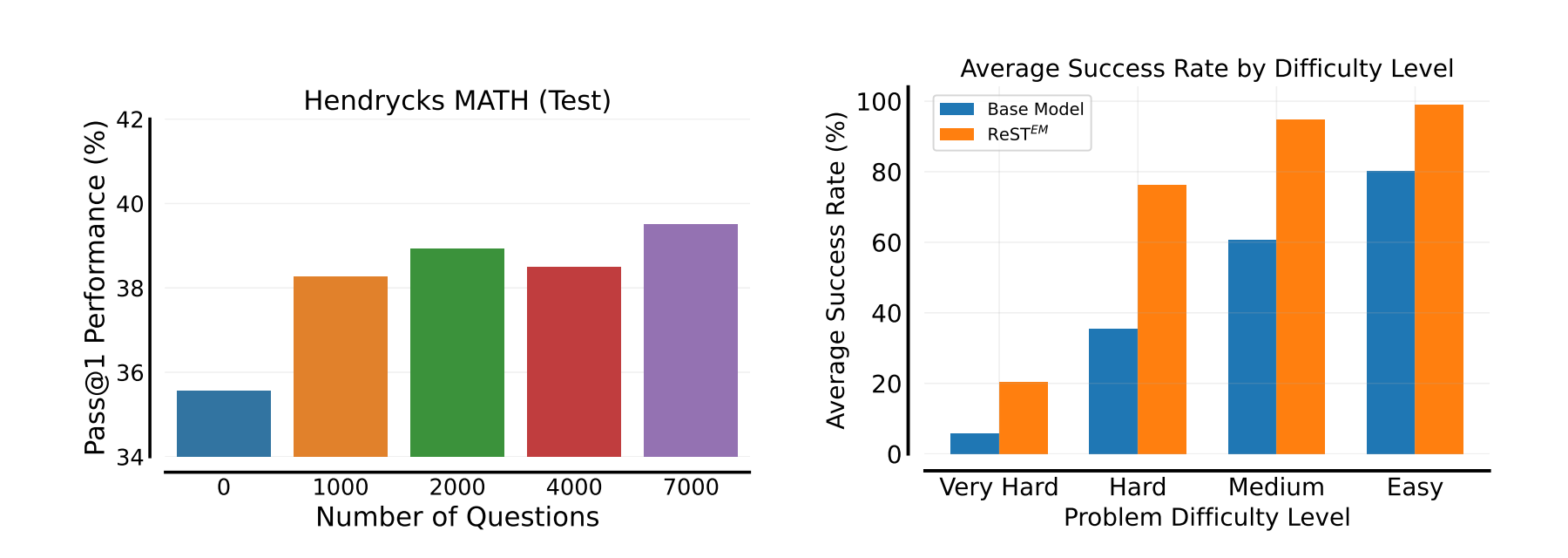
Large language models (LLMs) have shown remarkable problem-solving abilities, but their training often depends on vast amounts of human-generated data, which is costly and may not be optimal. ReST^EM addresses this by introducing a self-training loop that leverages the model's own generations, filtered by binary feedback, to iteratively improve performance. This approach is particularly relevant for AI practitioners seeking to scale model capabilities without proportional human effort. The paper demonstrates that self-generated data can surpass human data in effectiveness, especially for math and code tasks, and that careful iteration management preserves transfer to other benchmarks.
ReST^EM is grounded in the expectation-maximization (EM) framework, treating the problem as a reinforcement learning task with binary rewards. The method consists of two alternating steps:
E-step (Generate): The current policy (language model) generates multiple output sequences for each input from the original dataset. These outputs are scored using a binary reward function (0 or 1), which in practice checks correctness (e.g., for math problems, whether the final answer matches; for code, whether the program passes tests). Only outputs with reward 1 are retained for the next step.
M-step (Improve): The base pretrained model is fine-tuned on the filtered dataset using a reward-weighted negative log-likelihood loss: (J(\theta) = \mathbb{E}{(x,y) \sim D_i} [r(x,y) \log p\theta(y|x)]). Crucially, each M-step starts from the original base model, not the model from the previous iteration. This prevents drift and preserves the model's general capabilities, leading to better transfer performance on held-out tasks.
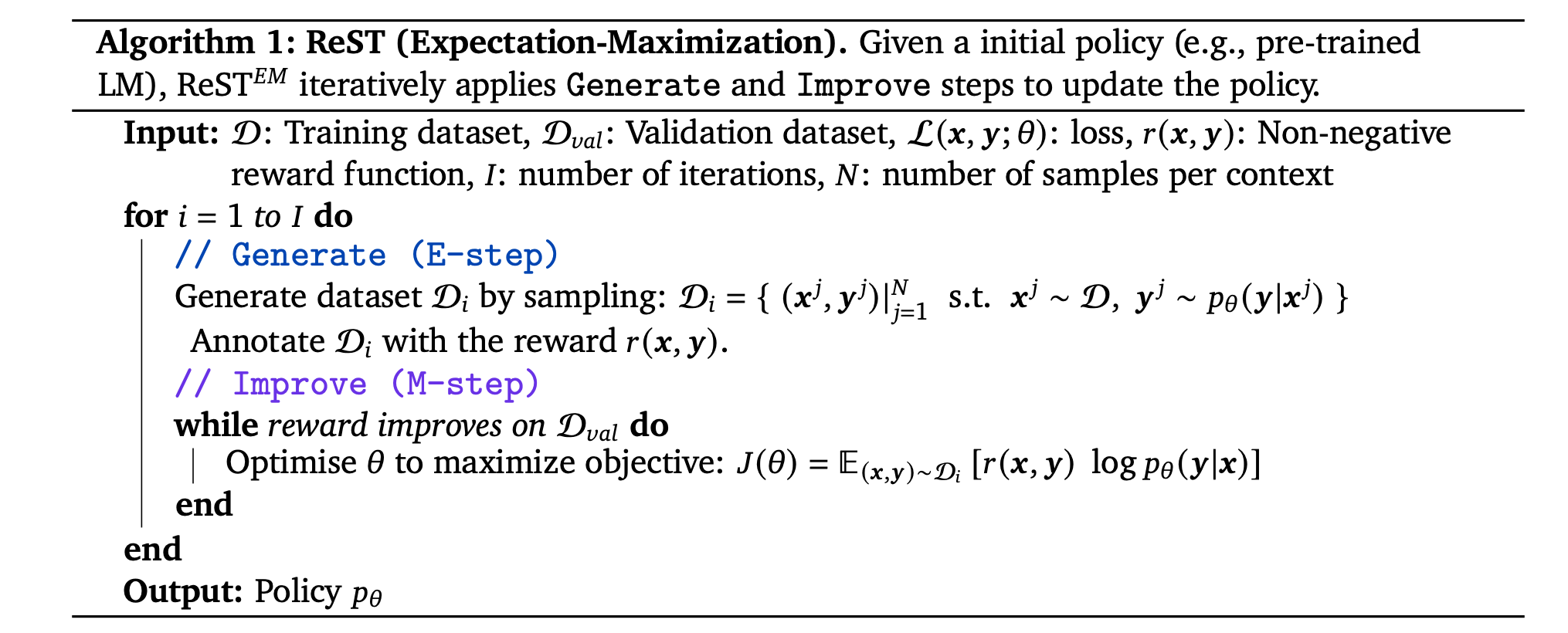
Unlike the original ReST method, ReST^EM does not augment the dataset with human-generated outputs, as these may not be optimal or readily available. The binary reward simplifies the process: any threshold (\tau \in (0,1)) yields the same filtering, so only one Improve step per iteration is needed.
The experiments use PaLM 2 models (S, S*, L) on MATH and APPS datasets, with evaluation on multiple benchmarks including GSM8K, HumanEval, and Big-Bench Hard.
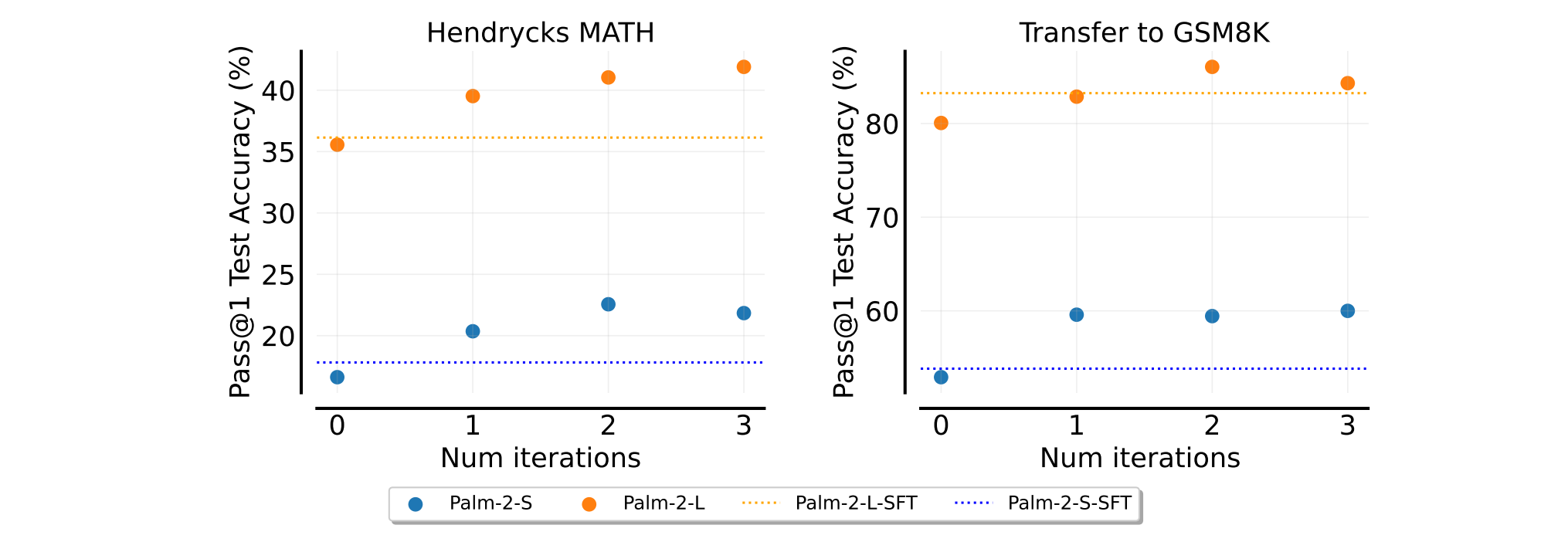
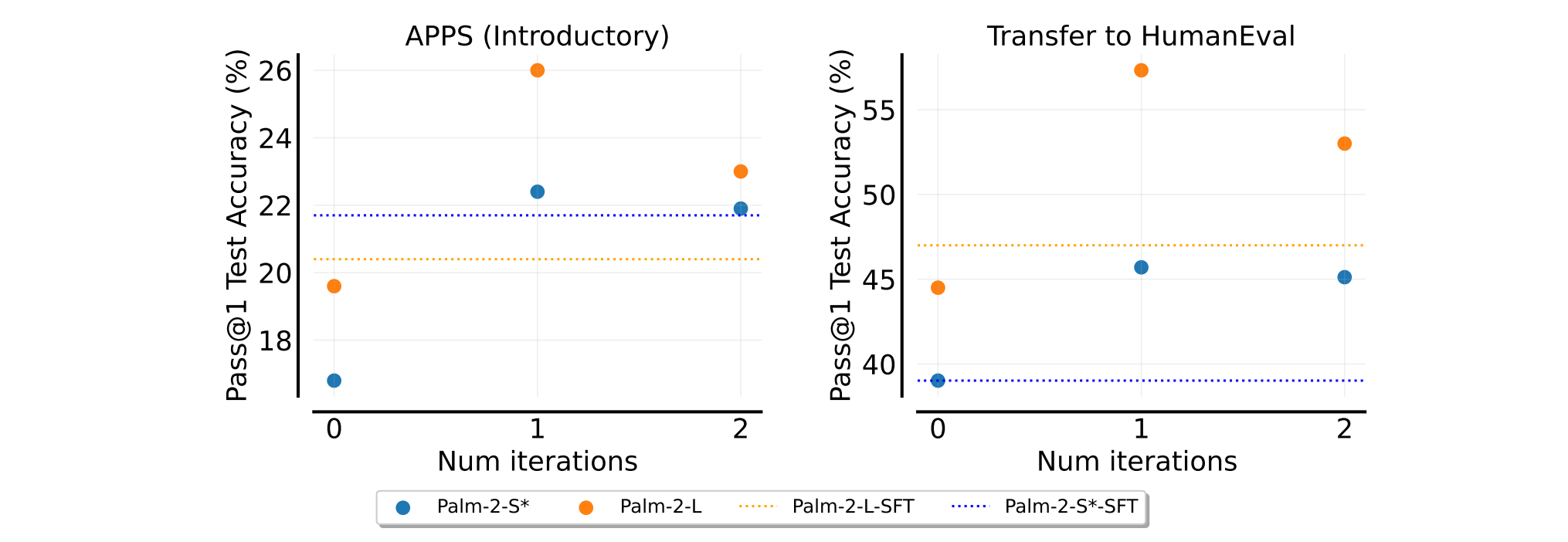
Key findings:
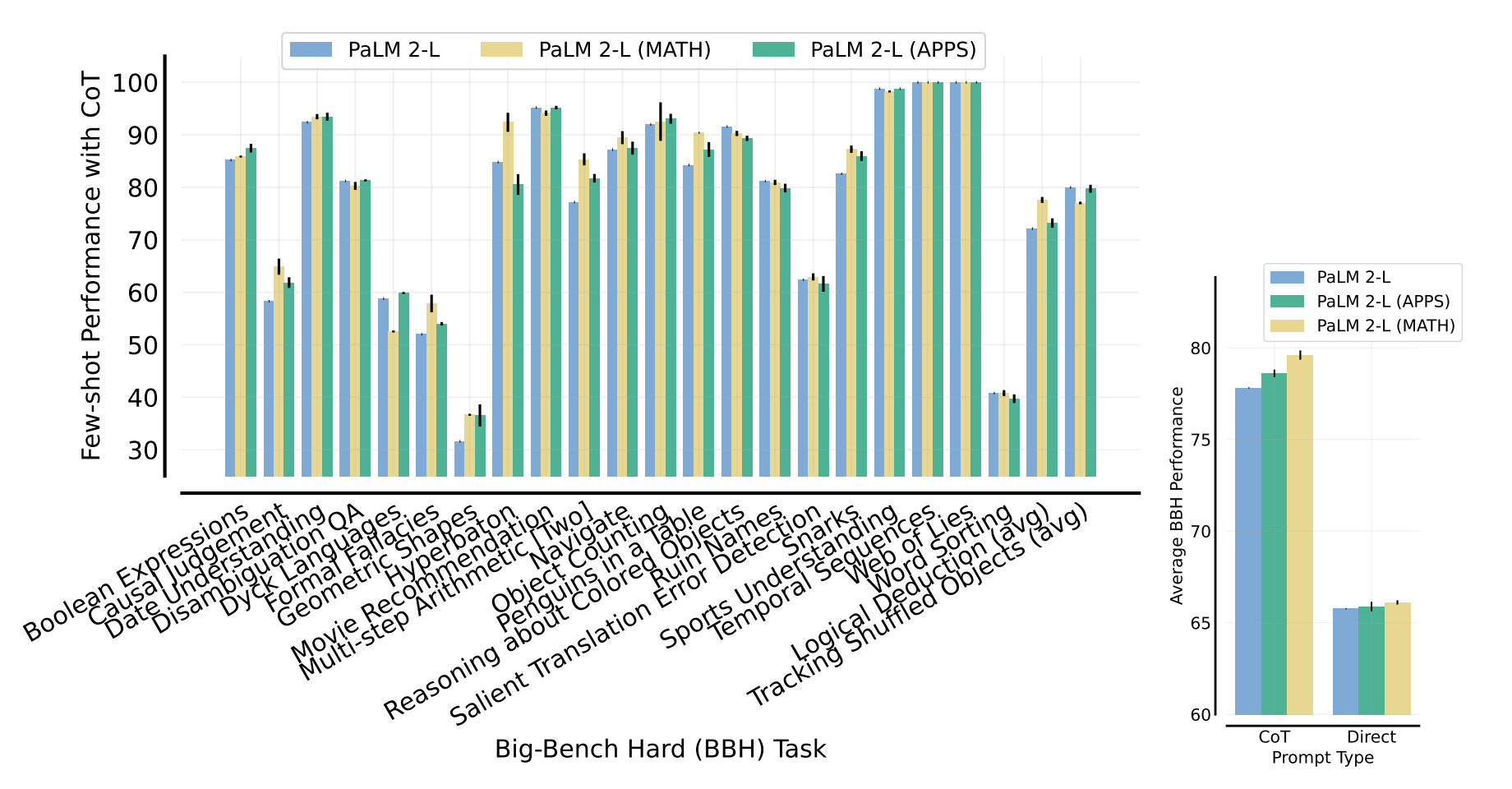
ReST^EM provides a practical, scalable self-training recipe for LLMs that reduces dependence on human annotations. By iteratively using the model's own correct generations, it achieves superior performance on math and code tasks while maintaining transferability. The finding that multiple iterations can overfit on code tasks underscores the need for task-specific tuning of iteration counts. For AI practitioners, this method offers a path to continuously improve models with minimal human intervention, potentially accelerating progress in problem-solving domains.
Alex Krizhevsky, Ilya Sutskever et al.
Ashish Vaswani, Noam Shazeer et al.
Douglas M. Bates, Martin Mächler et al.
Diederik P. Kingma, Jimmy Ba