PreprintCommunications of the ACM
ImageNet classification with deep convolutional neural networks
Alex Krizhevsky, Ilya Sutskever et al.
130k2017
0
Citations
0
Influential Citations
—
Venue
2024
Year
Provides a detailed recipe for online iterative RLHF and achieves state-of-the-art performance on various benchmarks using fully open-source datasets.
Reinforcement Learning from Human Feedback (RLHF) is the backbone of aligning large language models (LLMs) with human preferences, powering systems like ChatGPT and Claude. However, most existing implementations are either offline (using a fixed preference dataset) or rely on complex deep RL methods like PPO that are hard to tune and memory-intensive. This paper bridges the gap by providing a complete, open-source recipe for online iterative RLHF—a process where the model continuously collects new preference data during training, adapts its reward model, and improves its policy. The result is a state-of-the-art 8B model that outperforms many larger models, proving that iterative alignment can be both practical and powerful.
The workflow is divided into two main phases: reward modeling and iterative policy optimization.
The authors start by assembling a large, diverse set of open-source preference datasets (HH-RLHF, SHP, HelpSteer, PKU-SafeRLHF, UltraFeedback, UltraInteract, Distilabel-Capybara, Distilabel-Orca3). They apply a filtering step that removes low-quality samples, empty conversations, and pairwise comparisons with small score margins (roughly 10% of data is discarded).
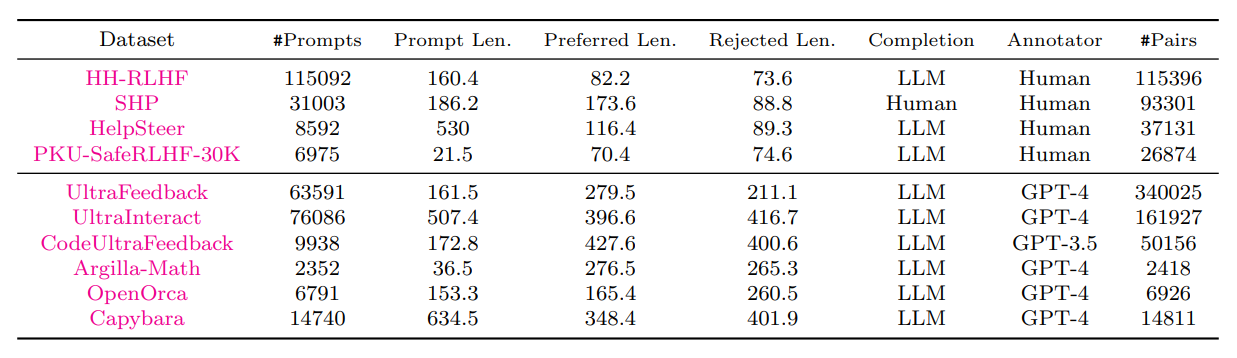
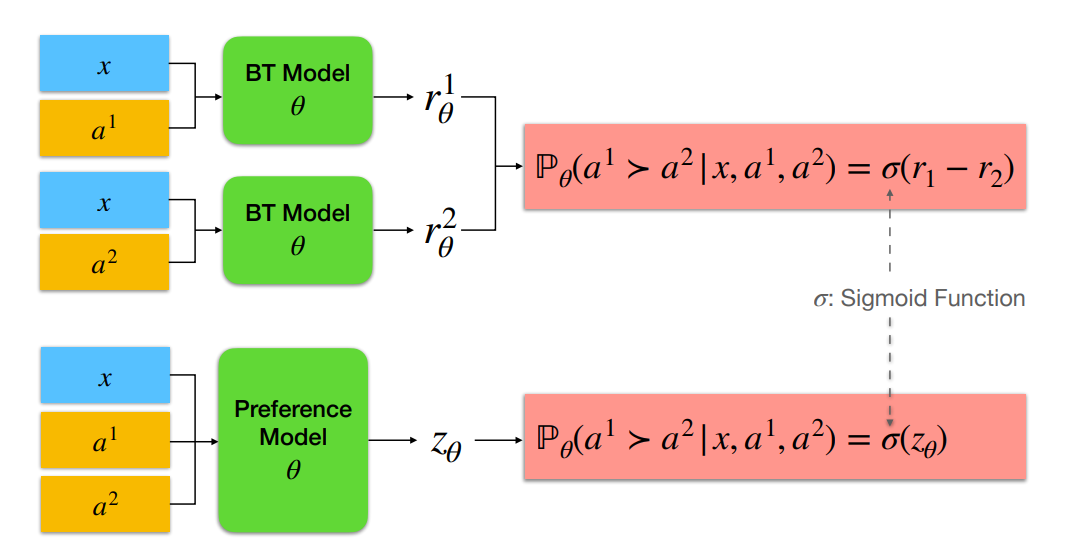
Two types of models are trained on this data:
Both are trained for one epoch. The authors experiment with two dataset mixes: Mix1 (HH-RLHF + SHP + UltraFeedback + Summarization) and Mix2 (all datasets).
The policy (LLaMA-3-8B) is first SFT on a mixture of instruction datasets. Then, iterative direct preference learning is applied:
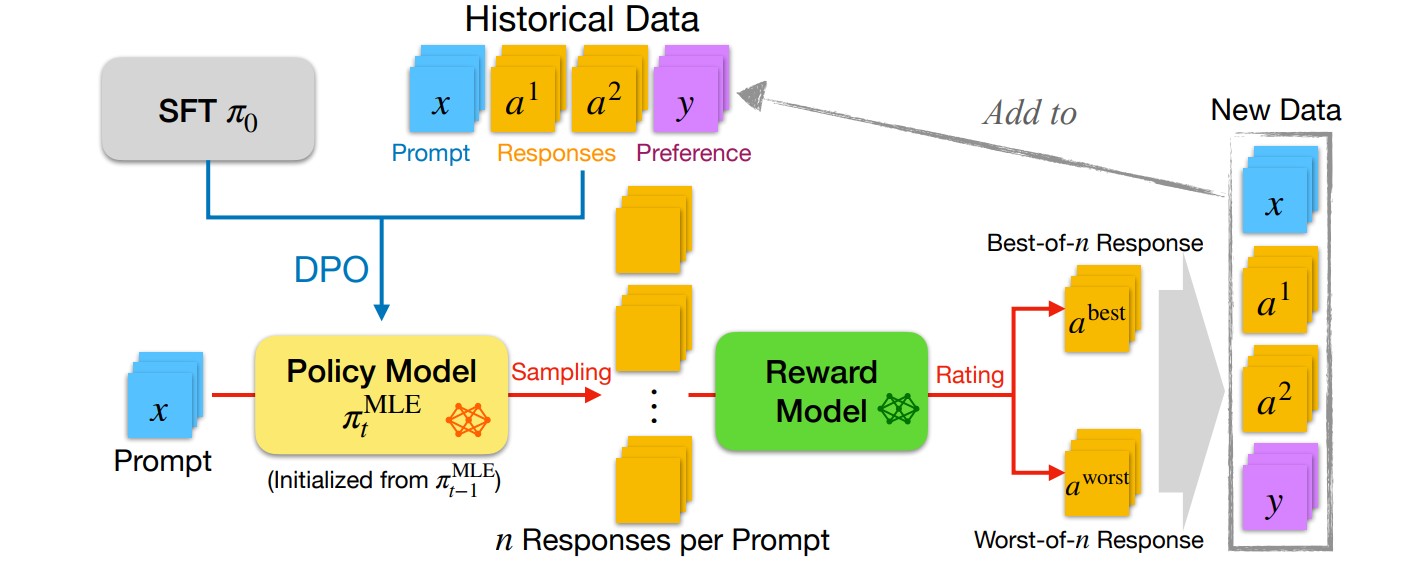
Prompts for online collection are drawn from UltraFeedback, HelpSteer, OpenOrca, UltraInteract, Capybara, and DIBT-10K.
The final model, SFR-Iterative-DPO-LLaMA-3-8B-R, was evaluated on AlpacaEval-2, MT-Bench, and Chat-Arena-Hard.

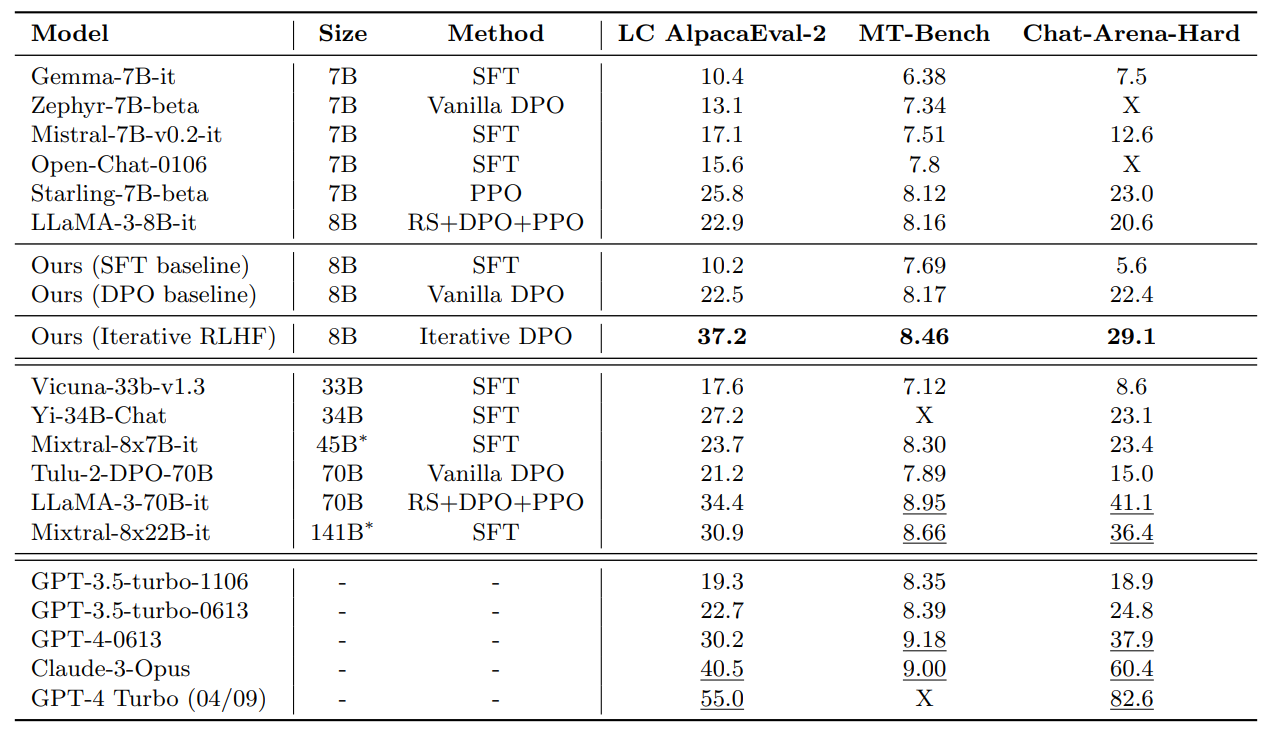

Key findings:
This paper democratizes advanced RLHF by offering a fully open-source, reproducible pipeline. It demonstrates that iterative online data collection—combined with careful dataset filtering and a dual-agent exploration strategy—can yield models that rival proprietary systems. For practitioners, the provided code repositories and HuggingFace datasets lower the barrier to implementing state-of-the-art alignment. The work also underscores the importance of addressing reward model over-optimization through continuous data refresh, a lesson that applies broadly to AI alignment research.
Alex Krizhevsky, Ilya Sutskever et al.
Ashish Vaswani, Noam Shazeer et al.
Douglas M. Bates, Martin Mächler et al.
Diederik P. Kingma, Jimmy Ba