PreprintCommunications of the ACM
ImageNet classification with deep convolutional neural networks
Alex Krizhevsky, Ilya Sutskever et al.
130k2017
250
Citations
32
Influential Citations
arXiv.org
Venue
2024
Year
A 2B vision-language model, built using a modified Idefics3 architecture with a smaller language backbone (SmolLM2 1.7B), aggressive pixel shuffle compression, 384x384 image patches, and a shape-optimized SigLIP vision backbone, featuring a 16k token context window.
Vision-language models (VLMs) have traditionally been large, requiring substantial GPU memory and compute. SmolVLM challenges this by showing that careful architectural choices—aggressive token compression, balanced encoder-LM allocation, and optimized training strategies—can yield models that run on devices with less than 1GB VRAM while still outperforming models 40x larger. This is critical for real-world applications like on-device image captioning, video analysis, and assistive technologies where latency, privacy, and power constraints matter.
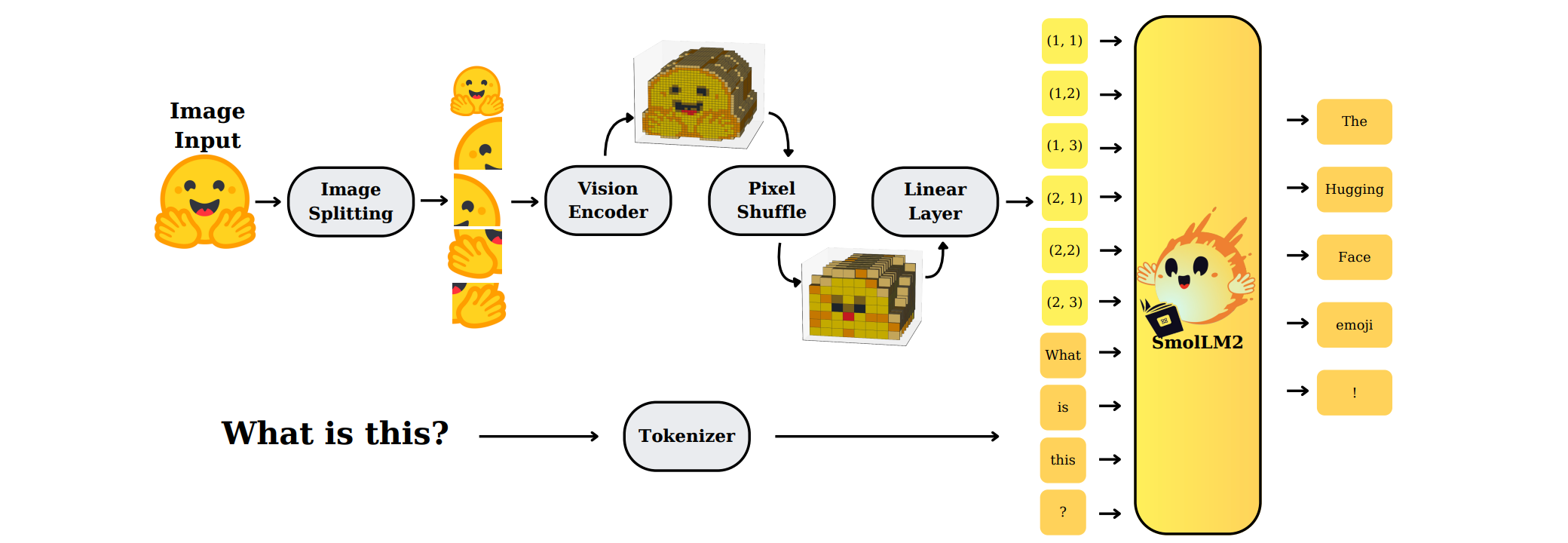
The core innovation is a systematic exploration of design trade-offs for small multimodal models. SmolVLM uses a modified Idefics3 architecture where encoded images are pooled and projected into a SmolLM2 language backbone. Three variants are built: SmolVLM-256M (93M SigLIP-B/16 + 135M SmolLM2), SmolVLM-500M (93M SigLIP + 360M SmolLM2), and SmolVLM-2.2B (400M SigLIP-SO400M + 1.7B SmolLM2).
Encoder-LM Balance: The paper finds that with small LMs (135M), a large encoder hurts performance due to imbalance. At 360M LM scale, the larger encoder improves scores by 11.6% but adds 66% parameters, making the compact encoder preferable. Only at 1.7B LM does the larger encoder add just 10% overhead.
Token Compression via Pixel Shuffle:
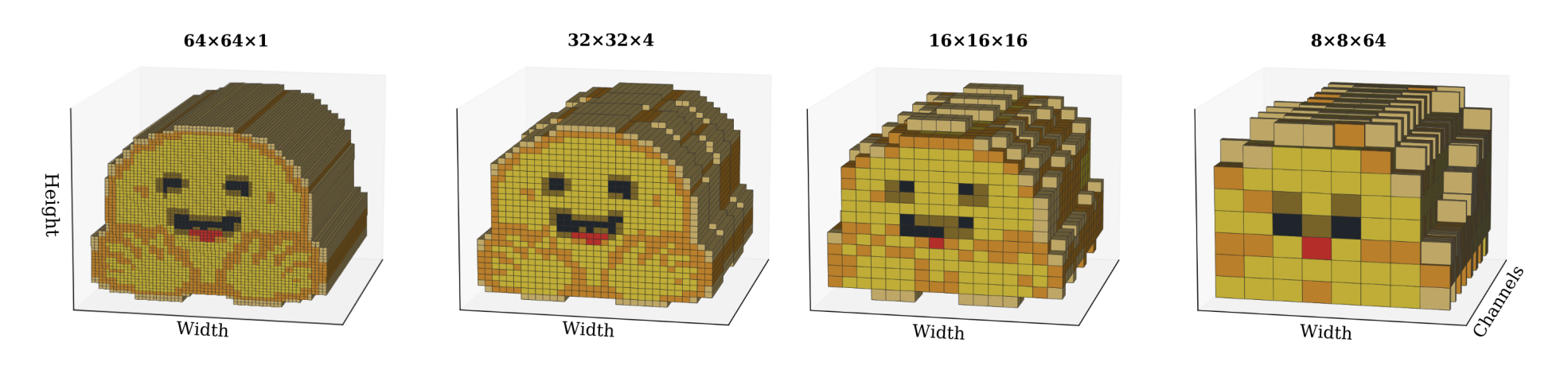
Pixel shuffle rearranges spatial features into channels, reducing token count by factor r². While larger models use r=2, SmolVLM benefits from r=4, as fewer tokens ease attention overhead. This is critical for small models with limited capacity.
Context Extension: To handle visual tokens (1024 for a 512×512 image with SigLIP-B/16), the context window is extended from 2k to 16k tokens by increasing the RoPE base from 10k to 273k and fine-tuning on long-context data. Smaller variants cap at 8k.
Positional Tokens vs. Strings:
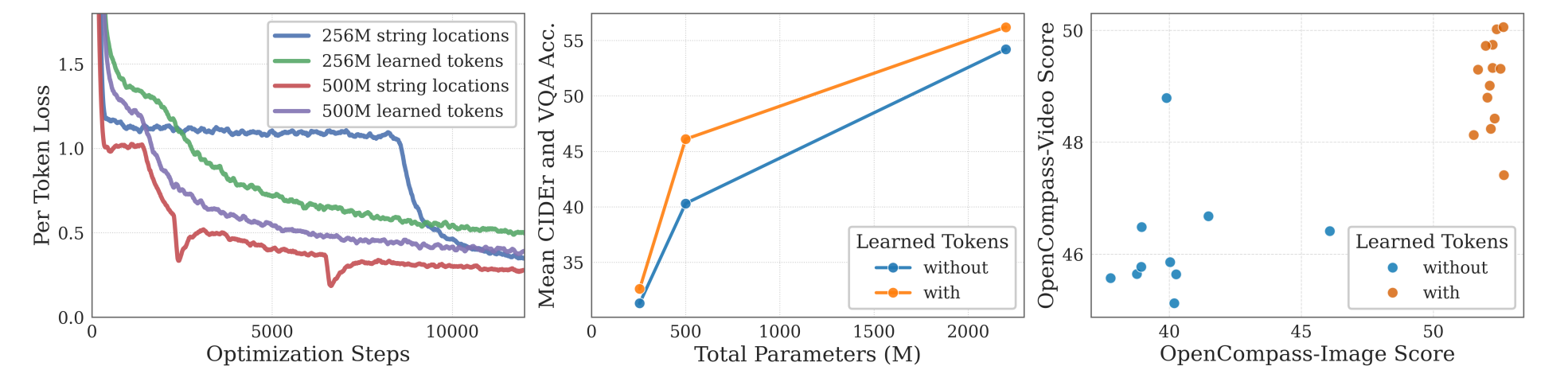
Learned positional tokens for sub-image encoding dramatically improve training convergence and OCR accuracy over naive string tokens like <row_1_col_2>, which cause early training plateaus.
Training Data and Strategies:
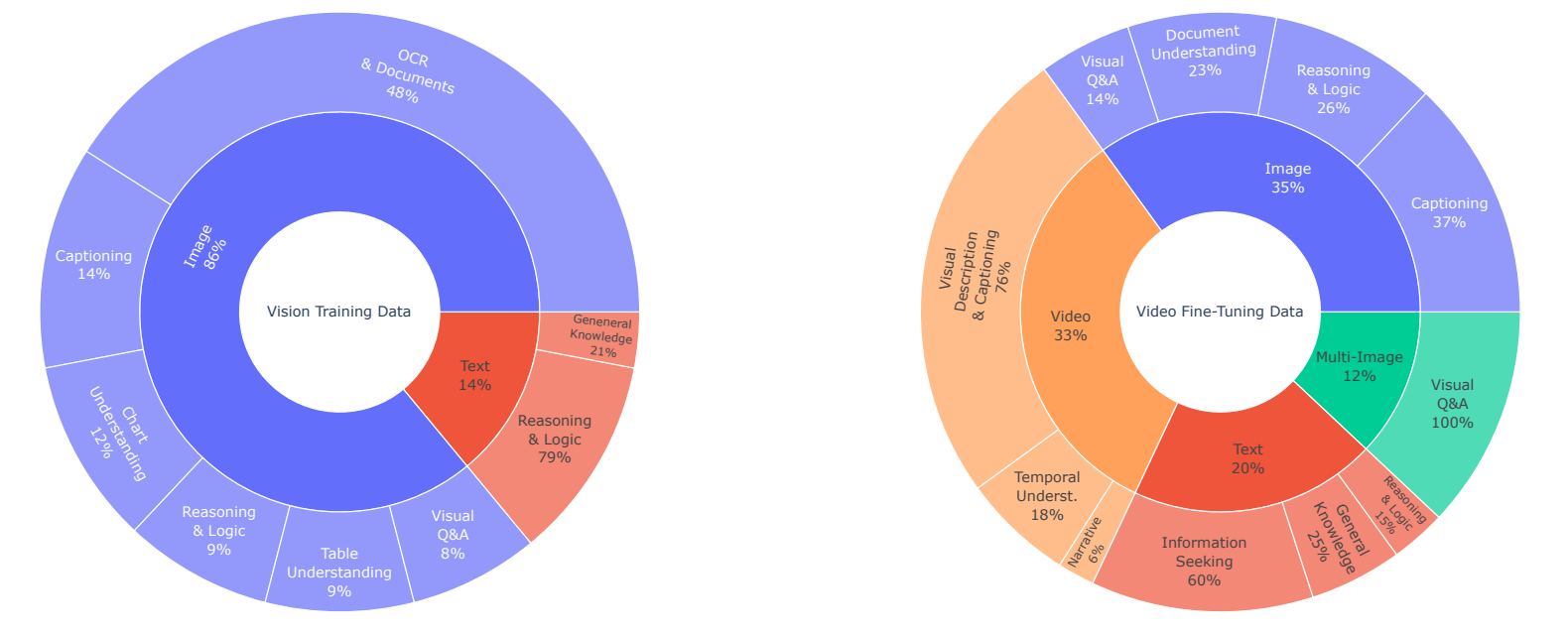
Training occurs in two stages: vision (document understanding, captioning, VQA, chart/table reasoning) and video (captioning, temporal understanding, narrative comprehension). A strict 14% text proportion is maintained, as reusing LLM-SFT text degrades performance by up to 6.5%. Chain-of-thought data is limited to 0.02-0.05% to avoid overwhelming visual capacity.
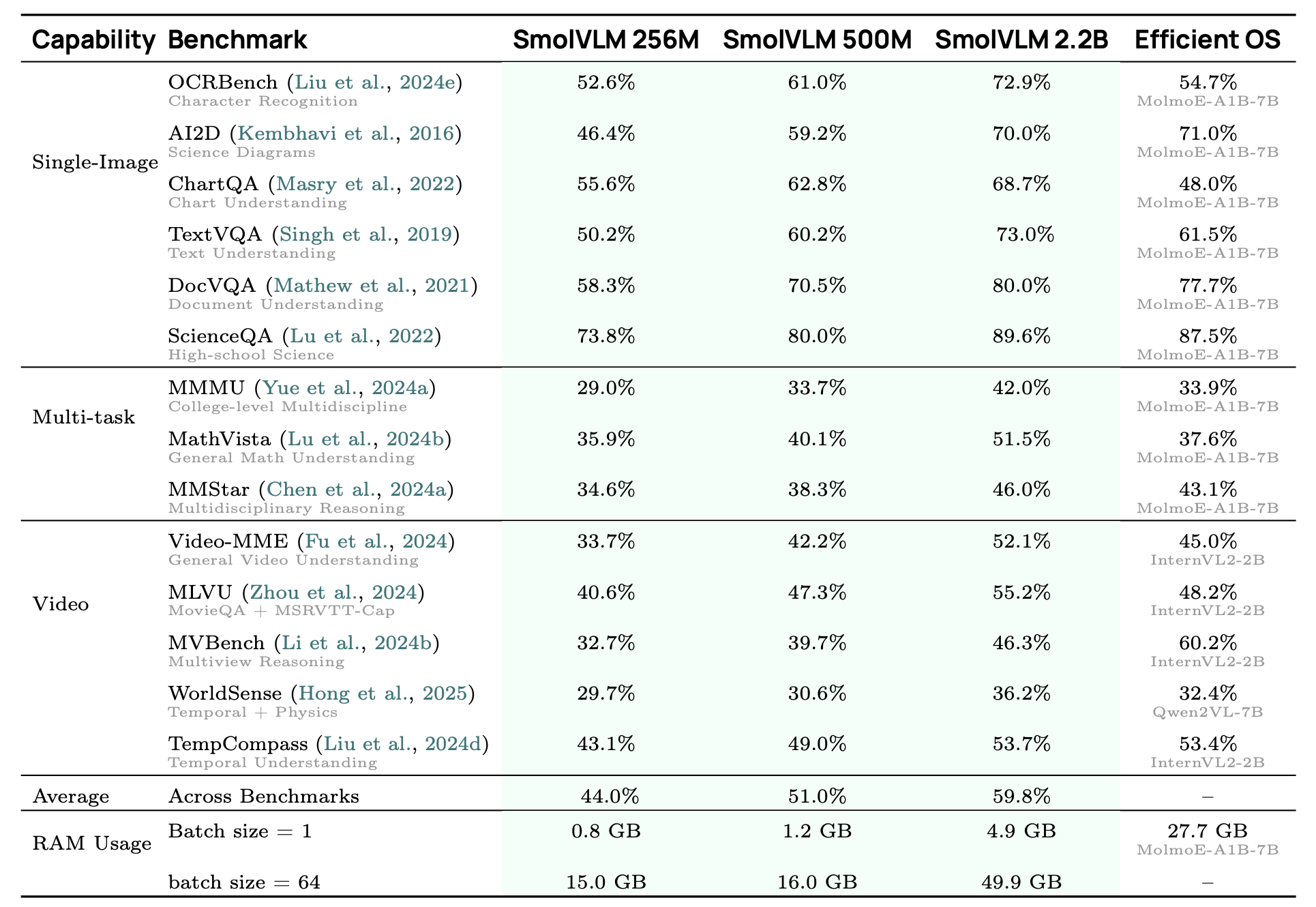
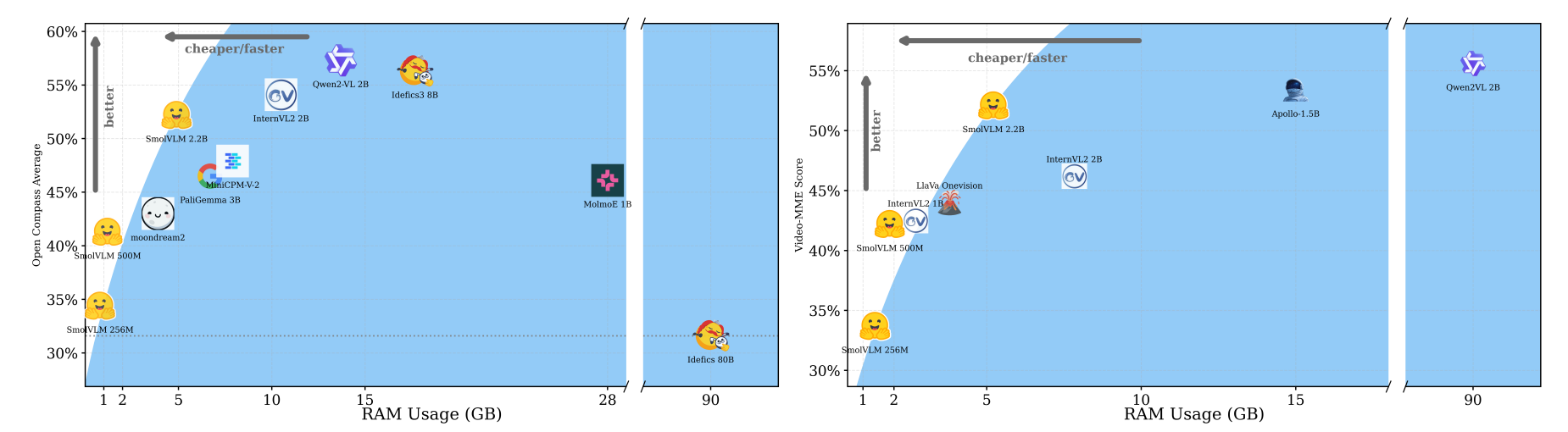
SmolVLM-2.2B achieves the highest overall score (59.8%) among models up to 80B parameters, outperforming Idefics 80B on most benchmarks. SmolVLM-256M uses only 0.8GB VRAM for single-image inference versus 27.7GB for MolmoE-A1B-7B. On video tasks, SmolVLM beats larger models on Video-MME and WorldSense.
On-device throughput is impressive: SmolVLM-256M achieves 16.3 examples/second on A100 and 2.7 on L4, making it suitable for real-time edge applications.
SmolVLM demonstrates that small VLMs can be both efficient and capable when designed with careful trade-offs. The key insights—aggressive token compression, balanced encoder-LM allocation, learned positional tokens, and limited CoT data—provide a blueprint for building practical multimodal AI that runs on phones, IoT devices, and other resource-constrained hardware. This work opens the door to widespread deployment of vision-language capabilities in privacy-sensitive and low-latency applications.
Alex Krizhevsky, Ilya Sutskever et al.
Ashish Vaswani, Noam Shazeer et al.
Douglas M. Bates, Martin Mächler et al.
Diederik P. Kingma, Jimmy Ba