PreprintCommunications of the ACM
ImageNet classification with deep convolutional neural networks
Alex Krizhevsky, Ilya Sutskever et al.
130k2017
0
Citations
0
Influential Citations
—
Venue
2023
Year
Proposes Reinforcement Learning from Evol-Instruct Feedback (RLEIF) method, applied to Llama-2 to enhance the mathematical reasoning abilities.
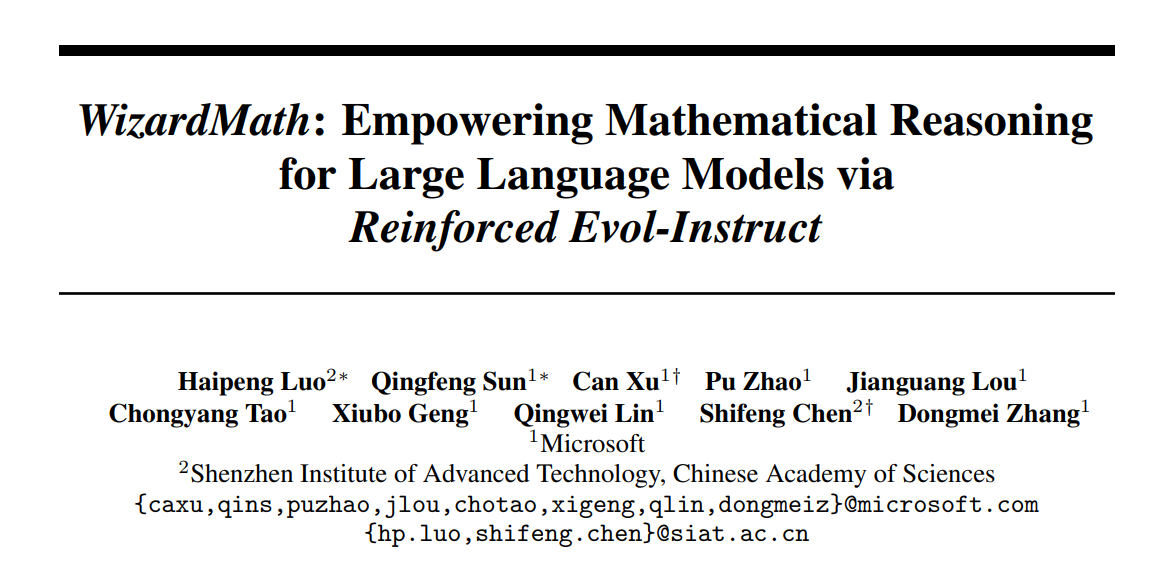
Mathematical reasoning remains a critical benchmark for large language models, yet open-source models have historically lagged behind proprietary systems like GPT-4 and PaLM. WizardMath tackles this gap head-on by introducing Reinforcement Learning from Evol-Instruct Feedback (RLEIF), a method that combines instruction evolution with process-supervised reinforcement learning. The paper shows that a 13B model can outperform PaLM 540B on GSM8k, and a 70B model rivals ChatGPT and Claude Instant. This is a significant step toward democratizing advanced math reasoning capabilities.
WizardMath builds on the Evol-Instruct paradigm from WizardLM and the process reward model (PRM) concept. The RLEIF pipeline consists of three stages:
Supervised Fine-Tuning (SFT): The base Llama-2 model is fine-tuned on a curated dataset of 15k step-by-step solutions for GSM8k and MATH, re-generated using a WizardLM 70B alpha model to ensure correct answers. Additionally, 1.5k open-domain conversations from WizardLM are mixed in to improve instruction following.
Reward Model Training: Two separate reward models are trained:
PPO Training with Evol-Instruct: The original math instructions are evolved through 8 turns of upward and downward evolution, expanding the dataset from 15k to 96k. During PPO, the final reward is the product of the instruction reward (rI) and the answer reward (rA). Wizard-E, a fine-tuned Llama model, performs the evolution without external APIs.
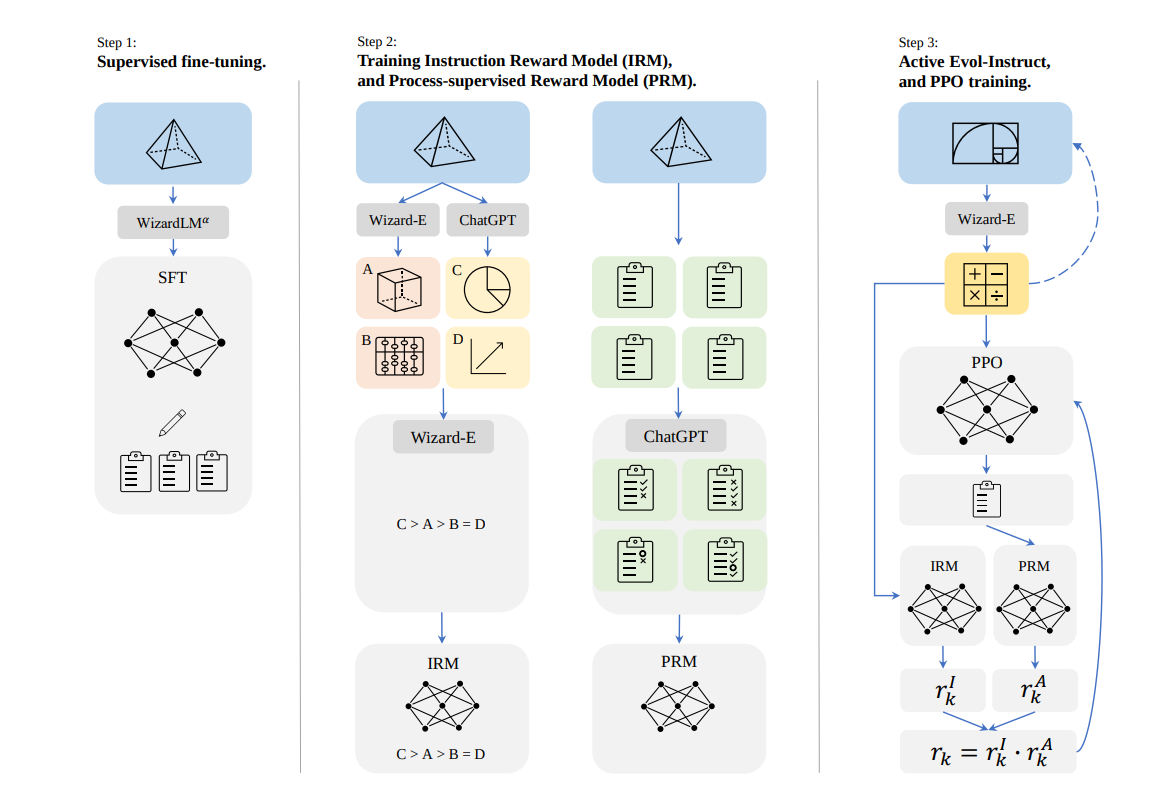
The evolution process includes:
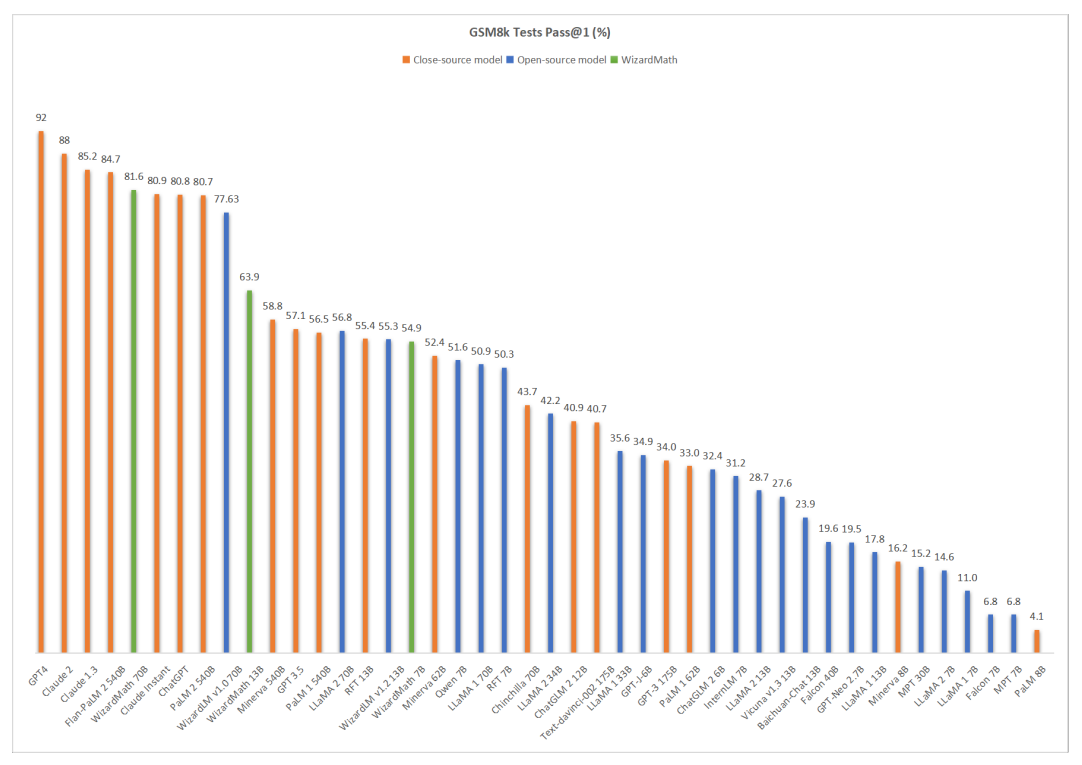
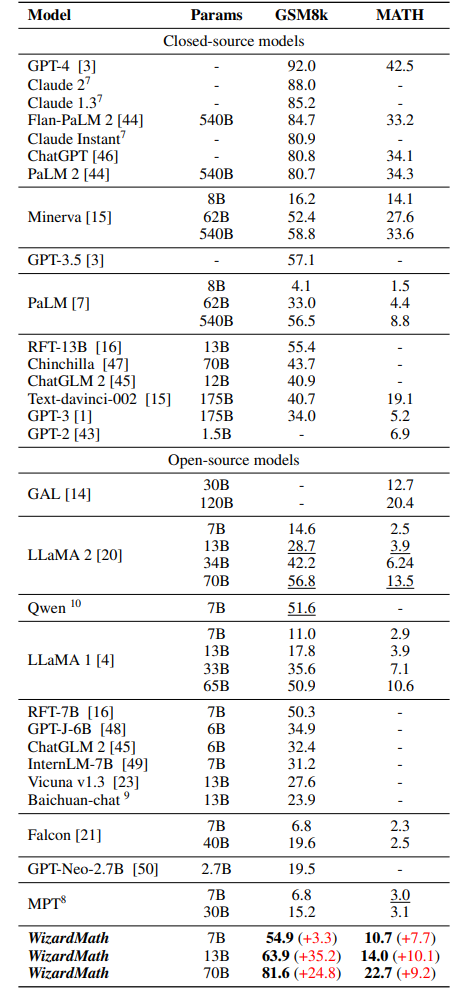
WizardMath demonstrates that careful integration of instruction evolution and process-supervised reinforcement learning can dramatically boost mathematical reasoning in open-source LLMs. The method is data-efficient (starting from only 15k examples) and does not require proprietary APIs for evolution after training Wizard-E. This work sets a new bar for open-source math models and provides a practical blueprint for applying RLEIF to other reasoning domains. The public release of code and weights further accelerates community progress.
Alex Krizhevsky, Ilya Sutskever et al.
Ashish Vaswani, Noam Shazeer et al.
Douglas M. Bates, Martin Mächler et al.
Diederik P. Kingma, Jimmy Ba