

Adaptive
FreemiumRevolutionize business AI with tailored, private, fast model tuning.
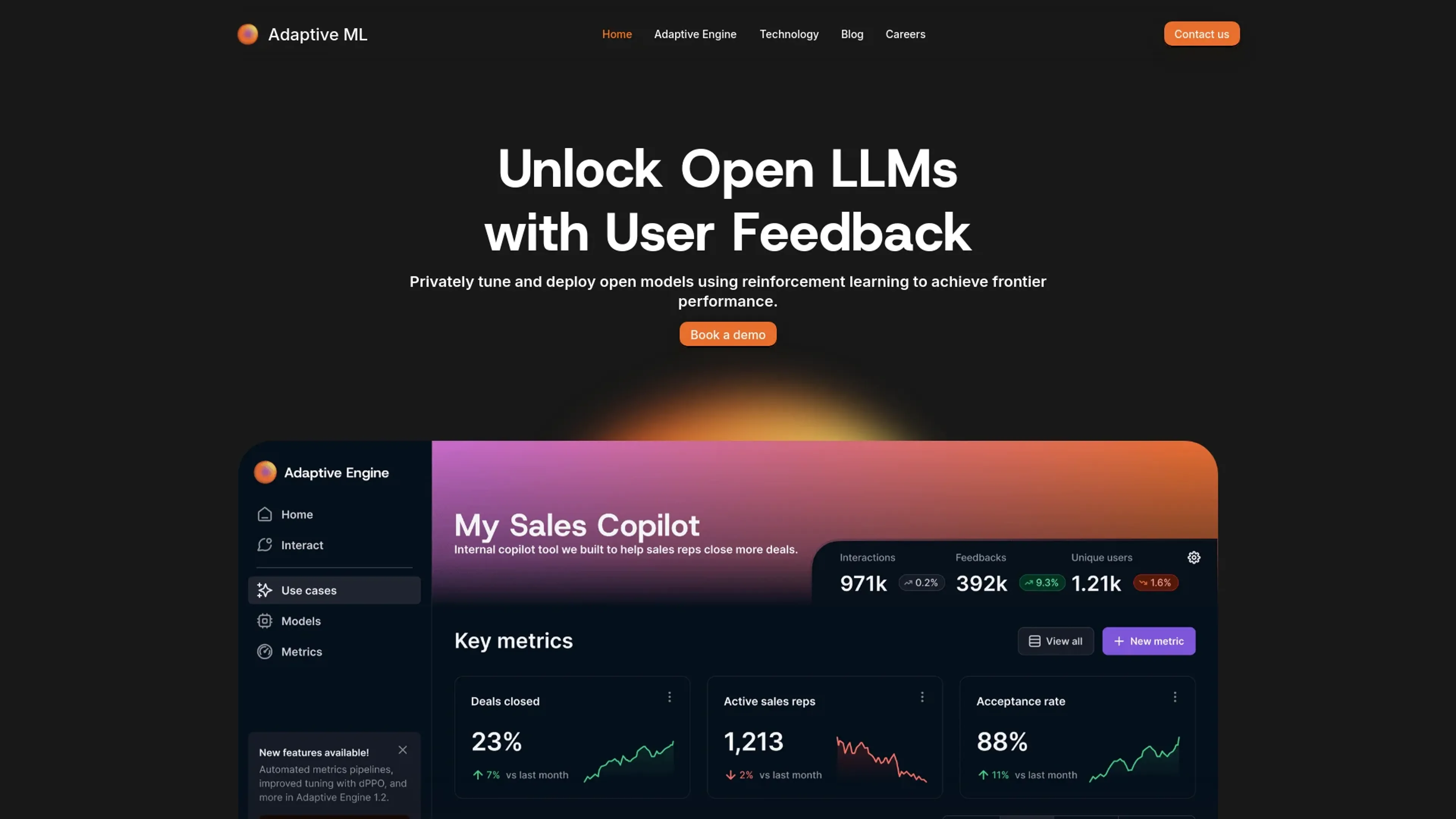
About Adaptive
Adaptive is an advanced AI tool designed to transform how businesses leverage large language models (LLMs). It provides a suite of tools for fine-tuning and deploying open models using reinforcement learning techniques, which enhances their performance and ensures they meet specific business needs while safeguarding user privacy. Adaptive is tailored for businesses aiming to boost their generative AI capabilities through optimized model adaptation, fast inference, and continuous improvement based on real-time feedback.
Key Features
- Model Adaptation with RLHF & RLAI: Utilizes reinforcement learning techniques, such as Reinforcement Learning from Human Feedback (RLHF) and Reinforcement Learning from AI (RLAI), to fine-tune models for better performance.
- Fast Inference: Ensures low-latency responses, critical for maintaining user engagement and operational efficiency.
- Automated A/B Testing: Empirically tests different models to identify and deploy the most effective version.
- Privacy-Centric Design: Operates models within a company's private cloud, ensuring data remains confidential and is not sent to third-party servers.
- Continuous Monitoring: Tracks key performance indicators (KPIs) and user metrics for ongoing model refinement.
Pros
- Enhanced Performance: Reinforcement learning techniques help models excel in their specific tasks, delivering superior performance.
- Data Privacy: By running models in a private cloud environment, Adaptive ensures that sensitive data is kept secure.
- Scalability: Suitable for both small-scale experiments and extensive deployments, accommodating diverse business needs.
- User Feedback Integration: Facilitates real-time improvements based on direct user feedback, enhancing model relevance and effectiveness.
Cons
- Complex Technology: The sophisticated nature of reinforcement learning may require a learning curve for users unfamiliar with the technology.
- Higher Resource Requirement: Advanced technology may demand more robust computing resources.
- Limited to LLMs: Focuses primarily on large language models, which might not address all potential AI applications.
Use Cases
- Tech Companies: Enhancing customer service bots and other AI-driven interactions.
- Financial Institutions: Implementing Adaptive for real-time fraud detection and financial analysis.
- Healthcare Providers: Personalizing patient interactions and improving diagnostic tools.
- Retail Chains: Utilizing Adaptive for dynamic product recommendations and customer engagement.
- Uncommon Use Cases: Non-profits using Adaptive for automating grant writing; academic institutions incorporating it into research and data analysis.
Pricing
Free Trial: Offers a 30-day free trial for new users to explore its capabilities. Enterprise Custom Solutions: Provides tailored pricing based on organizational needs and scale. Disclaimer: For the most current pricing details, please visit the official Adaptive website.
What Makes It Unique
Adaptive's standout feature is its capability to deploy and fine-tune state-of-the-art LLMs within private cloud environments, ensuring complete control over data and model adjustments. Its focus on incorporating real-time user feedback and maintaining stringent data privacy makes it a powerful tool for businesses seeking to advance their AI capabilities.
Ratings
Accuracy and Reliability: 4.8/5 Ease of Use: 4.0/5 Functionality and Features: 4.5/5 Performance and Speed: 4.7/5 Customization and Flexibility: 4.6/5 Data Privacy and Security: 5.0/5 Support and Resources: 4.3/5 Cost-Efficiency: 4.4/5 Integration Capabilities: 4.5/5 Overall Score: 4.58/5
Key Features
Pros & Cons
- Enhanced Performance: Reinforcement learning techniques help models excel in their specific tasks, delivering superior performance.
- Data Privacy: By running models in a private cloud environment, Adaptive ensures that sensitive data is kept secure.
- Scalability: Suitable for both small-scale experiments and extensive deployments, accommodating diverse business needs.
- User Feedback Integration: Facilitates real-time improvements based on direct user feedback, enhancing model relevance and effectiveness.
- Complex Technology: The sophisticated nature of reinforcement learning may require a learning curve for users unfamiliar with the technology.
- Higher Resource Requirement: Advanced technology may demand more robust computing resources.
- Limited to LLMs: Focuses primarily on large language models, which might not address all potential AI applications.
Best For
Alternatives to Adaptive
AiCogni
Unleash the Power of AI Communication with AiCogni
Aiwizard
Automate customer conversations, improve satisfaction, and analyze performance with AI-powered chatbot agents.
BrightBot
Versatile Chatbot Solution for Seamless Customer Interaction
KITT By LiveKit
KITT by LiveKit: Real‑time multimodal AI for live voice, video, and text
AI.LS
Master AI and ML with AI Learning Studio!
Olympia
Empower Your Business with Olympia's AI-Powered Consultants