

KindredMind
FreemiumHandle dementia calls in your reassuring voice.
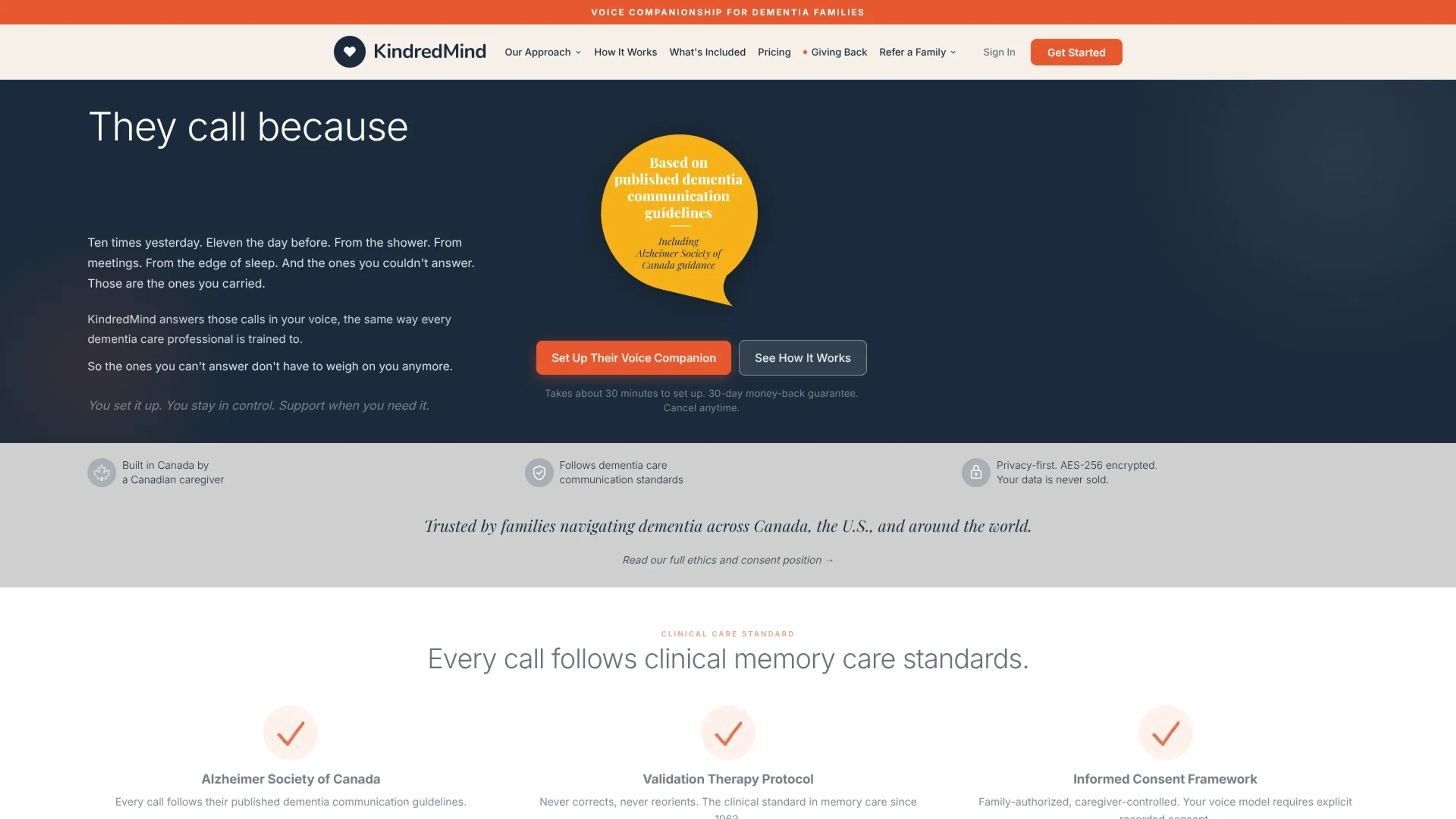
About KindredMind
KindredMind is a voice companion for families supporting someone with dementia. It answers their calls in the caregiver's cloned voice, following dementia communication guidelines to reduce anxiety and repetitive dialing. Conversations run on language models tuned to validation and simulated presence therapy and aligned with Alzheimer Society of Canada phone guidance. Families get a dedicated number, personalized responses from a knowledge base, and call summaries while staying in control of when AI steps in.
Key Features
- Living Voice cloning: Builds a caregiver voice from brief recordings and refines it from real calls.
- Clinical conversation engine: Uses GPT 4o and dementia rules that validate feelings instead of correcting facts.
- Personal knowledge base and training calls: Store routines, relationships, stories, and preferences to keep replies specific.
- Call handling tools: Include a dedicated number, auto schedule, live monitoring, emergency detection, and failsafe routing.
Pros
- Clinically aligned approach: Mirrors memory care communication, not generic chatbot talk or scripts.
- Caregiver relief: Reduces interruption and guilt by reliably answering calls in a familiar, calm voice.
- Personalization: From the knowledge base and Living Voice makes conversations feel recognizably like the caregiver.
- Supportive onboarding: Strong onboarding, free setup call, trial period, and a library of guides support family members.
Cons
- Cost barrier: Premium monthly pricing may limit access for families with tighter budgets.
- Stage limitations: Only suits mild to moderate stages where the person can still use a phone.
- Tech demands: Requires comfort with phone routing and apps, which can be stressful for some caregivers.
Use Cases
- Individual family caregivers: Adult children or spouses facing frequent reassurance calls.
- Working professionals with caregiving duties: Employees who must stay reachable but cannot interrupt every task.
- Distributed families: Siblings or relatives in different cities sharing oversight through shared dashboards.
- Professional caregivers and facilities: Personal support workers and memory care operators recommending it to families.
- Uncommon Use Cases: Included in employer caregiver benefits, or piloted in academic dementia research projects.
Pricing
Essential: $129 per month (USD). Includes 200 minutes per month, Living Voice cloned voice, dedicated phone number, personal knowledge base, Training Calls, daily routine awareness, call summaries after every call, weekly family digest, emergency alert system, and support for 11 languages. Standard: $179 per month (USD). Includes 300 minutes per month, everything in Essential, plus live call monitoring, silent listen and barge in, Auto-Schedule, monthly conversation insights, conversation patterns, overage protection controls, and priority support. Complete: $239 per month (USD). Includes 400 minutes per month, everything in Standard, plus professional voice clone priority, extended knowledge base, dedicated account support, quarterly family review call, and overage protection with a maximum $20 per month overage cap. Care Circle Family Plan: $319 per month (USD). Includes 500 pooled minutes per month across all members, up to 4 caregivers each with their own cloned voice, a phone number for each member, shared knowledge base, Training Calls, shared call summaries and digests, pooled call minutes, overage protection with a maximum $20 per month overage cap, and support for 11 languages. Disclaimer: Please note that pricing information may not be up to date. For the most accurate and current pricing details, refer to the official KindredMind website.
What Makes It Unique
KindredMind focuses on one problem: repetitive, anxiety driven calls from a loved one with dementia. Instead of blocking the phone, it answers in a caregiver cloned voice using dementia conversation rules that mirror clinical guidance. Living Voice refinements, clear consent and privacy rules, multilingual support, and carrier level failsafes make it feel like a specialised clinical companion rather than a generic chatbot.
Ratings
Accuracy and Reliability: 4.5/5 Ease of Use: 4.2/5 Functionality and Features: 4.6/5 Performance and Speed: 4.5/5 Customization and Flexibility: 4.4/5 Data Privacy and Security: 4.7/5 Support and Resources: 4.6/5 Cost-Efficiency: 3.8/5 Integration Capabilities: 3.5/5 Overall Score: 4.3/5
Key Features
Pros & Cons
- Clinically aligned approach: Mirrors memory care communication, not generic chatbot talk or scripts.
- Caregiver relief: Reduces interruption and guilt by reliably answering calls in a familiar, calm voice.
- Personalization: From the knowledge base and Living Voice makes conversations feel recognizably like the caregiver.
- Supportive onboarding: Strong onboarding, free setup call, trial period, and a library of guides support family members.
- Cost barrier: Premium monthly pricing may limit access for families with tighter budgets.
- Stage limitations: Only suits mild to moderate stages where the person can still use a phone.
- Tech demands: Requires comfort with phone routing and apps, which can be stressful for some caregivers.
Best For
Alternatives to KindredMind
AiCogni
Unleash the Power of AI Communication with AiCogni
Aiwizard
Automate customer conversations, improve satisfaction, and analyze performance with AI-powered chatbot agents.
BrightBot
Versatile Chatbot Solution for Seamless Customer Interaction
KITT By LiveKit
KITT by LiveKit: Real‑time multimodal AI for live voice, video, and text
AI.LS
Master AI and ML with AI Learning Studio!
Olympia
Empower Your Business with Olympia's AI-Powered Consultants