

Augment Code
FreemiumShip production code faster with whole-codebase agents.
About Augment Code
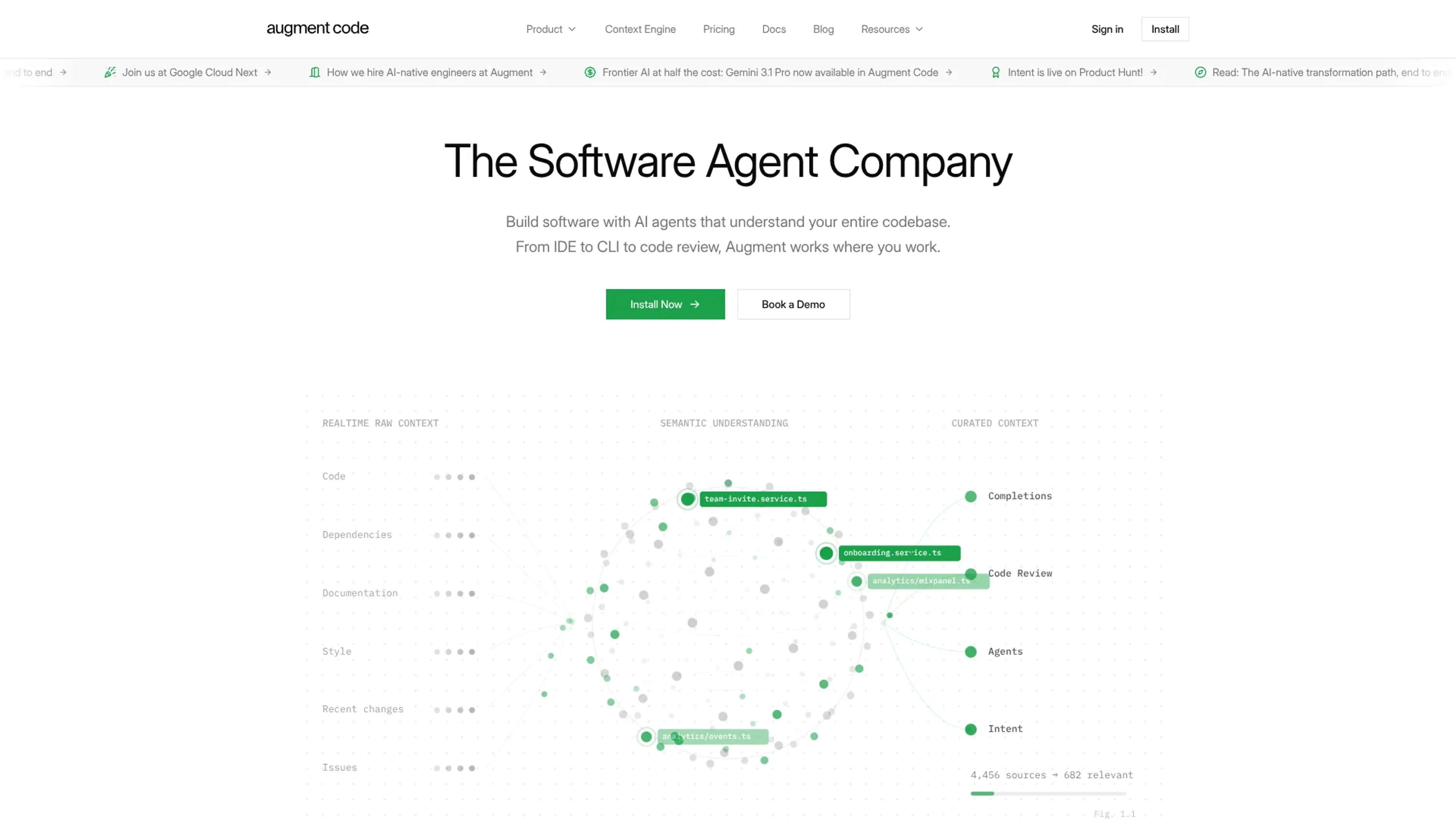
Augment Code helps engineering teams build software with AI agents that understand entire codebases. Its Context Engine keeps a live view of code, dependencies, documentation, issues, and recent changes, then feeds that into agents across IDEs, the terminal, a Mac desktop workspace called Intent, and GitHub code review. The result is AI support that behaves more like a senior teammate than an autocomplete toy, aimed squarely at professional teams shipping production code.
Key Features
- Context Engine: Continuously indexes repositories, libraries, docs, and history so agents act with project level awareness instead of file level guessing.
- IDE Agents (VS Code & JetBrains): Turn natural language tasks into edits and pull requests with task lists, multi step workflows, and persistent memories.
- Intent Workspace: Mac desktop app that coordinates multiple agents around a living spec, keeping implementation aligned with requirements in isolated, reproducible workspaces.
- Auggie CLI & Slack Integration: Terminal first and chat based agents that share the same context, ideal for shell driven workflows and lightweight collaboration.
Pros
- High quality context: Strong code reuse and architecture awareness compared to typical coding assistants.
- Multi surface coverage: Works in IDEs, CLI, Slack, and GitHub reviews, all sharing the same understanding of the codebase.
- Serious code review: Context aware review bot that catches subtle bugs and style mismatches with one click fixes in the IDE.
- Team friendly usage model: Credit pools at the team level and support for bring your own agent providers in Intent.
Cons
- Pricing tiered for pros: Costs more than basic chat based coding helpers, especially at higher usage.
- Platform limits for Intent: The Intent desktop workspace is currently focused on macOS, not Windows or Linux.
- Learning curve: Spec driven, multi agent workflows can feel unfamiliar to teams used only to inline autocomplete.
Use Cases
- Mid sized product engineering teams: Using it to ship features across large TypeScript, JavaScript, Java, or Python monorepos.
- Enterprise engineering organizations: Relying on the Context Engine and security features for regulated environments and large, multi repo estates.
- High growth startups: Adopting agents plus Intent to offload implementation work while founders and leads focus on product decisions.
- Senior individual developers and indie hackers: Using the Indie plan to get production ready help without standing up a large platform.
- Uncommon Use Cases: Used by research groups studying agentic software development; adopted by boutique consultancies to standardize AI assisted code review across client projects.
Pricing
Indie: $20 per month; includes 40,000 credits, Context Engine, MCP and native tools, SOC 2 Type II, auto top-up credits, and no AI training on your data. Standard: $60 per month per developer; includes everything in Indie, plus 130,000 credits. Max: $200 per month per developer; includes everything in Standard, plus 450,000 credits. Enterprise: Custom pricing; custom credit limits, Slack integration, annual volume discounts, SSO/OIDC/SCIM, SOC 2 and security reports, dedicated support, and no AI training on your data. Disclaimer: Please note that pricing information may not be up to date. For the most accurate and current pricing details, refer to the official Augment Code website.
What Makes It Unique
Augment Code centers everything around context quality. The Context Engine powers agents that can reason across millions of lines of code, not just the open file. Intent then coordinates multiple agents around a shared spec, giving teams both oversight and automation. Add first party code review, a terminal native experience, Slack integration, and support for multiple model providers, and the platform feels unusually cohesive for serious engineering work.
Ratings
Accuracy and Reliability: 4.7/5 Ease of Use: 4.2/5 Functionality and Features: 4.8/5 Performance and Speed: 4.6/5 Customization and Flexibility: 4.4/5 Data Privacy and Security: 4.7/5 Support and Resources: 4.4/5 Cost-Efficiency: 4.3/5 Integration Capabilities: 4.5/5 Overall Score: 4.5/5
Key Features
Pros & Cons
- High quality context: Strong code reuse and architecture awareness compared to typical coding assistants.
- Multi surface coverage: Works in IDEs, CLI, Slack, and GitHub reviews, all sharing the same understanding of the codebase.
- Serious code review: Context aware review bot that catches subtle bugs and style mismatches with one click fixes in the IDE.
- Team friendly usage model: Credit pools at the team level and support for bring your own agent providers in Intent.
- Pricing tiered for pros: Costs more than basic chat based coding helpers, especially at higher usage.
- Platform limits for Intent: The Intent desktop workspace is currently focused on macOS, not Windows or Linux.
- Learning curve: Spec driven, multi agent workflows can feel unfamiliar to teams used only to inline autocomplete.
Best For
Alternatives to Augment Code
Eden AI
If you need to build a proper workflow and use AI API to make product-building easy and effective, let’s have a look at Eden AI review. Check out the features!
ChatGPT (OpenAI)
Script for Adaptive Theme Management in Light and Dark Modes
Lovelacestudio
Step up your RPG game creation with lovelacestudio com. Explore innovative AI tools to build and share immersive worlds effortlessly.
Trypromptly
Level Up Your Daily Productivity With Trypromptly'S Smart Tools Designed For Efficiency. Achieve Better Results Effortlessly In Your Everyday Tasks.
CodiumAI
AI test generation for code
Devin
Autonomous AI software engineer