

OpenPipe
FreemiumOptimize AI models, enhance developer efficiency, seamless integration.
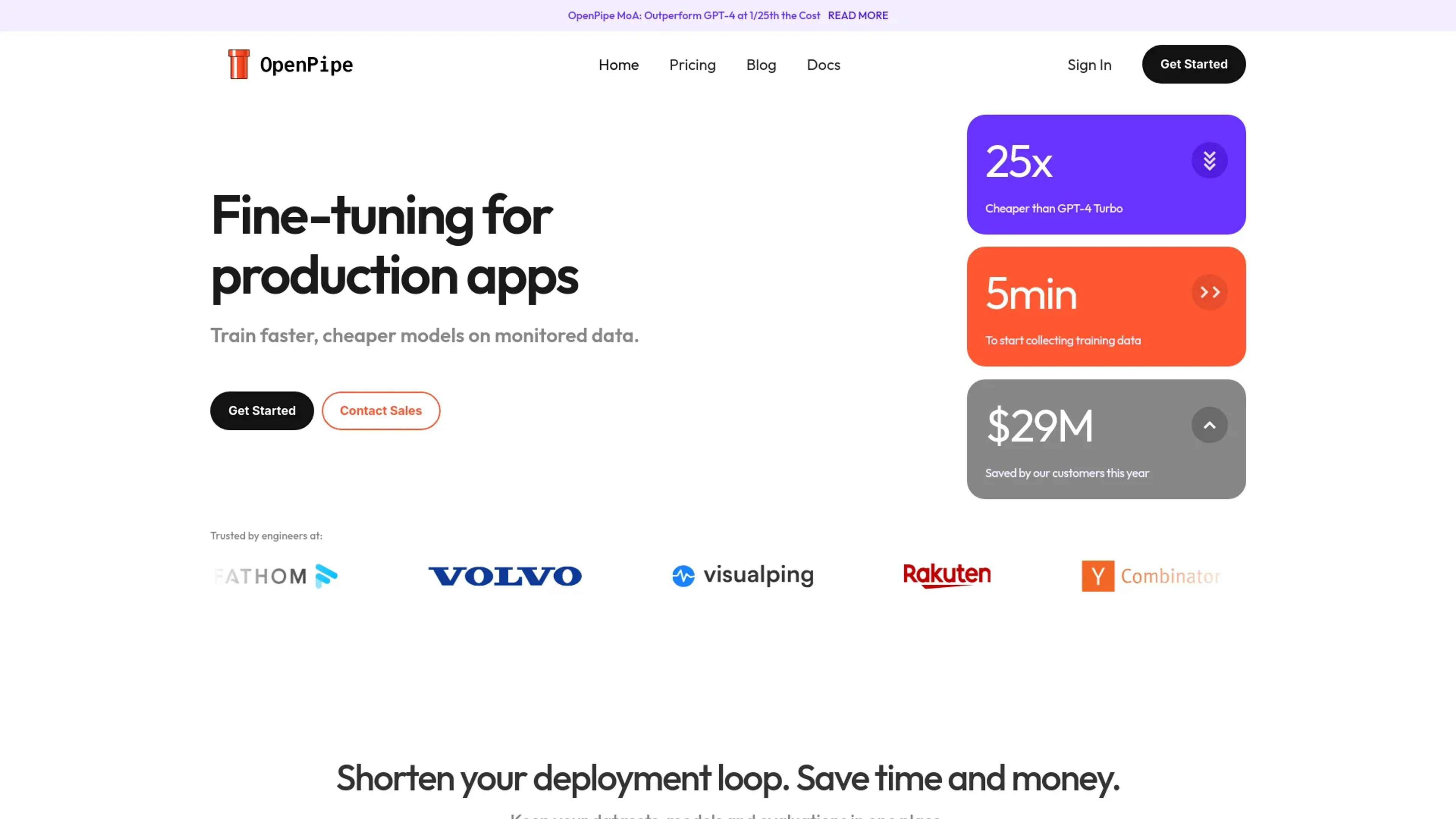
About OpenPipe
OpenPipe is a cutting-edge AI tool designed to streamline and enhance the capabilities of developers working in various environments. At its core, OpenPipe offers a robust platform for fine-tuning AI models, making it an essential asset for developers looking to optimize their applications for better performance and efficiency. Tailored specifically for the unique needs of the development community, this tool simplifies the complex process of model training and integration.
Key Features
- Custom Model Training: Allows developers to train models with their own data, ensuring greater relevance and efficiency.
- Seamless Integration: Designed to fit into existing development pipelines with minimal disruption.
- Real-Time Analytics: Provides real-time insights into model performance and accuracy.
- Scalability: Supports scaling from small-scale projects to enterprise-level deployments.
Pros
- Enhanced Accuracy: Improves the performance of AI models through precise fine-tuning.
- Time Savings: Reduces the time required for model training and deployment.
- Cost-Effective: Offers a scalable solution that can reduce overall development costs.
- User-Friendly Interface: Features an intuitive interface that simplifies complex processes.
Cons
- Initial Learning Curve: New users may require time to fully grasp the tool’s capabilities.
- Dependency on Data Quality: The effectiveness of fine-tuning is heavily reliant on the quality of input data.
- Limited Third-Party Integrations: Current support for external platforms is not as extensive as some competitors.
Use Cases
- Software Development Companies: Enhancing their product features with finely-tuned AI models.
- Tech Startups: Employing rapid prototyping and iterative development processes.
- AI Researchers: Conducting experiments with customizable model parameters.
- Educational Institutions: Teaching advanced AI courses with hands-on model training.
- Uncommon Use Cases: Non-profit organizations using it to improve their outreach strategies; Indie game developers optimizing game AI behavior.
Pricing
Free Trial: Get started with OpenPipe with a 30-day free trial. Standard Plan: Begins at $50.00 per month, offering basic features suitable for small projects. Enterprise Plan: Custom pricing based on specific requirements and scale. Disclaimer: For the most accurate and current pricing details, refer to the official OpenPipe website.
What Makes It Unique
OpenPipe stands out with its developer-centric approach, offering tools specifically designed to enhance the fine-tuning of AI models. Its unique selling point lies in its ability to integrate seamlessly into the existing development workflows, thereby minimizing disruption and maximizing efficiency.
Ratings
Accuracy and Reliability: 4.6/5 Ease of Use: 4.2/5 Functionality and Features: 4.8/5 Performance and Speed: 4.7/5 Customization and Flexibility: 4.5/5 Data Privacy and Security: 4.3/5 Support and Resources: 4.0/5 Cost-Efficiency: 4.4/5 Integration Capabilities: 4.1/5 Overall Score: 4.4/5
Key Features
Pros & Cons
- Enhanced Accuracy: Improves the performance of AI models through precise fine-tuning.
- Time Savings: Reduces the time required for model training and deployment.
- Cost-Effective: Offers a scalable solution that can reduce overall development costs.
- User-Friendly Interface: Features an intuitive interface that simplifies complex processes.
- Initial Learning Curve: New users may require time to fully grasp the tool’s capabilities.
- Dependency on Data Quality: The effectiveness of fine-tuning is heavily reliant on the quality of input data.
- Limited Third-Party Integrations: Current support for external platforms is not as extensive as some competitors.
Best For
Alternatives to OpenPipe
Eden AI
If you need to build a proper workflow and use AI API to make product-building easy and effective, let’s have a look at Eden AI review. Check out the features!
Lovelacestudio
Step up your RPG game creation with lovelacestudio com. Explore innovative AI tools to build and share immersive worlds effortlessly.
Trypromptly
Level Up Your Daily Productivity With Trypromptly'S Smart Tools Designed For Efficiency. Achieve Better Results Effortlessly In Your Everyday Tasks.
CodiumAI
AI test generation for code
Codelanguageconverter
Drive results with seamless code translations using codelanguageconverter.com. Effortlessly convert between programming languages to enhance your

Dante AI
Tailored AI chatbots trained on your data, no coding needed. Deploy to your website in minutes. Quickly build a GPT-4 chatbot with options to train the AI and customi