

Temporal Technologies
FreemiumEnsures resilient, fault-tolerant applications with durable execution.
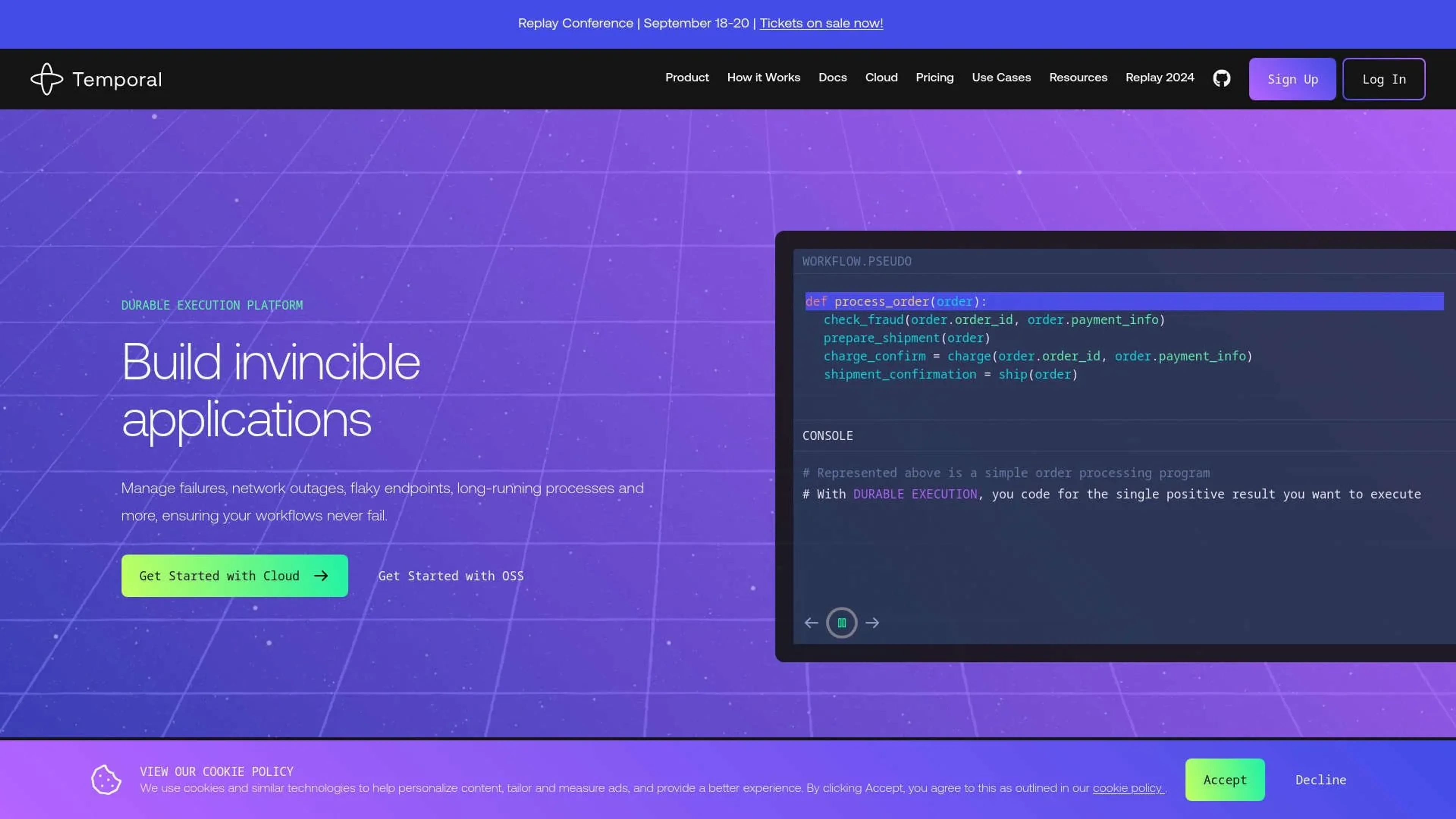
About Temporal Technologies
Temporal Technologies revolutionizes the way developers build and manage distributed systems. At its core, Temporal Technologies offers a durable execution platform that ensures applications are resilient against failures, network outages, and other disruptions. Designed for developers and enterprises, it simplifies the development of reliable and scalable systems by abstracting the complexities of infrastructure management.
Key Features
- Durable Execution: Temporal guarantees the execution of workflows, making applications fault-tolerant by default.
- Open Source: Built under the MIT license, Temporal is fully open-source, fostering a vibrant community and continuous innovation.
- Event-Driven Architecture: Simplifies the design and deployment of event-driven applications by managing state, retries, and error handling automatically.
- Saga & Distributed Transactions: Facilitates safe and consistent state across distributed services by employing the saga pattern, reducing the complexity of compensating transactions.
Pros
- Reliability: Temporal makes applications inherently durable, reducing failures by 10-100X.
- Scalability: Abstracts infrastructure complexities, allowing for seamless scaling of distributed systems.
- Community Support: Boasts a growing and active community, providing ample resources and support.
- Flexibility: Supports multiple programming languages and can be integrated into various applications, from transaction processing to applied AI.
Cons
- Initial Learning Curve: Requires some time to get accustomed to its advanced features and concepts.
- Limited Third-Party Integrations: While powerful, it currently supports a limited number of third-party platforms out-of-the-box.
Use Cases
- E-commerce Businesses: Utilizing Temporal for reliable order processing and inventory management.
- Financial Institutions: Employing the platform for secure and consistent transaction processing.
- Healthcare Providers: Leveraging Temporal to ensure fault-tolerant patient data management systems.
- Logistics Companies: Using Temporal for robust and reliable supply chain management.
- Uncommon Use Cases: Adopted by educational institutions for teaching distributed systems; utilized by non-profits for managing volunteer coordination workflows.
Pricing
Free Tier: Experience Temporal with a free tier offering. Pro Tier: The Pro Tier starts at $0.05 per execution. Disclaimer: For the most accurate and current pricing details, refer to the official Temporal Technologies website.
What Makes It Unique
Temporal Technologies stands out with its durable execution capability, a game-changer for building reliable, fault-tolerant applications. Its ability to abstract away the complexities of distributed systems and focus on business logic sets it apart, enabling developers to deliver reliable systems faster.
Ratings
Accuracy and Reliability: 4.8/5 Ease of Use: 4.3/5 Functionality and Features: 4.7/5 Performance and Speed: 4.6/5 Customization and Flexibility: 4.5/5 Data Privacy and Security: 4.7/5 Support and Resources: 4.4/5 Cost-Efficiency: 4.2/5 Integration Capabilities: 4.1/5 Overall Score: 4.5/5
Key Features
Pros & Cons
- Reliability: Temporal makes applications inherently durable, reducing failures by 10-100X.
- Scalability: Abstracts infrastructure complexities, allowing for seamless scaling of distributed systems.
- Community Support: Boasts a growing and active community, providing ample resources and support.
- Flexibility: Supports multiple programming languages and can be integrated into various applications, from transaction processing to applied AI.
- Initial Learning Curve: Requires some time to get accustomed to its advanced features and concepts.
- Limited Third-Party Integrations: While powerful, it currently supports a limited number of third-party platforms out-of-the-box.
Best For
Alternatives to Temporal Technologies
Eden AI
If you need to build a proper workflow and use AI API to make product-building easy and effective, let’s have a look at Eden AI review. Check out the features!
Lovelacestudio
Step up your RPG game creation with lovelacestudio com. Explore innovative AI tools to build and share immersive worlds effortlessly.
Trypromptly
Level Up Your Daily Productivity With Trypromptly'S Smart Tools Designed For Efficiency. Achieve Better Results Effortlessly In Your Everyday Tasks.
CodiumAI
AI test generation for code
Codelanguageconverter
Drive results with seamless code translations using codelanguageconverter.com. Effortlessly convert between programming languages to enhance your

Dante AI
Tailored AI chatbots trained on your data, no coding needed. Deploy to your website in minutes. Quickly build a GPT-4 chatbot with options to train the AI and customi