

About WTF Does This Company Do?
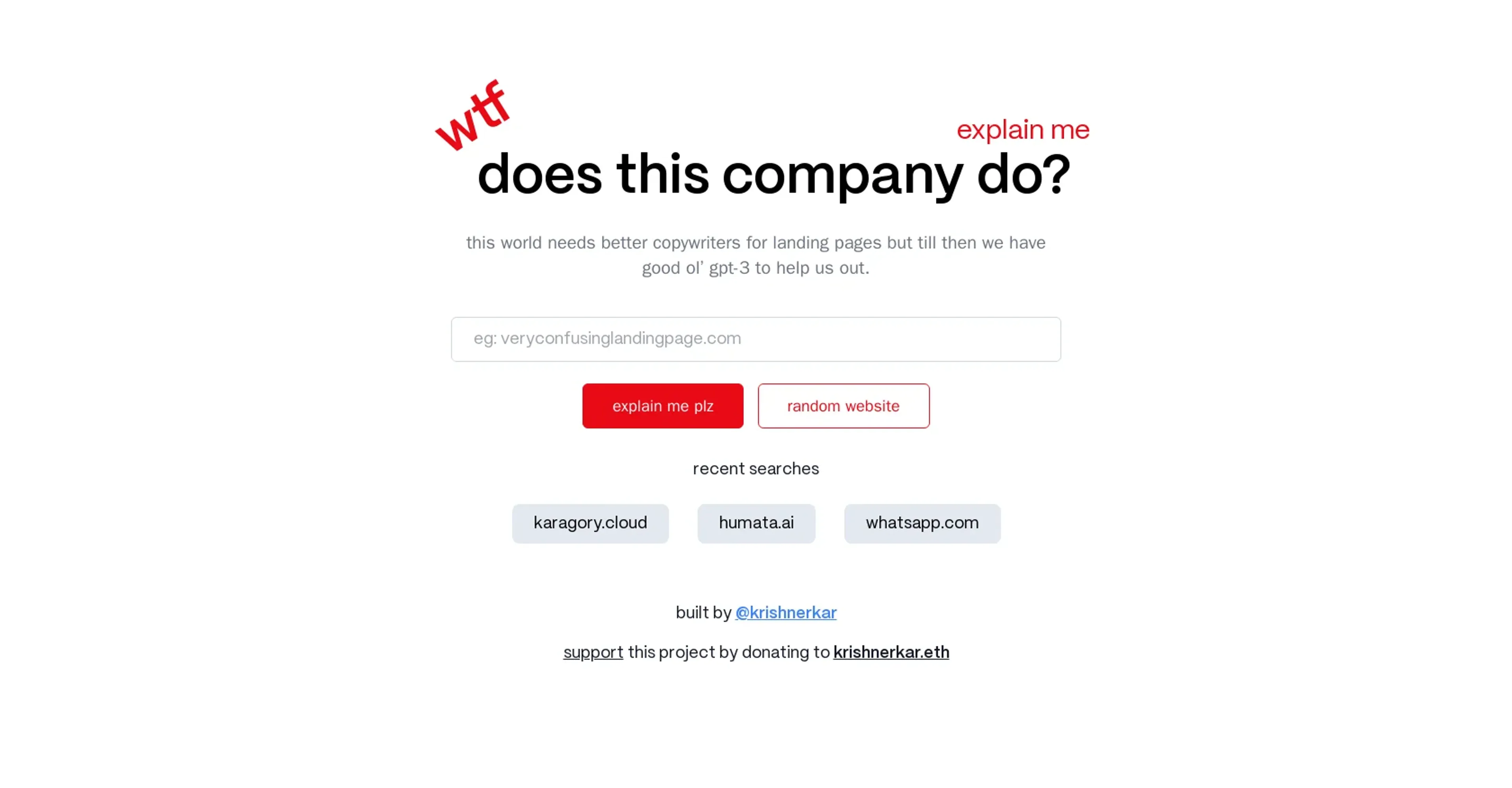
WTF Does This Company Do? is a unique and innovative tool designed to tackle the confusion that often arises when trying to understand what a company actually does. This quirky tool utilizes advanced AI, particularly GPT-3 algorithms, to translate complex corporate jargon into clear and understandable explanations. It's a lifesaver for investors, job seekers, and anyone who has ever felt perplexed by the vague descriptions found on company websites.
Key Features
- AI-Powered Explanations: Harnesses the power of advanced GPT-3 algorithms to interpret and simplify company descriptions.
- Simple Interface: Offers a straightforward design where users can input a company's web address and receive a clear explanation.
- Random Website Roast: Includes a feature for generating humorous takes on random websites, although users are cautioned about potentially offensive results.
- Recent Searches: Displays a list of recent searches, allowing users to see what others are querying.
Pros
- Time-Saving: Provides quick clarity on a company's activities, saving users from deciphering convoluted corporate language.
- User-Friendly: Accessible to users of all technical backgrounds due to its simple interface.
- Educational: Serves as a tool for understanding industry language and marketing strategies.
- Free to Use: Completely free with no hidden costs or subscriptions.
Cons
- Dependence on AI Accuracy: Explanations are contingent on the AI's understanding, which may not always be flawless.
- Potential Offense: The 'roast the website' feature could produce results that some users might find offensive.
- Limited to English: Non-English websites may not be accurately interpreted, limiting its usefulness for global markets.
Use Cases
- Entrepreneurs: Researching potential competitors and market gaps.
- Job Seekers: Understanding potential employers before applying or interviewing.
- Investors: Quickly grasping the core business of a potential investment.
- Marketing Students: Analyzing and improving company messaging as a case study tool.
- Uncommon Use Cases: Writers using it for clearer business communication; Non-native English speakers employing it to understand international business landscapes better.
Pricing
Free Access: Completely free to use with no hidden fees or subscriptions. Disclaimer: While WTF Does This Company Do? is currently free, it's advisable to check the tool's website for any updates on offerings or potential premium features.
What Makes It Unique
WTF Does This Company Do? sets itself apart with its playful approach to demystifying business language. It's not just a tool; it's a statement against overly complex verbiage found on many company websites. Its simplicity and humor make it not only useful but also enjoyable to use.
Ratings
Accuracy and Reliability: 4.2/5 Ease of Use: 5.0/5 Functionality and Features: 3.8/5 Performance and Speed: 4.5/5 Customization and Flexibility: 3.0/5 Data Privacy and Security: Not Applicable/5 Support and Resources: 3.5/5 Cost-Efficiency: 5.0/5 Integration Capabilities: Not Applicable/5 Overall Score: 4.2/5
Key Features
Pros & Cons
- Time-Saving: Provides quick clarity on a company's activities, saving users from deciphering convoluted corporate language.
- User-Friendly: Accessible to users of all technical backgrounds due to its simple interface.
- Educational: Serves as a tool for understanding industry language and marketing strategies.
- Free to Use: Completely free with no hidden costs or subscriptions.
- Dependence on AI Accuracy: Explanations are contingent on the AI's understanding, which may not always be flawless.
- Potential Offense: The 'roast the website' feature could produce results that some users might find offensive.
- Limited to English: Non-English websites may not be accurately interpreted, limiting its usefulness for global markets.
Best For
Alternatives to WTF Does This Company Do?
Readshark
Quick Book Summaries for Busy Professionals
QuestionAid
Effortlessly Generate Questions from Any Text with Question-AID
AI Art Apps Database
Access tutorials, software, and an artwork library to learn, create, and stay inspired with AI art.
FlashcardX
FlashcardX: Your AI-powered study companion to create flashcards effortlessly.
AixStock
Access practice tests, study guides, flashcards, interact with others, expert tutors, and get personalized feedback for mastery.
Jungle
Create flashcards in seconds, not hours