

Your Next Store
FreemiumDescribe your store, launch a live checkout-ready site.
About Your Next Store
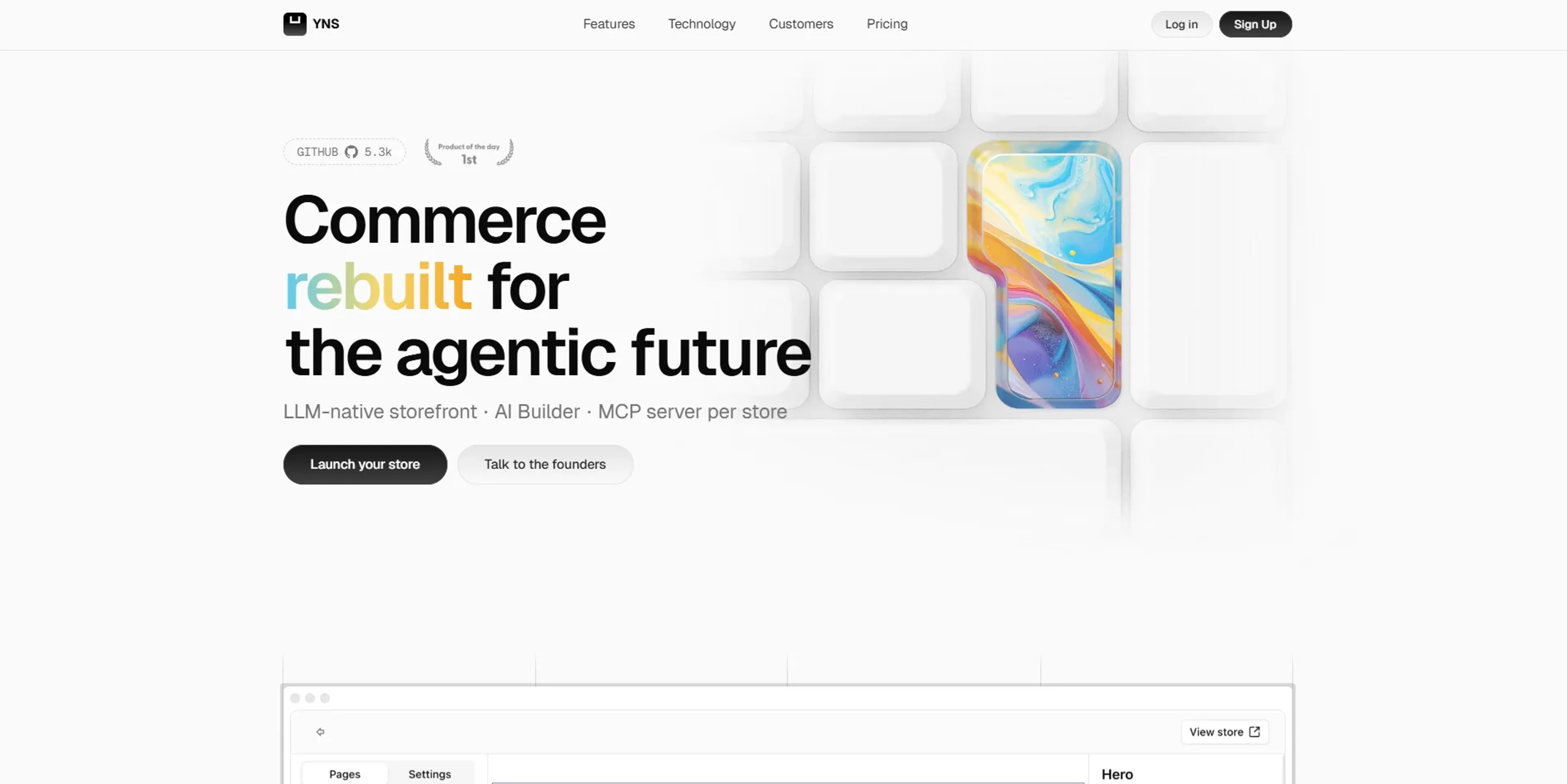
Your Next Store is an AI-first commerce platform that lets users describe a store in plain language and get a production-ready Next.js storefront with products, cart, and Stripe-powered checkout wired up. It combines an AI Store Builder, a managed backend, a TypeScript SDK, and an open-source storefront template aimed at both non-technical merchants and developer teams.
Key Features
- AI Store Builder: Chat-style builder that turns prompts into a ready-to-sell storefront, from layout to theme and basic content.
- No-code Visual Editor: Drag-and-drop Store Builder with commerce-specific blocks, so users can adjust layout, copy, and imagery without touching code.
- Modern Tech Stack: Next.js and React storefront, Stripe-native checkout, and a typed TypeScript SDK for programmatic control and custom integrations.
- Open-source AI-friendly Template: An open-source storefront that can be customized locally or with preferred LLM tools, reducing lock-in for developers.
Pros
- Very fast setup: Stores can go live in roughly 30 minutes for simple catalogs, which is quick even by SaaS standards. (yournextstore.com)
- Blends AI and no-code: Natural-language generation plus a visual editor supports both “describe it” and “tweak it” workflows.
- Performance-focused: Vercel CDN, smart caching, and static rendering keep storefronts extremely quick for shoppers. (yournextstore.com)
- Developer-friendly escape hatch: Open-source template and SDK let technical teams extend far beyond a typical page builder. (yournextstore.com)
Cons
- Transaction fees on top of Stripe: Percentage platform fees apply on most plans, in addition to separate Stripe processing costs. (yournextstore.com)
- Stripe-centric: Deep Stripe integration is great if you use Stripe, less so if your stack revolves around other gateways. (yournextstore.com)
- Younger ecosystem: Compared with giants like Shopify, the third-party app and partner ecosystem is still growing. (yournextstore.com)
Use Cases
- Indie DTC brands: Using the AI builder and templates to spin up branded stores without agencies.
- Small ecommerce teams: Replacing slower, plugin-heavy stacks with a faster storefront and simpler admin.
- Agencies and studios: Shipping client stores on a modern Next.js + Stripe stack while keeping customization options open.
- Developer-led startups: Treating it as a headless-style backend plus open-source frontend for custom experiences.
- Uncommon Use Cases: Adopted for AI-agent experiments that operate stores via MCP-style backends; used in internal tooling where teams prototype commerce flows controlled by LLMs.
Pricing
Free Trial: 7-day free trial for new stores before any paid commitment. Starter: $30 per month; includes 1.5% transaction fee, up to 500 products, custom domain support, basic analytics, and email support (48-hour response). Growth: $60 per month; includes 0.75% transaction fee, unlimited products, everything in Starter, 1 additional team member, advanced analytics, and WhatsApp support with 24-hour response SLA. Pro: $360 per month; includes 0.15% transaction fee, unlimited products, everything in Growth, up to 3 team members, priority support with 12-hour SLA, and early access to new features. Enterprise: Custom pricing; includes dedicated account manager, custom SLA and uptime guarantees, unlimited team members, bespoke integrations, security and compliance audits (SOC 2, ISO, etc.), white-glove onboarding and migration, and feature requests. Disclaimer: Please note that pricing information may not be up to date. For the most accurate and current pricing details, refer to the official Your Next Store website.
What Makes It Unique
Your Next Store leans into being LLM-native: each store effectively becomes an AI-accessible commerce surface, with an AI Builder, MCP-style server per store, and a stack intentionally tuned for agent workflows. Few competitors pair natural-language store generation, a no-code editor, and an open-source Next.js template while still handling Stripe-native checkout and everyday ecommerce operations in one place.
Ratings
Accuracy and Reliability: 4.3/5 Ease of Use: 4.6/5 Functionality and Features: 4.4/5 Performance and Speed: 4.8/5 Customization and Flexibility: 4.5/5 Data Privacy and Security: 4.2/5 Support and Resources: 4.0/5 Cost-Efficiency: 4.1/5 Integration Capabilities: 4.0/5 Overall Score: 4.3/5
Key Features
Pros & Cons
- Very fast setup: Stores can go live in roughly 30 minutes for simple catalogs, which is quick even by SaaS standards. (yournextstore.com)
- Blends AI and no-code: Natural-language generation plus a visual editor supports both “describe it” and “tweak it” workflows.
- Performance-focused: Vercel CDN, smart caching, and static rendering keep storefronts extremely quick for shoppers. (yournextstore.com)
- Developer-friendly escape hatch: Open-source template and SDK let technical teams extend far beyond a typical page builder. (yournextstore.com)
- Transaction fees on top of Stripe: Percentage platform fees apply on most plans, in addition to separate Stripe processing costs. (yournextstore.com)
- Stripe-centric: Deep Stripe integration is great if you use Stripe, less so if your stack revolves around other gateways. (yournextstore.com)
- Younger ecosystem: Compared with giants like Shopify, the third-party app and partner ecosystem is still growing. (yournextstore.com)
Best For
Alternatives to Your Next Store
AnimateDiff
Autoti
Automated car valuation, wide range of cars, expert guidance for buyers and sellers.
Travel Plan AI
Your personal AI guide for unforgettable journeys.
Respage
Automate lead acquisition, interact with potential leads, and capture lead information and preferences.
Vate.ai
Automate customer service, respond to inquiries, and personalize experiences by collecting customer insights.
PlugSugar
Automate conversations, answer questions with Web Search plugin, and customize ChatGPT experience using powerful AI plugins.