
Back to Blog css
css
 gemma
gemma community
 ai
ai ai
ai githubactions
 ai
ai
I built a CSS framework where every class name is an emoji
Tom Hayes February 23, 2026
0 views
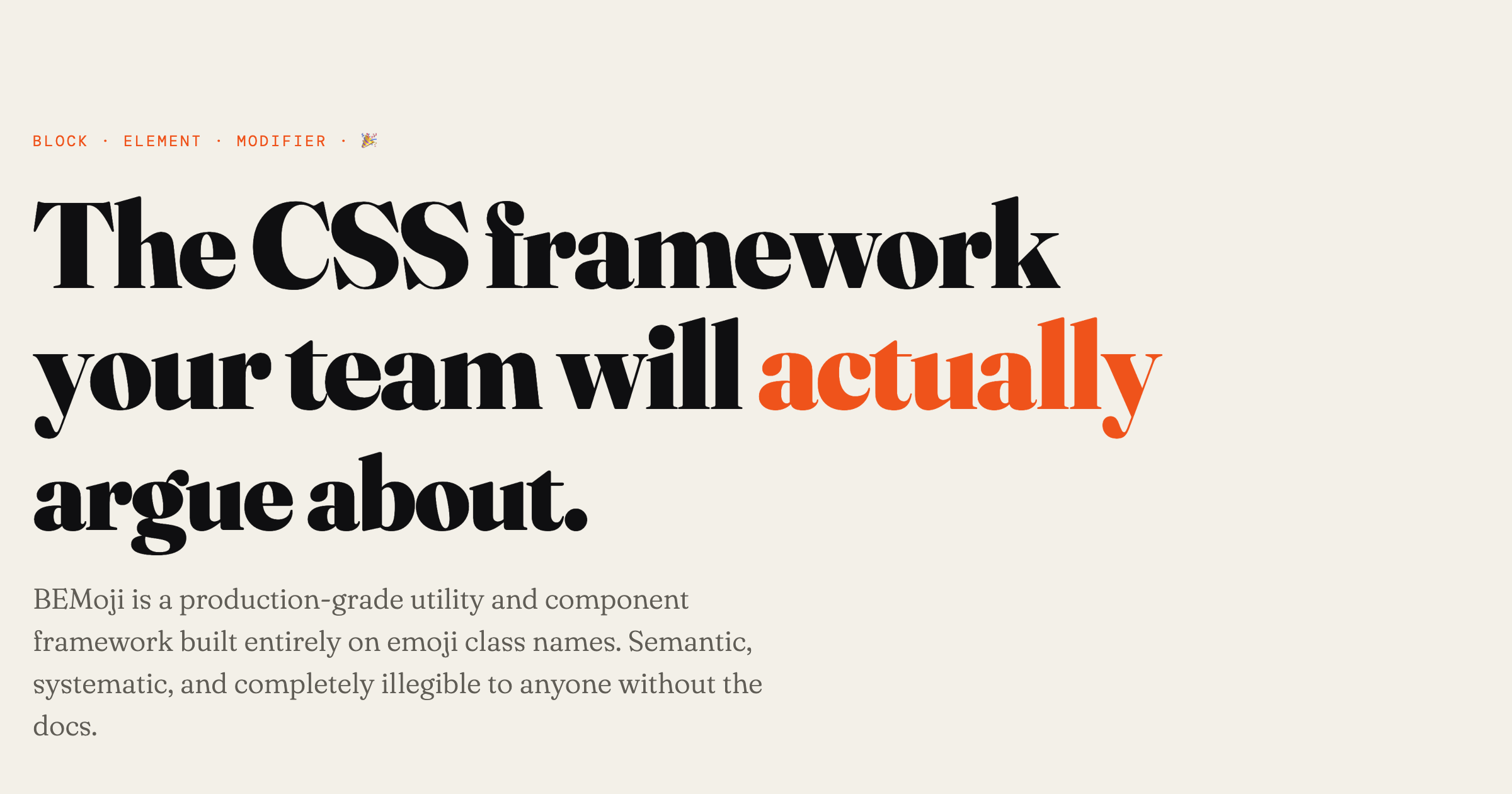
BEMoji is a fully featured BEM framework that uses emoji as class names. It's stupid. It works. It's on npm.
title: I built a CSS framework where every class name is an emoji published: true description: BEMoji is a fully featured BEM framework that uses emoji as class names. It's stupid. It works. It's on npm. tags: css, jokes, Tailwind, BEM cover_image: https://tomhayes.github.io/BEMoji/og-image.png
I got into one too many Tailwind vs BEM arguments this month and decided the correct response was to build something that makes both sides equally uncomfortable.
Meet BEMoji: a production-grade CSS framework where every class name is an emoji.
<article class="🃏">
  <div class="🃏__🖼️ 🃏__🖼️--🌟">
    <img src="hero.jpg" alt="...">
  </div>
  <div class="🃏__📝">
    <h2 class="🃏__🔠">Card Title</h2>
  </div>
  <footer class="🃏__🦶">
    <button class="🔘 🔘--🌟">Primary</button>
    <button class="🔘 🔘--👻">Disabled</button>
  </footer>
</article>
That is valid, production HTML. It works in every modern browser. I am not sorry.
Why does this exist
The core BEM pattern is block__element--modifier. BEMoji keeps that structure exactly, just swapping string names for emoji tokens. The double-underscore and double-hyphen delimiters are preserved, so the class names are still machine-parseable even if they're completely illegible to humans.
It started as a joke and then I accidentally made it real.
It's actually kind of a full framework
This is the part that got out of hand. BEMoji ships with:
- 143 canonical emoji tokens across blocks, elements, modifiers and utilities
- A complete design token system (yes, using emoji as CSS custom property names:
--📏-4,--🌑-md,--⭕-full) - 24 pre-built components (cards, buttons, badges, alerts, modals, tables, the lot)
- A PostCSS plugin so you can write readable BEM in your source and get emoji compiled at build time
- A Vite plugin with HMR support
- An ESLint plugin that enforces correct token usage
- A React
bem()helper - A CLI with
init,compile,audit,decode,encodeandexportcommands
The CLI's decode command is probably my favourite part:
npx bemoji decode "🃏__🖼️--🌟"
# card__image--featured
The PostCSS workflow
You don't have to write emoji by hand in your source files. The PostCSS plugin lets you use a bracket shorthand:
.[card] {
  border-radius: var(--⭕-md);
  box-shadow: var(--🌑-sm);
}

.[card__image--featured] {
  outline: 2px solid var(--🟡);
}
Which compiles to:
.🃏 {
  border-radius: var(--⭕-md);
  box-shadow: var(--🌑-sm);
}

.🃏__🖼️--🌟 {
  outline: 2px solid var(--🟡);
}
So the output is emoji soup but your source stays readable. Or as readable as it was before, anyway.
The React helper
import { useBem } from 'bemoji/react';

function Card({ featured }) {
  const b = useBem('card');

  return (
    <article className={b()}>
      <div className={b('image', { featured })}>
        ...
      </div>
    </article>
  );
}

// When featured=true, className becomes "🃏__🖼️ 🃏__🖼️--🌟"
There are legitimate arguments for this
I feel compelled to make the honest case, because it genuinely surprised me:
Free obfuscation. Your production CSS is meaningless to anyone without the config file. You get the obfuscation benefits of CSS Modules without the build complexity.
Enforced vocabulary. Every UI concept maps to one canonical emoji. The config file is your design system contract. Changing a concept's emoji is a one-line config change that propagates everywhere.
It's faster to type than you think. Once you have emoji picker shortcuts set up, 🃏 is two keystrokes. .card__image--featured is 24. The maths eventually works out.
None of this makes it a good idea. But they are real arguments.
The config
// bemoji.config.js
export default {
  blocks: {
    card:    '🃏',
    navbar:  '🧭',
    modal:   '🪟',
    alert:   '🔔',
  },
  elements: {
    image:  '🖼️',
    title:  '🔠',
    body:   '📝',
    button: '🔘',
  },
  modifiers: {
    primary:  '🌟',
    danger:   '🔴',
    disabled: '👻',
    loading:  '⏳',
  },
};
Install
npm install bemoji
npx bemoji init
The init command scaffolds a config, imports the base CSS, and wires up PostCSS.
Links
- Docs + demo: https://tomhayes.github.io/BEMoji/
- GitHub: https://github.com/tomhayes/BEMoji
- npm: https://npmjs.com/package/bemoji
My personal favourite token is 🦶 for footer. If you find a better use for it than I have, open a PR.
Comments
More Blog
View allgemmaFive Gemma-4 models, one accelerator: what porting E2B 31B to AWS Inferentia2 taught me
I ported the whole Gemma-4 family — E2B, E4B, 12B, 31B, and the 26B-A4B MoE — to run on...
X
xbillcommunityHey DEV, I'm Tobore. Let's actually connect.
Hey DEV, I'm Tobore. Let's actually connect. I've been on here for a while now, mostly writing and...
L
Laurina AyarahaiI burned through thousands of AI tokens. Then a friend did it for free
(yep, kinda clickbait, just for the funsies 😊) At the beginning of the year, I relaunched my...
P
Paulo HenriqueaiClaude might be saturating your machine
My laptop was sitting idle with the fan at full tilt. Nothing was running that I knew of. The culprit...
S
Sidhant PandagithubactionsAutomated GitHub Code Reviews Using Google Gemini
I Built a Thing! TL;DR — Google Gemini-based Pull Request reviews and Issue Triaging for...
D
Darren "Dazbo" LesteraiWhat is an "agentic harness," actually?
I've been hearing the word "harness" thrown around a lot lately. I assumed it just meant "the IDE" or...
T
Tilde A. ThuriumReady-made automations for this
Workflows from the Neura Market marketplace related to this DeepSeek resource
- Automate Blog Content Creation with Notion MCP, DeepSeek AI, and WordPressn8n · $9.99 · Related topic
- Generate AI Videos from Scripts with DeepSeek, Synthesia, and Together.ain8n · $24.99 · Related topic
- Compare Multi-Period Financial Data from Google Sheets with DeepSeek AI Analysisn8n · $14.99 · Related topic
- PostgreSQL Conversational Agent with Claude & DeepSeek (Multi-KPI, Secure)n8n · $14.99 · Related topic