
Back to Blog react
react gemma
gemma community
 ai
ai ai
ai githubactions
 ai
ai
Taming Real-Time State: Why Y.js is the Ultimate Tool for Collaborative React Apps
Tariq Bendallah March 1, 2026
0 views
Learn how to build real-time collaborative React apps using Y.js and Zustand. Discover CRDT...
Learn how to build real-time collaborative React apps using Y.js and Zustand. Discover CRDT architecture, custom hooks, and offline-first state management.
When I set out to build a real-time, customizable form builder, I had a clear vision: I wanted it to feel as seamless as Google Docs or Figma. The goal was a drag-and-drop interface where multiple users could jump in, edit simultaneously, and see each other’s changes instantly without stepping on each other’s toes.
As a full-stack developer, I knew the UI components and backend logic wouldn’t be the hardest part. The real boss fight was state synchronization. After evaluating the landscape of real-time collaboration tools, I landed on Y.js.
Here is a deep dive into why Y.js is so powerful, how it fundamentally works, and the Next.js/Zustand code patterns I used to cleanly integrate it into a production-ready React app.
The Synchronization Dilemma: Why CRDTs Win Before writing any code, you have to choose a synchronization strategy. The traditional approaches have glaring flaws for highly interactive use cases:
-
Operational Transformation (OT): Used by classic collaborative editors. It works, but it’s incredibly complex to implement correctly from scratch, requires a centralized server authority to resolve conflicts, and makes offline-first workflows a nightmare.
-
Last-Write-Wins (LWW): Too destructive. If two users edit a complex nested component simultaneously, someone’s data is getting overwritten.
Enter CRDTs (Conflict-free Replicated Data Types). Y.js is a battle-tested CRDT implementation that guarantees consistency without coordination. Each client makes its own decisions, works perfectly offline, and automatically resolves conflicts. It doesn’t just sync data; it mathematically syncs intent.
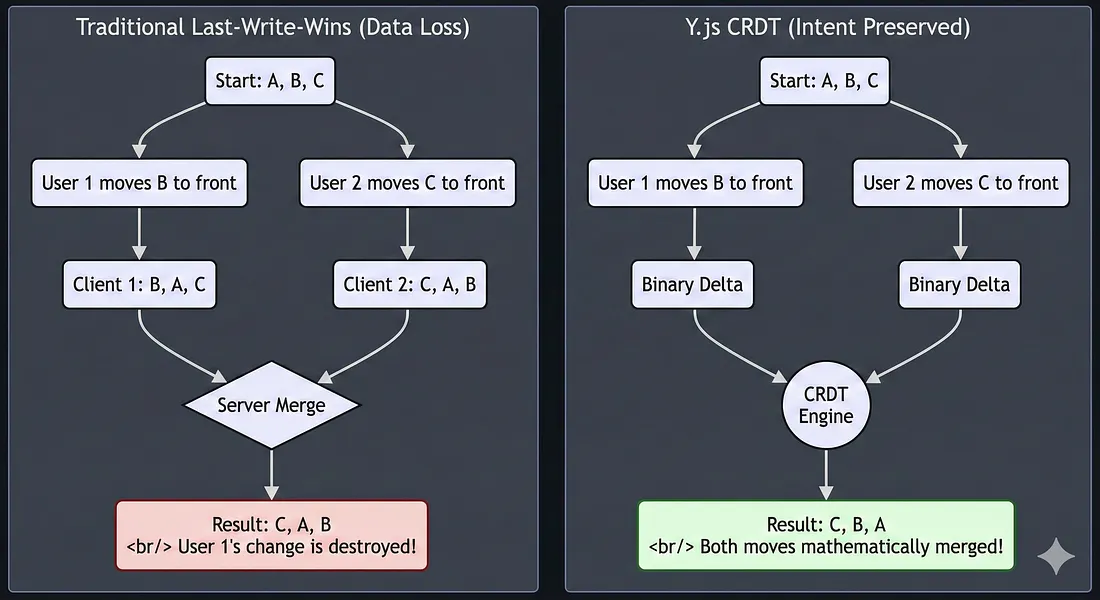
Even if two users move different components around at the exact same millisecond, the CRDT engine ensures both clients eventually converge to the exact same state without destroying data.
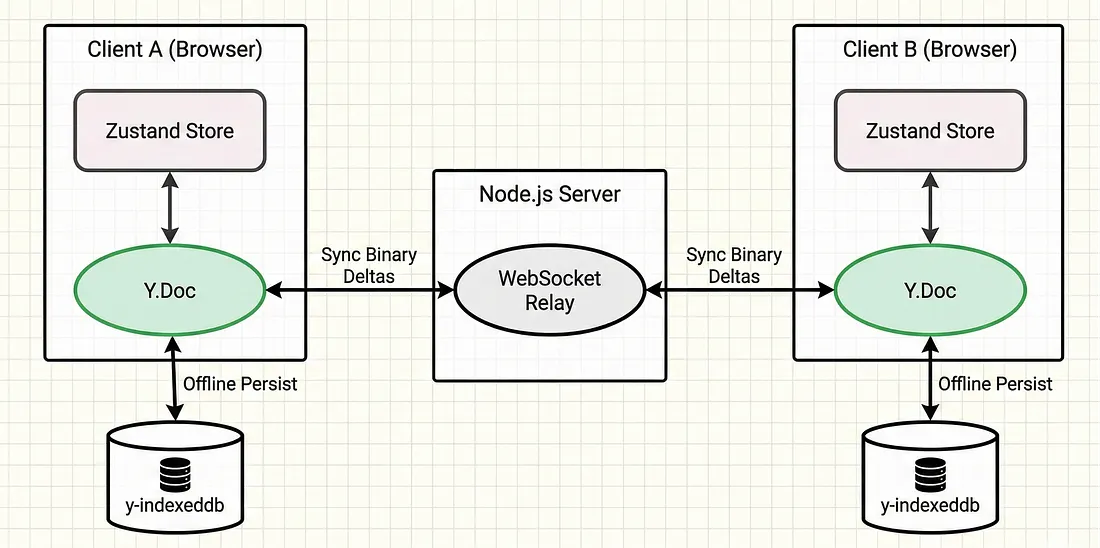
The Architecture: Bridging React and Y.js with Zustand Integrating a vanilla JavaScript library like Y.js with React’s render cycle requires a solid bridge. You don’t want your app re-rendering every time a remote cursor moves across the screen.
I solved this by making Zustand the heart of the application’s collaboration layer. I built a central store dedicated entirely to holding the Y.js instances and managing the connection lifecycle, keeping the core Y.Doc completely out of the React render cycle.
import { create } from 'zustand'
import * as Y from 'yjs'
import { WebsocketProvider } from 'y-websocket'
import { IndexeddbPersistence } from 'y-indexeddb'

const useYStore = create((set, get) => ({
  ydoc: null,
  provider: null,
  indexeddbProvider: null,

  initialize: (roomName) => {
    const ydoc = new Y.Doc()

    // 1. Offline support baked in
    const indexeddbProvider = new IndexeddbPersistence(roomName, ydoc)

    // 2. Real-time sync via WebSocket
    const provider = new WebsocketProvider(
      process.env.NEXT_PUBLIC_YJS_URL,
      roomName,
      ydoc
    )

    set({ ydoc, provider, indexeddbProvider })
  },

  cleanup: () => {
    // Crucial to prevent memory leaks in single-page apps!
    const { provider, indexeddbProvider, ydoc } = get()
    provider?.destroy()
    indexeddbProvider?.destroy()
    ydoc?.destroy()
  }
}))
In this architecture, the Node.js WebSocket server acts purely as a dumb relay. It doesn’t hold the source of truth; it just broadcasts binary updates between clients.
Taming the “Infinite Loop” Problem The hardest part of building a collaborative UI is the synchronization loop. If a user types into an input, React updates local state, sends it to Y.js, Y.js fires an observe event, and React updates again. It's a recipe for infinite render loops and sluggish performance.
To solve this, I wrote a custom hook (useSyncProps) that acts as a safe circuit breaker between the UI and the shared CRDT. The secret sauce is a useRef flag that temporarily mutes the incoming observer when the local user is actively typing.
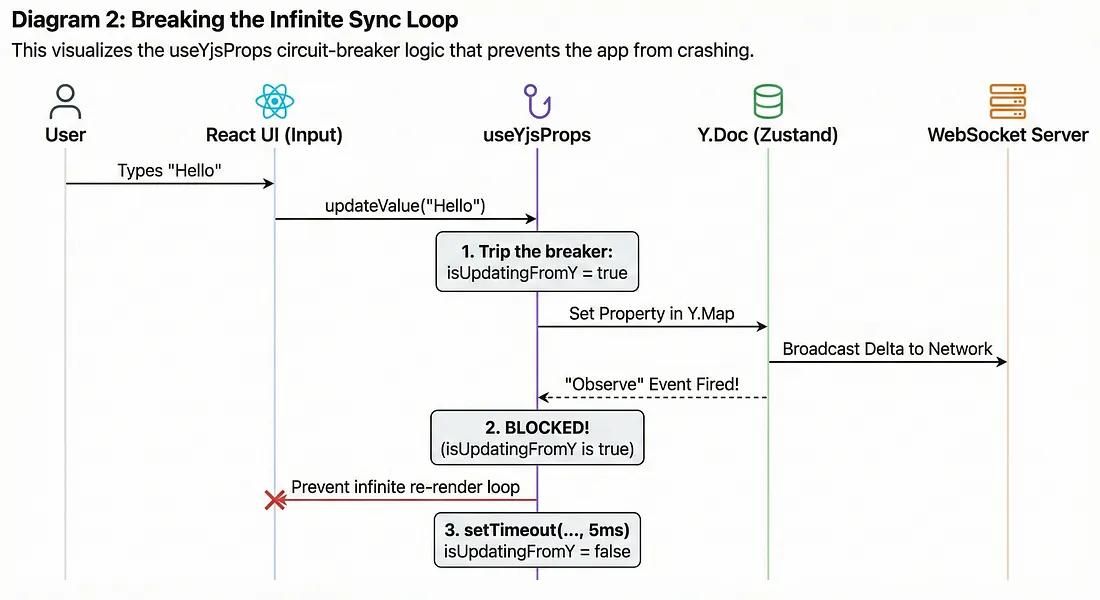
Here is the implementation of that pattern:
export function useSyncProps(componentId, initialValue, propKey) {
  const [localValue, setLocalValue] = useState(initialValue)
  const isUpdatingFromY = useRef(false)

  // Listen to remote changes
  useEffect(() => {
    const observer = () => {
      // The Circuit Breaker: Ignore our own updates!
      if (isUpdatingFromY.current) return

      const yValue = getYValueFromStore(componentId, propKey)
      setLocalValue(yValue)
    }
    sharedArray.observe(observer)
    return () => sharedArray.unobserve(observer)
  }, [])

  // Push local changes
  const updateValue = useCallback((newValue) => {
    isUpdatingFromY.current = true // Trip the breaker
    setLocalValue(newValue)

    updateItemProperty(componentId, propKey, newValue) // Update Y.js

    // Reset breaker after a tiny tick
    setTimeout(() => { isUpdatingFromY.current = false }, 5)
  }, [])

  return { value: localValue, updateValue }
}
This ensures the UI feels completely instant (0ms latency for the local user) while smoothly syncing with the rest of the network in the background.
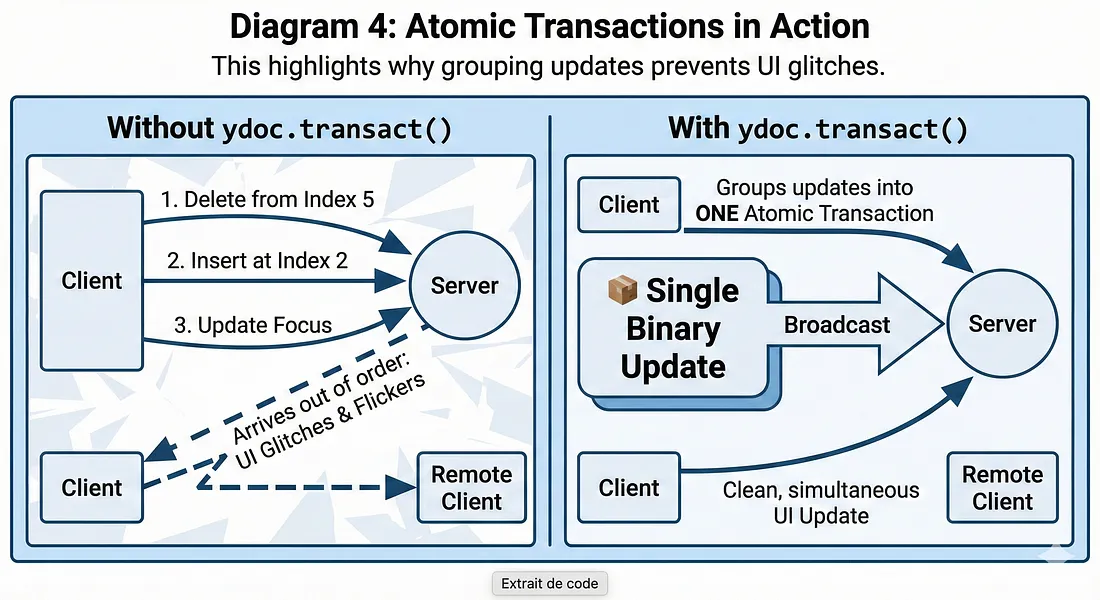
Atomic Updates with Transactions When a user performs a complex action — like dragging a component across a canvas or reordering an array — you are technically deleting an item and inserting it elsewhere. If you send these as two separate network requests, a remote user might see the item disappear for a split second before reappearing.
Y.js provides a brilliant solution for this: Transactions. By wrapping multiple mutations in a ydoc.transact(), Y.js pauses all observers, applies the changes, and broadcasts them as a single, atomic binary payload.
const moveItem = (fromIndex, toIndex) => {
  ydoc.transact(() => {
    const item = sharedArray.get(fromIndex)
    sharedArray.delete(fromIndex, 1)
    sharedArray.insert(toIndex, [item])
  }, ydoc.clientID) // Grouped by this specific user ID
}
This approach guarantees that remote clients receive clean, simultaneous UI updates without any flickering or visual glitches.
The Verdict Y.js takes the intimidating theory of distributed systems and packages it into an incredibly developer-friendly API.
Because it pairs so seamlessly with y-indexeddb, collaborative apps can be inherently offline-first. Furthermore, the built-in awareness protocol makes rendering multiplayer cursors and "who is online" badges straightforward without needing a massive, separate Redis or Pub/Sub architecture.
If you are building a modern web application where the UI is shared, complex, and highly interactive, do not try to reinvent the wheel with manual WebSocket events. Embrace CRDTs, grab Y.js, and focus your energy on building a great product.
Comments
More Blog
View allgemmaFive Gemma-4 models, one accelerator: what porting E2B 31B to AWS Inferentia2 taught me
I ported the whole Gemma-4 family — E2B, E4B, 12B, 31B, and the 26B-A4B MoE — to run on...
X
xbillcommunityHey DEV, I'm Tobore. Let's actually connect.
Hey DEV, I'm Tobore. Let's actually connect. I've been on here for a while now, mostly writing and...
L
Laurina AyarahaiI burned through thousands of AI tokens. Then a friend did it for free
(yep, kinda clickbait, just for the funsies 😊) At the beginning of the year, I relaunched my...
P
Paulo HenriqueaiClaude might be saturating your machine
My laptop was sitting idle with the fan at full tilt. Nothing was running that I knew of. The culprit...
S
Sidhant PandagithubactionsAutomated GitHub Code Reviews Using Google Gemini
I Built a Thing! TL;DR — Google Gemini-based Pull Request reviews and Issue Triaging for...
D
Darren "Dazbo" LesteraiWhat is an "agentic harness," actually?
I've been hearing the word "harness" thrown around a lot lately. I assumed it just meant "the IDE" or...
T
Tilde A. ThuriumReady-made automations for this
Workflows from the Neura Market marketplace related to this DeepSeek resource
- Automate Blog Content Creation with Notion MCP, DeepSeek AI, and WordPressn8n · $9.99 · Related topic
- Discover Real Market Problems from Reddit Posts with OpenAIn8n · $9.99 · Related topic
- Tesla News and Sentiment Analysis Tool (Powered by DeepSeek Chat)n8n · $9.99 · Related topic
- Automatically Discover Undocumented API Endpoints Using Regex and AIn8n · $19.99 · Related topic