
Back to Blog devchallenge
 ai
ai ai
ai ai
ai go
go playwright
 cli
cli
I Built EchoHR: The HR System That Doesn’t Ghost You
ujja March 10, 2026
0 views
This is a submission for the Notion MCP Challenge Rejections hurt. But ghosting hurts even...
*This is a submission for the [Notion MCP Challenge](https://dev.to/challenges/notion-2026-03-04)*
*Rejections hurt. But ghosting hurts even more.*
EchoHR is a **Notion-native employee lifecycle system** that ensures candidates and employees always receive timely updates, feedback, and visibility across their entire journey.
The goal is simple:
No candidate or employee should ever feel ghosted.
## What I Built
EchoHR is a fully automated employee lifecycle management system built on top of Notion MCP.
It provisions an entire HR operating system inside Notion, including:
* 20+ interconnected lifecycle data sources
* versioned workspace hubs
* relations and rollups across the entire employee journey
* automation playbooks
* AI-ready fields for feedback and summaries
* startup-scale demo datasets
The system covers the complete lifecycle:
Candidates → Applications → Interviews → Offers → Onboarding → Check-ins → Goals → Achievements → Performance Reviews → Compensation → Offboarding → Alumni
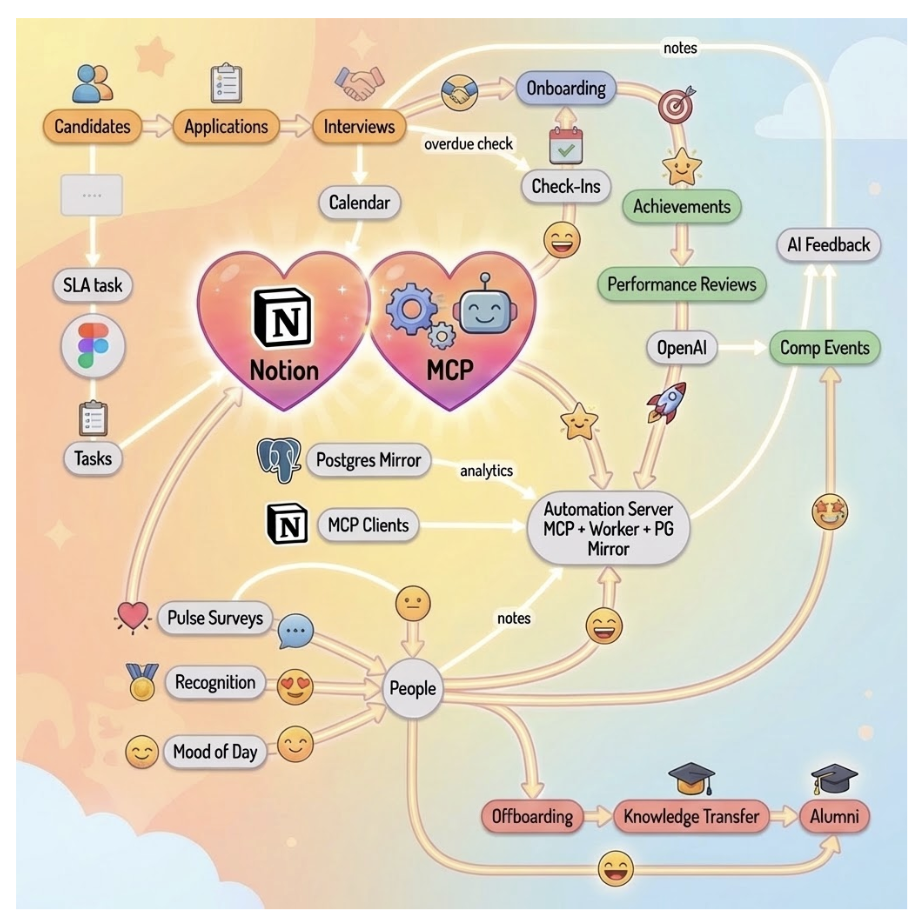
All records are connected through Notion relations and rollups, enabling a complete view of every employee journey.
To make experimentation easy for hackathons and demos, EchoHR can provision the entire workspace with one command.
This instantly creates:
* lifecycle pipelines
* feedback workflows
* onboarding journeys
* review systems
* promotion tracking
* exit processes
* dashboards and demo data
## Video Demo
{% embed https://youtu.be/D1zYQVfRA8w %}
Suggested demo flow:
1. One-command provisioning of the EchoHR workspace
2. Hiring pipeline with candidate progress
3. Automated onboarding journeys
4. AI-generated interview summaries
5. Slack notification workflows
6. Lifecycle dashboards and reporting
## Show us the code
GitHub repository:
[https://github.com/ujjavala/EchoHR](https://github.com/ujjavala/EchoHR)
The repository includes everything needed to spin up a fully functional EchoHR workspace.
## How I Used Notion MCP
EchoHR uses Notion MCP as the operational layer for lifecycle management.
It enables AI agents, automation workflows, and integrations to operate directly on structured HR data.
### Notion MCP (hosted)
Notion MCP provides the primary CRUD and schema layer for lifecycle operations.
It is used for:
* provisioning databases
* creating lifecycle records
* updating candidate stages
* logging check-ins
* posting AI summaries
EchoHR includes a one-click workspace provisioning command:
`npm run demo`
These provisions:
* pages
* data sources
* relations
* rollups
* demo records
* automation playbooks
Agents can then operate on the workspace through MCP.
### Slack MCP
Slack MCP enables human-first notifications so important updates never stall.
Examples include:
* candidate update reminders
* onboarding alerts
* offer acceptance notifications
* overdue feedback pings
This ensures recruiters and managers stay responsive.
### Figma MCP
EchoHR integrates with design workflows through Figma MCP.
Example automation:
When a Figma frame is marked Ready for Review:
* A review task is created in Notion
* The task links to the relevant check-in
* A Slack notification is posted
This bridges the design → product → engineering workflow.
### Calendar MCP Pattern
EchoHR uses calendar MCP patterns to schedule lifecycle events.
Examples:
* interview loops
* onboarding meetings
* post-offer check-ins
Agents create tasks in Notion and schedule them via calendar integrations.
### OpenAI MCP (automation server)
EchoHR includes an automation server that processes lifecycle notes and generates structured summaries.
### Under the Hood: MCP as an Orchestration Layer
Beyond individual integrations, EchoHR uses MCP as a coordination layer across systems.
Notion acts as the operational control plane, while automation and heavier workflows are handled via webhooks and an external automation server.
This enables:
* event-driven workflows (no polling)
* cross-tool orchestration (Notion + Slack + Figma + OpenAI)
* real-time feedback loops (notes → AI → Notion → Slack)
* scalability patterns like rate limiting, batching, and optional external storage
The goal is to keep humans in the loop, while MCP handles coordination across the lifecycle.
Example endpoint:
`/webhooks/meeting-notes`
This converts raw notes into:
* interview feedback summaries
* candidate-safe responses
* manager action items
The summaries are written back into Notion records automatically.
## Core Components
### Notion Workspace Seeder
The workspace seeder provisions the entire HR operating system.
It creates:
* lifecycle databases
* relations and rollups
* templates
* automation playbooks
* demo datasets
Running the setup creates a fully operational HR workspace inside Notion.
### Automation Server
EchoHR includes a lightweight automation server that connects Notion to external systems.
Endpoints include:
```http
POST /webhooks/notion
POST /webhooks/figma
POST /webhooks/meeting-notes
POST /summaries/interview
POST /summaries/review
POST /summaries/exit
POST /slack/notify
GET /health
```
These endpoints power automated workflows across the employee lifecycle. They are triggered by Notion lifecycle events and external signals, enabling event-driven automation instead of polling.
## Example Automations
### Candidate Workflow
When a new candidate is created in Notion:
* An application record is automatically created
* An SLA follow-up task is assigned to the recruiter
### Offer Workflow
When an offer status becomes Accepted:
* An onboarding journey is created
* The first three monthly check-ins are scheduled
* onboarding tasks are generated
### Design Workflow
When a Figma frame is marked Ready for Review:
* A review task is created in Notion
* The task attaches to the relevant check-in
* A Slack notification is posted
## AI-Powered Feedback
EchoHR integrates with OpenAI to generate summaries for:
* interview feedback
* performance reviews
* exit interviews
Example flow:
1. Interview notes are captured
2. `/webhooks/meeting-notes` processes them
3. AI generates candidate-safe summaries and manager action items
4. The results are written back into Notion
5. Slack notifications ensure feedback never stalls
## Demo Dataset
To make the system immediately usable, EchoHR seeds a realistic startup environment with:
* \~50 employees
* founders and executives
* HR and people operations
* managers and ICs
* open roles
* active hiring pipelines
* onboarding journeys
* performance reviews
* promotions and compensation events
* recognition and pulse surveys
* exit processes
This allows dashboards and workflows to be demonstrated instantly.
## One-Command Setup
Run:
`npm run demo`
This automatically:
* provisions the Notion workspace
* creates lifecycle databases
* seeds demo records
* configures relations and rollups
* persists install state for idempotent re-runs
You can also create a fresh versioned workspace:
`npm run demo \-- \--force-new`
Each installation creates a new workspace version, such as:
* EchoHR HQ v1
* EchoHR HQ v2
This makes experimentation safe during hackathons.
## The Differentiator
Most HR software focuses on compliance and reporting.
EchoHR focuses on human experience.
It introduces the concept of:
## Zero-Ghosting Lifecycle Management
Candidates should never wonder:
*"Did they forget about me?"*
Employees should never wonder:
*"Am I doing well here?"*
EchoHR enforces transparency through automated lifecycle checkpoints:
* candidate update deadlines
* interview feedback reminders
* onboarding check-ins
* review timelines
* promotion visibility
* exit follow-ups
Everything is tracked through interconnected Notion data sources.
## Limitations (Current Notion Constraints)
Some capabilities are limited by the current Notion API.
### Database Views
The API cannot create board, timeline, or gallery views.
EchoHR automatically creates a page called:
Set up Views (5–10 min)
This guides users through configuring dashboards manually.
### Visual Styling
Notion does not support custom CSS through the API.
Visual structure uses:
* page covers
* emojis
* callouts
* curated views
### Charts
Notion charts depend on workspace features.
If unavailable, charts can be embedded from external sources such as:
* Google Sheets
* Datawrapper
### Formula Updates
Formula properties cannot currently be modified after creation through the API.
They must be defined during provisioning.
## Why This Matters
Hiring and employee management systems often fail at one simple thing:
communication.
Candidates get ghosted.
Employees receive little feedback.
Performance reviews disappear into silence.
EchoHR demonstrates how Notion \+ MCP \+ AI automation can create a transparent and human-first operating system for people operations.
Instead of spreadsheets and disconnected tools, teams get a single lifecycle workspace where every stage is visible and actionable.
EchoHR isn’t just an HR system — it’s an example of how MCP can orchestrate tools into a cohesive, event-driven lifecycle engine.
One where communication is not an afterthought, but a guaranteed outcome.
Comments
More Blog
View allaiHow I'm using ASTs and Gemini to solve the "Codebase Onboarding" problem 🧠
Hi everyone! 👋 I’m Tara, a Senior Software Engineer and Consultant. Over the years, I've jumped...
T
tworrellaiLocal AI Will Save Us All (The Math Says So, Trust Me)
Every few weeks a take goes viral in tech circles making the case for ditching cloud AI and running...
S
Sebastian SchürmannaiLost in the AI Hype, I Started Small
And it helped me get back into tech without drowning TL;DR at the end Coming back to...
R
Rohini GaonkargoBuilding a Replay-Tested Interactive Brokers Client in Go
I wanted an IBKR library that felt like Go and had testing I could trust. So I wrote one.
T
Thomas MarcelisplaywrightPlaywright in Pictures: Fully Parallel Mode
Playwright’s fullyParallel mode is often treated as a simple performance switch. In practice, it...
V
Vitaliy PotapovcliDesigning a CLI for Both Humans and Agents
Learn how Alpic designed its CLI for both human developers and AI agents — covering tradeoffs like polling, context windows, interactivity, and statelessness.
J
Julien Vallini