
Back to Blog claudecode
Introducing
 gemma
gemma community
 ai
ai ai
ai githubactions
 ai
ai
I Made Claude Code Think Before It Codes. Here's the Prompt.
v.j.k. March 10, 2026
0 views
Claude Code is the fastest coder I've ever worked with. It can scaffold a feature, write tests, and...
title: I Made Claude Code Think Before It Codes. Here's the Prompt. published: true description: tags: claudecode, ai, tdd, productivity cover_image: https://dev-to-uploads.s3.amazonaws.com/uploads/articles/g7yz9ml71u14a3red18y.png
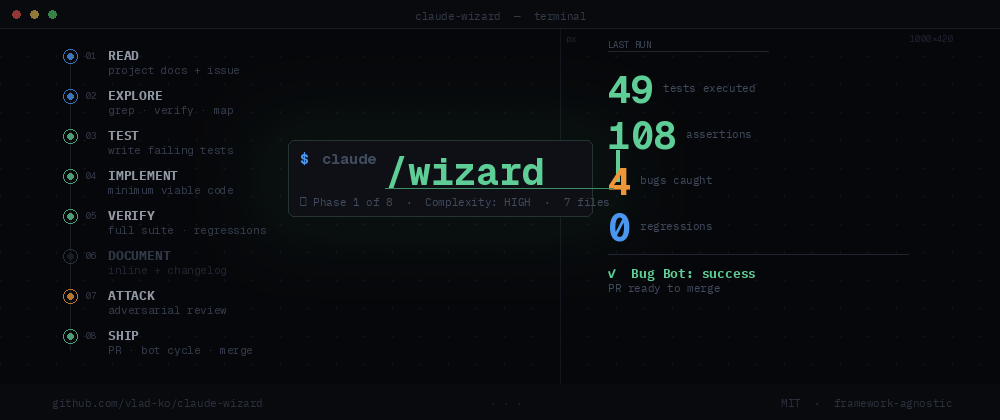
Use a ratio of 100:42 for best results.
published_at: 2026-03-10 15:07 +0000
Claude Code is the fastest coder I've ever worked with. It can scaffold a feature, write tests, and open a PR in minutes. But I kept running into the same problem: the code worked, and then it didn't.
A race condition in a status transition. A hard-coded string that should have been a constant. A transaction that rolled back an audit record it was supposed to keep. Tests that asserted true instead of asserting the right value.
The fixes were always fast too. But each fix came with a side quest: the incident, the regression, the "why didn't we catch this?" retro. The velocity was high. The net velocity, after accounting for the bugs, wasn't.
And even with a decent CLAUDE.md, I was still babysitting every session. Please don't forget TDD this time. Hey, you forgot to check Bug Bot. Can you actually run the tests before opening the PR? Each prompt felt like a conversation with someone extremely talented who also had the short-term memory of a goldfish. The problem wasn't Claude's ability. It was that good habits written down somewhere in a markdown file don't automatically become practiced habits. I was the process. Which meant the process was inconsistent, forgetful, and increasingly annoyed at itself.
So I tried something different. Instead of fixing Claude's output, I changed how Claude thinks.
The problem isn't intelligence. It's process.
Watch a junior developer work: they read the ticket, open the file, start typing. They're fast. They're also the ones who forget to check if the method they're calling actually exists, or whether the database column they're referencing was renamed three weeks ago. (It was renamed three weeks ago. It's always three weeks ago.)
Now watch a senior developer: they read the ticket, read the code around it, read the tests, check the git history, then start typing. They're slower to start but faster to finish, because they don't have to go back and fix what they broke.
Claude Code defaults to junior mode. Not because it lacks knowledge, but because it lacks process. It has no internal checklist telling it to verify assumptions, write tests first, or think about what happens when two requests hit the same endpoint at the same time. It's enthusiastic. It ships. And enthusiasm, it turns out, does not catch nullable datetime crashes.
I built that checklist.
Introducing /wizard
/wizard is a Claude Code skill, a markdown file that lives in your project and activates when you type /wizard in the CLI. It transforms Claude from a fast coder into a methodical software architect. Think of it as the senior engineer looking over Claude's shoulder, except this one never asks if you've tried turning it off and on again.
It's an 8-phase methodology, and it works best with a few things already in place: a CLAUDE.md defining your project conventions, a GitHub issue created before work begins (/wizard can help you write one), a real commitment to TDD, and a clean feature branch per task. For CI, I use GitHub Actions, but the skill doesn't care. It just needs something to respond to in Phase 8. More on that shortly.
Here's how the 8 phases work.
Phase 1: Plan before you touch anything
Claude reads your CLAUDE.md, finds the linked GitHub issue, and builds a structured todo list before a single line of code is written. It assesses complexity: how many files are likely affected, whether there's architectural impact, how much could go wrong. Then it sizes the work accordingly.
This sounds obvious. It is obvious. It's also the step that gets skipped most often when you're in a hurry, which is exactly when you need it most. Funny how that works.
Phase 2: Explore before you assume
With a plan in place, Claude explores the actual codebase. It greps for every model, method, relationship, and constant it intends to use and verifies they exist before referencing them in code.
Without this phase, Claude might confidently call user.clientProfile.accounts, a relationship chain it hallucinated with complete conviction. Phase 2 exists specifically to prevent that. This one change alone eliminated an entire class of bugs in my project. Turns out "does this actually exist" is a pretty good question to ask before you build on top of it.
Phase 3: Write the tests first
Phase 3 enforces TDD. Claude writes failing tests, runs them (they must fail), implements the minimum code to make them pass, then verifies. In that order, every time, no shortcuts.
But here's the key part: it uses a mutation testing mindset. Instead of assert($result), it writes assertEquals('completed', $result->status). Instead of checking that a function runs without errors, it checks that every side effect actually happened: the timestamp was set, the notification was sent, the counter was incremented.
The difference matters. assert(true) passes if the code does nothing. Mutation-resistant assertions catch real bugs. Your test suite should be a skeptic, not the friend who tells you your PR looks great without reading it.
Phase 4: Implement the minimum
With failing tests in place, Claude writes the implementation. Not the full vision, not the clever abstraction it already has in mind, just the minimum code required to make the tests pass. Scope creep is a bug too, and it's the most expensive kind because it looks like progress.
Phase 5: Verify nothing regressed
Phase 5 runs the broader test suite, not just the new tests. The goal is zero regressions. If something unrelated broke, better to find out now than in a PR review comment that says "uh, why is the billing module failing?"
Phase 6: Document while the context is fresh
Inline comments, changelog entries, anything that needs updating. Small step, easy to skip, always worth doing before the context evaporates. The next person reading this code might be you in three months, staring at it with absolutely no memory of why you made that decision.
Phase 7: The adversarial review
This is where /wizard earns its keep. Before every commit, Claude reviews its own work not as the author, but as an attacker. The checklist:
- What happens if this runs twice concurrently?
- What if the input is null? Empty? Negative?
- What assumptions am I making that could be wrong?
- Would I be embarrassed if this broke in production?
This isn't theoretical. In my codebase, this phase caught:
- A status transition service that lacked database locking. Two concurrent API calls could apply conflicting transitions. A race condition, just sitting there quietly, waiting for a bad day.
- A Blade template calling
->format()on a nullable datetime. A crash on any page load where the field was null. Completely silent until it wasn't. - Notification payloads using hard-coded category strings instead of the enum that was literally created in the same PR. Breathtaking, really.
None of these would have been caught by tests alone. They required thinking about the code in a different mode: as an attacker, not an author.
Phase 8: The quality gate cycle
Phase 8 handles the PR lifecycle. /wizard doesn't just open the PR and consider its job done. It monitors the automated review bot status (Bug Bot, CodeRabbit, whatever you have), reads every finding, fixes valid issues, replies to false positives, and repeats until the status is clean.
This is the phase I used to do manually and frequently forgot, leaving PRs sitting with unresolved bot findings for days. Now it's part of the process, which is exactly where it should have been all along.
A real example
Here's what all 8 phases look like on a real task: implementing ACAT transfer status tracking with notifications.
Phase 1: Claude reads CLAUDE.md, finds the GitHub issue, assesses the task as "Complex" (7+ files, architectural impact), and builds a todo list.
Phase 2: Claude greps for the AcatTransfer model, verifies the VALID_TRANSITIONS constant exists, checks that ClientProfile has the right relationships, and confirms the NotificationCategory enum. No hallucinated method chains. No surprises.
Phase 3: Claude writes 23 failing tests covering status transitions, notifications, command behavior, and dashboard rendering. Runs them. All fail. Good. That's the point.
Phase 4: Claude implements the service, command, 5 notification classes, controller changes, and Blade template. Runs tests. All pass.
Phase 5: Runs the full related test suite (49 tests). Zero regressions.
Phase 6: Updates the changelog and adds inline comments to the transition service.
Phase 7: Adversarial review catches that initiated_at->format() could NPE if the field is null. Fixes it before it becomes a 2am incident.
Phase 8: Opens PR. Bug Bot finds 4 issues:
- Hard-coded category strings (should use enum): fixed
- Missing database locking on status transitions: fixed with
lockForUpdate() - Nullable
initiated_atin Blade template: fixed with null-safe operator - Wrong notification tone for completion events: fixed
After 3 fix cycles, Bug Bot returns success. PR ready.
Total: 49 tests, 108 assertions, 4 bugs caught before they shipped. Not bad for a checklist.
How to install it
One command:
curl -sL https://raw.githubusercontent.com/vlad-ko/claude-wizard/main/install.sh | bash
This drops three files into .claude/skills/wizard/:
SKILL.md: The core 8-phase methodologyCHECKLISTS.md: Quick-reference checklistsPATTERNS.md: Common patterns and anti-patterns
Then type /wizard in Claude Code to activate it.
Making it yours
The skill is framework-agnostic by design. It doesn't know if you're writing Laravel, Rails, Next.js, or Rust. The methodology, plan, explore, test, implement, verify, document, review, ship, works everywhere.
But it gets more powerful when you customize it. In my project, I added:
- Laravel-specific test commands (
./vendor/bin/sail test) - Our logging service patterns (
LoggingService::logPortfolioEvent()) - Database locking conventions for our ORM
- Bug Bot thread resolution commands (GraphQL mutations)
- Alpine.js requirements for UI components
The more project-specific context you add, the less Claude has to guess. And the less Claude guesses, the fewer bugs slip through. Turns out those two things are related.
What it's not
/wizard is not a replacement for code review. It's not a testing framework. It's not a CI pipeline.
It's a process prompt: a way to encode senior engineering habits into Claude's workflow so those habits happen consistently, on every task, even at 2am when you're tired and just want the feature to ship.
The prompt is roughly 500 lines of markdown. There's no magic. It's the same checklist a good tech lead would run through, made explicit and repeatable. The only surprising thing is that nobody bothered writing it down sooner.
The source
The full skill is open-source at github.com/vlad-ko/claude-wizard. MIT licensed. Fork it, customize it, make it better.
It came out of building wealthbot.io, a fintech platform where "it mostly works" is genuinely not a product strategy. The patterns were refined over hundreds of PRs and real production incidents. The framework-specific parts have been stripped, but the methodology is battle-tested.
If you try it, I'd love to hear what it catches for you.
Comments
More Blog
View allgemmaFive Gemma-4 models, one accelerator: what porting E2B 31B to AWS Inferentia2 taught me
I ported the whole Gemma-4 family — E2B, E4B, 12B, 31B, and the 26B-A4B MoE — to run on...
X
xbillcommunityHey DEV, I'm Tobore. Let's actually connect.
Hey DEV, I'm Tobore. Let's actually connect. I've been on here for a while now, mostly writing and...
L
Laurina AyarahaiI burned through thousands of AI tokens. Then a friend did it for free
(yep, kinda clickbait, just for the funsies 😊) At the beginning of the year, I relaunched my...
P
Paulo HenriqueaiClaude might be saturating your machine
My laptop was sitting idle with the fan at full tilt. Nothing was running that I knew of. The culprit...
S
Sidhant PandagithubactionsAutomated GitHub Code Reviews Using Google Gemini
I Built a Thing! TL;DR — Google Gemini-based Pull Request reviews and Issue Triaging for...
D
Darren "Dazbo" LesteraiWhat is an "agentic harness," actually?
I've been hearing the word "harness" thrown around a lot lately. I assumed it just meant "the IDE" or...
T
Tilde A. ThuriumReady-made automations for this
Workflows from the Neura Market marketplace related to this DeepSeek resource
- PostgreSQL Conversational Agent with Claude & DeepSeek (Multi-KPI, Secure)n8n · $14.99 · Related topic
- Automate Blog Content Creation with Notion MCP, DeepSeek AI, and WordPressn8n · $9.99 · Related topic
- Generate AI Videos from Scripts with DeepSeek, Synthesia, and Together.ain8n · $24.99 · Related topic
- Compare Multi-Period Financial Data from Google Sheets with DeepSeek AI Analysisn8n · $14.99 · Related topic