
Back to Blog frontend
 gemma
gemma community
 ai
ai ai
ai githubactions
 ai
ai
Tend (and about Vibe Coding)
Daniel Schulz March 25, 2026
0 views
It’s been a while since I’ve coded for myself. I did push an update on Ssstyles and JSSynth every now...
It’s been a while since I’ve coded for myself. I did push an update on Ssstyles and JSSynth every now and then, but I haven’t done something new.
Why?
I needed a habit tracker to get on top of my health again. It needed to be easy to use and sync across devices without selling my data to ad companies, which means selfhosting. The awesome selfhosted list has a few projects, but…
- Habitica looks really nice, but it’s a bit much. I didn’t want to gamify things.
- Beaver Habits doesn’t support personal goals.
- OpenHabitTracker just looks really clunky.
I also wanted to brush off my Vue skills. Time to do it myself, then!
Building it
I started with a very minimalistic approach: HTML, CSS and Typescript with Petite Vue on top for reactive components. Not only did things go out of hand quickly, with the entire content of the app being driven by user-defined input, but Petite Vue itself hasn’t been maintained in years (which is a shame - i really liked the project).
So I went to the other extreme and set up Nuxt. If all the content was dynamic anyway, why not go all the way. I know that Nuxt has some performance and accessibility problems, but my performance target is a bit lower when building an “app-like” project, as opposed to a traditionally content driven one. It turned out I could still reach good performance metrics, thanks to caching user content to an IndexedDB and SSR’ing the app skeleton. Wrangling Hydration issues was an ongoing problem, though.
I figured I could mitigate accessibility problems as best as I can with enough testing. Marcus’ book Accessible Vue was a great help, too.
I used my own CSS framework Ssstyles as the foundation and I really love having a functioning system. I did find some caveats that I fixed during the development process, but most of the base styles and components worked out of the box and were a breeze to use.
Deploying
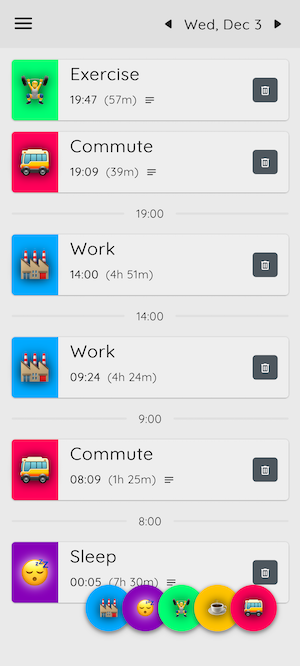
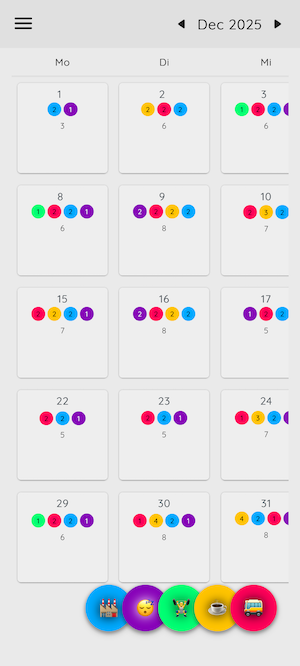
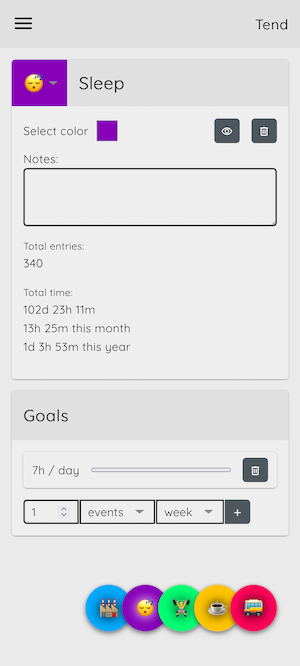
I tried something new here. Tend deploys directly to Netlify, where it’s usable as a PWA. There are no accounts or tracking and everything stays on your device. That also means there’s no sync across devices. That’s why every new release also creates a new docker container with a database and a simple single-account-login. It doesn’t deploy anywhere, but it’s self-hostable.
I did read a lot about backend security and learned one or two things about attack vectors. I hope it holds up!
So if you have a home server, you can use the docker setup, or else install the PWA.
On Vibe Coding
At some point midway through, my employer gave me access to Claude Code. I tried it here and I have some thoughts.
I think, Claude can be a welcome help to unwelcome tasks. Figuring out what the unwelcome tasks are is the harder part. If you use it to write a some syntax you rarely use - fine (though you can just use MDN for that as well). But using it to write your entire app? That’s for people who don’t like coding. In that case: please don’t. You’ll ship code that you don’t understand, full of bugs, problems and security risks.
I used Claude to write JSDocs and Tests. Those are unwelcome tasks to me and the LLM is fairly competent at documenting. Tests needed some more guidance. I found that Context Rot was a major problem. If the list of things that it needs to keep in mind gets too large, it becomes forgetful. I mean, so do I, but the things I forget are “updating the version number” or “writing a JSDoc”, not “how does the app work” and - more importantly even “what did I already try”. Claude went in circles multiple times when the context was approaching its limit, proposing fixes, testing and reverting them, when the correct solution was a simple missing import.
Struggles continued with anything regarding accessibility. The amount of misinformation it gave me and the faulty code it wanted to write is baffling. Claude seems to love aria. Whenever I described a problem (e.g. “label xy is ignored by VoiceOver on MacOS”), it completely ignored the underlying issue and slapped some aria on top of it. At this point I can only discourage from trusting AI tools when coding barrier-free content.
Would I use Claude again? For my job, yes. For private projects - maybe not. I did find it helpful for testing and documenting, but the price (both monetary and in resources) is still very steep with no signs of coming down.
Comments
More Blog
View allgemmaFive Gemma-4 models, one accelerator: what porting E2B 31B to AWS Inferentia2 taught me
I ported the whole Gemma-4 family — E2B, E4B, 12B, 31B, and the 26B-A4B MoE — to run on...
X
xbillcommunityHey DEV, I'm Tobore. Let's actually connect.
Hey DEV, I'm Tobore. Let's actually connect. I've been on here for a while now, mostly writing and...
L
Laurina AyarahaiI burned through thousands of AI tokens. Then a friend did it for free
(yep, kinda clickbait, just for the funsies 😊) At the beginning of the year, I relaunched my...
P
Paulo HenriqueaiClaude might be saturating your machine
My laptop was sitting idle with the fan at full tilt. Nothing was running that I knew of. The culprit...
S
Sidhant PandagithubactionsAutomated GitHub Code Reviews Using Google Gemini
I Built a Thing! TL;DR — Google Gemini-based Pull Request reviews and Issue Triaging for...
D
Darren "Dazbo" LesteraiWhat is an "agentic harness," actually?
I've been hearing the word "harness" thrown around a lot lately. I assumed it just meant "the IDE" or...
T
Tilde A. ThuriumReady-made automations for this
Workflows from the Neura Market marketplace related to this DeepSeek resource
- Automate Blog Content Creation with Notion MCP, DeepSeek AI, and WordPressn8n · $9.99 · Related topic
- Generate AI Videos from Scripts with DeepSeek, Synthesia, and Together.ain8n · $24.99 · Related topic
- Compare Multi-Period Financial Data from Google Sheets with DeepSeek AI Analysisn8n · $14.99 · Related topic
- PostgreSQL Conversational Agent with Claude & DeepSeek (Multi-KPI, Secure)n8n · $14.99 · Related topic