
Back to Blog html
html gemma
gemma community
 ai
ai ai
ai githubactions
 ai
ai
Coding an Extension that Summarises Web Pages with HTML, CSS, and JS
Helitha Rupasinghe June 22, 2026
0 views
In this post, I will show you how you can create a Google Chrome extension that instantly summarises...
In this post, I will show you how you can create a Google Chrome extension that instantly summarises the current web page. We are going to build TLDR Master, a minimal, privacy-friendly extension that runs entirely in your browser.
The best part? No API keys or external services are required. We will write a lightweight TF-IDF algorithm in pure JavaScript to extract the most important sentences from any article.
Creating the project
First, let's set up our project structure. Create a new folder named TLDR-Master and add the following files:
TLDR-Master
  |- assets
    |- css
      |- popup.css
    |- images
      |- logo16.png
      |- logo48.png
      |- logo128.png
  |- manifest.json
  |- popup.html
  |- popup.js
Part 1: modifying our HTML file.
Our extension will use a popup UI that appears when the user clicks the extension icon. Open popup.html and set up the basic structure.
We need a header with our logo and a theme toggle button. We'll also add a section to display the word count and reading time, a control group to let users choose how many bullet points they want (3, 5, or 7), and a main button to trigger the summarisation.
<!DOCTYPE html>
<html lang="en">
<head>
  <meta charset="UTF-8">
  <link rel="stylesheet" href="assets/css/popup.css">
</head>
<body>
  <div class="container">
    <div class="header">
      <img src="assets/images/logo128.png" alt="Logo" class="logo">
      <div class="header-text">
        <h2>TL;DR</h2>
        <span class="subtitle">Page Summary</span>
      </div>
      <button id="theme-btn" title="Toggle dark / light mode">
        <!-- SVG Icons for Sun/Moon -->
      </button>
    </div>

    <div id="page-meta" class="page-meta hidden">
      <span id="word-count"></span>
      <span class="dot">·</span>
      <span id="read-time"></span>
    </div>

    <div class="controls">
      <span class="control-label">Bullets</span>
      <div class="pill-group" id="bullet-count">
        <button class="pill" data-value="3">3</button>
        <button class="pill active" data-value="5">5</button>
        <button class="pill" data-value="7">7</button>
      </div>
    </div>

    <div id="loading" class="loading hidden">
      <div class="spinner"></div>
      <span>Analysing page…</span>
    </div>

    <div id="output" class="hidden">
      <div class="summary-header">
        <span class="summary-label">Summary</span>
        <button id="copy-btn" class="icon-btn" title="Copy to clipboard">
          <!-- Copy Icon -->
        </button>
      </div>
      <ul id="summary-list"></ul>
    </div>

    <button id="summarize-btn" class="primary-btn">Summarise Page</button>
  </div>
  <script src="popup.js"></script>
</body>
</html>
Part 2: modifying our CSS file.
Let's make our popup look clean and modern. Open assets/css/popup.css.
We will use CSS variables to easily implement a light and dark mode. We can toggle this by adding a data-theme="dark" attribute to the HTML. We also style the "pill" buttons for the bullet count and a nice spinner for when the extension is analysing the page.
/* ── Design tokens — light mode ── */
:root {
  --bg:          #ffffff;
  --surface:     #f4f4f8;
  --text:        #1a1a2e;
  --accent:      #0076ff;
  --accent-hover:#0062d6;
}

/* ── Dark mode tokens ── */
html[data-theme="dark"] {
  --bg:          #141420;
  --surface:     #1e1e30;
  --text:        #e2e2f0;
  --accent:      #3385ff;
  --accent-hover:#1a6fe8;
}

body {
  font-family: -apple-system, BlinkMacSystemFont, "Segoe UI", Roboto, sans-serif;
  width: 360px;
  margin: 0;
  background: var(--bg);
  color: var(--text);
  transition: background 0.2s, color 0.2s;
}

.primary-btn {
  background: var(--accent);
  color: #fff;
  border: none;
  border-radius: 8px;
  padding: 11px 16px;
  font-size: 14px;
  font-weight: 600;
  cursor: pointer;
  width: 100%;
  transition: background 0.15s;
}

.primary-btn:hover {
  background: var(--accent-hover);
}
Part 3: modifying our JS file.
This is where the magic happens! Open popup.js.
Because we want to keep everything local and private, we aren't sending the page text to an external AI. Instead, we inject a script directly into the active tab to extract the text and score it.
First, let's handle the UI logic, like the theme toggle and the bullet count selection:
// ── Theme toggle ───────────────────────────────────────────────────────────
document.getElementById('theme-btn').addEventListener('click', () => {
  const isDark = document.documentElement.getAttribute('data-theme') === 'dark';
  const next = isDark ? 'light' : 'dark';

  if (next === 'dark') {
    document.documentElement.setAttribute('data-theme', 'dark');
  } else {
    document.documentElement.removeAttribute('data-theme');
  }
  chrome.storage.local.set({ theme: next });
});

// ── Bullet-count pill toggle ───────────────────────────────────────────────
let bulletCount = 5;
document.querySelectorAll('.pill').forEach(btn => {
  btn.addEventListener('click', () => {
    document.querySelectorAll('.pill').forEach(b => b.classList.remove('active'));
    btn.classList.add('active');
    bulletCount = parseInt(btn.dataset.value, 10);
  });
});
Finally, we return the top N sentences to the popup, sorted by their original order in the document, and display them as a bulleted list!
Part 4: modifying our Manifest.Json file.
Finally, we need to tell Chrome about our extension. Open manifest.json. We are using Manifest V3 and we need a few specific permissions:
activeTab: To access the currently open tab.scripting: To inject our extraction script into the page.clipboardWrite: So users can copy the summary.storage: To save their preferred theme (light or dark).
{
  "manifest_version": 3,
  "name": "TLDR Web Summariser",
  "version": "1.2",
  "description": "Summarises the current web page instantly without API keys or external dependencies.",
  "permissions": [
    "activeTab",
    "scripting",
    "clipboardWrite",
    "storage"
  ],
  "action": {
    "default_popup": "popup.html",
    "default_icon": {
      "16": "assets/images/logo16.png",
      "48": "assets/images/logo48.png",
      "128": "assets/images/logo128.png"
    }
  },
  "icons": {
    "16": "assets/images/logo16.png",
    "48": "assets/images/logo48.png",
    "128": "assets/images/logo128.png"
  }
}
Deployment
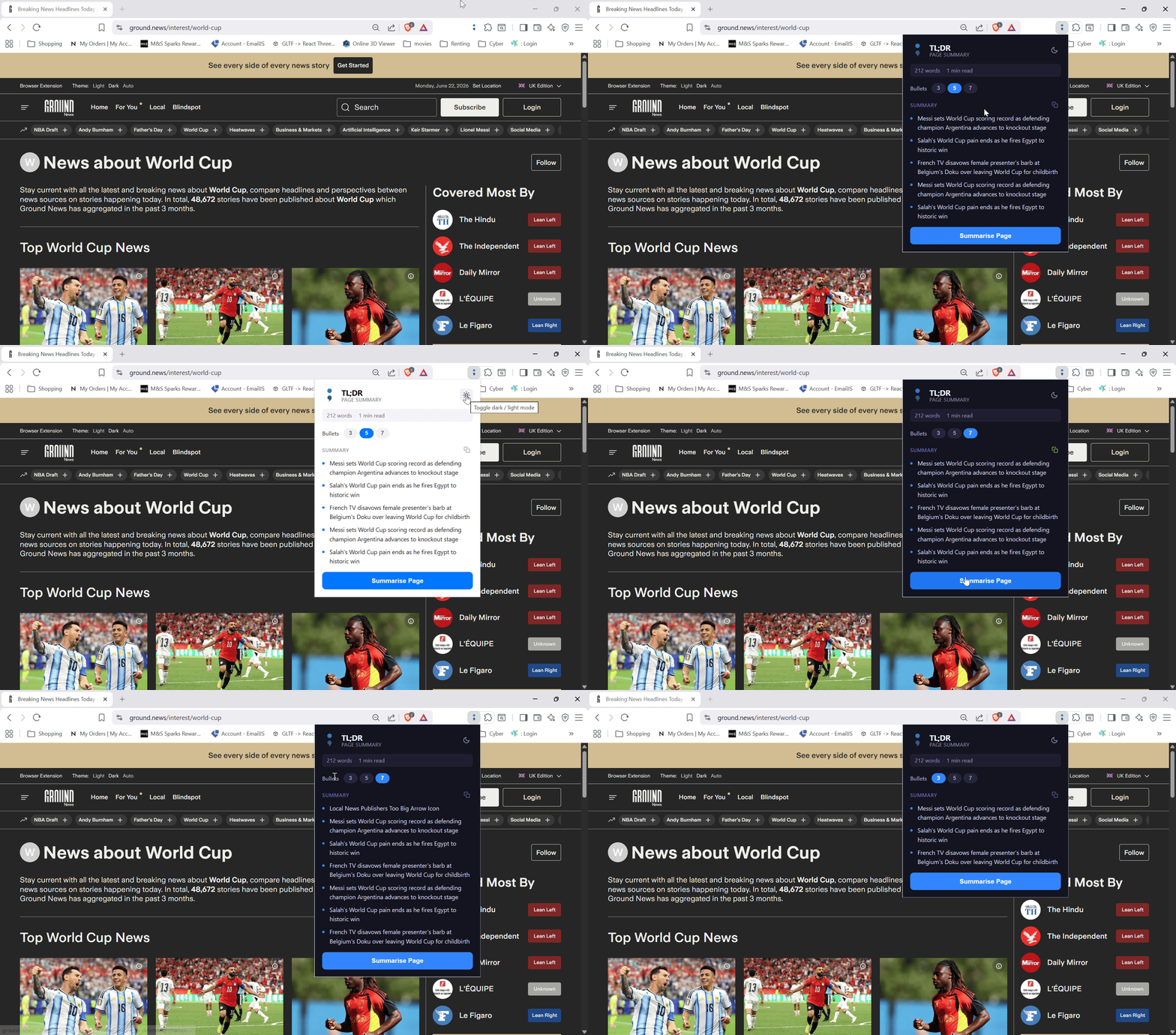
To test your new extension:
- Open Chrome and navigate to
chrome://extensions/. - Enable "Developer mode" in the top right corner.
- Click "Load unpacked" and select your
TLDR-Masterfolder. - Click the extension icon in your browser toolbar while on any article, and hit "Summarise Page"!
Conclusion
You've just built a fully functional, offline web summariser using only HTML, CSS, and vanilla JavaScript! By leveraging the chrome.scripting API and a classic NLP algorithm, you can provide immense value without relying on paid APIs or compromising user privacy.
Check out the full source code and contribute on GitHub: TLDR Master.
Comments
More Blog
View allgemmaFive Gemma-4 models, one accelerator: what porting E2B 31B to AWS Inferentia2 taught me
I ported the whole Gemma-4 family — E2B, E4B, 12B, 31B, and the 26B-A4B MoE — to run on...
X
xbillcommunityHey DEV, I'm Tobore. Let's actually connect.
Hey DEV, I'm Tobore. Let's actually connect. I've been on here for a while now, mostly writing and...
L
Laurina AyarahaiI burned through thousands of AI tokens. Then a friend did it for free
(yep, kinda clickbait, just for the funsies 😊) At the beginning of the year, I relaunched my...
P
Paulo HenriqueaiClaude might be saturating your machine
My laptop was sitting idle with the fan at full tilt. Nothing was running that I knew of. The culprit...
S
Sidhant PandagithubactionsAutomated GitHub Code Reviews Using Google Gemini
I Built a Thing! TL;DR — Google Gemini-based Pull Request reviews and Issue Triaging for...
D
Darren "Dazbo" LesteraiWhat is an "agentic harness," actually?
I've been hearing the word "harness" thrown around a lot lately. I assumed it just meant "the IDE" or...
T
Tilde A. ThuriumReady-made automations for this
Workflows from the Neura Market marketplace related to this DeepSeek resource
- Compare Multi-Period Financial Data from Google Sheets with DeepSeek AI Analysisn8n · $14.99 · Related topic
- Automate Blog Content Creation with Notion MCP, DeepSeek AI, and WordPressn8n · $9.99 · Related topic
- Automate Altcoin News to LinkedIn Posts with DeepSeek AI and Google Sheetsn8n · $14.99 · Related topic
- Automate YouTube Video Optimization with Google Sheets and DeepSeek AIn8n · $9.99 · Related topic