
Back to Blog android
 gemma
gemma community
 ai
ai ai
ai githubactions
 ai
ai
Building a custom launcher for ChromeOS
Thomas Künneth May 14, 2026
0 views
In this article, I will share some of my experience of enhancing Be nice to be a launcher on...
In this article, I will share some of my experience of enhancing Be nice to be a launcher on ChromeOS. Now, why would I want to do that anyway? I use my ChromeOS detachable more like an Android tablet than a traditional laptop; therefore, I find myself deeply missing the Android goodness that Google's desktop OS tends to strip away. Chief among these missing features is support for app widgets. Be nice has app widget support, so it would be great to run my app on ChromeOS. On a standard Android phone or tablet you can simply swap the home app in settings.
fun changeDefaultHomeApp() {
  val intent = Intent(Settings.ACTION_HOME_SETTINGS).apply {
    addFlags(Intent.FLAG_ACTIVITY_NEW_TASK)
  }
  if (context.packageManager.resolveActivity(
      intent,
      PackageManager.MATCH_DEFAULT_ONLY
    ) != null
  ) {
    context.startActivity(intent)
  }
}
Unfortunately, ChromeOS forces you to use its native environment.
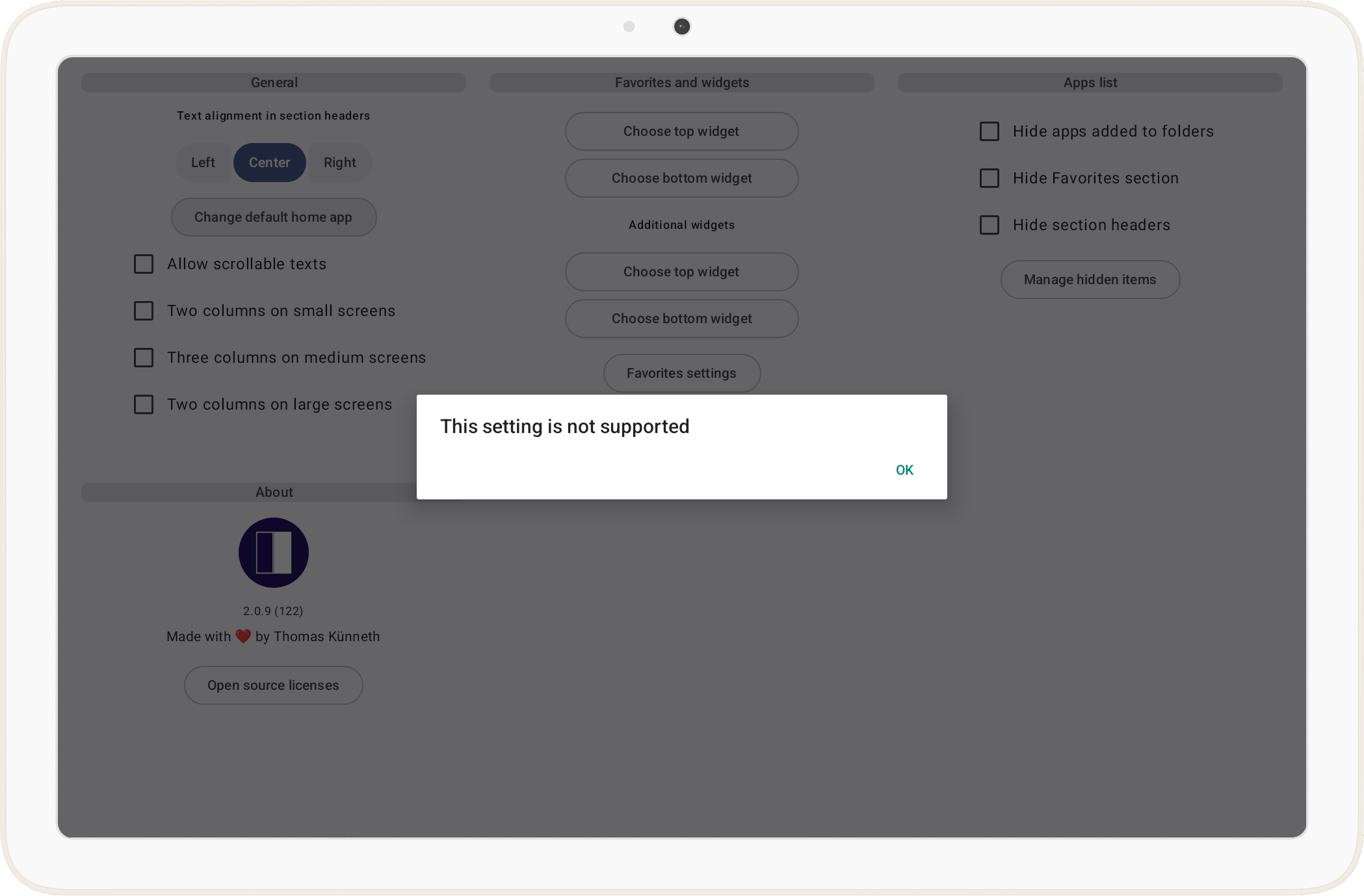
Consequently, the launcher will be treated just like any other Android app. What does this imply? While we can easily launch other apps, core launcher features like returning to the home screen via the system gesture or home button, acting as the dedicated home activity that fills the display with the normal Android home wallpaper visible behind transparent UI, and integration with the system-level overview or task switcher are not available. Instead, the launcher stays contained within its own window, meaning a swipe up or a press of the Everything Button will still take you back to the native ChromeOS shelf rather than your custom interface.
And there is another nasty issue. Before Be nice became a genuine launcher, its main goal was to run two apps side by side, utilizing the split-screen capabilities that are present in Android since 7.0 (Nougat). On ChromeOS, this behavior is consistently buggy. Specifically, when the launcher attempts to start another activity in the adjacent window for a side-by-side view, the originating app (Be nice itself) fails to redraw correctly and simply becomes a black, unresponsive rectangle. I have created an issue tracker item for this, as the black screen glitch makes automated multitasking nearly impossible on ChromeOS. The issue is, at the time of writing this article, marked as Assigned, though there has been no significant movement toward a fix. It is disheartening to see such a fundamental multitasking feature remain broken while Google continues to market these devices as serious productivity tools.
Let's return to Be nice. When the app is the default launcher, tapping an item in its Apps list launches the desired app just like any launcher would; however, when Be nice is not the default home app, it intentionally opens the tapped app in split-screen. While the default home app behavior is what we want on ChromeOS, on that platform we just can't become the launcher. To cater for this, I changed Be nice to do this:
private fun detectIsHomeApp(): Boolean {
  if (isRunningOnChromeOs()) {
    return true
  }
  if (Build.VERSION.SDK_INT >= Build.VERSION_CODES.Q) {
    val roleManager =
      context.getSystemService(RoleManager::class.java)
    return roleManager?.isRoleHeld(RoleManager.ROLE_HOME) == true
  } else {
    val intent = Intent(Intent.ACTION_MAIN).apply {
      addCategory(Intent.CATEGORY_HOME)
    }
    val resolveInfo =
      context.packageManager.resolveActivity(
        intent,
        PackageManager.MATCH_DEFAULT_ONLY
      )
    return resolveInfo?.activityInfo?.packageName == context.packageName
  }
}
But what does isRunningOnChromeOs() do?
fun isRunningOnChromeOs(): Boolean {
  val pm = context.packageManager
  return pm.hasSystemFeature(SYSTEM_FEATURE_TYPE_CHROMEBOOK) ||
    pm.hasSystemFeature(SYSTEM_FEATURE_ARC) ||
    pm.hasSystemFeature(SYSTEM_FEATURE_ARC_DEVICE_MANAGEMENT)
}
Because ChromeOS will not let Be nice hold the real home role, RoleManager would always report that we are not the default launcher. The early return true in detectIsHomeApp() is therefore a deliberate in‑app policy switch: on ChromeOS we pretend we are the home app so the rest of the codebase can follow the same paths it uses when Be nice truly is the launcher on phones and tablets, without claiming any privilege the OS refuses to grant.
isRunningOnChromeOs() exists because a single PackageManager feature is not reliable across ARC/ARCVM builds: android.hardware.type.chromebook was absent on my device, so relying on it alone left detection false and the old UX in place. org.chromium.arc (and the related org.chromium.arc.device_management flag) matches what Android’s own docs and compatibility tooling use for the ChromeOS Android runtime; we still OR in the chromebook feature string when the system exposes it. Together, that trio is a pragmatic runtime probe; not a perfect definition of ChromeOS everywhere, but a stable way to branch behavior where the platform already diverges from stock Android.
About wallpapers
On phones and tablets, Be nice is written like a classic launcher: the app theme turns on android:windowShowWallpaper and uses a transparent window background, and the main shell keeps the Material Scaffold surface transparent so the Android home wallpaper can show through wherever the UI does not paint an opaque layer. I do not sample the wallpaper with WallpaperManager and draw it myself; instead, I rely on the system to composite the wallpaper behind the window, which is simple and matches how many launchers behave.
<style name="Theme.BeNice" parent="Theme.AppCompat.DayNight.NoActionBar">
  <item name="android:windowShowWallpaper">true</item>
  <item name="android:windowBackground">@android:color/transparent</item>
</style>
The Compose tree leans into that model as well. For example, when Be nice believes it is acting as the default home app and the pager actually has transitions between widget-style home pages and other pages, the horizontal pager applies a fade on those transitions so the swipe does not feel like hard cuts over a solid sheet; visually that only works if there is something worth looking at behind the transparent regions.
val wallpaperFadeEdgeIndices = remember(pages) {
  computeWallpaperFadeEdgeIndices(pages)
}
val useHomeWallpaperPagerFade = state.isHomeApp && wallpaperFadeEdgeIndices.isNotEmpty()
ChromeOS breaks the mental model. The wallpaper you care about on a Chromebook is usually the ChromeOS desktop behind all windows, while Be nice runs inside the Android (ARC) window. windowShowWallpaper still asks the Android side to show its wallpaper layer, but that layer is often weak, empty, or simply not the same thing as the ChromeOS background you identify as my wallpaper. Transparent UI that looks intentional on a Pixel can read as muddy, flat, or accidental in a resizable Android window.
Scaffold(
  containerColor = if (defaultAppsManager.isRunningOnChromeOs()) {
    MaterialTheme.colorScheme.background
  } else {
    ComposeColor.Transparent
  },
  // ...
Even after switching the main Scaffold to an opaque background on ChromeOS, the pager’s cross-fade still runs only when the app considers itself the home app and the page list includes at least one transition between a widget-style home page and a non-widget page (the same situation useHomeWallpaperPagerFade encodes), so the animation eases between pages over the opaque shell, not over the live wallpaper, without pretending ARC gives you a phone-quality backdrop.
So the pragmatic fix is boring but honest: on ChromeOS, stop pretending the ARC wallpaper layer is a beautiful backdrop. In the main activity I branch Scaffold’s containerColor: opaque theme background on ChromeOS, transparent on everything else. That trades the phone-launcher aesthetic on ChromeOS for a predictable in-window surface, which matches how the platform actually presents Android apps.
Wrap-up
A pragmatic fix is also a boring one: a solid theme background is honest about ARC, but it is not necessarily nice. In a follow-up, I may explore what it would take to get an actually pleasant backdrop on ChromeOS, without lying to myself that windowShowWallpaper is doing the same job it does on a phone, whether that means sampling and drawing wallpaper myself, using a curated gradient or image asset, or finding a host-supported way to align with ChromeOS personalization. If you have solved this cleanly in a launcher-style app on ARC, I would love pointers.
Beyond wallpaper, the other open question is how to replace the system gestures you do not get on ChromeOS (home, recents, and that snap back to launcher feeling), without fighting the shell. I have started experimenting with notifications as a lightweight, always-reachable affordance: not as a fake home button, but as a predictable escape hatch back into Be nice when the OS route is wrong for how I actually use the device. I do not have a polished pattern yet. If you have tried notification-driven navigation (or a better substitute) for ARC-hosted almost launchers, kindly share what worked in the comments.
Comments
More Blog
View allgemmaFive Gemma-4 models, one accelerator: what porting E2B 31B to AWS Inferentia2 taught me
I ported the whole Gemma-4 family — E2B, E4B, 12B, 31B, and the 26B-A4B MoE — to run on...
X
xbillcommunityHey DEV, I'm Tobore. Let's actually connect.
Hey DEV, I'm Tobore. Let's actually connect. I've been on here for a while now, mostly writing and...
L
Laurina AyarahaiI burned through thousands of AI tokens. Then a friend did it for free
(yep, kinda clickbait, just for the funsies 😊) At the beginning of the year, I relaunched my...
P
Paulo HenriqueaiClaude might be saturating your machine
My laptop was sitting idle with the fan at full tilt. Nothing was running that I knew of. The culprit...
S
Sidhant PandagithubactionsAutomated GitHub Code Reviews Using Google Gemini
I Built a Thing! TL;DR — Google Gemini-based Pull Request reviews and Issue Triaging for...
D
Darren "Dazbo" LesteraiWhat is an "agentic harness," actually?
I've been hearing the word "harness" thrown around a lot lately. I assumed it just meant "the IDE" or...
T
Tilde A. ThuriumReady-made automations for this
Workflows from the Neura Market marketplace related to this Perplexity resource
- Automate SEO-Optimized Blog Creation with GPT-4, Perplexity AI & Multi-Language Supportn8n · $24.99 · Related topic
- Automate SEO Blog Content Creation with GPT-4, Perplexity AI, and WordPressn8n · $24.99 · Related topic
- Automate SEO Blog Creation + Social Media with GPT-4, Perplexity, and WordPressn8n · $24.99 · Related topic
- Auto-Generate SEO Blog Posts with Perplexity, GPT, Leonardo & WordPressn8n · $14.99 · Related topic