 Perplexity
Back to Blog sre
 devchallenge
 gemma
 devchallenge
 ai
 discuss
 aidevweekly
Build a production-style Autonomous SRE Command Center using Gemini 4 Argon
Saurabh Mishra October 30, 2026
0 views
When a production Kubernetes cluster starts throwing 5xx errors , the hardest part of incident...
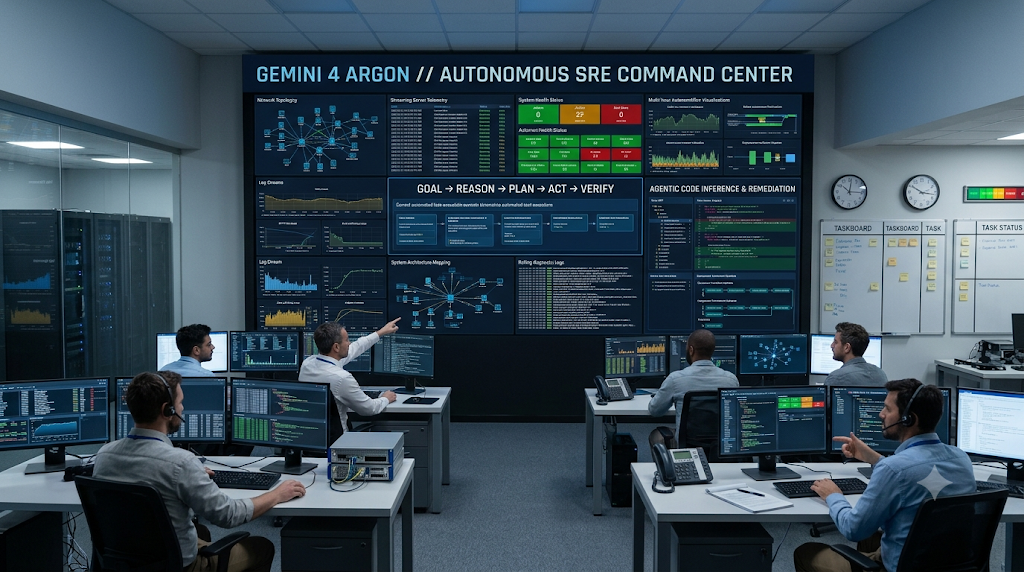
When a production Kubernetes cluster starts throwing 5xx errors , the hardest part of incident response isn't restarting a podit’s context correlation. On-call engineers waste critical minutes jumping between different dashboards, kubectl describe outputs, log aggregators, and network policies just to figure out whether an OOMKilled container is an isolated blip or the domino that brings down checkout.
To solve this, I set out to build a production-style Autonomous SRE Command Center powered by Gemini 4 Argon, Google Agent Development Kit (ADK), Neo4j, and the Model Context Protocol (MCP).
This post walks through the full engineering blueprint, the multi-agent architecture, the chaos engineering testbed, the interactive command center prototype, and a candid look at what worked—and what gaps remain when building autonomous AI infrastructure tooling
1. The Engineering Requirements
To move beyond a basic "chat-with-your-logs" wrapper, the system was designed around strict architectural, functional, and operational requirements:
Functional & AI Architecture Requirements
Real-Time Kubernetes Telemetry Dashboard: Live visibility into cluster health, GKE nodes, namespaces, deployments, pods, CPU/memory pressure, network I/O, and database connection pools.
Neo4j Kubernetes Knowledge Graph: Instead of treating Kubernetes resources as flat lists, model the entire topology (Cluster -> Node -> Namespace -> Deployment -> Pod -> Service -> CloudSQL) in Neo4j to enable multi-hop blast-radius reasoning.
Multi-Agent Pipeline via Google ADK: Rather than a single monolithic prompt, orchestrate five specialized agents with distinct responsibilities:
Incident Investigation Agent: Detects anomalies and correlates logs, metrics, and Kubernetes events.
Root Cause Analysis (RCA) Agent: Traverses the Neo4j graph to separate symptoms from the underlying fault and calculates the blast radius.
Security & Zero-Trust Agent: Validates proposed fixes against Kubernetes RBAC, NetworkPolicies, and least-privilege constraints.
Remediation Agent: Generates the exact kubectl, Helm, or Terraform patch required to resolve the incident.
Verification Agent: Monitors post-remediation telemetry to confirm SLO recovery.
MCP Tool Integration: Standardized Model Context Protocol tools for cluster inspection, log querying, Cypher execution, and safe infrastructure mutations.
Human-in-the-Loop (HITL) Governance & Auditability: Strict RBAC (ADMIN, OPERATOR, READ-ONLY), mandatory human approval before any mutating operation, and cryptographic audit logs.
The Chaos Engineering Testbed
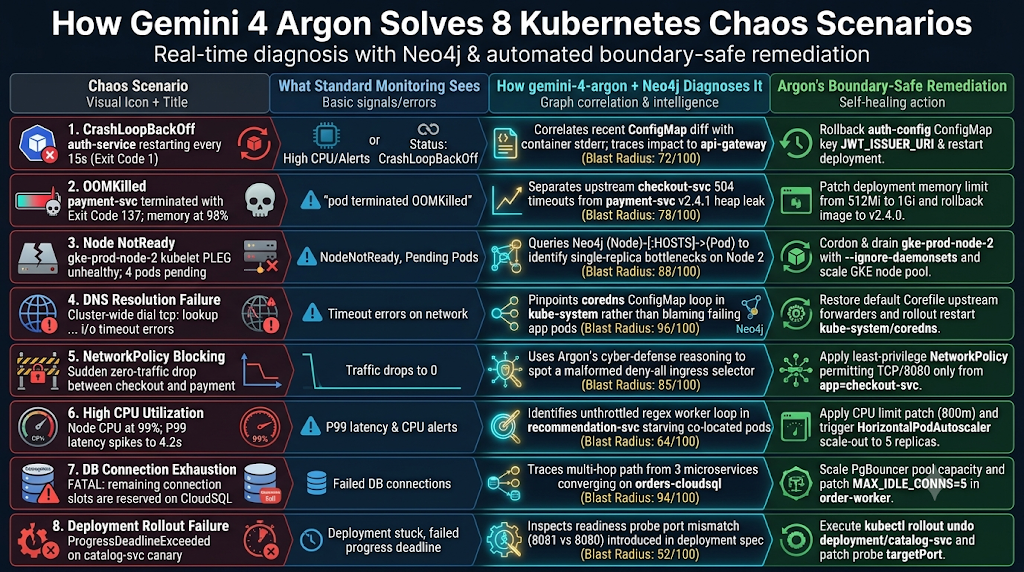
An SRE agent is only as good as the failures it can diagnose. The system was designed to handle 8 canonical Kubernetes failure modes:
CrashLoopBackOff (misconfigured environment variables / bad startup probes)
OOMKilled (memory leak / under-provisioned container limits)
Node NotReady (kubelet failure / disk pressure)
DNS Resolution Failure (CoreDNS degradation / config drift)
NetworkPolicy Blocking (zero-trust egress/ingress lockouts between microservices)
High CPU Utilization (noisy neighbor / unthrottled worker loops)
Database Connection Exhaustion (connection pool saturation against CloudSQL)
Deployment Rollout Failure (broken image tag / failing readiness probes)
2. System Architecture & Multi-Hop Reasoning
The core differentiator of this architecture is combining MCP (for real-time state inspection) with Neo4j (for topological dependency mapping)
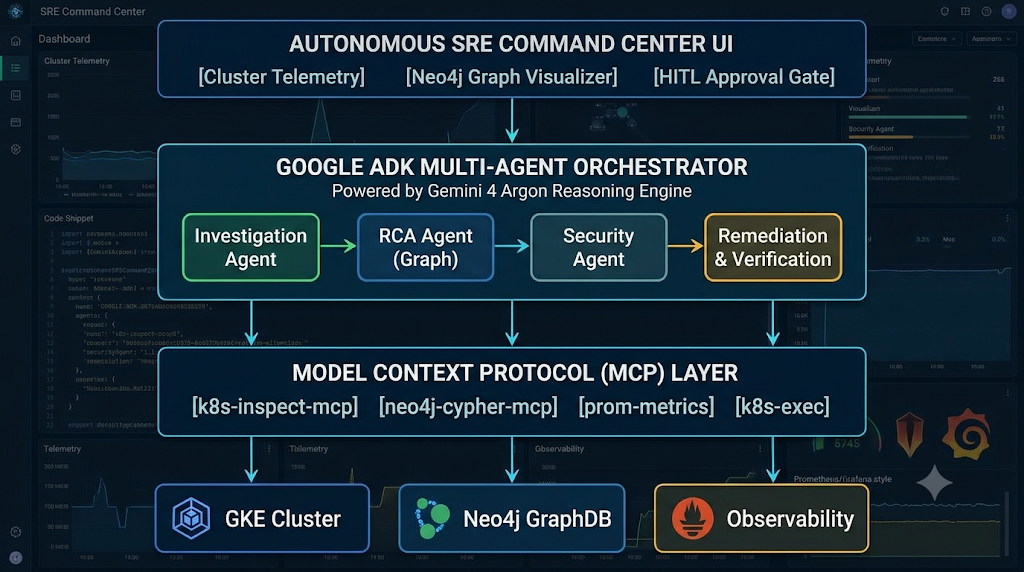
Inside the Agent Configuration (gemini-4-argon + Google ADK)
Each agent leverages specific gemini-4-argon capabilities—such as Implicit Context Caching for the cluster topology schema, Thinking Levels for multi-hop RCA, and Structured Outputs for deterministic remediation payloads:
from google.adk.agents import LlmAgent
from google.genai import types

# RCA Agent configured with Gemini 4 Argon's HIGH thinking mode for multi-hop graph analysis
rca_agent = LlmAgent(
    name="root_cause_analysis_agent",
    model="gemini-4-argon",
    instruction="""
    You are a Principal SRE Root Cause Analysis Agent.
    1. Query the Neo4j Kubernetes Knowledge Graph via MCP to trace upstream/downstream dependencies.
    2. Separate cascading symptoms (e.g., API Gateway 502s) from the underlying root fault.
    3. Report negative findings honestly—if telemetry is inconclusive, state what is missing.
    4. Calculate a Blast Radius Score (0-100) based on hop depth and critical path exposure.
    """,
    generate_content_config=types.GenerateContentConfig(
        thinking_config=types.ThinkingConfig(thinking_level="HIGH"),
        temperature=0.1,
    ),
    tools=[mcp_neo4j_cypher_query, mcp_k8s_get_events, mcp_prom_query_range],
)
4. The Result: Inside the Command Center & Chaos Scenarios
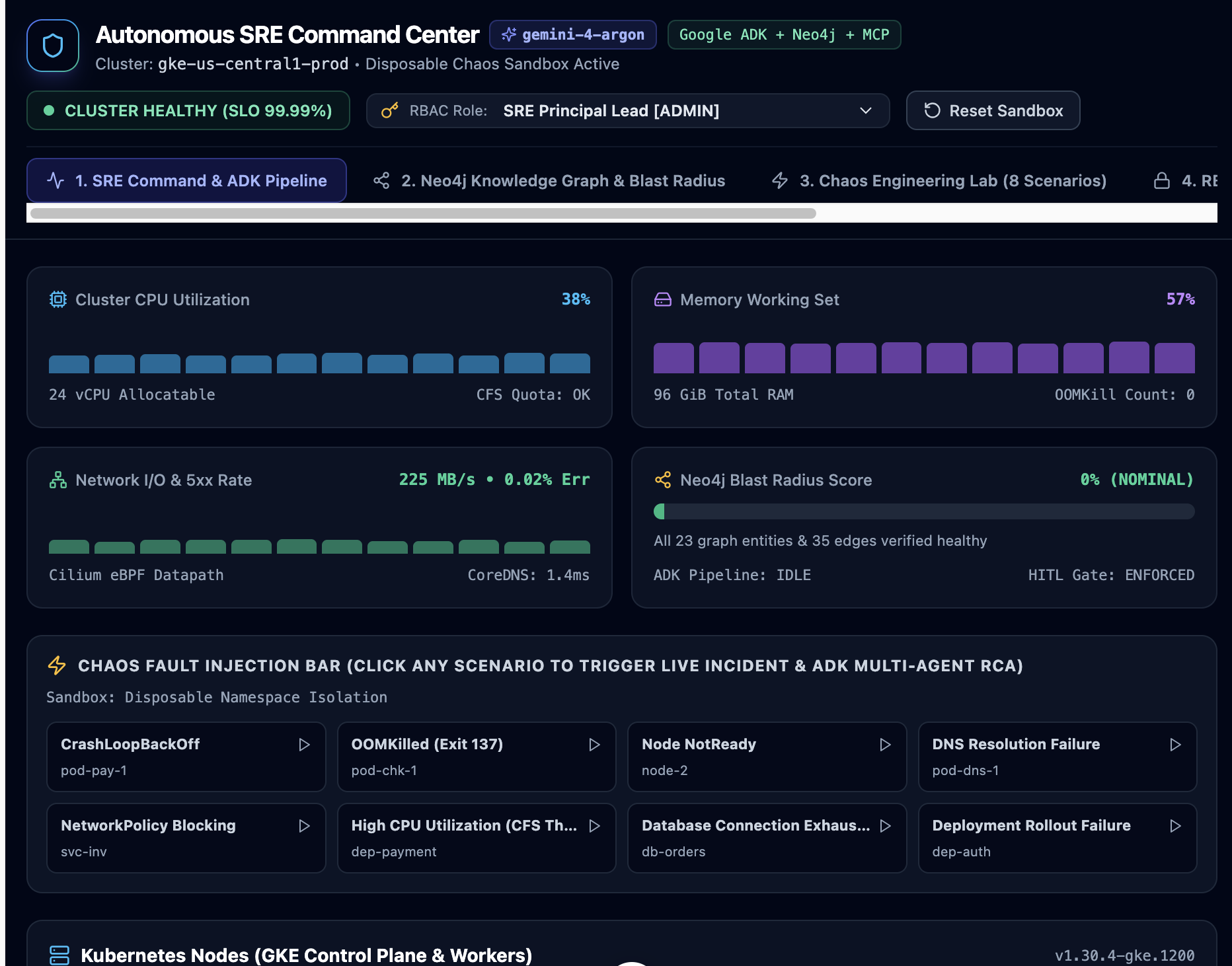
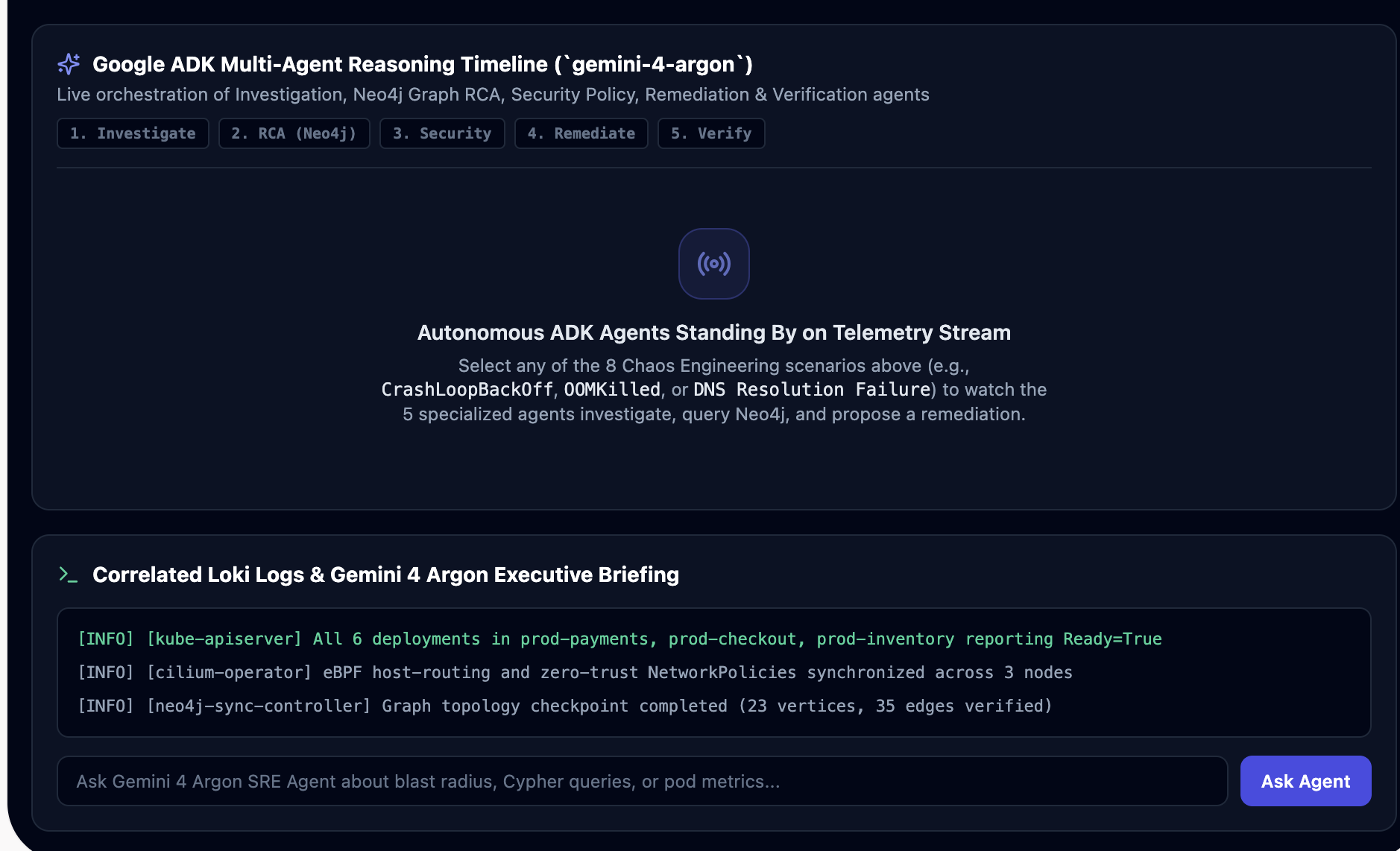
The implementation delivered an interactive Autonomous SRE Command Center (App.jsx) that simulates the entire gemini-4-argon reasoning loop, Neo4j graph traversal, and MCP tool execution across all 8 chaos engineering scenarios.
Key Highlights of the Command Center UILive Gemini 4 Argon
** Reasoning Timeline**: Displays each ADK agent's active thinking stage, the exact MCP tool payload executed, the Neo4j Cypher query returned, and the synthesized root cause.
Interactive Neo4j Topology & Blast Radius Visualizer: Renders the live dependency graph (Cluster -> Node -> Namespace -> Deployment -> Pod -> Service -> CloudSQL) with multi-hop fault propagation highlighted in real time.
Human-in-the-Loop (HITL) Gate & RBAC Enforcement: Exploits Gemini 4 Argon's native pause-before-mutation behavior. When Argon prepares a kubectl patch or rollout undo, execution pauses in the UI until an ADMIN or OPERATOR clicks Approve & Execute Remediation. Switching to READ-ONLY locks out mutation controls completely.
Cryptographic Audit Log: Records every chaos injection, gemini-4-argon reasoning trace, MCP call, and human approval signature.
5.Engineering Evaluation:
What Worked vs. What Was Missed When evaluating an AI-generated autonomous system against strict production engineering criteria, transparency matters:
What Succeeded
Faithful Modeling of Gemini 4 Argon’s Agentic Workflow: The prototype accurately demonstrates how gemini-4-argon coordinates multi-turn investigation, Neo4j Cypher traversal, zero-trust security verification, and boundary-safe human confirmation across all 8 chaos scenarios.
Explainable Blast-Radius Calculation: Instead of outputting opaque severity labels, the command center visualizes the exact Neo4j graph paths and Cypher queries used to compute the blast radius.
Zero-Trust & HITL Controls: RBAC gating (ADMIN, OPERATOR, READ-ONLY) and immutable audit logging are built directly into the operational workflow
Key Capabilities Included:
Real-Time Kubernetes Cluster Telemetry & Health Matrix: Tracks live CPU, Memory, Network I/O, 5xx error rates, GKE nodes (gke-prod-node-1..3), namespaces, deployments, pods, and CloudSQL connection pools.
Interactive Neo4j Kubernetes Knowledge Graph & Multi-Hop Blast Radius Visualizer: Models Cluster -> Node -> Namespace -> Deployment -> Pod -> Service -> Database relationships with live multi-hop dependency highlighting, blast radius scoring, and a toggleable Cypher query inspector.
8 Chaos Engineering Fault Injection Scenarios: Supports one-click simulation of CrashLoopBackOff, OOMKilled, Node NotReady, DNS Resolution Failure, NetworkPolicy Blocking, High CPU Utilization, Database Connection Exhaustion, and Deployment Rollout Failure.
Google ADK Multi-Agent Pipeline & HITL Approval Gate: Visualizes the 5 specialized agents (Incident Investigation, Root Cause Analysis, Security & Zero-Trust Policy, Remediation, and Verification), enforces RBAC role permissions (ADMIN, OPERATOR, READ-ONLY), and logs cryptographic audit signatures
6. Conclusion
Gemini 4 Argon marks a fundamental shift in how we architect AI for production operations. By pairing a 1M-token frontier model that knows when to pause before mutating state with a Neo4j Kubernetes Knowledge Graph and Google ADK, SRE teams can compress 45-minute war-room investigations into a 30-second, human-verified remediation workflow
Github Repo:-
https://github.com/saurabhmi2212/Autonomous-SRE-Command-Center
Comments
More Blog
View alldevchallengeCongrats to the Hacktoberfest Open-Source AI Challenge Week 3: Slow and Steady Winners!
The results are in for Week 3 of our five Hacktoberfest DEV Challenges! For Slow and Steady, we asked...
J
JemgemmaFour GPUs, One Quantization Ladder: Gemma 4 E2B From a 4 GB Laptop to an NVIDIA L4
Gemma 4 E2B from BF16 to Q2_K on a Tesla T4, an NVIDIA L4, a GTX 1650 laptop and an RTX 3050 desktop, with byte-identical GGUF files and the same llama.cpp build. The ladder keeps its shape on all four cards, 218 questions die on all four, and any two GPUs grade 2 to 4 questions differently at BF16.
X
xbilldevchallengeSingularity News :: CCG
This is a submission for the Hacktoberfest Open-Source AI Challenge Week 4: Ghost in the Machine ...
P
Peter VivoaiGiving AI Pain: The Architecture of Synthetic Scars & The Rapid-Regret Miner
Why 90% of AI coding frustration comes from the Quota vs. Prompt-Compliance Death Loop, why Rich Sutton's Bitter Lesson fails in open-world software, and how we compile mid-flight collisions into 4-Vector Synthetic Scars and a Six-Pillar Critic.
R
Randal L. SchwartzdiscussIs Tech Actually Welcoming to Beginners, or Do We Just Say It Is?
We hear it all the time in tech. Everyone starts somewhere. There are no stupid questions. Don't be...
J
Jessica DoeringaidevweeklyAI Dev Weekly #32: GPT-6.1 Terra, Gemini Carbon, Kimi K3.1 and Copilot Fusion
Week of Oct 23-29: GPT-6.1 Terra, restricted Gemini Carbon access, Kimi K3.1 Pro, Copilot Fusion and GitHub's agentic workflow launches.
J
Joske VermeulenReady-made automations for this
Workflows from the Neura Market marketplace related to this Perplexity resource
- Kubernetes RCA and Alerting Using Gemini, Loki, Prometheus, Slackn8n · $24.99 · Related topic
- AI Chatbot Call Center: Taxi Booking Worker (Production-Ready, Part 5)n8n · $24.99 · Related topic
- Automate SEO-Optimized Blog Creation with GPT-4, Perplexity AI & Multi-Language Supportn8n · $24.99 · Related topic
- Automate SEO Blog Content Creation with GPT-4, Perplexity AI, and WordPressn8n · $24.99 · Related topic