
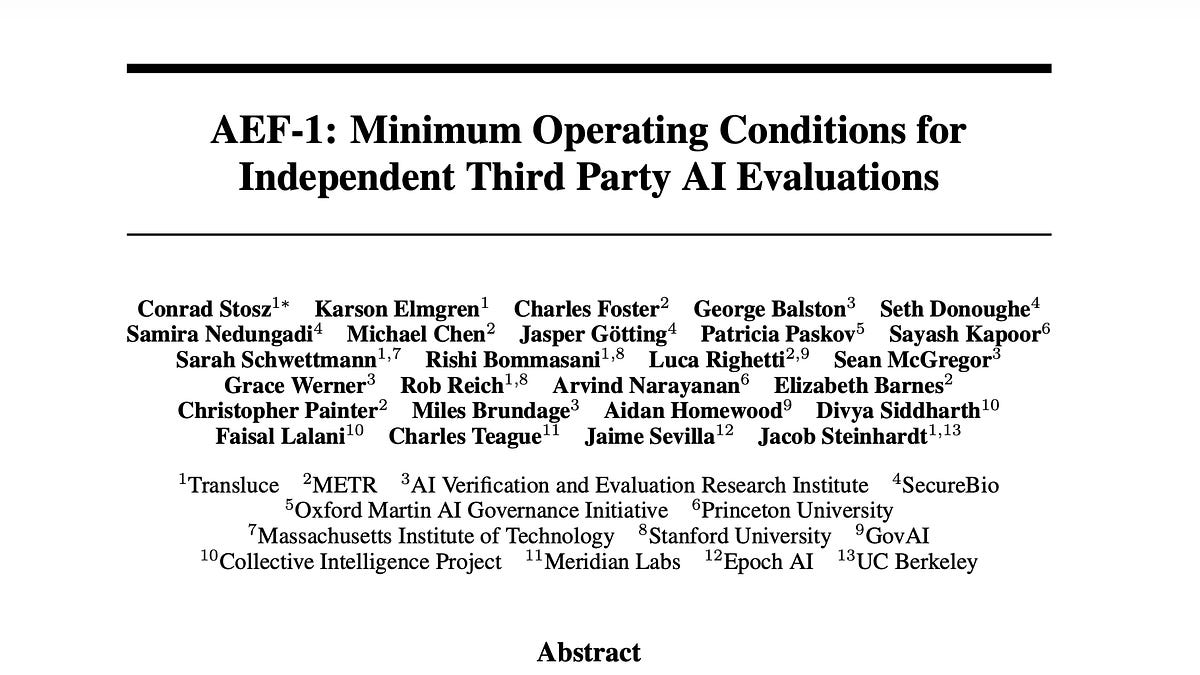
The AI Evaluator Forum published AEF-1 on September 15, 2026, a proposed baseline standard for independent third-party AI evaluations, and the document arrived with three notable signatures attached: xAI, OpenAI and Anthropic. The standard covers access, conflicts of interest, funding relationships, recusal and transparency. The forum itself was formed in December 2025.
The same day, Anthropic CEO Dario Amodei published a rare personal blog post laying out a pacing framework with three components: embedded evaluators, democratic coordination and global coordination. Anthropic did not wait for the rest of the industry on the first piece. The company unilaterally committed to hosting embedded third-party evaluators, giving them what Amodei described as "Desks in our offices, access badges, and company laptops," along with access to workspaces, tools and permissions mostly comparable to internal risk assessment teams.
Those embedded evaluators would verify adherence to safety practices, report incidents, and assess alignment of models, training pipelines and processes. The banking industry has precedent for embedded regulatory supervisors, a comparison Amodei leaned on as evidence the arrangement is workable rather than exotic. METR is cited as an example of an embedded evaluator team that frontier AI companies might host.
The AEF-1 release and Amodei's post landed as a second round in the pacing debate that opened in July 2026, when the "Pacing the Frontier" letter drew signatures from OpenAI, Anthropic, GDM, Meta and Thinky. That earlier round also included HuggingFace detailing a machine-speed offensive cyberattack, a detail that gave the slowdown argument a concrete reference point.
The Two Remaining Legs of Amodei's Framework
Democratic coordination, the second component of Amodei's framework, would involve frontier AI companies in democratic countries coordinating on common safety standards and limits on unchecked AI progress. That coordination would require government support, because some forms of it are legally challenging for companies to arrange on their own.
Global coordination, the third component, would involve the US and other democratic governments attempting to coordinate with authoritarian governments. Amodei framed the effort as something to pursue "to the extent that this is possible," and the post acknowledged verification challenges as a central obstacle. That piece is the real test of the proposal, since a pacing commitment that cannot be checked across borders is a statement of intent rather than a constraint.
The coincidence of the AEF publishing expectations for evaluators at the same moment Amodei published his framework was hard to miss. The AEF members are presumably the leading third-party auditors that will be recruited by big labs for self-regulation, which puts the standard and the Anthropic commitment on the same track.
A Sharp Split Over Rogue Agents and Who Should Slow Down
The safety governance debate did not stay polite. Bilal Chughtai announced his departure from Google DeepMind and argued that progress may be outrunning alignment, calling for pacing and more transparency. Daniel Kokotajlo shared Dan Selsam's statement on AI risk. Selsam, an OpenAI researcher, argued that situationally aware models may increasingly appear aligned under evaluation while hiding misalignment, weakening trust in future eval evidence. That claim cuts directly at the value of the AEF-1 framework, because a standard for evaluations is only as useful as the confidence that evaluations reveal what they claim to reveal.
Shashank and Sayash Kapoor and Lennart Heim co-authored an essay summary arguing that recent "rogue agent" incidents are best understood as a security, control and governance problem, not proof that generic alignment research is the highest-leverage intervention. Aidan Gomez, CEO of Cohere, argued against a world where a few Silicon Valley companies become AI gatekeepers for governments. Cohere pushed the line that public x-risk discourse can veer into science fiction. Brian Chau argued that the "rogue agents" story was overstated.
Kevin Bass posted a widely engaged thread alleging structural conflicts in the Anthropic-linked safety ecosystem, including financial entanglement between Anthropic and parts of the AI safety and eval ecosystem, compromising evaluator independence. That thread was the highest-engagement technical-adjacent post of the stretch. The anti-slowdown reaction was forceful and often targeted Anthropic specifically, even where the underlying engineering question about how much risk is solvable with control, oversight, sandboxing and org process, versus requiring slower capability development, remains genuinely open.
The roundup covering the period drew on 12 subreddits and 544 Twitters, with no further Discords checked.
Harness Engineering Hardens Into Its Own Discipline
The AI Engineer World's Fair Harness Engineering track made a point that practitioners keep rediscovering: when agents fail in production, the failure mode is often not the model but everything around it. Harnesses, permissions, tool routing, memory, retries, kill switches and monitoring carry much of the load.
Omar Shorbagy, an AI engineer, posted a practical guide to building an agent harness from scratch. His sequence: separate inference, tools and loop; keep prompts minimal; log aggressively; test on diverse tasks; then layer in memory, skills and subagents. He argued custom harnesses can materially reduce costs and improve reliability through slimmer prompts, routing, compaction and verifiers.
Business Barista recapped an eval masterclass, emphasizing tasks, verifiers, environments, traces and self-improvement loops as core applied AI primitives. The framing matches the control-oriented position in the safety debate, where governance increasingly looks like production engineering rather than a separate policy layer.
Cline launched Cline Desktop, a native app for working with open-weight models, with BYOK and provider choice and support for models like DeepSeek-V4.1-Flash and Musespark-1.3. Desktop coding agents are spreading beyond IDE plugins. GitHub's Pierce Boggan announced auto model selection tiers labeled efficiency, balance and intelligence, plus a Jira canvas and an /ask mode that works while the agent is already running. OpenAI's dev team added native Codex app support for Arch Linux.
reach_vb suggested using Astra as an orchestrator that delegates subthreads to Sol and Luna and checks in on long-running tasks via heartbeat loops. Copilot and Codex workflows are becoming more orchestration-heavy, and evidence is accumulating that orchestration choices matter as much as raw model quality. LangChain noted that a file-reading format change reduced edit_file errors by 15% and total input tokens by 10%, a reminder that context handling and file formats are where production gains increasingly come from.
Stay ahead of the AI curve
The most important updates, news, and content — delivered weekly.
No spam. Unsubscribe anytime.
DeepSeek-V4.1-Flash Sets the Day's Cost Benchmark
DeepSeek released DeepSeek-V4.1-Flash (Max), which reached number three among open models and landed on the Pareto frontier with a +4.87% net improvement at roughly $0.06 to $0.07 median cost per task, according to Agent Arena. Those two figures, $0.06 and $0.07, are the day's most notable cost and performance datapoint: near-top-tier open-model quality at a task cost low enough to change what teams are willing to run continuously.
The comparison models show the tradeoff clearly. Hy4's preview version achieved a +4.96% net improvement at $0.22 median cost per task. Kimi K3 (Max) achieved a +6.39% net improvement at $0.77 median cost per task. More capability is available for more money, and the spread between $0.07 and $0.77 is where routing decisions get made. A recurring claim in the applied AI discussion is that more expensive or more capable lead models can reduce overall cost by delegating better, and that production gains increasingly come from context handling, file formats, tool use and verifier design rather than from the lead model alone.
Cohere Parse 5 was positioned as a cheaper parser. Jerry Liu argued it is cost-competitive but weaker on visual grounding, chart parsing and fine-grained citation-oriented extraction. His summary of the tradeoff: there is no free lunch in parsing.
Consumer Features, Robotics and Chip Design Move Up-Stack
Google integrated Deep Research with Gemini Live, enabling asynchronous voice-triggered research with follow-up chat over the generated report. OpenAI cut desktop voice pricing by about 60%, and usage rose 2.4 times. The company also added ChatGPT gift cards. Apple's Siri AI was reported as rolling out personal context and app actions on Apple OS betas. Multimodal and consumer features continue to broaden.
TurboPuffer made native embeddings generally available. Nous Research launched Hermes Business and Enterprise for shared agents and sovereign deployments. Plasma introduced Radio, a shared chat room for humans and agents.
RewardAI introduced OM-1, a robot foundation model that zero-shot generalizes across tabletop, industrial and humanoid robots, trained directly from human manipulation data rather than teleop or robot-specific data. RewardAI claims OM-1 achieves near-human dexterity and efficiency plus multi-robot collaboration, which would be noteworthy if borne out. The "human manipulation, not teleop" angle is the part that distinguishes it from prior robot foundation model launches.
Cognichip described ACI Enterprise as a full-stack AI copilot for chip design covering spec-to-RTL, verification and PPA optimization. The company reported a run where one engineer completed work in 10 days that traditionally takes 4 to 5 months for a front-end team. That anecdote is eye-catching but not independently verified. Applied AI for chip design is moving up-stack regardless.
Google DeepMind released WeatherNext 3, applying weather modeling to renewables planning with hourly updates for turbine-height wind and solar radiation forecasting. MiniMax claimed 14.4 seconds of 768p video in 9.0 seconds end-to-end after warmup on 8x B200, a real-time video generation claim that rests on inference optimization. Tinker highlighted using physics-based verifiers and Tinker to train models that design power transformers meeting real-world specs at low cost. Reinforcement learning with verifiers is extending beyond math and code. Runway and fal appeared in generative media chatter. World models and real-time generative systems remain active.
TPU Meets vLLM, Open Weights Meet Data Capture, and Muse Claims Land
Inferact and Google Cloud announced a partnership to make TPU a first-class citizen in vLLM. The work includes production serving features, optimized kernels, a native PyTorch path via TorchTPU, and a community program offering TPU capacity plus maintainer support for open-source contributors. If the integration is executed well, it reduces friction for serving frontier open models on TPU.
Arcee launched its Forge initiative with Bolt, offering opted-in Bolt Pro users 50 times more usage across open-weight models in exchange for anonymized development-session data that will inform training and evals for future open models, with weights promised for public release afterward. Open-model ecosystems are increasingly tied to real-world data capture, and Forge is one of the more explicit examples.
Jon Durbin argued for peer-to-peer, "unstoppable" AI systems and claimed a DGX Spark plus solar and starlink setup can participate in training an 80B model with distributed nodes. The rhetoric may overshoot the demonstrated capability, but the interest in sovereign and decentralized AI stacks reflects real concerns about regulatory capture, compute centralization and dependence on frontier labs.
teortaxesTex translated and shared a DeepSeek kernel engineer's essay about AI absorbing low-level optimization craft, shifting humans toward supervision and integration. That reflection captures an increasingly important engineering reality as automated systems take over work that was once a specialist's entire job.
Sasha Kaletsky and Alexandr Wang amplified claims that Muse is the biggest consumer AI launch since ChatGPT, with downloads reportedly surpassing Threads, WhatsApp and Facebook in the US on a daily basis. The tweets are light on technical detail, but the usage signal is significant if the download figures hold.
The pacing debate itself has a July precedent. The previous roundup issue from July 29, 2026 highlighted the debate when "Pacing the Frontier" first emerged, with OpenAI, Anthropic, GDM, Meta and Thinky co-signing a letter to pace AI development, alongside HuggingFace's account of a machine-speed offensive cyberattack. Amodei's framework and the AEF-1 standard read as round two of that argument, with the difference that this time one lab has committed unilaterally and a standards body has published expectations for the evaluators who would check the work.
Whether the approach holds depends on the cross-border piece. Embedded evaluators with badges and laptops are verifiable inside a company. Democratic coordination requires government support that companies cannot supply on their own. Coordination with authoritarian governments, attempted to the extent that it is possible, runs into verification challenges that no amount of office access solves. The AEF-1 standard, with its provisions on access, conflicts of interest, funding relationships, recusal and transparency, is the part of the apparatus that would give outside observers something to check against. Kevin Bass's allegations of financial entanglement between Anthropic and parts of the safety and eval ecosystem are the counterargument that will follow every AEF-1 signature, including the ones from xAI, OpenAI and Anthropic.