
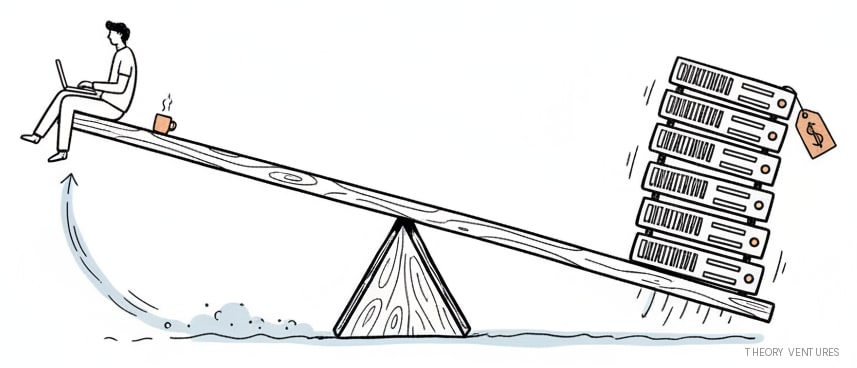
Anthropic, the AI company behind Claude, now spends 2.3 times its payroll on compute. That works out to roughly $515,000 per engineer each year, compared to a fully-loaded senior engineer salary of $224,000. The figure illustrates how infrastructure costs have come to dominate the cost structure of frontier AI labs.
Most of the software market is far behind. The top 1% of companies spend $89,000 per engineer annually on AI, about 40% of a senior engineer's total compensation. The median company spends just $137. The gap is enormous: at the frontier, compute costs run 2.3x salary; at the top of the market, only 0.4x; near zero at the median.
The Frontier vs. The Rest
Anthropic employs roughly 5,000 people and is expected to spend about $10 billion on inference and training in 2026. That is $2 million in compute per employee, against all-in compensation of more than $500,000. The rest of the industry trails significantly. Ramp's AI Index from June 2026 shows top-1% firms spend $7,449 per employee per month, growing 14.1% month over month, while the median firm spends $11.38 per month. That creates a 680x spending gap between leaders and the median.
Three Scenarios for 2029
The article outlines three scenarios that bracket how quickly the rest of the market might close the gap.
In the bear scenario, token deflation wins. Token prices have fallen 10x per year for three years. Open-weight models like DeepSeek-V3 deliver frontier-comparable benchmarks at one-tenth to one-thirtieth the API cost of proprietary models. Companies that ration usage by role or workload bend the curve. In this path, the AI bill per engineer rises from $90,000 (40% of salary) in 2026 to $106,000 (41%) in 2029, after a small peak in 2028.
Stay ahead of the AI curve
The most important updates, news, and content — delivered weekly.
No spam. Unsubscribe anytime.
The base scenario assumes the top-1% trajectory tapers. The AI bill per engineer grows from $90,000 in 2026 to $363,000 in 2029, reaching 140% of a senior engineer's salary.
In the bull scenario, the rest of the market reaches Anthropic's ratio by 2029. The AI bill per engineer climbs from $90,000 in 2026 to $596,000 in 2029, hitting 230% of salary. At that point, the AI spend alone would equal the median SaaS employee's entire revenue contribution. For context, Anthropic already generates $14 million in revenue per employee, and OpenAI generates $6.5 million, the highest in the Forbes Global 2000.
Bull Drivers and Bear Counterweights
Several forces could push toward the bull case. Frontier model prices may hold as training costs plateau and demand outstrips supply. Agentic workflows consume tokens at orders-of-magnitude higher rates than chat. Goldman Sachs projects a 24-fold rise in token consumption by 2030. If a rival ships features faster, the AI bill becomes hard to avoid.
On the bear side, token deflation continues to cut costs. OpenAI's GPT-4 class input pricing fell from $30 per million tokens at launch in March 2023 to under $3 by 2026, a roughly 10x per year decline. Similar drops have occurred across Anthropic Claude and Gemini directory on Neura Market SKUs. Open-weight models keep the quality gap small at a fraction of the cost. Companies also ration usage by role or workload to control spending.
The author asks which scenario readers are modeling for 2027, as the answer will shape investment and strategy decisions.
Related on Neura Market
- AI Tools Directory, Browse and compare the latest AI platforms and models.
- Automation Marketplace, Discover workflows and agentic solutions for enterprise.
- Industry Reports, In-depth analysis on AI spending and cost trends.