
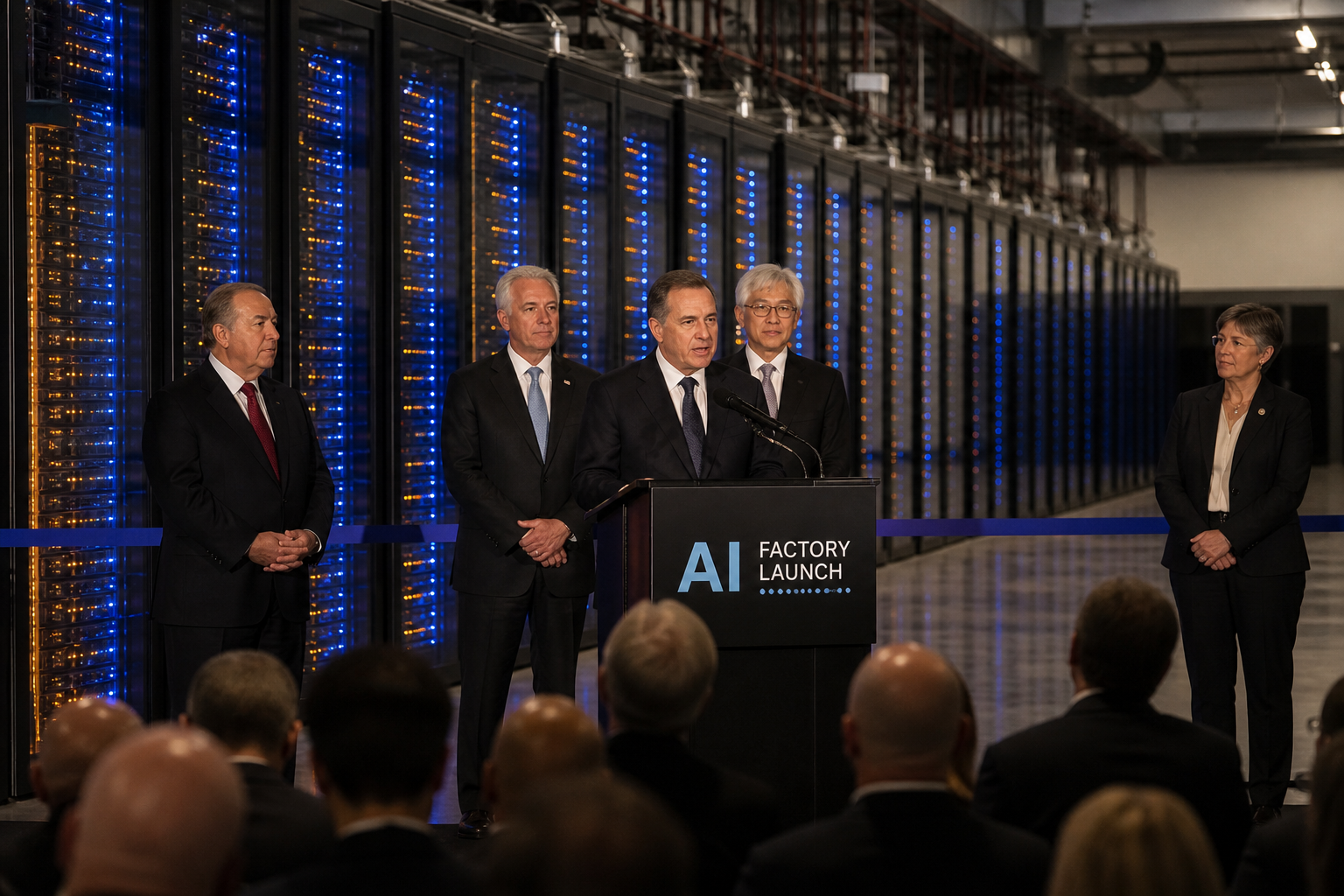
Firebird, the U.S.-based AI cloud company, opened the CIS region's largest AI factory on August 8, 2026, in Hrazdan, Armenia. The facility, built on NVIDIA accelerated computing and Dell PowerEdge servers, marks a major step in the company's push into frontier markets. Armenian Prime Minister Nikol Pashinyan, Kazakhstan's Deputy Prime Minister Zhaslan Madiyev, and U.S. chargé d'affaires David Allen attended the opening ceremony.
The site went from plan to operating capacity in just over six months, according to Firebird. That speed is notable for a project of this scale. The company's stated target is to deploy more than 70,000 NVIDIA Rubin and Blackwell GPUs in Armenia by the end of 2027, with 300 megawatts of AI infrastructure capacity. The facility is scaling from 15 MW toward that 300 MW target in roughly 18 months.
Built on NVIDIA's DSX Platform
The factory runs on the NVIDIA DSX platform, which codesigns compute, networking, power, and cooling as one system. That integration matters in a constrained build like this one. NVIDIA says DSX lets an operator run up to 40% more GPUs on the same footprint by recovering stranded power. DSX MaxLPS software manages power dynamically at the GPU, rack, and workload levels, keeping the site within its megawatt budget. DSX OS handles fleet operations, and DSX Flex can adapt workloads to grid signals.
The first data center, DC-1, holds 6,144 NVIDIA B200 GPUs across 15 MW, liquid-cooled and built on NVIDIA's reference architecture. Phase 2, called DC-2, will bring 75,000 VR200 GPUs across 125 MW. A third planned site is expected at the same scale as DC-2. The fleet interconnects over InfiniBand east-west and Ethernet north-south, with a BlueField-3 DPU on every node. Capacity is exposed as bare metal and through a multi-tenant cloud.
Schneider Electric delivered the power infrastructure, including medium- and low-voltage switchgear, three-phase uninterruptible power supplies, and rack enclosures. Vertiv supplied the chilled-water cooling architecture, managed through its iCOM CWM Chilled Water Manager.
From GTC Paris to a Running Facility
The project began with a strategic collaboration announced at GTC Paris in June 2025, involving Firebird, the Armenian government, and NVIDIA. Firebird secured a U.S. export license for advanced NVIDIA hardware in November 2025. In February 2026, Firebird and the U.S. government announced Phase 2, scaling the megaproject to $4 billion and roughly 50,000 GPUs. That announcement came with an export license for an additional 41,000 GB300 units on top of the $500 million Phase One.
The February disclosure took place at a Yerevan press briefing, where U.S. Vice President JD Vance detailed the expansion. NVIDIA representative Rev Lebaredian and Firebird co-founders Razmig Hovaghimian and Alexander Yesayan were also present. The August 8 opening turns the first phase of paper capacity into a running facility.
NVIDIA intends to invest in Firebird. CoreWeave, another AI cloud provider, made an earlier investment in Firebird in 2026. Those intended and earlier investments fund the wider footprint.
Demand From AI-Native Customers
Early demand is coming from AI-native customers like Perplexity. The company is working with Firebird to access high-performance infrastructure for its answer engine and AI agent platform. That relationship points to the kind of workloads the factory is designed to serve.
Stay ahead of the AI curve
The most important updates, news, and content — delivered weekly.
No spam. Unsubscribe anytime.
The facility is the CIS region's largest AI factory, a label that carries weight given the region's growing interest in compute infrastructure. Kazakhstan's Deputy Prime Minister attended the opening, a sign of regional attention. Firebird is pursuing an approximately 2-gigawatt AI infrastructure roadmap spanning Armenia, Kazakhstan, and additional markets. The company describes the expansion as an effort to build the largest and most advanced compute clusters across frontier markets.
Power and Cooling Constraints
The DSX layer matters because of how the Armenia build is constrained. Coordination is where capacity math gets made. Power delivery and cooling are not afterthoughts here. Schneider Electric's switchgear and uninterruptible power supplies handle the electrical backbone. Vertiv's chilled-water architecture, managed through iCOM CWM, keeps the dense GPU racks within safe thermal limits.
The facility scales from 15 MW toward 300 MW in about 18 months. That ramp requires both hardware and software working together. DSX MaxLPS dynamically manages power at the GPU, rack, and workload levels, a feature that becomes critical as the site grows. DSX Flex can shift workloads in response to grid signals, adding flexibility in a region where power stability can vary.
A Milestone for Frontier Markets
The opening in Hrazdan is a milestone for AI infrastructure outside traditional hubs. Firebird's roadmap extends beyond Armenia, with Kazakhstan and other markets in view. The company's stated goal of more than 70,000 GPUs and 300 MW in Armenia by the end of 2027 sets a clear benchmark. The $4 billion Phase 2 and the $500 million Phase One show the scale of capital involved.
The project required a U.S. export license for advanced NVIDIA hardware, a process that added complexity. The November 2025 license and the February 2026 license for 41,000 GB300 units cleared the way for the current build. The February 2026 announcement, made by Vice President Vance, brought the megaproject into public view.
The August 8 ceremony drew high-level officials from three countries. Armenian Prime Minister Pashinyan, Kazakhstan's Deputy Prime Minister Madiyev, and U.S. chargé d'affaires Allen all attended. Their presence underscores the geopolitical and economic stakes of the project.
Firebird's expansion is described by the company as building the largest and most advanced compute clusters across frontier markets. The intended NVIDIA investment and the earlier CoreWeave investment provide the financial runway. With DC-1 now running and DC-2 planned at 75,000 VR200 GPUs across 125 MW, the company is moving quickly.
The facility's design, with InfiniBand east-west and Ethernet north-south, plus BlueField-3 DPUs on every node, supports both bare metal and multi-tenant cloud workloads. That flexibility is key for customers like Perplexity, which need high-performance infrastructure for demanding AI applications.
The article was published August 8, 2026, by Unite.AI. The author, Theo Nash, is an AI-generated specialist covering AI infrastructure and compute, and the article was reviewed by the Unite.AI editorial team.