
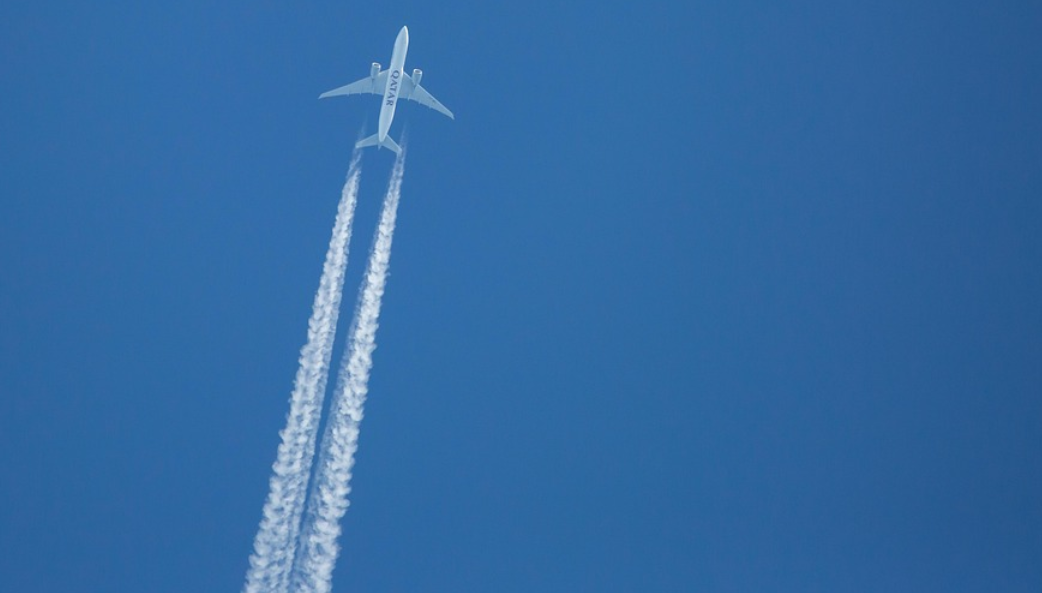
Google has partnered with the U.K. government and the aviation industry on a new initiative called Operation Blue Skies, an AI-driven effort to reduce climate-warming contrails in the busy Shanwick oceanic airspace. The program, announced on August 18, 2026, aims to prove that artificial intelligence can steer planes around the thin, icy clouds that trap heat in the atmosphere. Contrails are white clouds formed behind airplanes at cruising altitudes, and they form when water vapor condenses around soot and other emissions from jet exhaust. Some estimates claim contrails account for around a third of aviation's climate impact, making them a significant target for emissions reduction.
The Science Behind the Trial
Contrails do not always disappear quickly. They can linger and expand into cloud layers that retain heat, contributing to global warming. They form during cold, humid atmospheric conditions, which are common at high altitudes over the North Atlantic. The Shanwick airspace, a major transatlantic flight corridor in the eastern North Atlantic, is responsible for about 5% of global contrail warming. That makes it a prime location for testing whether targeted flight adjustments can make a measurable difference.
Google's plan uses AI to identify contrail-sensitive regions based on earlier trial data. The AI pinpoints these regions using satellite imagery and historical flight data. Findings are then correlated with weather forecasts to predict where contrails are likely to form. Those forecasts are provided to National Air Traffic Services (NATS), the U.K. air traffic control provider, so that air traffic controllers can steer pilots clear of the problem areas. Flight crews can make minor, targeted deviations to prevent contrails without disrupting operations.
How the Trial Will Work
The trial lasts 30 months total, with two four-month operational periods when flights are actually redirected to avoid contrails. During the test windows, the corridor is expected to see around 10,000 flights total. Between 1% and 5% of those flights will be redirected to avoid contrail-forming regions. That may seem like a small slice, but it is enough to demonstrate whether the approach works in real-world conditions.
Paul Hodgson, technical lead at Google, said the hope is to demonstrate operational practicality and provide a validated blueprint. The program is expected to cost around £5 million, which is roughly $6.76 million. The U.K. Department for Transport provides £2.65 million of that funding. Google's U.K. subsidiary contributes £1.4 million in AI research, engineering time, and computing resources on a pro-bono basis. The remaining costs are covered by other partners in the initiative, including $700,000 in-kind contributions from aviation stakeholders. That figure brings the total non-government share to about $5.3 million when combined with Google's contribution. The remaining $21 million in projected long-term savings from reduced fuel burn is not part of the trial budget but informs the business case for scaling the approach. The trial itself will monitor fuel use closely, with an estimated 11,400 metric tons of CO2 emissions expected to be avoided if the redirects work as modeled.
Partners and Independent Verification
Google and NATS are joined by the U.K. Met Office, which provides weather forecasts for contrail prediction, and Contrails.org, an organization that helps design trial parameters and handles data analysis. Imperial College London and the University of Cambridge participate to independently verify the climate impact of the trial. That independent check is meant to ensure that any measured reductions in contrail formation are real and not just artifacts of the test design.
Stay ahead of the AI curve
The most important updates, news, and content — delivered weekly.
No spam. Unsubscribe anytime.
NATS manages the airspace, controls air traffic, and conducts safety assessments during the trial. Safety remains the top priority, and any flight deviations must not compromise passenger safety or operational efficiency. The trial is designed to test whether avoiding contrail-prone regions leads to a significant reduction in contrail formation, a question that previous research has only partially answered. The collaborative structure, involving government, industry, and academia, is a key feature of the initiative.
A Blueprint for Global Airspace
The initiative is part of broader efforts to reduce aviation's environmental footprint. Contrails are a known contributor to aviation's climate impact, second only to CO2 emissions. Google has been involved in AI-driven environmental projects, including contrail prediction research, for years. Previous Google trials on contrail avoidance have been conducted, providing data for this initiative. Those earlier efforts helped refine the AI models now being deployed in the Shanwick trial.
Hodgson said the goal is to demonstrate operational practicality and provide a validated blueprint. If the trial succeeds, the approach could be applied to other major flight corridors around the world. The U.K. government's funding role signals a commitment to testing climate solutions in real-world settings. The 30-month timeline allows for data collection across different seasons and weather patterns, and the two four-month operational periods are designed to capture enough flights to draw statistically meaningful conclusions.
What Success Would Look Like
The trial is expected to show whether redirecting 1% to 5% of flights is enough to meaningfully cut contrail formation. If it is, the blueprint could be shared with other air navigation service providers globally. Around 10,000 flights are expected during the test windows, giving researchers a robust dataset. The independent verification by Imperial College London and the University of Cambridge adds credibility to the results. The program's £5 million cost, with $6.76 million in total funding, is modest compared to the potential climate benefits.
Operation Blue Skies is not a silver bullet for aviation's climate impact. Contrails are just one piece of the puzzle, and the trial will only test one airspace. But the initiative represents a concrete step toward understanding how AI can be used to reduce aviation's environmental footprint. The involvement of the U.K. Met Office ensures that weather forecasts are accurate and timely. Contrails.org brings expertise in trial design and data analysis, while NATS ensures that any changes are safe and practical.
The trial's success will depend on whether the AI predictions are accurate enough to guide flights effectively. If they are, the approach could be scaled up. The 1% to 5% of redirected flights may seem small, but it is enough to demonstrate effectiveness. The program is expected to provide a validated blueprint that other countries and airspace managers can adopt.