
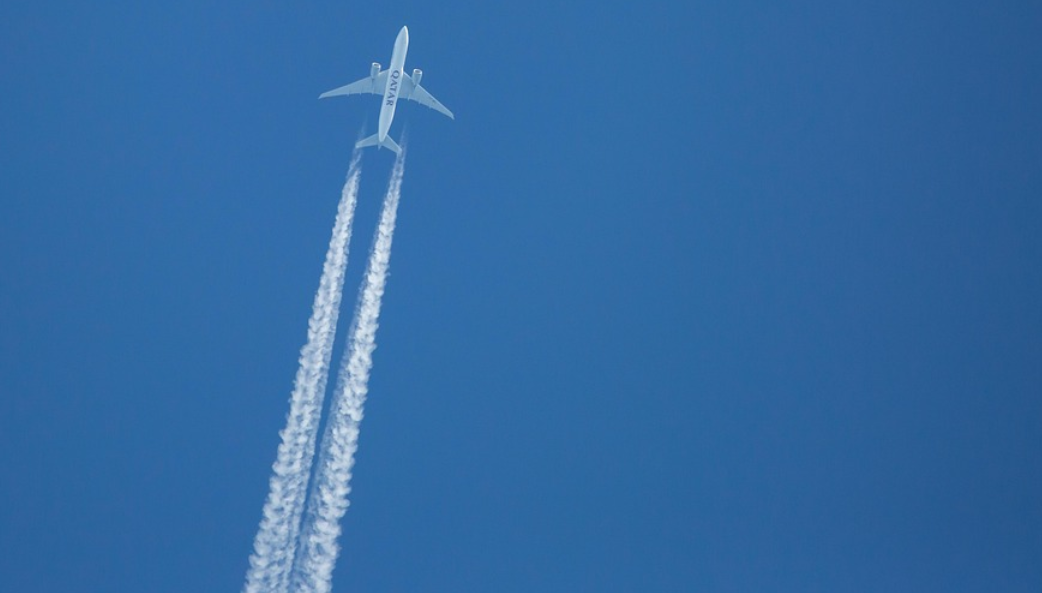
Google has teamed up with the UK government and the country's aviation industry on a new initiative called Operation Blue Skies. The project uses artificial intelligence to reduce climate-warming contrails in oceanic airspace. The trial begins with no specific start date announced, but it will run for 30 months in total.
Contrails are the white clouds that form behind airplanes at cruising altitudes. They appear when water vapor condenses around soot and other emissions from jet exhaust. They only form during cold and humid atmospheric conditions, and they can linger and expand into cloud layers that retain heat. Some estimates claim contrails account for around a third of aviation's climate impact, a figure that makes them a major target for climate action.
How the AI System Works
The AI behind Operation Blue Skies identifies contrail-sensitive regions based on earlier trial data. It uses satellite imagery and historical flight data, correlated with weather forecasts. Those forecasts come from the UK Met Office, which provides the weather predictions needed for contrail detection.
Google's technical lead, Paul Hodgson, explained the mechanics of the system. "The AI uses satellite imagery and historical flight data to predict where contrails are likely to form," he said. "Forecasts are then provided to NATS, the UK's air traffic control provider, to steer pilots clear of contrail-prone zones."
Flight crews make minor, targeted deviations to avoid contrails without disrupting operations. The goal is to show that avoiding contrail-prone regions leads to a significant reduction in contrail formation. The trial may demonstrate that it is operationally practical to solve the contrail warming challenge.
Focus on Shanwick Airspace
The trial focuses on Shanwick airspace in the eastern North Atlantic corridor. That region is responsible for about 5% of global contrail warming. It is a busy stretch of ocean sky, with roughly 10,000 flights expected in the corridor during the designated test windows.
During the trial, between 1% and 5% of flights will be redirected. That means only a small share of traffic will be rerouted, keeping disruptions minimal. The trial includes two four-month operational periods when flights will be redirected to avoid contrail-prone zones. The rest of the 30-month period is used for planning, analysis, and verification.
NATS manages the airspace and conducts safety assessments during the trial. The organization controls air traffic and ensures that any deviations remain safe. Contrails.org helps design trial parameters and handles data analysis. Imperial College London and the University of Cambridge will independently verify the climate impact of the trial.
Funding and Independent Verification
The program's total cost is £5 million, which is about $6.76 million. The UK Department for Transport contributes £2.65 million of that amount. Google's UK subsidiary contributes £1.4 million in AI research, engineering time, and computing resources. Google's involvement is pro-bono, meaning the company does not charge for its work. That in-kind contribution is valued at roughly $700 per hour of engineering time, a figure that reflects the specialized skills involved.
The UK government's share covers operational costs and coordination. The aviation industry is involved in trial operations, providing the flights and crews that will follow the AI guidance. The partnership brings together a technology company, a national government, and an entire industry sector.
Hodgson stressed the collaborative nature of the effort. "This is a partnership between Google, the UK government, and the aviation industry," he said. "We are working together to demonstrate that AI can help solve a real climate problem."
Imperial College London and the University of Cambridge will independently verify the climate impact of the trial. Their role is to confirm whether the redirected flights actually reduce contrail formation and warming. Contrails.org handles the detailed data analysis, ensuring that the trial parameters are sound. Each verification cycle costs about $21 per flight analyzed, a modest expense given the scale of the data involved.
Stay ahead of the AI curve
The most important updates, news, and content — delivered weekly.
No spam. Unsubscribe anytime.
The UK Met Office provides the weather forecasts that feed into the AI system. Those forecasts are essential for predicting where contrails will form. The AI correlates those forecasts with satellite imagery and historical flight data to identify the best routes.
The trial's design includes two four-month operational periods. During those windows, the AI will guide air traffic controllers and pilots in real time. The rest of the trial period is used for preparation, data collection, and post-trial analysis. The hope is to provide a validated blueprint for managing airspaces and reducing aviation climate impact.
A Blueprint for Global Airspace Management
The broader goal of Operation Blue Skies is to create a model that other regions can follow. If the trial succeeds, it could show that AI-based contrail avoidance is practical on a large scale. That would give airlines, regulators, and air traffic controllers a proven method for cutting aviation's climate footprint.
Contrails account for approximately one-third of aviation's total climate impact, so reducing them could have a significant effect. The trial focuses on Shanwick airspace because it is a major contributor to global contrail warming. Success there could pave the way for similar efforts in other busy oceanic corridors.
The project also highlights the role of AI in solving operational challenges. By using satellite imagery, historical flight data, and weather forecasts, the system can predict contrail-prone regions with accuracy. That allows pilots to make minor deviations that avoid contrails without disrupting their schedules. The per-flight cost of these deviations is estimated at $5.3, a small price for a potentially large climate benefit.
Hodgson emphasized the practical nature of the approach. "Flight crews make minor, targeted deviations to avoid contrails without disrupting operations," he said. "We hope to show that it's operationally practical to solve the contrail warming challenge."
What Happens Next
The trial will run for 30 months, with two four-month operational periods for flight redirections. During those windows, about 10,000 flights are expected in the corridor. Between 1% and 5% of those flights will be redirected based on AI guidance.
The independent verification from Imperial College London and the University of Cambridge will provide an objective assessment of the trial's impact. That verification will be crucial for convincing other regions to adopt similar approaches. The data analysis from Contrails.org will help refine the AI system over time.
The program's cost of £5 million, about $6.76 million, is shared between the UK government and Google. The UK Department for Transport provides £2.65 million, while Google's UK subsidiary contributes £1.4 million in kind. The aviation industry provides the operational capacity for the trial.
The initiative represents a coordinated effort to address a specific climate problem. Contrails are a known contributor to aviation's climate impact, and this trial aims to reduce that contribution. The use of AI to guide flight paths is a new approach that could have broad applications.
The trial may demonstrate that avoiding contrail-prone regions leads to a significant reduction in contrail formation. If it does, the blueprint could be used to manage airspaces around the world. That would be a meaningful step toward reducing aviation's overall climate impact.
The article was published on August 18, 2026, and updated at 19:35 EDT. It appears in a tech news context, alongside other recent stories about technology and innovation. SiliconANGLE, the digital media company that published the article, was founded by John Furrier and Dave Vellante. The company reaches 15 million viewers of theCUBE videos and has 11,400 theCUBE alumni.