
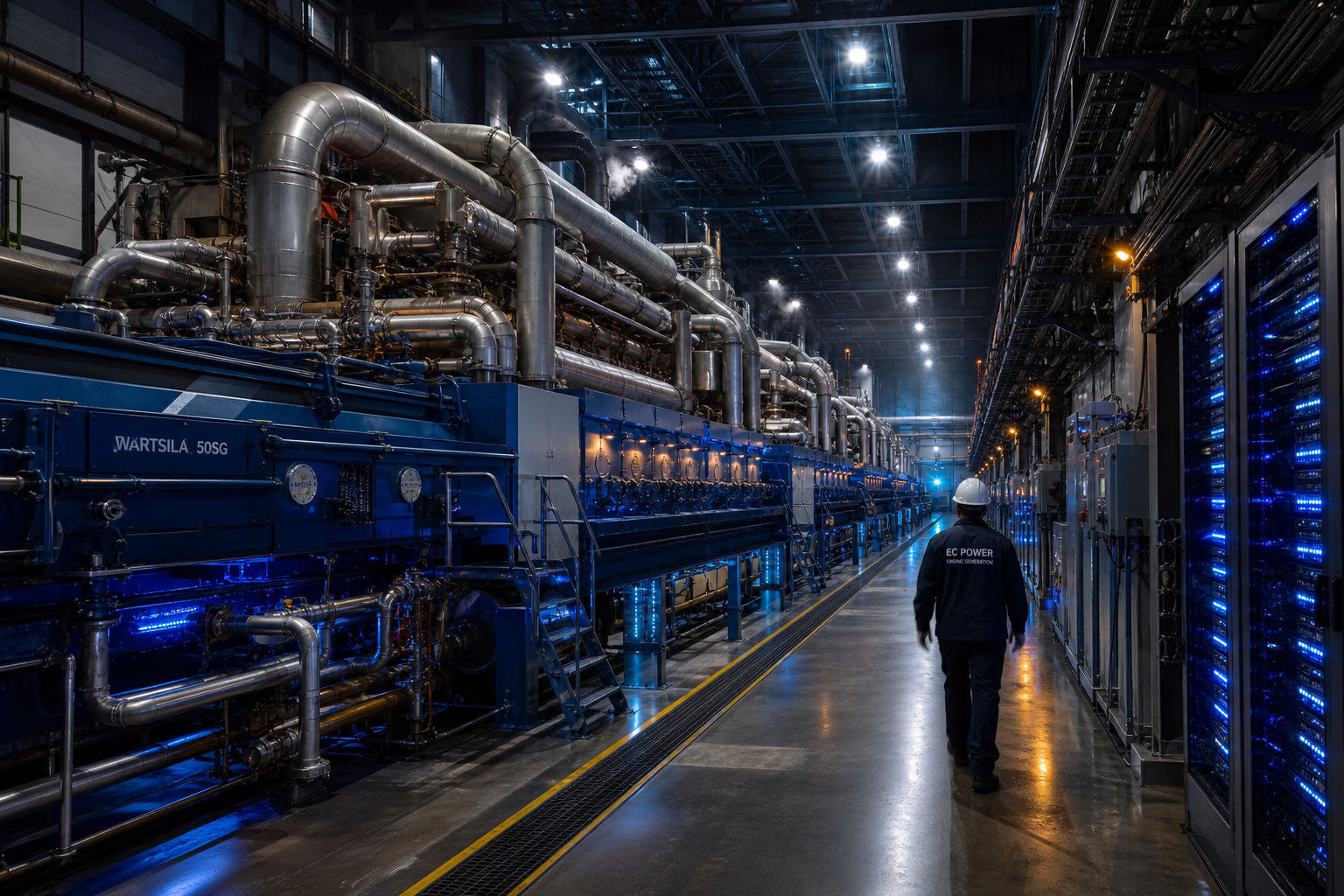
HD Hyundai Heavy Industries has signed a $673.8 million contract to supply 1,000 megawatts of engine-based power generation systems to U.S. data centers. The buyer is Corban Energy Group, an energy infrastructure developer based in Elmwood Park, New Jersey. The announcement came on August 9, 2026.
The order is the largest power-generation engine contract in HD Hyundai Heavy Industries' history. It marks the company's second major push into the U.S. data center market in just four months.
A Gigawatt-Scale Order
The contract covers roughly a hundred HiMSEN engines, each rated at 9.6 megawatts. Dividing 1,000 MW by 9.6 MW yields about 104 units. These are medium-speed engines designed for continuous, around-the-clock operation. They can start quickly, follow load changes, and run as prime power, not backup generation.
Corban Energy Group will deliver the power to data centers operated by a major U.S. technology company. The tech firm's name was not disclosed. Corban builds LNG storage and cryogenic equipment and supplies gas, LNG, and power products to infrastructure projects, including data centers.
HD Hyundai and Corban intend to expand cooperation into follow-on projects. The deal suggests a growing pattern: data center operators are contracting for on-site generation as grid interconnection queues stretch into years.
From April to August: A Rapid Scale-Up
HD Hyundai entered the U.S. data center market in April 2026 with a $425 million contract for Aperion Energy Group. That order covered 33 natural-gas-fired engines totaling roughly 684 MW. Those engines were in the 20-MW class.
The Corban order is larger on every axis. It is worth $673.8 million, nearly 60% more than the April deal. It delivers 1,000 MW, about 46% more capacity. And it uses a different engine model, the 9.6-MW HiMSEN, which is positioned for continuous, mission-critical loads.
The back-to-back orders suggest the strategy is scaling. When a tech company needs a gigawatt and the grid can't commit, buying a hundred engines becomes a strategy.
The Fuel Trade-Off and Prime Power Role
The engines run on natural gas. That ties the operating cost and emissions profile of the power generation to gas supply. It is a trade-off: gas is widely available and engines can be deployed quickly, but fuel costs and emissions remain ongoing concerns.
Medium-speed engines are modular, so capacity can be added in roughly 10-MW increments. That flexibility is valuable for data center operators who need to match power supply to phased construction and load growth.
The order is described as prime power, not backup generation. That distinction matters. Backup systems sit idle most of the time. Prime power runs continuously, which is what data centers need for around-the-clock operations.
Rising Demand for Data Center Power
The Electric Power Research Institute (EPRI) projects that data centers will consume a much larger share of U.S. electricity in the coming years. According to EPRI's Powering Intelligence 2026 analysis, data centers account for roughly 4-5% of U.S. electricity demand today. That share could rise to 9-17% by 2030, depending on the scenario.
The wide range reflects uncertainty about efficiency gains, AI workload growth, and the pace of new construction. But even the low end represents a near-doubling of data center electricity consumption. The high end would mean data centers consume nearly one-fifth of all U.S. electricity.
Stay ahead of the AI curve
The most important updates, news, and content — delivered weekly.
No spam. Unsubscribe anytime.
That demand is driving procurement decisions. Grid interconnection queues stretch into years, so on-site generation becomes an attractive option for operators who need power now.
HD Hyundai's Broader Data Center Push
HD Hyundai is not stopping at engines. The company's shipbuilding holding arm is developing floating data center technology. Affiliates are also expanding into power distribution equipment and engine maintenance services.
That positions HD Hyundai across the data center power chain, from generation to distribution to upkeep. The Corban order is a central piece of that strategy, but it is not the whole picture.
The April 2026 Aperion deal was the first U.S. data center power contract for HD Hyundai. The August 2026 Corban deal is the second. Both involve natural-gas-fired engines. Both are aimed at the same end market: data centers operated by major U.S. technology companies.
The role of a fuel-and-power developer like Corban is to contract for generation equipment, then deliver power to the tech company. That arrangement lets the tech firm focus on its core business while the developer handles the energy infrastructure.
What the Deal Signals
The 1,000 MW order is a sign of a shift in AI infrastructure: on-site generation as a procurement strategy. Data center operators are increasingly contracting for their own power rather than waiting for the grid to catch up.
The Corban order is larger than the April deal on every axis, which suggests the approach is gaining traction. It also shows that engine-based generation can scale to gigawatt levels, not just hundreds of megawatts.
The trade-off remains fuel. Natural gas ties operating cost and emissions to gas supply. But for operators who need power now, the speed and modularity of engine-based generation may outweigh those concerns.
HD Hyundai's back-to-back orders suggest the strategy is scaling. The company has moved from a 684 MW deal in April to a 1,000 MW deal in August. That is a 46% increase in capacity in four months.
The contract value tells a similar story. The April deal was worth $425 million. The August deal is worth $673.8 million. That is a 58% increase in dollar terms.
Both deals involve unnamed U.S. tech companies. Both rely on natural-gas-fired engines. Both are aimed at data centers that need continuous, reliable power.
The EPRI projections provide the backdrop. Data centers at 4-5% of U.S. electricity demand today could reach 9-17% by 2030. That growth is driving demand for on-site generation, and engine makers like HD Hyundai are stepping in to fill the gap.
The Corban order is the largest power-generation engine contract in HD Hyundai Heavy Industries' history. It is also a signal that the market for data center power is moving from pilot projects to gigawatt-scale deployments.