
A bankruptcy judge has put approval of Google's $10 million purchase of Spirit Airlines' internal business data on hold. The delay followed an objection from the carrier's flight attendants, who want stronger protections for employee data before the sale goes through.
The material Google wants covers emails, Teams messages, software, spreadsheets, and operating records. The company intends to use it for product development and AI. Until the judge signs off, the dispute has to be resolved before the transaction can close.
Ben Lorica wrote about the case in an article published on Gradient Flow on September 15, 2026. His interest goes past the dollar figure. He recently observed that as capable models become easier to access, more durable value shifts toward what a company learns by running its own systems.
That line of thinking pushed him to examine one slice of the picture more closely: the record of how people actually carry out the work. It also left him asking whether this kind of operating history is worth more than most companies assume.
Knowing Versus Operating
What most companies retain is a record of results. Finished financial analysis, closed support tickets, shipped code, recommendations delivered to customers.
Lorica separates that material from the trail left behind while the work is happening. An agent attempting the same work may need more than the final artifact. It can learn from which information a person searched for, what they skipped, which tools they reached for, where they stalled, how they adjusted, and how they judged the job done.
Final documents can show an AI what a company knows. Workflow history can show it how the company operates.
This is no longer purely theoretical. Researchers recently mined software-development event logs to infer the roles people fill and to generate matching agent specifications. Companies are also standing up training environments where agents rehearse full tasks and receive scores on whether they truly completed them.
The idea underneath is old. People improve at a job by accumulating experience, not only by reading the finished output of those who came before. Agents may need the same thing.
Three Layers, and the Limits of the Raw Archive
None of this means a Slack archive becomes a competitive moat overnight. Most workplace exhaust is probably just exhaust.
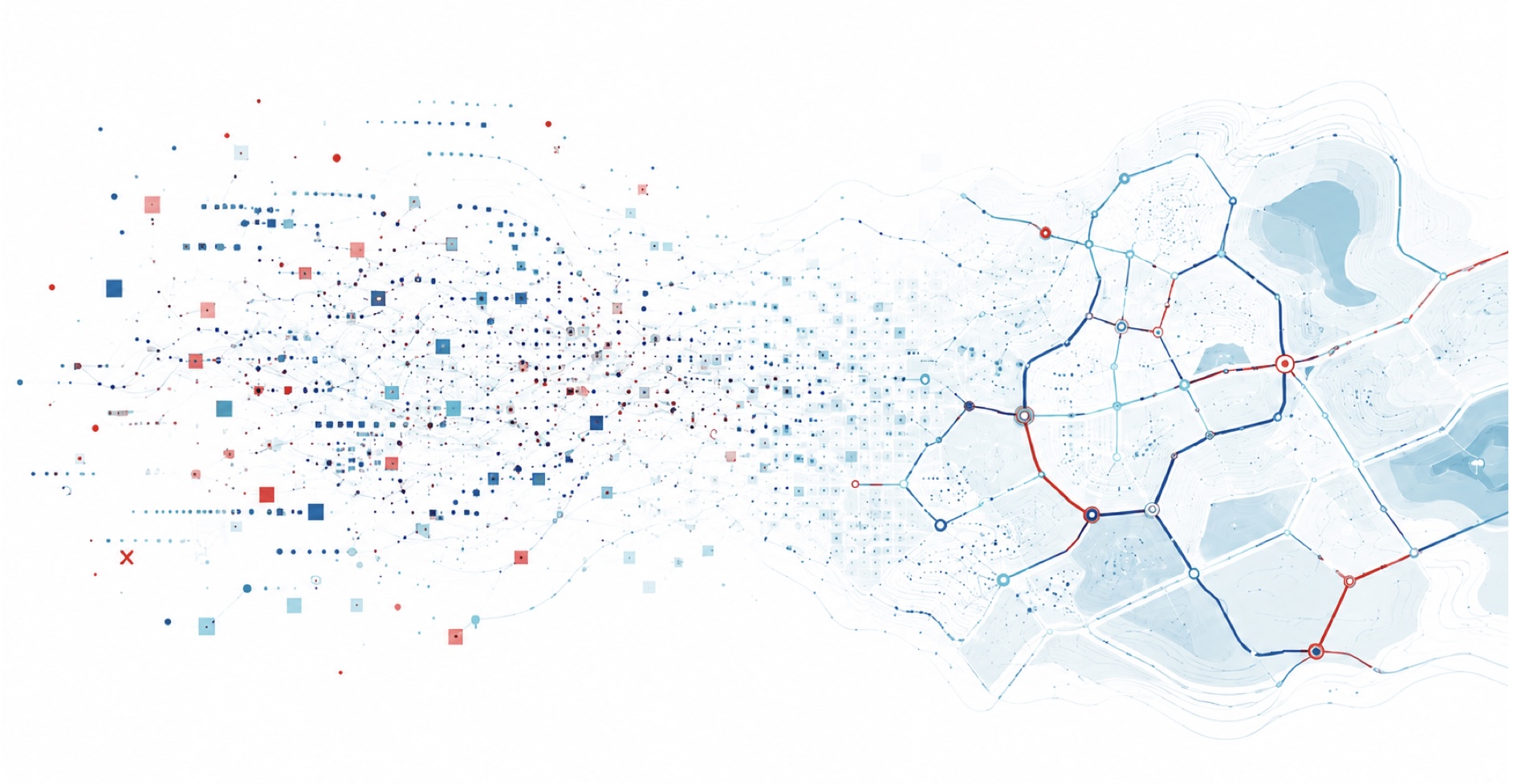
Lorica sees three useful layers. At the bottom sit messages, meetings, tickets, commits, clicks, and logs. Above that are trajectories, where fragments get linked into a sequence running from goal to decision to action to outcome. The top layer, and the most valuable, is what can be built from trajectories: strong examples, failure cases, evaluations, corrections, and reusable workflows.
One recent system shows how that progression works. It scans messy traces left by agents, spots procedures that repeat, and converts some of them into executable workflows. In a single example, a task that had taken 34 API calls dropped to 11 once the recurring procedure was compiled.
Compiling it took extra work, so this is not proof that every workflow suddenly gets cheaper. The point is that experience which once vanished into logs can sometimes be turned into something reusable.
The raw archive is not the asset. The asset is the capacity to convert operating experience into something a machine can learn from and reuse.
A Preservation Problem, Not Only a Leakage Problem
Stay ahead of the AI curve
The most important updates, news, and content — delivered weekly.
No spam. Unsubscribe anytime.
There is a preservation problem here too. Companies may fret about valuable workflow data leaking when the more pressing issue is that they never captured the valuable parts in the first place.
A decision gets severed from its outcome. An unusual exception disappears into chat. Someone fixes a problem and nobody writes down why the fix worked. A company can hold onto plenty of activity and still lose much of the experience.
Lorica asks readers to picture two competitors with access to essentially the same capable model and comparable internal documents. The first wires the model to those documents.
The second also holds hundreds or thousands of examples showing how experienced employees investigate problems, pick tools, handle unusual cases, recover from mistakes, and verify their work. It has tied those examples to outcomes and built evaluations that tell it whether its agent is genuinely improving.
The second company does not merely have more data. It has built a learning system around its own operating experience.
Where the Work Gets Processed
At the model layer, companies increasingly have credible choices, even if open models are not always the cheapest or best fit for a given task. Lorica would not frame this as open versus closed AI. A frontier API might suit one workload, a hosted open model another, and something running inside your own infrastructure a third.
Once a workflow holds valuable company know-how, the question stops being only which model performs best. It also becomes where you are comfortable having that know-how processed and stored.
For anyone running an enterprise AI program, Lorica suggests starting with work that is valuable, comes up often, demands real expertise, and yields outcomes you can evaluate. A simple test: would you spend meaningful time teaching a new employee to do the task well? If yes, ask whether some of that accumulated experience could be made useful to an AI system too.
He would not begin by recording everyone all day. The useful material is not the volume of activity. It is the decisions, exceptions, failed approaches, corrections, and feedback that explain what good performance looks like. The goal is not a bigger archive. It is a better record of how the work succeeds.
Settling Rights Before Someone Else Does
Lorica would also resolve the rights question early. Can the company use those records for AI, and what employee or customer information is mixed in?
Teams should also decide what can move after an acquisition, what an outside model provider may retain, and which workflows are distinctive enough that tighter control justifies the added operational burden.
The Spirit dispute offers a preview of what happens when those questions wait until after somebody decides the data is valuable. Google agreed to pay $10 million for the data, and the flight attendants' objection has now put the approval on hold.
Companies have spent years preserving the outputs of work. Agents may make the process behind those outputs just as important. The opportunity is not to save everything. It is to recognize which parts of that experience are worth keeping, and turn them into something an AI system can actually learn from.