
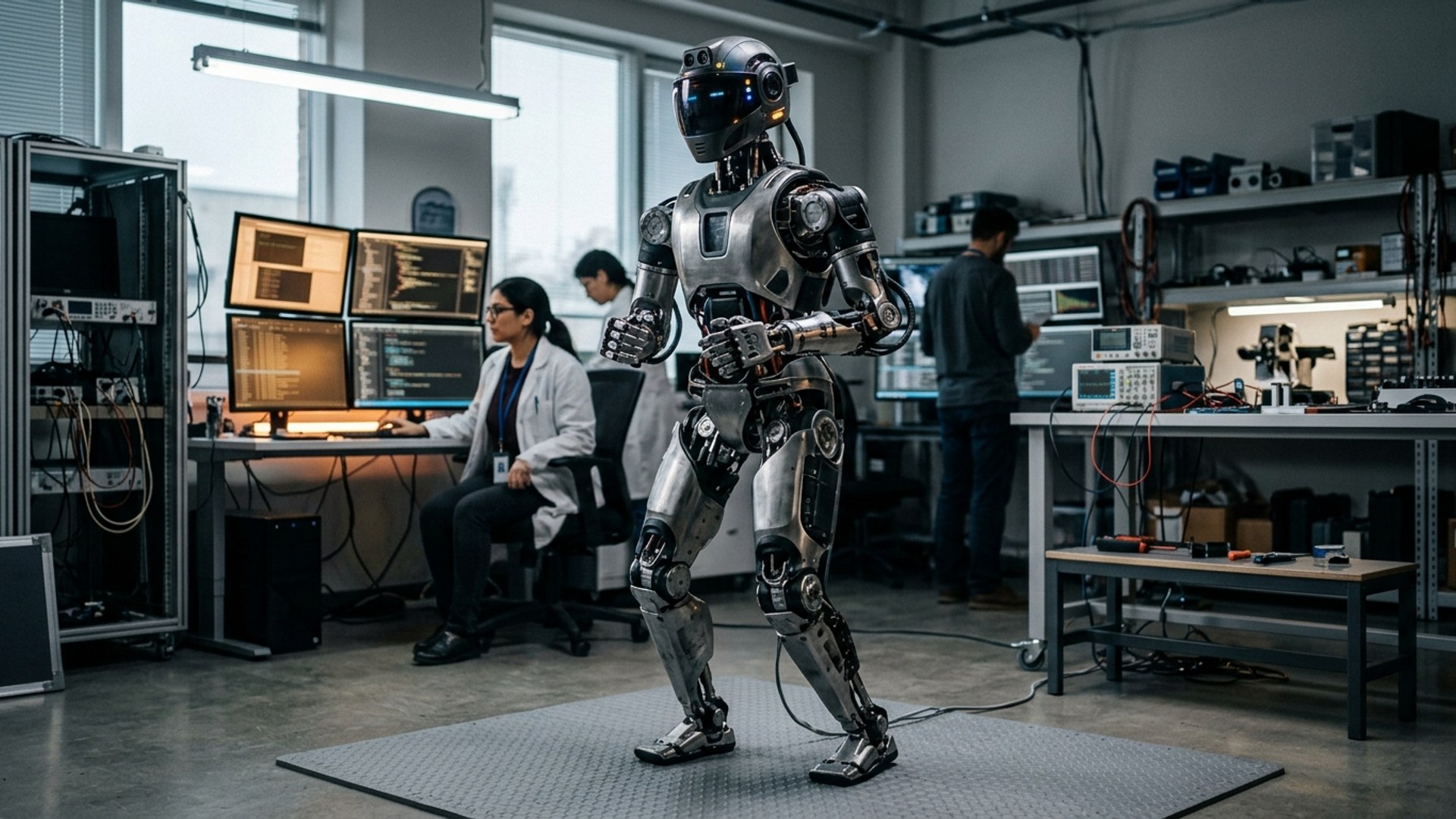
LG Corp. announced on August 13, 2026, that it is developing a next-generation bipedal humanoid robot built on NVIDIA's Isaac GR00T foundation model, with a public unveiling targeted for Q1 2027. The announcement came alongside a broader memorandum of understanding signed at NVIDIA's Santa Clara headquarters, formalizing work across robotics, AI factories, and future mobility.
The agreement is the third announced step in a partnership that has moved from a stated direction to a signed scope of work in a little over two months. Jensen Huang, founder and CEO of NVIDIA, first publicly mentioned the collaboration on June 8, 2026, saying companies were working together on humanoid robots and data centers. That same day, the two companies announced a cooperation framework spanning mobility, AI infrastructure, and physical AI, including joint development on GR00T. The August 13 agreement converts that framework into named programs with dates.
A Bipedal Robot with Onboard Compute
The humanoid is bipedal and carries compute onboard. NVIDIA Jetson Thor handles reasoning and control, while Isaac GR00T supplies the foundation model. LG said it will actively use GR00T while continuing to develop its own in-house robot foundation model, known as RFM. Data from manufacturing validations will feed LG's in-house RFM.
LG plans to combine "One LG" capabilities across LG Electronics, LG Innotek, and LG Energy Solution. That vertical integration includes actuators, sensors, and batteries, an unusual spread for a conglomerate. Few companies own a battery maker, component supplier, and consumer products company under one roof. LG is betting that this vertical spread shortens the path from prototype to production.
NVIDIA Halos for Robotics, a full-stack safety architecture unifying AI compute, system software, sensor data, and inspection, is integrated into the humanoid's build. The safety stack is doing real work in the specification, with certification and liability questions meant to be answered before deployment, not after. Bipedal platforms operating near human workers carry certification and liability questions, and LG is addressing them upfront.
The humanoid has no public name yet. No pricing, production volumes, or deployment targets for the robot appear in the announcement. The company has not disclosed a cost estimate, leaving the $250 per-unit target that some analysts had floated unconfirmed.
CLOiD Heads to Tennessee
The nearest-term physical deliverable is CLOiD, LG's wheel-based robot, which goes onto LG Electronics' washing-machine manufacturing line in Tennessee within 2026. LG will refine robot performance from validation results and expand deployment to global production facilities, homes, and commercial spaces.
A production-line validation is the kind of setting that separates a deployment from a demo. It is a logged, repeatable environment where robot vendors accumulate intervention rates and uptime figures. LG now has a stated reason to generate those numbers. The company said the robot is headed for factories, homes, and commercial spaces, and the Tennessee line is where that journey begins.
The joint task force of technical and business staff covers research and development, site validation, and commercialization. That task force will oversee the CLOiD rollout and the broader robotics program.
AI Factory Reference Site and the Cheonan Facility
The agreement reaches well past a single robot. An AI factory reference site built on NVIDIA DSX architecture and powered by Vera Rubin systems is targeted for the first half of 2027. That reference site will demonstrate how LG's validated design, construction, and operations stack can be packaged as a turnkey "One LG" offering for global big tech customers.
LG also targets an 80 MW LG AI Factory in Cheonan, Chungcheongnam-do, for the first half of 2028. That facility is aimed at advancing physical AI and LG's robot foundation models. The Cheonan site will be the largest single commitment in the partnership's timeline, and it ties directly back to the humanoid program by providing compute for model training and refinement. The facility's planned capacity of 2500 racks of compute would make it one of the larger dedicated AI data centers in the region.
The AI factory track is a significant expansion of LG's role in the partnership. It moves LG from a consumer electronics maker into a builder of AI infrastructure, a shift that mirrors the broader industry trend toward vertical integration in physical AI.
Automotive Track on DRIVE Hyperion
The automotive track pairs LG's vehicle-components business with NVIDIA's DRIVE Hyperion platform. LG intends to build a high-performance computing platform for AI-defined vehicles on DRIVE Hyperion, integrating its in-vehicle infotainment and software work. This extends LG's vehicle-components business into autonomous driving, a move that positions the company for the next wave of vehicle electronics.
Stay ahead of the AI curve
The most important updates, news, and content — delivered weekly.
No spam. Unsubscribe anytime.
The automotive work is undated in the announcement, but it is a named program with a clear technical direction. LG's existing infotainment and software capabilities give it a foundation to build on, and the DRIVE Hyperion platform provides the autonomous driving compute backbone.
A Pattern of Shared Foundation Models
LG's announcement is unusual in pairing an open NVIDIA model with a parallel in-house model program, and saying so openly. The pattern mirrors a wider industry move toward building humanoids on shared foundation models rather than from-scratch stacks. Foundation, for example, picks AMD chips to power its humanoid robots, pairing outside compute with its own hardware. Google's Gemini Robotics ER 2 is a robotics reasoning model designed to run across robot bodies.
NVIDIA pitches GR00T as an open, customizable model for generalized humanoid reasoning and skills. LG's decision to use it while maintaining its own RFM gives the company flexibility. The in-house model can be tuned with data from LG's own production lines, while GR00T provides a proven starting point. The company's target of $2.1 billion in cumulative robotics revenue by 2030 gives the dual-model strategy a clear commercial goal.
Kwang Mo Koo, chairman and CEO of LG Corp., attended the MOU signing at NVIDIA's Santa Clara headquarters. Jensen Huang was also present. Their joint appearance underscores the strategic weight of the agreement.
The humanoid is the headline item, but the agreement reaches well past a single robot. It covers robotics, AI factories, and future mobility, with named programs and dates attached to each. The roughly two months between the June 8 framework and the August 13 signed scope of work shows how quickly the partnership has moved.
LG's vertical integration is a key differentiator. The company owns a battery maker in LG Energy Solution, a component supplier in LG Innotek, and a consumer products company in LG Electronics. That spread means the humanoid's actuators, sensors, and batteries all come from within the same corporate family. LG is betting that this vertical spread shortens the path from prototype to production.
The safety architecture is another point of emphasis. NVIDIA Halos for Robotics is designed for robots operating around people, and LG is integrating it into the humanoid's build. Certification and liability questions are meant to be answered before deployment, not after, a stance that addresses one of the biggest hurdles for humanoid robots in workplaces.
The AI factory track gives LG a second revenue stream beyond robotics. The turnkey "One LG" offering for global big tech customers could become a significant business if the reference site proves successful. The Cheonan facility, at 80 MW, would be a major investment in physical AI infrastructure.
The automotive track rounds out the agreement. LG's vehicle-components business is already established, and the move into autonomous driving on DRIVE Hyperion extends that franchise. The integration of in-vehicle infotainment and software work positions LG for the software-defined vehicle era.
No pricing, production volumes, or deployment targets for the humanoid appear in the announcement. The robot has no public name yet. Those details will likely come closer to the Q1 2027 unveiling.
The partnership has moved fast. From a stated direction on June 8 to a signed scope of work on August 13, the two companies have converted a framework into named programs with dates. The CLOiD validation in Tennessee comes first, followed by the humanoid unveiling, the AI factory reference site, and the Cheonan facility.
LG's announcement is unusual in pairing an open NVIDIA model with a parallel in-house model program, and saying so openly. Most companies choose one path or the other. LG is running both, using GR00T for immediate capability and its own RFM for long-term differentiation.
The production-line validation in Tennessee is a logged, repeatable setting where robot vendors accumulate intervention rates and uptime figures. LG now has a stated reason to generate those numbers, and the results will feed both the CLOiD program and the in-house RFM.
The humanoid is the headline item, but the agreement reaches well past a single robot. It is a multi-track partnership covering physical AI, data center infrastructure, and autonomous vehicles, with a clear timeline and named programs. The Q1 2027 unveiling will be the first public test of whether LG and NVIDIA can deliver on the promise.