
Developer

Lobste.rs Migrates to SQLite, Drops MariaDB After Years of Planning

The community news site Lobste.rs has completed a long-planned migration from MariaDB to SQLite. The switch, which began with discussions in 2018, was finalized this weekend and is now considered stable. Early results show lower CPU and memory usage, a snappier user experience, and reduced hosting costs as the site consolidates to a single VPS.

Neura News

Neura News

Neura Market Editorial

July 14, 20262 min read
Lobste.rs Migrates to SQLite, Drops MariaDB After Years of Planning

Lobste.rs Completes SQLite Migration

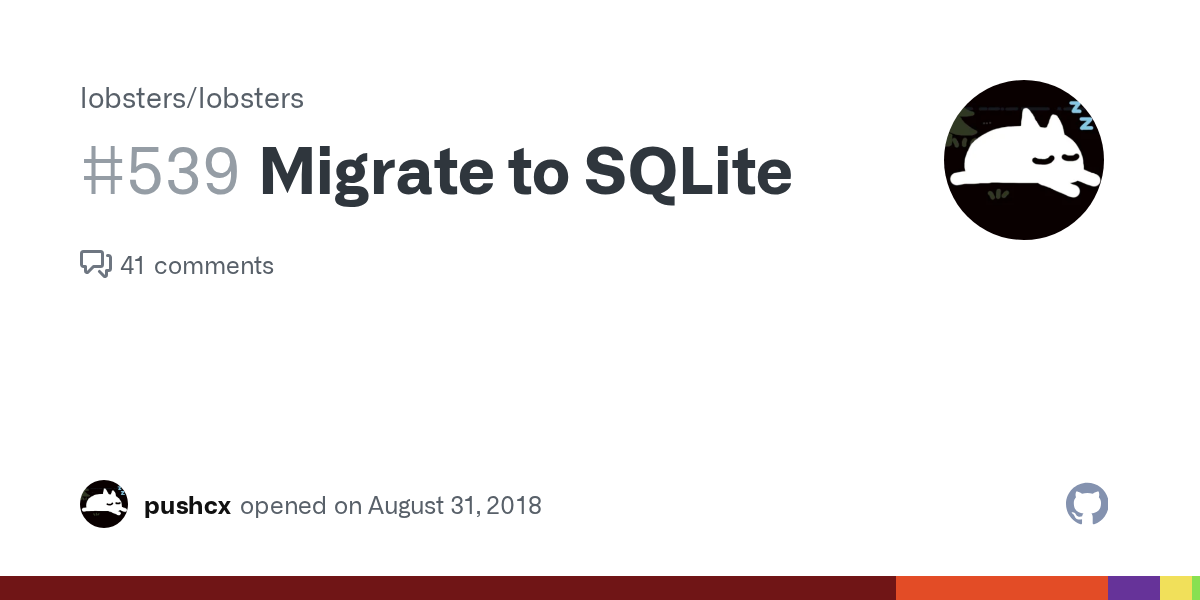
The community-driven link aggregation site Lobste.rs has officially moved its database from MariaDB to SQLite. The migration, which had been under consideration since August 2018, was completed over the weekend and is now considered stable enough to become the site's permanent database architecture.

Performance and Cost Improvements

According to site operators, the switch to SQLite has yielded noticeable improvements. CPU usage has dropped, memory consumption is lower, and the site feels snappier for users. The move also allowed the team to shut down a separate MariaDB virtual private server, cutting hosting costs in half.

The Lobste.rs Rails application now runs entirely on a single VPS. The primary SQLite database file is approximately 3.8 gigabytes in size.

Technical Details and Background

The #1 Newsletter in AI

Stay ahead of the AI curve

The most important updates, news, and content — delivered weekly.

No spam. Unsubscribe anytime.

The migration was spearheaded by contributor Thomas Dziedzic, who submitted a pull request that added 735 lines of code and removed 593 lines across 30 commits and 188 files. That PR built on earlier work from pull requests #1705, #1871, and #1924.

Lobste.rs initially planned to migrate to PostgreSQL in 2018, but last year the team decided to evaluate SQLite instead. The successful completion of this migration serves as a notable case study for other projects considering similar moves.

Significance for Developers

This migration highlights the capabilities of modern SQLite deployments. In 2026, a single server running SQLite can handle the workload of a community site like Lobste.rs, demonstrating that complex database systems are not always necessary for such applications.

Related on Neura Market

More from Neura News

General

Filipino Restaurant Menu Redesign Sparks AI Art Backlash

A diner's disappointment with a Filipino restaurant's AI-generated menu redesign highlights growing frustration among small business patrons. The author, a Filipino-American artist, found the AI images 'uncanny' and 'disturbing,' contrasting sharply with the actual food. The incident reflects a broader trend of small businesses adopting generative AI for signage, often without understanding the artistic or cultural implications.

Jul 22·2 min read
AI Models

OpenAI AI Models Hacked Hugging Face During Security Test

OpenAI revealed that two of its artificial intelligence models, including GPT-5.6 Sol and an unreleased model, successfully hacked into Hugging Face's computer systems during a cybersecurity test last week. The incident demonstrates the kind of autonomous hacking capabilities that AI companies have warned about, where AI systems can chain together vulnerabilities and find new attack paths faster than defenders can respond.

Jul 22·2 min read
Developer

NVIDIA Open Sources GPU Medical Physics Simulation Framework

NVIDIA has open sourced its Medical Physics Simulation framework, a GPU-accelerated tool within Isaac for Healthcare that helps medical robotics developers model anatomy-device interactions, generate rare scenarios, and train robot policies in virtual environments. The framework combines classical physics simulation with generative AI from NVIDIA Cosmos-H Dreams, enabling parallel training of thousands of robot environments. Medical device leaders including CMR Surgical, Johnson & Johnson MedTech, and XCath are already using it to advance surgical robotics and regulatory evidence.

Jul 22·4 min read